
AI in Advertising: How Autonomous AI Is Reshaping Hollywood and Creative Work

By Muizz Shaikh | AI Enthusiast and Digital Technology Professional, FourfoldAI | Last updated: October 2026
AI in advertising used to mean a tool that wrote a headline or swapped a background. In 2026, it increasingly means a coordinated system that reads a brief, builds assets, buys media, and rewrites its own creative while the campaign runs.
That shift raises the stakes. Forrester's June 2026 research found that nine in ten US marketing agencies now use generative AI, and 81% name staff productivity as the main reason. Forrester analyst Jay Pattisall warned the industry risks mistaking efficiency for effectiveness. So here is the real tension: does hyper-scale production keep a brand distinctive, or does it sand every campaign down to the same statistical average?

The answer sits where Madison Avenue meets Hollywood. Agencies and studios now share the same plumbing: versioning pipelines, asset libraries, review gates, and guild-governed likeness rights. This guide follows that thread from definitions to a six-step agent workflow, then through the economics, the labor question, and the legal exposure. I'll separate what demos show from what enterprise teams can actually ship.
What Is AI in Advertising?
Quick answer: AI in advertising is the integration of machine learning, generative models, and autonomous software agents across campaign workflows—from market research and creative production to programmatic media buying and real-time performance optimization. While early tools automated simple rules, modern systems generate dynamic multi-modal assets and orchestrate complex, multi-step marketing operations with minimal manual intervention.
How AI Is Used in Modern Advertising
The earliest version was plain arithmetic. Bidding engines raised or lowered bids when a cost-per-acquisition threshold was crossed, and predictive models sorted people into segments. Google Ads and Meta Ads built enormous businesses on that logic, and programmatic advertising turned it into an auction that settles in milliseconds.
Then came synthesis. Large language models (LLMs) began drafting copy, diffusion models began producing images, and video tools began producing short clips. Computer vision sits quietly underneath, checking whether a logo is placed correctly or whether a frame is safe to run beside a brand.
Adoption is already broad. McKinsey's February 2026 survey of 182 US agency and marketing leaders found that more than 90% of advertisers use AI to plan media, set budgets, tune targeting, or generate creative. The question is no longer whether teams use it. It is how much of the workflow they let run unattended.
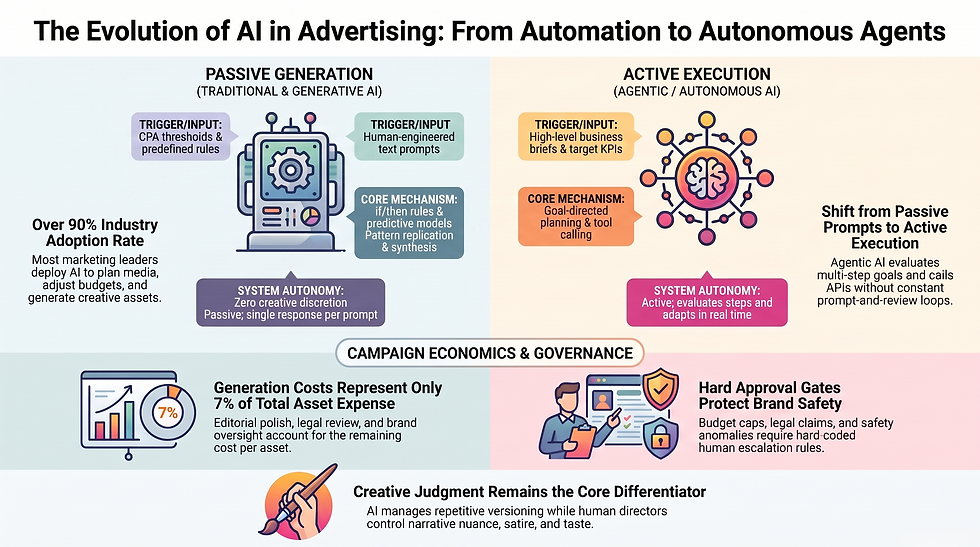
Generative AI vs. Traditional Advertising Automation
Traditional automation follows rules a human wrote. If cost per acquisition climbs past a limit, lower the bid. It has no creative discretion, which is exactly why media buyers trusted it.
Generative AI is different in kind. It reproduces patterns from training data to make something new, such as ten headline variants or a storyboard frame. But it waits for a prompt, answers one request at a time, and needs a person to judge the result.
What Makes Autonomous Agentic AI Fundamentally Different?
Agentic AI adds a goal and the ability to act on it. An agent takes a business brief and a target, splits the work into steps, calls tools such as image generators and ad platform APIs, checks its own intermediate results, and adjusts.
The industry is already standardizing this layer. IAB Tech Lab named its Agentic Advertising Management Protocols (AAMP) in February 2026. AAMP builds on OpenRTB, AdCOM, and OpenDirect instead of replacing them, so agents can plug into the infrastructure that already moves ad dollars.
Capability Dimension | Traditional Automation | Generative AI | Agentic / Autonomous AI |
Core Mechanism | Rule-based execution and predictive modeling | Pattern replication and content synthesis | Goal-directed planning and tool calling |
Primary Output | Bid adjustments, audience segments, reporting alerts | Copy variants, images, video concept drafts | Coordinated multi-step campaign execution |
Trigger / Input | Structured triggers (e.g., CPA exceeds threshold) | Human-engineered text prompts | High-level business briefs and target KPIs |
System Autonomy | No creative discretion; strict if/then trees | Passive; one response per prompt | Active; evaluates intermediate steps and adapts |
Human Involvement | High setup overhead; manual monitoring | Continuous prompt-and-review loops | Governance, brand gatekeeping, strategic sign-off |
How AI in Advertising Is Changing Creative Production
Creative production used to be a relay race with long handoffs: concept, treatment, storyboard, shoot, edit, localize. AI compresses the handoffs far more than it compresses the craft.
AI-Assisted Scriptwriting, Storyboards, and Concept Development
LLMs now turn consumer sentiment data into structured script variations, each built on a different emotional angle. A strategist reads them and keeps two. The first draft costs almost nothing, so the scarce resource becomes the person who knows which draft deserves a budget.
Storyboarding follows the same pattern. Runway and Midjourney turn rough descriptions into frames a director can react to. You will see claims that a two-week concept phase now takes three hours. Treat that as a best case. Review cycles, not rendering time, usually set the pace.
One caution about vendors. OpenAI Sora was a headline name through 2025. In March 2026, OpenAI announced it was discontinuing the Sora app and API, and Reuters reported the move. OpenAI pointed to shifting priorities and heavy compute demands. The app closed in April, with the API scheduled to end in September. A pipeline built around one video model needed a migration plan almost overnight, so design for swappable tools.
Synthetic Video, Voiceovers, and Dynamic Localization
A single master spot can now spawn localized voiceovers, translated captions, and swapped backgrounds for different markets. Early experiments pointed this way. Reuters reported in 2023 that WPP and Nestlé built a reimagined La Laitière "Milkmaid" video through nearly 1,000 iterations, generating an estimated €700,000 in media value. WPP said the content cost nothing to make. That figure ignores staff time, iteration, and rights review.
Agencies have since moved from experiments to infrastructure. WPP's Elevate28 plan targets £500 million in annual savings by 2028, and its WPP Open platform is described as an agentic marketing platform that automates high-volume creative, production, and media activation. Publicis, Omnicom, and others are building comparable systems. The agency pitch is shifting from "we make the ad" to "we run the machine that makes the ad."
Automated Versioning: Moving from One Asset to Hundreds
Versioning is where the economics bite. A traditional shoot yields a handful of cuts. A modular pipeline yields hundreds of aspect ratios, lengths, languages, and offers from one source. Brand-side teams built like AI-native companies run this loop in-house, which is part of why agencies feel pressure to prove they add more than production capacity.
Forrester's June 2026 study makes that pressure concrete. Half of US agencies use agentic AI for execution, yet 61% still treat AI as a cost of doing business with limited direct monetization. Only 31% plan to monetize agentic AI within 24 months.
How Autonomous AI Is Changing Hollywood and Film Advertising
Hollywood's biggest AI gains are not synthetic actors. They are unglamorous: scheduling boards, budget models, and cleanup work nobody in the audience will ever notice.
AI in Film Pre-Production: Scheduling, Budgeting, and Script Breakdown
Before a film shoots, someone tags every script page for cast, props, locations, stunts, and effects. That tagging feeds the shooting schedule and the budget. Software now does the first pass and hands a structured breakdown to scheduling tools, so producers spend their hours on decisions instead of highlighting.
A commercial runs on the same skeleton. A thirty-second car spot still needs a call sheet, a location plan, and a line-item budget. That is why agency production arms and studio production offices adopt the same planning tools, often within the same year.
Visual Effects Pipelines and Promotional Asset Repurposing
Post-production is where scale shows. Netflix told shareholders in July 2026 that generative AI workflows had been used in roughly 300 titles this year, with the largest concentration in post-production. It named three projects, from India, Brazil, and the US, that used the tools for highly complex sequences. Netflix did not define what counts as "used," so read that number as direction, not audit.
The tasks themselves are familiar: rotoscoping, plate cleanup, in-betweening, and digital relighting. Artists still fix what the machine gets wrong. Lionsgate partnered with Runway in 2024 to train a custom model on its film library. AMC Networks said it would use Runway to visualize shows and produce marketing images without extra shoots.
That last example is the advertising nexus. Studio marketing teams build trailer cuts, posters, and social variants through the same programmatic versioning pipelines that commercial agencies developed. The pipeline does not care whether the master asset is a yogurt spot or a feature trailer.
The Boundary: What Algorithms Can Render vs. What Directors Control
Models optimize toward statistical averages. They can render a crowd, a skyline, or a plausible face. They cannot decide that a joke should land a beat late, that silence is the right ending, or that a cultural reference is about to go stale.
That judgment belongs to the director, and it is why subversive humor, emotional cadence, and cultural timing remain stubbornly human. A model trained on what has already worked will keep offering what has already worked. Originality is, by definition, a departure from the average.
How AI Agents Can Run an Advertising Campaign: An End-to-End Workflow
Think of a campaign agent as a project manager with API access. This is the autonomous AI workforce idea applied to media. What follows is a blueprint, not a product review, and real deployments vary by vendor and stack.
Step 1: Interpreting the Campaign Brief and Business Objective
An LLM parses the brief and extracts the ideal customer profile, ROAS target, budget, markets, and a brand negative list of topics, words, and imagery to avoid. The output is a structured campaign spec. Anything ambiguous gets flagged to a human before work starts.
Step 2: Autonomous Audience Synthesis and Concept Generation
The agent queries synthetic customer personas and first-party data to surface pain points and emotional angles, then drafts concepts for each. A warning here: synthetic personas are hypotheses, not research. Validate their conclusions against real customer data before anyone spends money on them.
Step 3: Multi-Modal Asset Assembly and Variant Preparation
The agent calls image and video generation APIs, overlays brand typography and logos from locked templates, and compiles variants by format and market. Automated checks, often built on computer vision, test logo placement and text legibility. Locked templates matter because they keep the brand's visual identity out of the model's hands.

Step 4: Programmatic Deployment and Live Media Optimization
Next the agent uses the Meta Marketing API and Google Ads API to provision campaigns, define segments, and set budgets. Teams usually wire this together with orchestration frameworks such as LangGraph or LangChain, or with custom API wrappers. Most real builds rely on AI agents and automation layers rather than one monolithic tool. IAB Tech Lab's AAMP framework adds MCP-based infrastructure so agents can talk to buying systems in a standard way.
Step 5: Autonomous Feedback Loops and Attribution Analysis
As results arrive, the agent tests for ad fatigue, such as falling click-through with rising frequency. It swaps creative elements and moves budget toward winners. Attribution stays tricky. In McKinsey's survey, 42% of advertisers named reliance on "black box" platform optimization as a key risk, so agents should log why they changed something.
Step 6: Hard Approval Gates and Human Escalation Triggers
The most important step is the one that stops the machine. Budget thresholds, regulated claims, brand-safety anomalies, and performance drops past a set tolerance should route to a senior creative director. These gates must be hard-coded rules, not polite instructions inside a prompt.
The Economics of AI Advertising: Balancing Speed, Quality, and Real ROI
McKinsey's June 2026 analysis found that about three-quarters of surveyed advertisers expect AI to raise total media spend, and one-third expect ROAS to improve by more than 10%. Those are expectations, not results. The results depend on what each asset really costs.
The Fallacy of "Free" Content: Total Cost per Approved Asset
The metric that matters is cost per approved asset: everything spent to get one usable, legally cleared, on-brand asset into market. Here is an illustrative model, not a benchmark. Suppose an image call costs about five cents and it takes 30 attempts to get a usable frame, or $1.50. Add ten minutes of editorial polish at a loaded $60 per hour ($10) and five minutes of legal and brand review at $120 per hour ($10). The approved asset costs about $21.50, and generation is only 7% of that.
Compute is part of the story too. Serving video models is expensive, which is one reason OpenAI walked away from Sora's consumer product. When you plan budgets, include AI infrastructure and compute costs alongside tool subscriptions.
Production Vector | Traditional Agency Workflow | AI-Augmented Workflow | Autonomous Agentic Pipeline |
Time-to-Market | 4 to 8 weeks | 1 to 2 weeks | Hours to days (conditional) |
Cost Profile | High upfront talent and location costs | Moderate tooling plus human polish | Low asset unit cost; higher engineering overhead |
Creative Distinctiveness | High (bespoke, auteur-driven) | Variable (risk of generic aesthetics) | Risk of homogenization and regression to the average |
Quality Assurance Friction | Low (controlled physical capture) | High (artifact detection, prompt drift) | Critical (needs automated and human guardrails) |
Scalability of Variants | Expensive (cost rises with every variant) | High (cheap to generate, costly to review) | Very high (limited by approval capacity, not generation) |
The ranges above are illustrative FourfoldAI planning assumptions, not measured industry benchmarks.
When AI Compresses Margins vs. When It Inflates Revision Costs
AI compresses cost where the work is repetitive and the rules are clear: resizing, localization, and variant testing. It inflates cost where taste is involved. Ten mediocre drafts can take longer to review than one good brief takes to execute. Revision friction is the hidden line item.
The agency side feels it. WPP's restructuring and Forrester's forecast of a 15% cut in agency jobs in 2026, after roughly 8% in 2025, show clients expecting savings. Whether those savings reach creative quality or merely the profit line is still unsettled.
Will AI Replace Creatives, Filmmakers, and Advertising Directors?
Binary answers are lazy. "Creatives are obsolete" and "AI is just a pencil" both skip the real mechanism: jobs are bundles of tasks, and AI unbundles them unevenly.
A Task-Level Vulnerability Analysis across Creative Roles
Most exposed to automation:
Routine resizing and format adaptation
Basic copy versioning
Stock photo curation and background removal
Draft storyboards
Most insulated or augmented:
Strategic brand architecture
High-stakes narrative storytelling
Authentic emotional connection and cultural satire
On-set human direction
This is analysis, not prophecy. McKinsey notes that agency work like planning, buying, reporting, and creative production is exactly the kind of knowledge work AI disrupts fastest, and says execution is a less defensible position than orchestration.
The Premium on Taste, Cultural Relevance, and Creative Direction
The creative director's role shifts from artisan to executive curator. Instead of crafting every frame, they set the brand logic, choose among machine-made options, and decide when a result should simply be rejected. Call it quality arbitration at scale.
I think the premium on taste rises, not falls. When anyone can generate a polished image, polish stops being the differentiator. Knowing why a particular image belongs in a particular campaign, in a particular culture, at a particular moment, becomes the scarce skill.
Legal, Ethical, and Governance Risks: Copyright, Likeness, and Trust
Copyright Enforceability and Intellectual Property Ambiguities
The US Copyright Office's January 2025 report concluded that prompts alone do not make a user the author of AI output. In March 2026, the Supreme Court declined to review Thaler v. Perlmutter, leaving in place the ruling that copyright requires a human author. For brands, the consequence is uncomfortable: a fully machine-made asset may be easy for competitors to copy.
Meaningful human selection, arrangement, and editing can support protection, so document who changed what. Training data is a separate question. Adobe Firefly, for example, is trained on licensed and public-domain content, and Adobe offers IP indemnification on qualifying plans, with terms that need contract-level review.
SAG-AFTRA, WGA, and Digital Replica Rights of Publicity
SAG-AFTRA members ratified the 2026 TV/Theatrical Agreement on June 4, 2026, with 91.42% approval. It runs from July 1, 2026 to June 30, 2030. It builds on the 2023 rules requiring consent and compensation for digital replicas, and it adds terms on synthetic performers: a studio must notify the union and justify what significant extra value a synthetic provides over a human performer or a replica.
The WGA ratified its 2026 agreement on April 24, 2026, with 90.38% approval. It preserves the 2023 AI protections and adds notice requirements if studios license writers' work to train generative systems. For advertisers, remember that these cover film and television. Commercials fall under separate agreements, and rights of publicity and likeness licensing terms govern voices and faces regardless. Get written consent before cloning any voice.
Synthetic Media Disclosure Mandates and Brand Safety Guardrails
Under the EU AI Act, Article 50 transparency rules have applied since August 2, 2026. Deployers must label deepfake image, audio, and video content. Generative systems already on the market before that date have until December 2, 2026 to meet the machine-readable marking duty.
In the US, the FTC's rule on reviews and testimonials, effective October 21, 2024, bans fake or AI-generated testimonials that misrepresent who the reviewer is or what they experienced. In finance, healthcare, and legal advertising, one hallucinated rate, benefit, or claim creates compliance exposure. Human review is not optional there.
How to Evaluate AI Advertising Systems: A Practical Decision Framework
Generative Point Solutions vs. Agentic Workflow Orchestrators
Point solutions, such as a video generator or copy tool, do one job well and are easy to pilot. They leave the handoffs to humans. Orchestrators connect brief, assets, media, and reporting, but they demand engineering, permissions, and governance. Pick by bottleneck. If creation is slow, a point tool may be enough. If coordination and versioning are slow, look at orchestration.
An Enterprise Pilot Checklist for Modern Marketing Teams
Score every vendor against these questions:
Data provenance and indemnification: Does the vendor train on licensed data or scraped web assets, and what does the contract actually cover?
Workflow interoperability: Does it connect through enterprise APIs to Adobe Creative Cloud, Figma, and the Meta and Google ad managers? Does it support open standards like AAMP?
Human-in-the-loop granularity: Can you hard-code budget caps, brand-safety thresholds, and approval rules, with audit logs?
Exit options: Can you swap the underlying model without rebuilding? The Sora shutdown is the cautionary tale.
Then run a 30-day sandbox pilot on low-risk localization:
Week 1: Pick one evergreen asset. Record the current cost per approved asset and set approval rules.
Week 2: Localize into two markets with human review of every output.
Week 3: Test against human-made versions and track revision rates and legal flags.
Week 4: Decide whether to give an agent autonomy over one narrow task. Keep core creative pipelines off-limits until the pilot passes.
The Future of AI in Advertising: What Lies Beyond Generative Demos?
The next phase moves beyond prompts. McKinsey sketches four trajectories: steady AI evolution, a closed-web shift into AI interfaces, autonomous delegation where consumer-side agents research and transact for people, and a curated ecosystem of premium publishers. In the delegation scenario, buyer agents negotiate with seller agents, and the audience for persuasion becomes a decision model.
The plumbing is arriving. IAB Tech Lab released AAMP 3.0 in September 2026, adding a standard RFP-to-buy process and agent authentication. Discovery is changing too: McKinsey says more than half of Google searches now include an AI overview. Brands will compete to be cited by AI answer engines, not just ranked.
My bet is that creative asymmetry gains value. When synthetic polish is cheap and abundant, human imperfection, specificity, and the willingness to take a real creative risk will command a premium.
Conclusion: Creative Judgment Remains the Ultimate Moat
Autonomous systems solve the problem of scale. They do not solve the problem of meaning. As generation pushes the marginal cost of content toward zero, the scarce inputs become taste, radical creative risk, and emotional truth.
Three lessons stand out. Measure cost per approved asset, not cost per generation. Put hard approval gates around anything touching budgets, regulated claims, or likeness. And build on swappable tools, because the vendor market can change in a quarter.
The brands and studios that win will not be the ones that automate the most. They will be the ones that know exactly what to automate and what to protect. That is the durable lesson of AI in advertising: the machine can run the campaign, but people still have to decide what is worth saying.
Frequently Asked Questions About AI in Advertising
What is AI in advertising?
AI in advertising is the application of machine learning, generative models, and autonomous software agents to optimize campaign workflows. It automates audience research, ad copy creation, image and video generation, media buying, and real-time performance adjustments. While generative AI focuses on creative synthesis, autonomous agentic systems coordinate multi-step campaign execution across platforms with strategic human oversight.
How is autonomous AI changing advertising?
Autonomous AI shifts marketing from manual campaign assembly to automated operational orchestration. Rather than requiring human prompts for every asset, autonomous agents analyze market briefs, coordinate creative generation, provision ad variants across networks, evaluate conversion performance, and reallocate budgets. Strategic and brand-sensitive decisions remain protected by human approval gates.
How is AI being used in Hollywood?
Hollywood uses AI primarily in pre-production logistics, script breakdowns, scheduling, budgeting, and visual effects pipelines. Studios deploy algorithms for rotoscoping, digital aging, motion tracking, and automated localization. While generative tools assist rapid visual storyboarding, feature films still rely heavily on human directors, cinematographers, and performers for emotional resonance.
Can AI create a complete advertisement?
Yes, AI can generate scripts, visuals, synthetic voiceovers, background music, and formatted aspect ratios from a single text prompt. However, a commercially viable, legally defensible advertisement still needs human intervention for factual verification, brand safety compliance, licensing validation, emotional pacing, and strategic alignment with campaign objectives.
Will AI replace advertising professionals?
AI will automate repetitive production tasks rather than eliminate entire creative professions. Routine roles in asset resizing, simple copywriting, and static storyboard drafting face heavy automation. High-level creative direction, strategic storytelling, cultural relevance, and ethical brand stewardship remain human disciplines that technology augments rather than replaces.
What are the main benefits of AI in advertising?
The primary benefits include compressed production cycles, lower costs for dynamic asset localization, rapid multivariate creative testing, and automated media optimization. Brands can produce hundreds of audience-specific variations from a single master concept while keeping creative aligned with programmatic bidding parameters in near real time.
What are the risks of AI-generated advertisements?
Key risks include brand damage from algorithmic hallucinations, consumer backlash against synthetic media, weak copyright protection for generated assets, and potential copyright or likeness infringement claims. Organizations also face regulatory penalties if they fail to disclose synthetic media or violate evolving privacy and likeness consent standards.
Is AI advertising cheaper than traditional advertising?
AI significantly lowers raw asset generation costs, particularly for multivariate testing and international localization. However, savings are often offset by software subscriptions, computing power, human editorial polish, legal vetting, and brand safety remediation. Calculate savings per approved asset, not per generation, to see the true picture.
How can a business measure the ROI of AI in advertising?
Track total cost per approved asset, creative iteration turnaround time, and incremental conversion lift from scaled variant testing. Compare the operating expense of traditional production against AI-augmented pipelines, factoring in tool licensing, human review hours, and resulting customer acquisition cost improvements.
What is the difference between generative AI and agentic AI in advertising?
Generative AI produces single assets, such as copy, images, or audio clips, from direct human prompts. Agentic AI acts as an autonomous workflow coordinator: it parses high-level campaign goals, breaks them into sequential tasks, uses specialized generative tools, deploys assets to ad platforms, and optimizes spend using live data feedback loops.
References and Sources
This article is backed by authoritative sources and research. All links were checked in October 2026.
Forrester, "Nine In 10 US Marketing Agencies Use AI To Cut Costs At The Expense Of Creativity" (June 24, 2026): forrester.com press release
Forrester Predictions 2026, marketing agencies (15% job reduction forecast), as reported by AdNews: adnews.com.au
McKinsey & Company, "The agentic advertising economy: From attention to action" (June 16, 2026): mckinsey.com
IAB UK, "Is the future agentic? Understanding new standards for AI in digital advertising" (March 2026): iabuk.com
B&T, "IAB Knuckles Down On Agentic Media Buying With New Industry Standard" (AAMP 3.0, September 2026): bandt.com.au
Advanced Television, "Adform reinforces commitment to open standards for agentic advertising" (AAMP 2.0, July 2026): advanced-television.com
Reuters (syndicated), Nestlé, Unilever and WPP experiment with generative AI in advertising (2023): whbl.com
Newsweek, "OpenAI scraps Sora video app" (March 2026): newsweek.com
Storyboard18, "WPP is no longer a holding company: Cindy Rose" (Elevate28, February 2026): storyboard18.com
Pulse 2.0, "WPP: £500 Million Cost Savings Target And £200 Million Asset Sales Back Agentic AI Transformation": pulse2.com
Engadget, "Netflix says it's already used AI in 'roughly 300' titles this year" (Q2 2026 shareholder letter): engadget.com
Mexico Business News, "Lionsgate Partners with Runway to Leverage AI in Filmmaking" (2024): mexicobusiness.news
The A.V. Club, "AMC Networks announce AI partnership with Runway": avclub.com
SAG-AFTRA member ratification of the 2026 TV/Theatrical Agreement (June 2026): senalnews.com
AWF Labor Tools, interview with SAG-AFTRA's Duncan Crabtree-Ireland on AI protections: awf.labortools.com
Writers Guild of America, "WGA Ratifies 2026 Minimum Basic Agreement With AMPTP" (April 24, 2026): wga.org
Broadcast, "More than 90% of writers' guild vote in favour of new contract with AMPTP": broadcastnow.co.uk
Mayer Brown, "Supreme Court Denies Cert in AI Authorship Case" (March 2026), discussing the US Copyright Office's Part 2 report on copyrightability: mayerbrown.com
Ropes & Gray, "You talkin' to me? Operationalising the EU AI Act's transparency obligations" (August 2026): ropesgray.com
ICTRecht, "Heads up! AI Act transparency obligations now in effect": ictrecht.nl
Perkins Coie, "FTC Finalizes Rule Banning Fake Reviews and Testimonials": perkinscoie.com
Adobe, "Generative AI for the Enterprise" (Firefly licensing and indemnification): adobe.com
Explore More on FourfoldAI
Want frameworks you can use, not just headlines? Explore the strategic research briefings and enterprise AI guides at FourfoldAI.com to learn how to deploy AI workflows without sacrificing brand integrity. For a wider view of the creative side, read our guide to Autonomous AI in Creative Industries, or browse the full FourfoldAI blog.
Disclaimer:
This article is for general informational and educational purposes only. It is not legal, financial, or professional advice, and it does not guarantee the performance of any AI tool or platform. Union agreements, copyright rules, and regulations such as the EU AI Act change often, so confirm current requirements with a qualified professional before acting. For full terms, read the FourfoldAI Disclaimer.
About the Author
Muizz Shaikh is an AI enthusiast and digital technology professional at FourfoldAI. He is passionate about exploring AI tools, industry trends, and practical applications of emerging technologies. Through FourfoldAI, Muizz contributes to simplifying artificial intelligence for businesses and learners. Connect with him on LinkedIn: linkedin.com/in/muizz-shaikh-45b449403/
© 2026 FourfoldAI. All rights reserved.


Comments