
AI in Finance and FinTech 2026: How Banks, Insurers, and Investment Firms Are Deploying AI

Something shifted in financial services over the past eighteen months. Banks stopped treating AI as a chatbot experiment bolted onto a customer support page. Insurers stopped using it purely to summarize claims files. Investment firms moved past the "ask an LLM to explain an earnings call" phase entirely.
AI in Finance and FinTech 2026 now means something more concrete: production-grade, low-latency decision systems that sit inside core banking rails, underwriting engines, and trading infrastructure — not next to them. The technology is doing real work, under real regulatory scrutiny, with real money attached to every output.
That last part is what makes financial services different from almost every other industry adopting AI right now. A marketing team can tolerate a slightly-off AI-generated blog draft. A bank cannot tolerate a model that approves a loan it shouldn't, misprices risk on a derivatives book, or hallucinates a compliance disclosure. The stakes are asymmetric, and the regulators know it.
This guide walks through how banks, insurers, and investment firms are actually deploying AI in 2026 — the architecture underneath it, the risks nobody wants to talk about publicly, the compliance frameworks (SR 11-7, the EU AI Act, SEC and FINRA rules) shaping what's allowed, and a practical deployment framework for institutions trying to move fast without breaking something regulators will notice.

What Is AI in Finance and FinTech in 2026?
Defining Modern Financial AI
Modern financial AI in 2026 is the integration of specialized machine learning models, small language models (SLMs), retrieval-augmented generation (RAG), and autonomous agent workflows into core banking, insurance, and capital markets systems — used to execute real-time decisioning, risk modeling, and operational tasks, all under strict regulatory compliance and human oversight.
That definition matters because it excludes a lot of what got labeled "AI in finance" back in 2023 and 2024. A generic chatbot answering FAQ questions on a bank's website isn't really what this term points to anymore. Neither is a static dashboard with a machine learning model quietly running in the background, disconnected from any actual decision.
What's changed is the depth of integration. AI systems in 2026 don't just inform a human's decision — increasingly, they execute the decision themselves, within tightly bounded permissions, with a human reviewing exceptions rather than every transaction. That's a fundamentally different risk posture, and it's why governance has become as important as the model itself.
Three things distinguish this generation of financial AI from what came before it. First, domain adaptation — institutions are fine-tuning smaller, specialized models on proprietary transaction data rather than relying on general-purpose LLMs for everything. Second, retrieval grounding — outputs are increasingly tied to verifiable source documents rather than a model's internal parameters alone. Third, agentic execution — systems that don't just generate a recommendation but carry out multi-step workflows, subject to permission scopes and audit trails.

Traditional Financial IT vs. Enterprise Financial AI
Dimension | Traditional Financial IT | Enterprise Financial AI (2026) |
System Logic | Deterministic rule engines, hard-coded thresholds | Probabilistic models with deterministic guardrails layered on top |
Processing Speed | Batch processing, often overnight cycles | Real-time and near-real-time inference, sub-second in fraud use cases |
Adaptability | Requires manual rule rewrites for new patterns | Continuously retrained or fine-tuned against new data distributions |
Auditability | Fully traceable but rigid logic paths | Requires explicit XAI tooling (SHAP, LIME) to reconstruct reasoning |
Operational Focus | Transaction processing, static reporting | Decisioning, prediction, and increasingly, autonomous action |
The practical takeaway: legacy IT was built to be predictable. Financial AI has to be predictable and adaptive at the same time — which is precisely why model risk management has become the defining discipline of this era, more so than the model architecture itself.
How Banks Are Deploying AI in 2026
Retail and commercial banking have arguably moved the furthest, mostly because fraud losses and underwriting inefficiency provide such a clear, measurable ROI case.
Real-Time Fraud Detection and AML Graph Networks
Legacy rule-based fraud systems break down at scale. Once transaction volume climbs past a certain throughput, static "if this, then flag that" logic produces too many false positives, and fraudsters learn to route around known patterns within weeks.
Graph Neural Networks (GNNs) address this by modeling relationships between accounts, devices, IP addresses, and transaction chains rather than evaluating each transaction in isolation. A single transfer might look unremarkable on its own. But when it's the fourth hop in a network of accounts opened within the same 48-hour window, using overlapping device fingerprints, the graph structure reveals the pattern a rules engine misses entirely.
Edge-deployed small language models and lightweight classifiers now handle the millisecond-level scoring layer — the decision of whether to hold a transaction for review happens before settlement, not after. This is one of the clearest cases where low-latency real-time inference isn't a nice-to-have; it's the entire point.
Agentic Credit Scoring and Automated Underwriting
Traditional FICO-style scoring has real limitations — thin-file applicants, gig-economy income patterns, and small businesses without long credit histories often get scored poorly not because they're risky, but because the model wasn't built for their financial profile.
Multi-modal alternative data underwriting — pulling in cash-flow patterns, transaction categorization, and verified income sources beyond a traditional credit file — is expanding who can be underwritten fairly. The catch is that fair-lending law doesn't care how sophisticated the model is. Disparate impact analysis still applies, and institutions deploying these systems are building bias-testing pipelines directly into the underwriting flow, not as an afterthought.
Hyper-Personalized Conversational Banking
Conversational banking assistants in 2026 handle materially more than balance inquiries. Multi-turn interactions — disputing a charge, initiating a wire transfer within pre-set limits, restructuring a payment plan — now run through agentic assistants connected to core banking APIs under strict permission scopes.
The critical design decision here isn't the conversational quality. It's the API permissioning layer that determines what the agent is actually allowed to execute versus what requires a human handoff. Institutions that got this wrong early on learned quickly that an overly permissive assistant is a liability, not a convenience feature.
Commercial Loan Structuring and Document Parsing
Commercial lending teams have historically spent enormous hours manually parsing credit agreements, covenants, and collateral documentation. Domain-adapted RAG systems now parse thousands of pages of loan documentation, flagging covenant terms, cross-default clauses, and collateral conditions in a fraction of the time — while citing the exact source page for every extracted term, which matters enormously when a credit committee needs to verify the output before signing off.
How Insurers Are Deploying AI in 2026
InsurTech has taken a slightly different path — the biggest gains are showing up in claims processing and dynamic risk pricing rather than customer-facing chat.
Autonomous Claims Processing and First Notice of Loss (FNOL)
Computer vision models now evaluate damage photographs submitted at first notice of loss, estimating repair costs and, for straightforward claims below a defined threshold, triggering payout through parametric insurance smart contracts without a human adjuster touching the file.
This isn't full automation across the board — complex claims, disputed liability, and anything above a materiality threshold still routes to human adjusters. But the routine claims that used to take days now resolve in hours, and adjusters spend their time on the cases that actually need judgment.
Telematics and Real-Time Continuous Risk Pricing
Actuarial science built on static historical tables is giving way to continuous pricing models fed by telematics, IoT sensors, and in some property lines, satellite imagery. A driver's actual behavior — braking patterns, time-of-day exposure, route risk — increasingly informs premium pricing in near real time rather than through an annual renewal cycle alone.
This shift raises its own fairness questions, which is exactly why insurance risk-pricing AI sits inside the high-risk category under emerging EU regulation, discussed further below.
AI-Driven Fraud Interception in InsurTech
Organized insurance fraud rings rarely show up as a single suspicious claim — they show up as patterns across dozens of claims sharing subtle connective tissue: the same repair shop, overlapping witness names, claim timing clustered around policy inception. Pattern-recognition models trained specifically for fraud-ring detection are catching these networks before claims clear, rather than after a costly payout has already gone out the door.
How Investment Firms and Asset Managers Are Deploying AI
Capital markets have leaned hardest into research automation and quantitative signal generation, where speed and information coverage translate almost directly into alpha.
LLM-Assisted Investment Research and Earnings Analysis
Private vector database pipelines now ingest SEC filings, earnings call transcripts, and alternative data sources — satellite imagery of retail parking lots, shipping data, credit card panel data — at a volume no human research team could process manually. The value isn't that the AI "understands" the market better than an analyst. It's that it surfaces the relevant passage across ten thousand documents in seconds, letting the analyst spend their time on judgment rather than search.
Quantitative Signal Generation and Algorithmic Execution
Deep learning models are increasingly layered onto traditional factor-based strategies rather than replacing them outright. The combination tends to outperform either approach alone — traditional factors provide interpretability and stability, while learned signals capture non-linear relationships that classical models miss. Execution algorithms then work to minimize market impact, splitting orders to avoid moving the price against the fund's own position.
Automated Portfolio Rebalancing and Risk Stress Testing
Macro stress testing — simulating an interest rate shock, a geopolitical event, a liquidity crunch — used to be a quarterly exercise. AI-driven simulation now runs these scenarios across multi-asset portfolios continuously, flagging concentration risk or correlation breakdowns as they emerge rather than after the fact, which matters enormously in fast-moving markets.
The Technical Architecture of Modern Financial AI
Small Language Models (SLMs) vs. Massive LLMs
Banks increasingly prefer domain-tuned models in the 7B–14B parameter range, hosted on-premise or in dedicated private cloud environments, over massive general-purpose LLMs accessed through public APIs. The reasoning is straightforward: smaller models fine-tuned on financial taxonomy and internal data are faster, cheaper to run at scale, and don't require sending sensitive customer data outside the institution's security perimeter.
This doesn't mean large frontier models have no place in financial services — they're still valuable for complex research synthesis and less latency-sensitive tasks. But for the high-volume, low-latency, security-sensitive workloads (fraud scoring, transaction categorization, document classification), SLMs have become the default choice
Financial RAG Architecture
Retrieval-Augmented Generation (RAG) in financial contexts typically combines hybrid search — keyword matching plus dense vector retrieval — with a re-ranking layer that prioritizes the most contextually relevant passages before generation. For regulatory filings and financial reports specifically, this hybrid approach matters because pure vector search alone can miss exact-match requirements (a specific regulation number, a precise dollar figure) that keyword search catches reliably.
The output is only as trustworthy as the retrieval layer underneath it. Institutions building out enterprise AI governance models are learning that retrieval quality — not model size — is usually the bottleneck on accuracy in financial RAG systems.
Model Context Protocol (MCP) in Banking
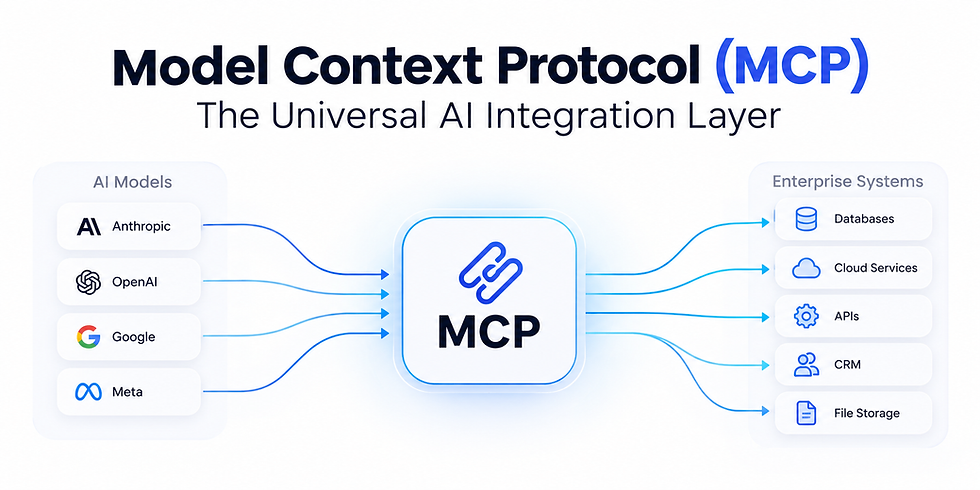
Model Context Protocol (MCP) has emerged as a standardized way for AI systems to interface securely with legacy banking infrastructure — mainframe systems running on COBOL, core banking platforms like FIS or Fiserv — without requiring a custom integration for every single connection point. For institutions running decades-old core systems alongside brand-new AI tooling, this standardization layer is what makes building secure agentic AI workflows practical rather than a multi-year integration nightmare
Enterprise Risks of Financial AI Deployment
None of this comes without real risk, and institutions that treat AI deployment as purely a technology rollout — without a parallel risk framework — tend to find out the hard way why regulators care so much.
Risk Category | Technical Root Cause | Financial & Legal Impact | Primary Control Mechanism |
Model Hallucination | Probabilistic token completion in unconstrained LLMs | Incorrect financial advice, bad loan approvals | Deterministic RAG, output validation layers |
Black-Box Opacity | High-dimensional neural networks lacking interpretability | Regulatory rejection, fair-lending exposure | Explainable AI (XAI), SHAP/LIME scoring |
Model Drift | Macroeconomic shifts altering underlying data distributions | Mispriced risk, unexpected credit defaults | Continuous drift monitoring, shadow testing |
Data Poisoning & Leakage | Confidential customer records entering public training sets | Privacy fines, loss of customer trust | On-premise SLMs, differential privacy, DLP |
Agentic Runaway | Unbounded tool-calling permissions in financial workflows | Unauthorized trades or incorrect fund transfers | Strict API permissioning, human-in-the-loop |
Of these, agentic runaway is the newest concern on the list, and arguably the one institutions are least prepared for. A model that hallucinates a paragraph of text is embarrassing. A model with tool-calling access that initiates an unauthorized transfer is a different category of problem entirely — which is why permission scoping has become as important as model accuracy in agentic deployments. Institutions researching AI data loss prevention strategies are finding that the access-control layer, not the model itself, is usually where things go wrong.
The FourfoldAI 5D Financial AI Deployment Architecture
Watching institutions deploy AI successfully — and watching a fair number stumble — a consistent pattern emerges. The organizations that get this right follow a disciplined sequence rather than jumping straight to production. At FourfoldAI, we frame that sequence as the 5D Financial AI Deployment Architecture:
Discover → Domain-Adapt → Validate → Defend → Deploy
1. Discover
Not every workflow deserves an AI system. The discovery phase identifies high-ROI use cases with two prerequisites: clear data availability and a measurable efficiency gain. Institutions that skip this step tend to end up with AI pilots that never make it past a proof-of-concept — impressive in a demo, but with no clear path to production value.
2. Domain-Adapt
General-purpose models rarely perform well enough on financial-specific tasks out of the box. This phase involves fine-tuning compact models on proprietary financial taxonomy, historical SEC filings, and internal transaction logs — building a model that actually understands the institution's specific data patterns rather than generic financial language.
3. Validate
This is where most of the regulatory weight sits. Models go through rigorous quantitative stress testing, hallucination benchmarking against known-answer datasets, and formal review under the institution's model risk management framework. Nothing moves to production without a documented validation trail — this is non-negotiable for anything touching credit, insurance, or investment decisions.
4. Defend
Production inference endpoints get wrapped in real-time guardrails: input sanitization to catch prompt injection attempts, output checking against known failure modes, and access controls that limit exactly what each system can touch. This is the layer institutions most often underinvest in, usually because it doesn't show up in a demo.
5. Deploy
Scaling into production with continuous observability — drift monitoring, automated feedback loops, and clearly defined fallback mechanisms for when the system encounters something outside its trained distribution. Deployment isn't the finish line; it's the point where ongoing governance actually starts.
Navigating Regulatory Compliance in Financial AI
Federal Reserve Model Risk Management (SR 11-7 and Beyond)
SR 11-7, issued by the Federal Reserve in 2011, has functioned as the foundational US framework for model risk management for over a decade — establishing expectations around independent validation, ongoing monitoring, and documentation for any quantitative model used in decision-making. In April 2026, the Federal Reserve and OCC issued updated interagency guidance modernizing this framework with a more risk-based, proportionate supervisory approach. The core disciplines — independent review, validation, and governance — remain intact; what's shifted is how tailored the expectations are to an institution's actual risk profile and model complexity.
For AI specifically, the practical guidance hasn't changed much in substance: any system using machine learning, deep learning, or agentic logic to inform or execute a financial decision falls within model risk management scope. Institutions still building around SR 11-7's three-pillar structure — validation, monitoring, documentation — are well-positioned regardless of how the specific letter designation evolves.
SEC and FINRA Rules on Algorithmic Communication
Both the SEC and FINRA require complete auditability for AI-generated financial communications and investment recommendations. This means any AI system drafting client-facing research, recommendations, or marketing material needs a documented audit trail showing what data informed the output — a requirement that pushes firms firmly toward retrieval-grounded systems over free-form generation for anything client-facing.
The EU AI Act's Impact on Credit and Insurance AI
Under the EU AI Act, AI systems used for creditworthiness assessment and insurance risk pricing fall under the high-risk category, triggering obligations around risk management, data governance, human oversight, and conformity assessment. It's worth noting the compliance timeline here has been in motion — the original deadline for standalone high-risk systems was set for August 2026, though the Digital Omnibus process agreed in May 2026 has moved toward deferring parts of that timeline into 2027 for some categories. Institutions operating in or serving EU customers should treat this as an evolving compliance target rather than a fixed date, and build documentation practices now rather than waiting for the deadline to firm up.
Agentic AI in Finance: Autonomous Workflows and Financial Agents
The defining shift of 2026 isn't a new model architecture. It's the move from passive insight generation to autonomous execution.
Passive Insights ("AI generates a report") → Autonomous Execution ("AI executes a multi-step transaction")
This shift shows up across several concrete capabilities. Multi-agent orchestration is now handling parts of M&A due diligence — one agent parsing data room documents, another cross-referencing findings against deal terms, a third flagging discrepancies for human review. Automated trade reconciliation agents compare execution records against custodian statements continuously rather than in an end-of-day batch process. Autonomous loan processing agents handle document collection, verification, and preliminary decisioning within defined risk thresholds, escalating anything ambiguous to a human underwriter.
None of this works safely without governing the non-human identities (NHIs) these agents operate under. An agent with a service account that has broad transaction authority is a different risk profile than a read-only research agent — and institutions are increasingly building identity and access management frameworks specifically for agentic systems, separate from how they've historically managed human user permissions.
How to Measure the ROI of Financial AI Implementations
AI initiatives that can't tie back to a measurable outcome tend to get quietly deprioritized at budget review time. Twelve KPIs, across four categories, tend to capture what actually matters:
Cost & Efficiency
Reduction in cost-per-claim processed
Decrease in manual loan underwriting time
Operating expense (OpEx) savings from automation
Risk & Fraud
False positive reduction rate in AML screening
Precision score in fraud interception
Decrease in model drift incidents requiring intervention
Revenue & Growth
Lift in cross-sell conversion rates
Automated lead response rate
Portfolio risk-adjusted yield improvement
Accuracy & Governance
Zero-hallucination rate in regulatory reporting
Model validation SLA compliance rate
Time-to-market for fully audited models
The last category — accuracy and governance — is the one institutions most often skip when building an ROI case, largely because it's harder to attach a dollar figure to. But a model that's fast and cheap yet fails a regulatory audit isn't actually delivering ROI. It's deferring a cost.
Financial AI Deployment Checklist for 2026
A practical checklist for institutions evaluating readiness before scaling an AI system into production:
Core Use-Case Mapping — ROI and risk classification defined for every AI project before development begins
Private Model Strategy — proprietary financial data isolated from public model training pipelines
Model Risk Management — formal audit trail established for AI validation, aligned to current regulatory expectations
Explainability Protocols — XAI techniques integrated into credit scoring and underwriting decisions
Real-Time Guardrails — deterministic output validation active on all customer-facing models
Low-Latency SLM Deployment — edge models deployed for time-critical fraud detection use cases
Data Privacy & DLP — differential privacy and entity masking enforced across RAG pipelines
Agentic Permission Scopes — strict API limits set for autonomous financial agent tool-calling
Human-in-the-Loop (HITL) — mandatory human sign-off enforced on high-value transactions
Continuous Observability — real-time drift detection and automated rollback controls live in production
The Future of Financial AI: 2026 to 2030
A few developments on the horizon are worth watching closely, even if they're not production-ready today. Quantum machine learning is being explored for complex derivative pricing problems that classical computing struggles to solve efficiently, though practical financial applications remain early-stage. Decentralized insurance pools governed by autonomous risk-pricing agents are emerging as a niche but growing category within parametric insurance. Zero-knowledge proof (ZKP) techniques are gaining attention as a way to run private AI inference on sensitive financial data without exposing the underlying records — appealing for institutions balancing AI capability against strict privacy mandates. And as central bank digital currencies move further into pilot and rollout phases across various jurisdictions, native agent-based settlement layers are being discussed as a longer-term architecture question rather than an immediate deployment target.
None of these are 2026 production realities for most institutions. But the architecture decisions being made today — around data isolation, model governance, and agent permissioning — are exactly what determines whether an institution is ready to adopt them when they mature.
Conclusion — From Passive Analytics to Autonomous Action
AI in Finance and FinTech 2026 isn't defined by a single flashy use case. It's defined by a structural shift across the entire industry — banks, insurers, and investment firms all moving from AI as a passive analytical layer toward AI as an active participant in decisioning and execution, bound tightly by model risk management, explainability requirements, and human oversight.
The institutions succeeding at this aren't necessarily the ones with the biggest models or the flashiest demos. They're the ones treating governance as a first-class engineering requirement, not a compliance checkbox added after the fact. Domain adaptation, rigorous validation, and architectural discipline matter more than raw model capability in an industry where a single bad output carries real financial and legal consequences.
That combination — high-performing AI paired with uncompromised governance — is what separates institutions that scale AI successfully from those still stuck running pilots that never quite make it to production.
Frequently Asked Questions About Financial AI
How is AI used in finance and FinTech in 2026?
AI is used across fraud detection, credit underwriting, claims automation, algorithmic trading, and conversational banking. In 2026, the emphasis has shifted toward agentic systems that execute multi-step financial workflows autonomously, within strict permission boundaries and regulatory oversight, rather than simply generating analysis for a human to act on.
What is the main benefit of AI in banking?
The primary benefit is speed combined with pattern detection at a scale humans can't match — catching fraud in milliseconds, parsing thousands of pages of loan documentation in seconds, and personalizing customer interactions instantly. The secondary benefit is cost reduction through automation of routine underwriting and servicing tasks.
How does AI detect credit card fraud in real time?
AI fraud detection combines graph neural networks, which map relationships between accounts and devices, with edge-deployed small language models that score transactions in milliseconds. This allows suspicious transactions to be flagged or held before settlement completes, rather than being caught after the fact through post-transaction review.
What is generative AI in financial services?
Generative AI in financial services refers to models that produce text, summaries, or analysis — such as research reports, client communications, and document summarization. In regulated financial contexts, generative outputs are typically grounded through retrieval-augmented generation to ensure claims are traceable to verified source documents.
How do insurance companies use AI for claims processing?
Insurers use computer vision to assess damage photographs at first notice of loss, enabling faster payout decisions for straightforward claims. Parametric smart contracts can auto-trigger payouts for claims meeting predefined criteria, while complex or disputed claims are routed to human adjusters for review.
What is explainable AI (XAI) in financial risk modeling?
Explainable AI refers to techniques like SHAP and LIME that make a model's decision-making process interpretable to humans. In financial risk modeling, XAI is essential for regulatory compliance, since institutions must be able to explain why a credit or insurance decision was made, not just what the decision was.
How do investment firms use AI for quantitative trading?
Investment firms combine deep learning models with traditional factor-based strategies to identify trading signals, then use execution algorithms to minimize market impact when placing orders. AI is also used extensively for research automation, parsing filings and transcripts far faster than manual analyst review.
What are the biggest risks of using AI in finance?
The biggest risks include model hallucination producing incorrect financial guidance, black-box opacity that fails regulatory scrutiny, model drift as market conditions change, data leakage of sensitive customer information, and agentic runaway, where autonomous systems with excessive permissions take unauthorized actions.
What is SR 11-7 and how does it apply to AI models?
SR 11-7 is Federal Reserve guidance on model risk management, originally issued in 2011 and updated through subsequent interagency guidance. It requires independent validation, ongoing monitoring, and documentation for any quantitative model used in financial decisions — a scope that regulators have confirmed extends to AI and machine learning systems.
What is the difference between an LLM and an SLM in banking?
Large language models (LLMs) are general-purpose and typically accessed through external APIs, while small language models (SLMs), often in the 7B–14B parameter range, are fine-tuned on proprietary data and hosted on-premise. Banks favor SLMs for latency-sensitive, security-critical tasks like fraud scoring and transaction classification.
How does Retrieval-Augmented Generation (RAG) work in financial research?
RAG combines a retrieval layer — often hybrid keyword and vector search — with a generation model, ensuring outputs are grounded in specific source documents like filings or transcripts rather than the model's internal training data alone. This makes outputs traceable and auditable, which is essential in regulated financial research.
What are autonomous AI agents in FinTech?
Autonomous AI agents are systems that execute multi-step financial workflows with minimal human intervention, operating within defined permission scopes. Examples include agents handling trade reconciliation, preliminary loan processing, and due diligence document review, with human oversight reserved for exceptions and high-value decisions.
How does the EU AI Act impact financial institutions?
The EU AI Act classifies credit scoring and insurance risk-pricing AI systems as high-risk, requiring risk management processes, data governance, human oversight, and conformity assessment. Compliance timelines for these obligations have been subject to revision through 2026, so institutions should treat the requirements as an active, evolving compliance target.
Can AI models completely replace human loan underwriters?
No. Even in highly automated underwriting workflows, human-in-the-loop review remains standard practice for high-value decisions, edge cases, and anything triggering fair-lending concerns. AI typically handles the data gathering, verification, and preliminary scoring, while final judgment on ambiguous cases stays with human underwriters.
How do banks prevent AI models from hallucinating financial data?
Banks primarily rely on retrieval-augmented generation to ground outputs in verified source documents, combined with output validation layers that check generated content against known facts before it reaches a customer or decision-maker. Continuous monitoring and human review of flagged outputs add a further layer of protection.
How can financial institutions measure the ROI of AI projects?
ROI is typically measured across cost efficiency, risk and fraud reduction, revenue growth, and governance accuracy. Concrete KPIs include cost-per-claim reduction, false positive rates in fraud screening, cross-sell conversion lift, and model validation SLA compliance.
References and Further Reading
This article draws on current regulatory guidance and industry research, including:
Federal Reserve Board, SR 11-7: Guidance on Model Risk Management
European Commission, EU Artificial Intelligence Act (Regulation (EU) 2024/1689)
U.S. Securities and Exchange Commission, SEC.gov
Financial Industry Regulatory Authority, FINRA.org
Office of the Comptroller of the Currency, OCC.gov
Readers are encouraged to consult official regulatory sources and legal counsel for compliance decisions, as frameworks referenced in this article continue to evolve through 2026 and beyond.
Disclaimer:
This article is intended for informational and educational purposes only and does not constitute financial, legal, investment, or regulatory advice. AI regulations and compliance requirements referenced here, including SR 11-7 and the EU AI Act, are subject to ongoing change. Readers should consult qualified professionals and official regulatory sources before making deployment or compliance decisions. For our full disclaimer, please visit: fourfoldai.com/disclaimer
About the Author
Muizz Shaikh is an AI enthusiast and digital technology professional at FourfoldAI. He is passionate about exploring AI tools, industry trends, and practical applications of emerging technologies. Through FourfoldAI, Muizz contributes to simplifying artificial intelligence for businesses and learners. Connect with him on LinkedIn: linkedin.com/in/muizz-shaikh-45b449403/
© 2026 FourfoldAI. All rights reserved.


Comments