
AI in Manufacturing and Industry 4.0: How Intelligent Automation Is Rebuilding the Factory Floor in 2026

AI in manufacturing combines machine learning, computer vision, generative AI, edge computing, and robotics with real-time shop-floor telemetry to optimize equipment uptime, automate quality control, streamline scheduling, and run factory operations with less manual intervention. Inside the broader framework of Industry 4.0, artificial intelligence works as the cognitive layer — the part that takes a connected, data-rich factory and turns it into something that can actually analyze a problem, decide what to do about it, act on that decision, and keep adjusting.
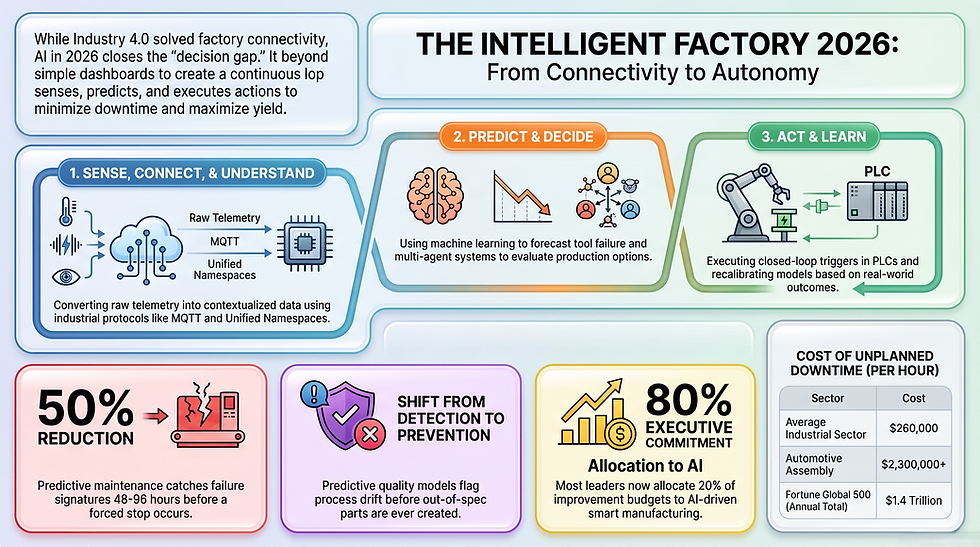
Industry 4.0 already solved connectivity. Sensors talk to gateways, gateways talk to historians, historians feed dashboards. What most factories still lack is the layer that reads all of that data and does something useful with it before a machine fails or a batch goes out of spec. That's the gap AI in manufacturing closes, and it's why 2026 looks different from the pilot-heavy years that came before it.
In one sentence: 2026 is the year manufacturers stop running isolated AI pilots on one line in one plant and start running multi-agent systems that touch scheduling, maintenance, and quality across entire production networks — a shift Deloitte's own 2026 outlook frames as the move from experimentation to at-scale deployment.
Deloitte's research backs this up with specifics. Their 2026 Manufacturing Industry Outlook found that 80% of manufacturing executives plan to put at least 20% of their improvement budgets into smart manufacturing initiatives this year, with agentic AI named as a primary driver. That's not a modest test-and-learn allocation — it's a sizable commitment from an industry that spent much of 2025 dealing with contraction, tariff uncertainty, and a manufacturing PMI stuck below 50 for long stretches. Manufacturers aren't investing in AI because it's fashionable. They're investing because the operational math finally works.
This guide walks through what AI in manufacturing actually is, how it fits inside Industry 4.0, the technology stack behind it, ten applications already running in production plants, and a practical framework for rolling it out without becoming another failed pilot statistic.

What Is AI in Manufacturing?
A plain-English definition for operations leaders
Strip away the marketing language and industrial AI is pattern recognition applied to physics. A vibration sensor bolted to a motor bearing generates a waveform. A thermal camera watching a weld generates a heat map. A machine vision system inspecting a stamped panel generates pixel data. None of that is useful on its own — a human operator can't read a raw accelerometer signal and know a bearing will fail in nine days. AI models can, because they've been trained on thousands of hours of prior signals paired with what happened afterward: the bearing that failed, the weld that cracked, the panel that got rejected.
That's the core distinction. Traditional sensors measure. AI models interpret. A PLC register tells you a temperature reading. A trained model tells you that reading, combined with vibration frequency and current draw on the spindle motor, means this specific CNC tool has roughly 40 machining hours left before dimensional drift pushes parts out of tolerance.
How AI differs from traditional factory automation
Classic factory automation runs on deterministic logic. If temperature exceeds 80°C, trigger the alarm. If the part sensor doesn't register a part within two seconds, stop the conveyor. These IF-THEN rules are reliable, auditable, and completely blind to anything the engineer who wrote them didn't anticipate.
Machine learning models work differently. Instead of a fixed rule, they learn a probability distribution from historical data. Show a computer vision model ten thousand images of acceptable and defective welds, and it learns the visual signature of a defect — including defect types nobody explicitly coded a rule for. That's the trade-off: probabilistic systems generalize to situations rule-based automation never saw coming, but they need governance, monitoring, and human oversight that a fixed PLC ladder-logic program never required.
Why AI has become the core engine of Industry 4.0
IIoT sensors deployed across a modern plant generate a genuinely enormous volume of data — accelerometers sampling at kilohertz rates, vision systems capturing every unit on a line, SCADA historians logging thousands of tags every second. No team of human operators can watch that firehose and catch the signal buried in it. This is sensor fatigue, and it's the quiet failure mode of a lot of early Industry 4.0 rollouts: plants that spent heavily on connectivity and ended up with dashboards nobody has time to stare at.
AI is what turns that raw telemetry into something a plant manager can act on — an alert instead of a chart, a recommendation instead of a data table. Without it, Industry 4.0 connectivity investments plateau. With it, the same sensor data starts driving decisions instead of just decorating a control room monitor.
What Is Industry 4.0 and How Does AI Fit Into It?
From mechanization to intelligent operations
Manufacturing has moved through four broad eras. Industry 1.0 brought steam power and mechanized production in the late 18th century. Industry 2.0 introduced electricity and the assembly line, making mass production possible. Industry 3.0 added computers, PLCs, and early automation from the 1970s onward, replacing manual control with programmable logic. Industry 4.0, the current era, layers connectivity, IIoT sensors, cloud computing, and — increasingly — artificial intelligence on top of that automated base, connecting machines, systems, and people in ways the earlier eras never attempted.
The complete Industry 4.0 technology stack
A real Industry 4.0 stack spans physical hardware and enterprise software at once. On the shop floor sit the sensors — vibration, thermal, optical, acoustic — feeding edge gateways. Those gateways talk to SCADA systems and PLCs managing real-time control. Above that sits the MES layer tracking work orders, and the ERP system managing procurement, inventory, and finance. Physical robotics — from fixed-arm welders to mobile AMRs — execute the physical work. AI sits across all of it, not as a separate layer bolted on top, but as the interpretive function that makes sense of what each layer is reporting.
AI as the decision-making layer of the smart factory
Here's the failure pattern worth naming directly: a plant installs a hundred new sensors, builds a beautiful dashboard, and six months later operators have stopped checking it because it just shows more numbers, not fewer problems. Raw data without contextualized AI produces sensor fatigue, not operational improvement. The dashboard becomes wallpaper. AI's job in this stack is to be the layer that filters noise from signal and turns a wall of SCADA tags into three actionable recommendations a shift supervisor can act on in the next ten minutes.
How AI Rebuilds the Factory Floor: The 7-Step Intelligence Stack
This is where FourfoldAI's proprietary framework comes in. We call it The Factory Intelligence Stack: From Automation to Autonomy, and it maps the full journey raw shop-floor data takes before it becomes an autonomous action.
Sense. Physical sensors capture high-frequency raw telemetry at the point of the machine. Accelerometers on bearings, acoustic emission sensors listening for micro-cracks, infrared cameras watching thermal drift on a motor housing — this is the layer closest to the physics of the equipment itself, and its accuracy sets a ceiling on everything built above it.
Connect. OT gateways and a Unified Namespace (UNS) route that raw, often unstructured shop-floor data across protocols like OPC UA and MQTT. This is the plumbing layer, and it's where a lot of brownfield integration pain lives — a 20-year-old stamping press wasn't built with a UNS in mind, so this step often means retrofitting a protocol gateway onto legacy hardware just to get its data into a modern pipeline.
Understand. Industrial AI cleans that telemetry, stripping out sensor noise, dropout, and false signals, then contextually enriches it — mapping a raw tag name to what it actually represents using an ISA-95 hierarchy so the system knows "Line 3, Station 7, Spindle Motor" instead of just a cryptic tag ID.
Predict. Machine learning and deep learning models forecast what's coming — tool failure within a maintenance window, dimensional drift on a part before it exceeds tolerance, a thermal anomaly building in a bearing housing days before it would trip an alarm.
Decide. Reasoning engines and, increasingly, multi-agent systems evaluate the options — reschedule this job order, hold this machine for maintenance, flag this batch for inspection — and weigh them against production targets, not just the single metric a simpler system might optimize in isolation.
Act. Closed-loop triggers execute the decision. That might mean updating a PLC parameter directly, dispatching a cobot or AMR to a task, or generating an automated work order inside the MES without a human retyping it from a paper note.
Learn. Closed-loop feedback ingests the real-world outcome of that action back into the model. Did the predicted failure actually happen on schedule? Was the rescheduled job order the right call? That feedback recalibrates the model over time, which is the difference between a static rule and a genuinely learning system.
The seven steps aren't a one-time project. They're a running loop, and most manufacturers today have partially built the first three or four steps — Sense, Connect, Understand, sometimes Predict — while Decide, Act, and Learn remain manual. That gap is exactly where the next wave of manufacturing AI investment is heading.

10 Real-World Applications of AI in Manufacturing
1. Predictive maintenance and asset health management
Predictive maintenance uses sensor data and machine learning to forecast equipment failure before it happens, replacing scheduled or reactive maintenance with maintenance triggered by actual asset condition.
This is the most mature AI application on the factory floor, and for good reason — the financial case is stark. Unplanned downtime costs manufacturers an average of roughly $260,000 per hour across sectors according to Aberdeen Group research, climbing past $2.3 million per hour in automotive assembly, where a stopped line cascades into missed just-in-time delivery penalties within minutes. Siemens' downtime research puts the annual toll on Fortune Global 500 companies at close to $1.4 trillion, or roughly 11% of total revenue — a figure that has risen sharply since 2019 as plants run leaner and every idle hour hurts more.
The mechanics: accelerometers mounted on motor bearings and gearboxes capture vibration signatures across multiple frequency bands. Acoustic emission sensors pick up the ultrasonic signature of a developing micro-crack long before it's audible to a human ear. A trained model correlates these signals against historical failure data to estimate remaining useful life (RUL) — not just "this will fail eventually" but "this bearing has an estimated 60 to 90 operating hours left." That window is what lets a maintenance team schedule a repair during a planned changeover instead of scrambling after a 2 a.m. failure alarm, and it's the difference between MTBF (mean time between failures) trending up and MTTR (mean time to repair) trending down simultaneously.
2. AI-powered visual quality control and computer vision
High-speed industrial cameras paired with computer vision models now inspect parts at line speed — often 30 to 60 frames per second — catching surface defects like scratches, pitting, misaligned components, or solder bridge defects that a human inspector would miss on a fast-moving line, especially during the fatigue-prone hours of a long shift. Edge inferencing hardware processes these frames locally, right at the camera, because sending every frame to the cloud for inspection would introduce latency no production line can tolerate. A defect gets flagged in milliseconds, not after the part has already moved three stations down the line.
3. Production process and cycle time optimization
AI models trained on historical process data identify bottlenecks that aren't obvious from a single station's throughput numbers — a starved downstream station that looks fine in isolation but is actually being fed inconsistently by an upstream process with variable cycle times. In injection molding, models tune parameters like barrel temperature, injection pressure, and cooling time in real time based on material lot variation, something a fixed recipe can't adapt to. The result is tighter cycle-time variance, not necessarily a dramatically faster average cycle — consistency is often the bigger win than raw speed.
4. Predictive quality: defect prevention before creation
Predictive quality is a step ahead of visual inspection. Instead of catching a defect after it exists on a finished part, predictive quality models watch upstream process telemetry — temperature curves, pressure profiles, material feed rates — and flag process drift before it produces an out-of-spec part. It's the difference between a camera catching a bad weld and a model noticing the weld current has drifted 3% over the last 20 units and recommending a parameter check before unit 21 goes bad. This shift from retrospective detection to proactive prevention is where a lot of the scrap-rate reduction in modern plants actually comes from.
5. Dynamic production scheduling and dispatching
A fixed production schedule is a plan for a world where nothing goes wrong. Real factories deal with machine outages, rush orders inserted mid-week, labor shift constraints, and raw material shipments that arrive late. AI-driven scheduling systems use constraint-satisfaction algorithms to re-sequence job orders dynamically — reoptimizing the whole schedule in minutes when a machine goes down, rather than requiring a planner to manually rework a spreadsheet while the line sits idle waiting for a decision.
6. Digital twins and physics-based AI simulation
A digital twin couples a kinematic, physics-based model of a machine or production line with its real-time telemetry stream, creating a live simulation that mirrors the physical asset's actual state. Engineers can test a proposed process change — a new cycle time, a different tool path, an altered material feed — against the digital twin before touching the physical line, catching stress points or bottlenecks the change would introduce without risking real production. Siemens' Nanjing facility, recognized as a World Economic Forum Global Lighthouse site, was designed, tested, and optimized entirely as a digital-native factory before construction began, cutting time-to-market by roughly a third in the process.
7. Intelligent robotics, cobots, and physical AI
Collaborative robots, or cobots, work alongside human operators without the fixed safety cages traditional industrial robots require, using force sensing and vision to detect a human presence and adjust in real time. AMRs (autonomous mobile robots) navigate a dynamic factory floor — around forklifts, pallets, and people — rather than following a fixed magnetic-tape path. The newer development is physical AI: foundation models trained to control robotic bodies with more general-purpose adaptability, rather than being hand-programmed for one specific pick-and-place task. Deloitte's 2026 outlook notes that manufacturer interest in physical AI has more than doubled in two years, with adoption plans jumping from roughly 9% to 22% of surveyed manufacturers.
8. Generative AI for plant engineers and technical documentation
Retrieval-augmented generation (RAG) systems built on a plant's own maintenance manuals, PLC error code libraries, and historical repair logs let a technician ask a natural-language question — "what does fault code E47 on the Line 2 extruder mean and what's the standard fix?" — and get an answer grounded in the plant's actual documentation instead of a generic manual. The same approach helps generate shift handoff reports automatically from a day's telemetry and event logs, capturing institutional knowledge that used to walk out the door every time an experienced technician retired.
9. Agentic AI for multi-system factory orchestration
This is the fastest-moving application category. The progression runs from a simple chatbot, to a copilot that suggests actions a human approves, to an AI agent that takes bounded actions autonomously within defined guardrails, up to a multi-agent system where several specialized agents coordinate with each other. In manufacturing, that might look like a scheduling agent noticing a supplier delay flagged by a procurement agent, and adjusting the production sequence to keep other lines running while the delayed material catches up — all without a planner manually connecting those two pieces of information. Deloitte frames agentic AI as poised to elevate smart manufacturing specifically because it can operate continuously across data sources a human team would need dedicated headcount to monitor in real time.
10. AI for industrial energy optimization and sustainability
Energy-hungry processes — compressed air systems, cleanroom HVAC, furnace loads — are prime targets for AI-driven optimization. Models detect compressed air leaks from subtle pressure signatures long before a manual audit would catch them, dynamically manage cleanroom HVAC setpoints based on actual occupancy and process load rather than a fixed schedule, and track carbon footprint per manufactured unit for sustainability reporting. A Unilever site in Pondicherry, recognized as a 2026 WEF Global Lighthouse for its work addressing water scarcity, is one example of AI-driven sustainability programs producing results that show up in both environmental metrics and the balance sheet.
AI in Manufacturing vs Traditional Automation vs Intelligent Automation
It helps to be precise about what changes at each layer, since these three terms get used almost interchangeably in vendor marketing when they actually describe distinct capabilities.
Operational logic. Traditional automation runs on fixed, deterministic IF-THEN rules coded by an engineer. Artificial intelligence runs probabilistic, data-driven models trained on historical patterns. Intelligent automation combines both — adaptive AI-driven rules layered on top of the deterministic control systems that still run the physical equipment safely.
Data handling. Traditional automation reads structured PLC and SCADA tags — clean, numeric, predictable. AI handles unstructured data too: camera images, audio waveforms, free-text maintenance notes. Intelligent automation unifies both IT and OT data into a single contextualized stream, which is precisely what a Unified Namespace architecture is built to do.
Adaptability. Traditional automation adapts to nothing without a programmer manually rewriting the logic. AI models retrain dynamically as new data arrives. Intelligent automation closes the loop — self-correcting workflows that adjust without waiting for a human to notice a pattern and file a change request.
Decision authority. Traditional automation triggers strict, static actions. AI produces predictive recommendations, typically for a human to review. Intelligent automation governs autonomous execution within defined boundaries, keeping a human in the loop for higher-stakes decisions while letting routine ones run themselves.
Primary output. Traditional automation produces repeatable mechanical action. AI produces forecasts, anomaly flags, and classifications. Intelligent automation produces full end-to-end process execution — the forecast, the decision, and the action, chained together.
The practical takeaway for a plant leader: buying "AI" alone doesn't get you intelligent automation. It gets you better forecasts. The value shows up when those forecasts are wired into the existing automation layer closely enough that a predicted failure actually triggers a work order, instead of sitting in a dashboard someone has to remember to check.
What Technologies Power AI in Manufacturing?
Machine learning and deep neural networks form the predictive backbone — everything from simpler regression-based RUL estimators to deep convolutional networks trained on years of sensor history.
Industrial computer vision and spatial computing handle the visual inspection and spatial-awareness tasks — defect detection, part counting, robotic guidance systems that need to understand a 3D scene, not just a 2D image.
Generative AI and industrial large knowledge models power the documentation, troubleshooting, and reporting layer — RAG systems grounded in a plant's own manuals rather than general internet text.
Agentic AI and multi-agent frameworks coordinate decisions across systems that used to require a human to manually bridge — scheduling, procurement, and maintenance agents that share context and act within guardrails.
Edge AI hardware and NPU/TPU inferencing run models physically close to the sensor, at the machine, because a defect-detection decision that needs to happen in milliseconds can't wait for a round trip to a cloud data center.
Industrial Internet of Things (IIoT) sensors — vibration, thermal, acoustic, optical — are the raw data source everything above depends on. No sensor data, no model, regardless of how sophisticated the algorithm is.
Digital twins and spatial simulation provide the testbed where process changes get validated against a physics-based model before touching a physical line.
Industrial data platforms and Unified Namespaces (UNS) are the connective tissue — the architecture that lets data generated at the sensor level actually reach the models and applications that need it, in a format they can use, without a custom point-to-point integration for every single data source.
The Smart Factory Data Architecture: How AI Connects to the Real Factory
FourfoldAI's second proprietary model, The 6-Layer Smart Factory Architecture, maps how a factory's physical and digital layers stack on top of each other.
Layer 1 — Physical Assets & Sensors. Motors, CNC machines, conveyors, cameras — the physical equipment and the sensors instrumenting it.
Layer 2 — Operational Technology. PLCs, SCADA systems, distributed control systems — the real-time control layer that has run factories reliably for decades and isn't going anywhere.
Layer 3 — Execution & Planning. MES, quality management systems, historians — the systems that track what's actually happening against what was planned.
Layer 4 — Data Architecture & Integration. Unified Namespace, MQTT brokers, edge gateways — the plumbing that moves data from Layer 2 and Layer 3 into a form the AI layer can consume.
Layer 5 — Industrial AI & Model Execution. Edge inferencing, computer vision pipelines, agentic workflows — where the actual intelligence lives and runs.
Layer 6 — Human Oversight & Safety Constraints. Operator dashboards, action-approval workflows, physical E-stops — the layer that keeps a human in ultimate control, regardless of how autonomous Layer 5 becomes.
The hardest layer to build in practice is Layer 4, and specifically the brownfield integration problem it creates. Most plants aren't building a factory from scratch. They're retrofitting sensor gateways onto a 30-year-old stamping press that was never designed to speak OPC UA, running a serial connection into a protocol converter just to get that machine's data into the modern pipeline at all. This is unglamorous, physically hands-on integration work — pulling cable, mounting a gateway, configuring a driver — and it's routinely the actual bottleneck in a smart factory rollout, even when the AI model itself is already validated and ready to deploy.
What Are the Business Benefits of AI in Manufacturing?
Unplanned downtime reduction. Industry data consistently points to a 30% to 50% reduction in unplanned downtime once predictive maintenance models are deployed against a meaningful population of critical assets, driven by catching failure signatures 48 to 96 hours ahead of a forced stop rather than reacting after the fact.
Overall Equipment Effectiveness (OEE) expansion. OEE — the product of availability, performance, and quality — is the standard yardstick for factory productivity. Reducing unplanned downtime directly lifts the availability component, and industry benchmarks suggest that meaningful downtime reductions translate into roughly 2 to 3 percentage points of annual OEE improvement, which compounds significantly across a full year of production.
First-pass yield enhancement and scrap rate reduction. WEF Global Lighthouse Network data shows individual sites achieving defect reductions in the 35% range and scrap or waste reductions as high as 55% across supply chains once predictive quality and computer vision inspection are running at scale.
Accelerated Mean Time to Repair (MTTR) via generative troubleshooting. RAG-based technical assistants cut the time a technician spends searching through PDF manuals or calling a more senior colleague, translating directly into faster fault diagnosis and repair — industry benchmarks point to MTTR reductions in the 20% to 40% range where these tools are deployed alongside predictive maintenance.
What Challenges Prevent Manufacturers From Scaling AI?
The enterprise obstacle list
Legacy connectivity remains the single most common blocker — brownfield equipment that predates modern industrial networking standards and needs custom integration work before it can even feed a model. Poor data hygiene compounds it: mislabeled tags, inconsistent units, missing timestamps, and sensor drift that went uncalibrated for years all degrade model accuracy before a single algorithm is even trained. IT/OT friction shows up as organizational, not technical, resistance — the IT security team wants a locked-down network, the OT engineering team needs low-latency access to control systems, and the two groups often report through entirely different chains of command with different risk tolerances. Workforce reluctance rounds out the list, particularly among experienced operators who've seen automation initiatives promise the world and deliver a dashboard nobody uses.
Why AI pilots fail on the factory floor ("Proof-of-Concept Purgatory")
Five specific traps explain why so many manufacturing AI pilots never make it past a single line.
Solving a cool tech problem instead of a costly operational bottleneck. Teams sometimes pick the AI use case that's technically interesting — a flashy computer vision demo — over the use case that's actually expensive, like the changeover process nobody wants to touch because it's tedious to model.
Model training on isolated, uncontextualized data streams. A model trained on one line's data, without the surrounding ISA-95 context of what job order, shift, and material lot that data belongs to, often can't generalize to a second line even in the same plant.
Siloed ownership between IT teams and plant-floor OT engineers. A pilot that IT builds without OT engineers as genuine co-owners tends to die the moment the data science team moves on to the next project, because nobody on the floor understands it well enough to maintain it.
Lack of user-centered design for frontline operators. An alert that fires with no clear recommended action, delivered through an interface an operator has to leave their station to check, gets ignored regardless of how accurate the underlying model is.
Inability to scale custom edge hardware across heterogeneous plants. A pilot built around one plant's specific camera model and edge gateway often can't be dropped into a sister plant running different hardware without significant rework, which turns "scaling the pilot" into "rebuilding the pilot" five separate times.
How to Implement AI in Manufacturing: A Practical 7-Step Framework
Step 1: Identify the high-cost operational bottleneck. Start from the P&L, not the technology catalog. What specific failure mode, quality issue, or scheduling inefficiency is costing the most money right now? That's the use case worth piloting first.
Step 2: Audit data availability and sensor hygiene. Before writing a line of model code, check whether the sensors needed even exist, whether their historical data is clean enough to train on, and whether tags are labeled consistently enough to trust.
Step 3: Establish the IT/OT integration architecture. Decide how data will move from Layer 2 (OT) to Layer 5 (AI) before building the model — a Unified Namespace approach here saves enormous rework later compared to point-to-point integrations that don't scale past one line.
Step 4: Deploy a targeted, low-risk proof-of-value (PoV). Scope the pilot tightly — one line, one failure mode, one measurable KPI — and set a defined evaluation window rather than letting the pilot run indefinitely without a clear success criterion.
Step 5: Define strict operational safety boundaries and human oversight. Decide up front exactly what the AI system is and isn't allowed to do autonomously, and where a human approval step is mandatory — this belongs in the design from day one, not bolted on after an incident.
Step 6: Quantify operational and financial metrics. Track the specific numbers that justified the pilot — downtime hours avoided, scrap rate change, MTTR reduction — in the same units finance and operations leadership already use, not a separate "AI metric" nobody else recognizes.
Step 7: Standardize model deployment across multi-plant networks. Once a use case proves out on one line, build the deployment as a repeatable template — standardized hardware, standardized data contracts — so plant two doesn't require rebuilding the pilot from scratch.
Which AI Manufacturing Use Cases Should Companies Prioritize First?
Best starting points — predictive maintenance and visual inspection — share a common trait: a clear, quantifiable ROI and relatively contained data requirements, since both can often start on a single critical line without touching the broader IT/OT architecture.
Intermediate use cases — AI-driven scheduling and predictive quality — require more integration across systems (MES, ERP, quality management) and are worth tackling once the foundational data architecture from the first wave is proven and reusable.
Advanced use cases — agentic multi-agent orchestration and fully autonomous production lines — depend on the maturity of everything below them in the Factory Intelligence Stack, and attempting them before the Sense-Connect-Understand layers are solid is a common reason ambitious AI programs stall.
AI in Manufacturing ROI: How Should Manufacturers Measure Success?
Three distinct metric classes matter, and conflating them is a common mistake.
Operational metrics — OEE, MTBF, MTTR, scrap rate, yield — measure whether the physical plant is actually running better. These are the metrics plant managers already track, and AI's success should show up directly in them.
Financial metrics — maintenance cost per unit, energy cost per ton, scrap expense — translate operational improvement into dollars finance can validate, which matters enormously for securing budget for the next phase of rollout.
AI performance metrics — model precision and recall, false positive rate, inference latency, and operator action acceptance rate — measure whether the AI system itself is behaving well. A model with excellent precision that operators routinely ignore because its alerts arrive at the wrong point in their workflow isn't actually delivering value, regardless of how good the underlying statistics look on a data science dashboard.
The Future of AI in Manufacturing: From Smart Factories to Autonomous Factories
The trajectory runs along a fairly clear continuum: connected factory (sensors report data), smart factory (data informs human decisions), intelligent factory (AI recommends actions), semi-autonomous factory (AI executes routine decisions with human oversight on exceptions), and eventually a fully autonomous factory where entire production sequences run with minimal human intervention except for strategic and safety-critical decisions. Most manufacturers today sit somewhere between connected and intelligent, with a small number of Lighthouse-caliber sites pushing into semi-autonomous territory.
Deloitte's 2026 outlook points to physical AI — robots and autonomous systems with more general adaptability than fixed-purpose industrial robots — as the next major investment wave, with manufacturer adoption plans more than doubling in two years. The World Economic Forum's Global Lighthouse Network, now spanning more than 220 sites across over 30 countries, reports that generative AI use cases have grown to represent roughly a quarter of the top solutions deployed across the network, up sharply from a few years ago, and that 94% of the network's most successful transformations combine AI with other technology domains — IoT, cloud, and digital twins together, rather than any single technology deployed in isolation.
Expect industrial foundation models — large models pretrained on cross-industry manufacturing data and fine-tuned for a specific plant or process — to become a meaningful category over the next few years, reducing the amount of plant-specific training data needed to stand up a new use case. NIST's continued work on AI risk management frameworks, and the broader push from bodies like the WEF toward standardized measurement of industrial AI impact, suggest the next phase of adoption will come with more rigorous benchmarking than the pilot-heavy early years — which should, in theory, make it easier to tell genuine operational impact apart from vendor claims.
Frequently Asked Questions About AI in Manufacturing
What is AI in manufacturing? AI in manufacturing refers to the use of machine learning, computer vision, generative AI, and robotics to analyze shop-floor data, predict equipment failures, automate quality inspection, and optimize production scheduling — turning raw sensor data into operational decisions.
How is AI used in Industry 4.0? Within Industry 4.0, AI acts as the decision-making layer sitting on top of IIoT connectivity. It interprets the data that connected sensors, PLCs, and MES systems generate, and turns that data into predictions and actions rather than just dashboards.
What is the difference between AI and traditional automation in manufacturing? Traditional automation follows fixed, deterministic rules coded by an engineer. AI uses probabilistic models trained on historical data, allowing it to recognize patterns and handle situations no one explicitly programmed a rule for.
What are the top applications of AI on the factory floor? The most widely deployed applications are predictive maintenance, computer vision-based quality inspection, dynamic production scheduling, digital twins, and increasingly agentic AI systems that coordinate scheduling and maintenance decisions across multiple systems.
How does AI improve predictive maintenance? AI analyzes vibration, acoustic, and thermal sensor data to estimate a machine component's remaining useful life, flagging a likely failure days in advance so maintenance teams can act during a planned window instead of after an unplanned breakdown.
What is a smart factory? A smart factory connects physical equipment, sensors, and enterprise software into a unified data architecture, using that connectivity — combined with AI — to inform or automate operational decisions in near real time.
What is intelligent automation in an industrial context? Intelligent automation combines AI's pattern recognition with the deterministic reliability of traditional automation, producing closed-loop systems that can adapt to new conditions while still operating within safe, governed boundaries.
Can AI be integrated with legacy (brownfield) manufacturing equipment? Yes. Brownfield integration typically involves retrofitting sensor gateways and protocol converters onto older equipment so its data can reach a modern data architecture like a Unified Namespace, without requiring the equipment itself to be replaced.
What is the biggest barrier to scaling AI in manufacturing? The most common barrier is legacy connectivity and poor data hygiene, compounded by organizational friction between IT and OT teams who often have different priorities, risk tolerances, and reporting structures.
What is agentic AI in manufacturing operations? Agentic AI refers to autonomous AI agents that take bounded actions within a manufacturing system — adjusting a schedule, generating a work order, or reconciling a supply disruption — without requiring a human to manually execute every step, while still operating inside defined safety and approval guardrails.
Final Thoughts: AI Is Becoming the Operating System of Industry 4.0
Industry 4.0 built the nervous system — sensors, connectivity, data pipelines reaching every corner of the plant. AI is what gives that nervous system a brain. The factories pulling ahead in 2026 aren't the ones with the most sensors installed. They're the ones that closed the loop between sensing a problem and acting on it, whether that's a predictive maintenance model catching a bearing failure four days out or an agentic system rebalancing a schedule the moment a supplier flags a delay.
None of this replaces sound engineering judgment or the plant-floor expertise that took decades to build. It amplifies it — freeing skilled people from watching dashboards and chasing false alarms, and putting them back on the higher-judgment work only they can do. That's the practical, unglamorous version of the "operating system" framing: not a factory that runs itself with no one watching, but one where the watching is finally pointed at the right things.
If you're mapping out where your own plant sits on this journey — Sense, Connect, Understand, or already into Predict and Decide — FourfoldAI covers the frameworks, architecture patterns, and adoption playbooks for industrial AI in more depth across the site. Explore more at fourfoldai.com.
Disclaimer:
This article is intended for general informational purposes only and does not constitute engineering, financial, or professional advisory guidance for any specific manufacturing operation. Statistics and benchmarks cited are drawn from third-party research (Deloitte, Siemens, Aberdeen Group, World Economic Forum, and others) current as of 2025–2026 and may change as new data becomes available. For the full disclaimer, visit: fourfoldai.com/disclaimer
References
Deloitte — 2026 Manufacturing Industry Outlook
Deloitte — State of AI in the Enterprise, 2026 Report
World Economic Forum — Global Lighthouse Network: Rewiring Operations for Resilience and Impact at Scale
World Economic Forum — What Does the Factory of the Future Look Like?
Siemens — True Cost of Downtime Research
Aberdeen Research — Unplanned Downtime Cost Benchmarks (via industry roundups, 2026)
Manufacturing Dive — Agentic AI and the Manufacturing Status Quo
About the Author
Muizz Shaikh is an AI enthusiast and digital technology professional at FourfoldAI. He is passionate about exploring AI tools, industry trends, and practical applications of emerging technologies. Through FourfoldAI, Muizz contributes to simplifying artificial intelligence for businesses and learners. Connect with him on LinkedIn: linkedin.com/in/muizz-shaikh-45b449403/
© 2026 FourfoldAI. All rights reserved.


Comments