
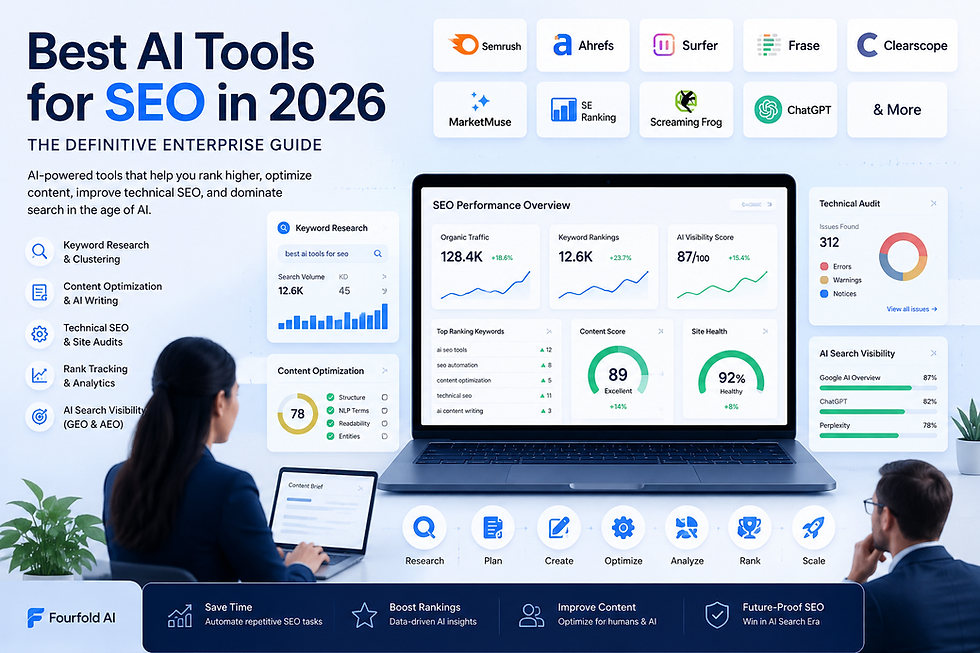
Best AI Tools for SEO in 2026: The Definitive Enterprise Guide

Search stopped being a single channel a while back. Ranking on Google is still the foundation, but your content now needs to survive contact with Google AI Overviews, get picked up in ChatGPT Search results, and hold its own inside Perplexity's citations — often within the same week you publish it. That's the real story behind the best AI tools for SEO in 2026: the winners aren't just keyword tools with a chatbot bolted on. They're platforms built to satisfy a traditional crawler and a large language model at the same time.
This guide breaks down 20 platforms we evaluated across pricing, AI generation quality, SEO performance, and — critically — how ready each one is for Generative Engine Optimization (GEO) and Answer Engine Optimization (AEO). Whether you're running an agency managing thirty client sites or a solo blogger trying to figure out which subscription actually earns its keep, you'll find a clear recommendation below. We also cover how AI search optimization fits into a broader AI search explained framework, since the tools only matter once you understand what they're optimizing for.
Why AI SEO Tools Matter More Than Ever
Search engines used to reward pages that repeated the right words enough times. That era is over. Ranking systems now build a graph of entities and relationships, then match a person's intent against that graph rather than against a string of text. A page about "best running shoes for flat feet" has to demonstrate it actually understands pronation, arch support, and injury prevention as connected concepts — not just mention them in passing.
How AI Changed SEO
Semantic search models classify intent before they ever look at your keyword density. Vector-based ranking systems represent content as points in mathematical space, so a page can rank for a query that never appears verbatim on the page, as long as the underlying meaning is close enough. This is why entity-first SEO and topical authority mapping have replaced flat keyword lists as the starting point for content planning. Tools that still optimize purely on keyword frequency are optimizing for a search engine that stopped existing several algorithm updates ago.
Traditional SEO vs. AI Search
A traditional crawler indexes a page and matches it against a query at retrieval time. An AI search system does something closer to research: it retrieves multiple sources, extracts the relevant passages, and synthesizes an answer — sometimes citing you, sometimes not. Passage retrieval matters more than full-page ranking in this world, because an AI model might pull one paragraph from your page and ignore the rest entirely. That changes how you structure content: every section needs to stand on its own as a complete, extractable answer.

SEO vs. GEO vs. AEO
These three terms get used interchangeably, and that's a mistake. SEO (Search Engine Optimization) is the practice of ranking in classic engines like Google and Bing. GEO (Generative Engine Optimization) is about earning citations inside AI-generated answers from tools like ChatGPT and Perplexity — it's less about ranking and more about becoming a trusted source the model pulls from. AEO (Answer Engine Optimization) targets the direct-answer format itself: featured snippets, voice search results, and the short factual blurbs AI assistants read aloud. A mature 2026 content strategy treats all three as one connected discipline, not three separate projects.
How We Evaluated the Best AI SEO Tools
Testing Methodology
Our team tested these platforms across live client and personal sites over a six-month stretch, tracking organic performance shifts, day-to-day usability, API responsiveness, and the actual quality of AI-generated output before and after human editing. We paid particular attention to how each tool performed once AI Overviews started appearing on the majority of commercial search queries, since that single shift has reshaped what "ranking" even means.
Evaluation Criteria
Each tool was scored against seven factors:
Features and integration capabilities — does it connect to your CMS, Google Search Console, and existing stack?
Pricing versus scaled value — what does the cost look like once you add the AI visibility or content add-ons most vendors now sell separately?
Ease of use and workflow integration — how much training does a new hire need before they're productive?
AI generation quality and fact-checking safeguards — does the AI draft need thirty minutes of editing or three hours?
SEO performance — organic visibility metrics from real campaigns, not vendor case studies alone.
AI search optimization — GEO score and citation readiness across ChatGPT, Perplexity, Gemini, and Google AI Mode.
Best use cases — who genuinely benefits, and who's overpaying for features they won't touch.
Quick Comparison Table
Tool | Best For | Starting Price | Free Plan | Core AI Feature | Core SEO Feature | AI Search Ready | FourfoldAI Rating |
Semrush | All-in-one agencies | $139.95/mo | Limited | Semrush Copilot | 140+ point Site Audit | Yes (add-on) | 9.2/10 |
Surfer SEO | Content optimization | $99/mo | No | Content Editor + Surfer AI | Content Score (500+ signals) | Yes | 8.9/10 |
SE Ranking | Budget-conscious agencies | $52/mo | 14-day trial | AI Results Tracker | Keyword × engine rank tracking | Yes (add-on) | 8.6/10 |
Clearscope | Enterprise content teams | $129/mo | No | AI Drafts | A–F content grading | Yes | 8.5/10 |
Ahrefs | Backlink & keyword research | $129/mo | Limited | Agent B | Site Explorer | Yes (Brand Radar add-on) | 8.8/10 |
Frase | AI visibility + briefs in one | $39/mo | 7-day trial | Content Guard agent | GEO + SEO dual scoring | Yes (native) | 8.7/10 |
MarketMuse | Enterprise topic strategy | $99/mo | Yes | Personalized Difficulty | Content Inventory | Limited | 8.2/10 |
NeuronWriter | Budget content optimization | $23/mo | No | NLP content score | SERP-based term suggestions | Limited | 8.0/10 |
Jasper AI | Brand-consistent content teams | $49/mo | No | GEO Hub | Brand IQ | Yes | 8.3/10 |
Search Atlas | Automated technical SEO | $79/mo | No | OTTO SEO automation | 60+ tool suite | Yes | 8.1/10 |
Ratings reflect FourfoldAI's testing methodology as of mid-2026 and weigh pricing, output quality, and AI search readiness equally.
20 Best AI Tools for SEO
1. Semrush
Overview: The broadest all-in-one platform covering SEO, PPC, content, and AI visibility tracking under one login. Best Features: Semrush Copilot (free AI recommendations engine), the AI Visibility Toolkit tracking brand presence in ChatGPT and AI Overviews, and ContentShake AI for drafting. Pros: Massive keyword and backlink database; 140+ point technical audits; Copilot ships free with every plan. Cons: Single-user limitation on lower tiers; the AI Visibility Toolkit is a $99/month add-on rather than included. Pricing: Pro from roughly $139.95/month, Guru $249.95/month, Business $499.95/month. Best For: Agencies and mid-to-large businesses that want one dashboard instead of five subscriptions. FourfoldAI Verdict: If you can only license one tool, Semrush is still the safest all-around bet — the AI Visibility add-on is worth budgeting for once your clients start asking about ChatGPT citations.
2. Surfer SEO
Overview: The category leader for real-time, data-driven content optimization. Best Features: Content Editor with live scoring, Surfer AI Writer, Topical Map for content gap analysis. Pros: Analyzes 500+ on-page signals; strong Google Docs and WordPress integration; genuinely fast content briefs. Cons: No backlink analysis, technical audit, or rank tracking — you'll still need a companion tool; AI Tracker for GEO costs $95/month extra. Pricing: Essential $99/month, Scale $219/month, Enterprise from $999/month annually. Best For: Content teams and agencies publishing ten or more optimized articles monthly. FourfoldAI Verdict: Best-in-class for the writing and optimization layer specifically — pair it with a keyword research tool rather than expecting it to replace one.
3. SE Ranking
Overview: A budget-friendly all-in-one suite that undercuts Semrush and Ahrefs on price while still shipping AI search tracking. Best Features: AI Results Tracker covering Google AI Overviews, AI Mode, ChatGPT, and Perplexity; white-label reporting on every tier. Pros: Strong value for agencies; accurate daily rank tracking; sentiment scoring on AI mentions. Cons: Keyword limits are calculated as keywords × search engines tracked, which quietly eats your quota faster than expected. Pricing: Essential/Core from around $52–103/month annually; AI Search Visibility add-on runs $71–89/month. Best For: Freelancers and small-to-mid agencies that need white-label deliverables without Semrush-level cost. FourfoldAI Verdict: The best value-for-money pick on this list if you understand the keyword multiplier before you commit to a tier.
4. Clearscope
Overview: A focused content-grading platform built around real-time A–F scoring against top-ranking pages. Best Features: Google Docs integration, Content Inventory refresh tracking, AI Prompt Tracking for LLM visibility. Pros: Cleanest, most writer-friendly interface in this category; unlimited users on every plan. Cons: No keyword research, backlink data, or technical audits; premium pricing with no annual discount. Pricing: Essentials from $129/month, Business $399/month, Enterprise custom. Best For: Mid-market in-house content teams with an active publishing cadence and multiple writers. FourfoldAI Verdict: Worth the premium if content quality directly drives revenue for you — skip it if you're a solo blogger on a tight budget.
5. Ahrefs
Overview: The gold standard for backlink data, now extending into AI visibility through its Brand Radar add-on. Best Features: Site Explorer, Keywords Explorer with 28+ billion keywords, and Agent B, an embedded AI research assistant. Pros: Largest and most frequently refreshed backlink index in the industry; deep competitive research tools. Cons: Brand Radar's full six-platform AI tracking runs $699/month on top of the base plan — expensive for AI search monitoring specifically. Pricing: Lite from $129/month; Brand Radar indexes $199/month per platform or $699/month bundled. Best For: Link-building and competitive research at scale. FourfoldAI Verdict: Unmatched for backlinks and keyword depth — but treat Brand Radar as an enterprise-only line item, not a default add-on.
6. Frase
Overview: An agentic SEO and GEO platform that researches, drafts, optimizes for both Google and AI engines, and watches your published pages for ranking decay. Best Features: Dual SEO/GEO scoring in the same editor, Content Guard for automated content refresh alerts, native AI visibility tracking across eight platforms. Pros: AI visibility tracking is included in the base plan rather than sold separately — a real differentiator versus Surfer or Clearscope. Cons: Steeper learning curve than a simple content editor; briefs alone won't replace a dedicated keyword tool. Pricing: Starter from $39/month annually, Growth $79/month, Team $129/month. Best For: Teams that want GEO and traditional SEO scoring without stacking two subscriptions. FourfoldAI Verdict: The strongest value story on this list for anyone who's already seeing referral traffic from ChatGPT or Perplexity.
7. MarketMuse
Overview: An enterprise content intelligence platform built for topic modeling and inventory-level strategy across an entire site. Best Features: Personalized Difficulty scoring, Content Inventory analysis, nine content brief types on the top tier. Pros: Unmatched depth for planning content at the domain level rather than the single-article level. Cons: Query limits on lower tiers are restrictive; pricing is now largely quote-based rather than published. Pricing: Free tier available; Optimize around $99/month, Research $249/month, Strategy $499/month. Best For: Enterprise teams managing large content portfolios who need to prioritize what to write next, not just how to write it. FourfoldAI Verdict: Overkill for solo creators, but genuinely difficult to replace for teams planning content at scale.
8. NeuronWriter
Overview: A budget-friendly NLP content optimizer that delivers Surfer-style scoring at a fraction of the cost. Best Features: SERP-based term recommendations, internal linking suggestions, built-in plagiarism checking on higher tiers. Pros: Genuinely the strongest price-to-feature ratio in the content optimization category. Cons: No GEO scoring, no AI search visibility tracking, smaller user base than established competitors. Pricing: Bronze/Silver from $23/month, Gold $69/month with unlimited team members. Best For: Freelancers and budget-conscious creators who want NLP optimization without a premium subscription. FourfoldAI Verdict: The clear budget pick — just know you'll need a separate tool once AI search visibility becomes a priority.
9. Jasper AI (Enterprise for SEO)
Overview: An AI marketing platform built for large teams managing brand-consistent content across many channels, not purely SEO. Best Features: Brand Voice training, GEO Hub for citation monitoring, no-code AI Agent Builder. Pros: Best-in-class brand consistency across a large content team; strong multilingual support. Cons: Not primarily an SEO tool — you'll still need Surfer, Frase, or Semrush for on-page optimization and keyword data. Pricing: Creator around $39–49/month, Pro $59–69/month, Business custom (often $99–125/seat/month). Best For: Enterprise marketing leaders managing content across ads, email, and social alongside SEO. FourfoldAI Verdict: Choose Jasper for brand governance at scale, not as your primary SEO content engine.
10. Inlinks (Entity SEO)
Overview: A specialist platform built entirely around entity-based SEO, automated internal linking, and schema generation. Best Features: Knowledge Graph Builder, automated FAQ and Organization schema, entity-coverage content briefs. Pros: One of the few tools purpose-built for the entity-first approach that increasingly drives both Google and AI search rankings. Cons: Not a substitute for deep backlink or keyword research; entity SEO has a real learning curve for keyword-trained teams. Pricing: Free tier available; Freelancer $49/month, Agency $196/month, Enterprise from $1,999/month. Best For: Publishers and affiliate sites managing hundreds of pages that need scalable, automated internal linking. FourfoldAI Verdict: A genuinely different angle on SEO tooling — worth adding alongside a traditional suite rather than instead of one.
11. Alli AI
Overview: An on-page SEO automation platform that deploys changes directly to your live site through a code snippet, without developer involvement. Best Features: Bulk title/meta/heading automation, AI internal linking automation, schema generation without manual coding. Pros: Genuinely fast deployment — recommendations go live in seconds once approved. Cons: Snippet-based deployment means changes stop rendering if you cancel; not built for AI content generation. Pricing: Business $299/month, Agency $599/month, Enterprise custom. Best For: Agencies managing multiple client sites that need on-page fixes deployed at scale without CMS access headaches. FourfoldAI Verdict: A strong technical execution layer — pair it with a research tool since Alli AI itself doesn't do keyword discovery.
12. Search Atlas
Overview: An all-in-one platform positioning itself as a replacement for the fragmented SEO stack, anchored by its OTTO SEO automation engine. Best Features: OTTO automated technical fixes, Content Genius AI writing, QUEST for LLM visibility tracking. Pros: Genuinely broad tool coverage (60+ tools) under one subscription; automation executes fixes rather than just flagging them. Cons: Credit-based pricing can balloon quickly on large sites; per-site OTTO activation fees add up for agencies. Pricing: Starter from $79/month annually, Growth $199/month, higher tiers scaling toward $999/month. Best For: Agencies wanting to consolidate research, content, and technical execution into one platform. FourfoldAI Verdict: The automation is real, but budget carefully — the sticker price rarely matches the final bill once credits are factored in.
13. Writesonic (Writesonic V5 / ContentShake AI)
Overview: An AI writing platform that has repositioned itself around combining content drafting with AI search visibility tracking. Best Features: AI Article Writer for long-form drafts, AI Visibility Action Center covering up to ten AI platforms on higher tiers. Pros: One of the few writing-first tools that also tracks Grok, DeepSeek, and Meta AI, not just the major three. Cons: Entry tiers track ChatGPT only; article caps can feel restrictive for high-volume publishers. Pricing: Starter tiers from roughly $39–79/month, scaling to $199–399/month for full multi-platform tracking. Best For: Teams that want AI drafting and AI visibility tracking under a single subscription. FourfoldAI Verdict: A smart pick if GEO tracking breadth matters more to you than deep SEO research features.
14. Scalenut
Overview: A GEO-focused platform combining AI content generation with brand visibility monitoring across AI-driven search. Best Features: Brand Monitor for AI mention tracking, Cruise Mode for rapid article drafting, automated internal linking. Pros: Genuinely affordable relative to feature depth; Perplexity tracking on higher tiers. Cons: English-language strength only; article output can lean repetitive without heavy editing. Pricing: Starter $59/month, Plus $89/month, Professional $199/month. Best For: Small-to-mid teams that want AI content generation and basic AI visibility tracking in one affordable package. FourfoldAI Verdict: A solid all-rounder for teams not ready to pay Semrush or Search Atlas pricing.
15. RankIQ
Overview: A blogger-first SEO tool built around a hand-curated keyword library and a simple content grading workflow. Best Features: Niche-specific keyword library with competition scoring, Content Optimizer with live A+++ grading, Title Analysis. Pros: Genuinely the most affordable path to structured content optimization for independent bloggers. Cons: Not built for agency-scale workflows, multi-writer QA, or technical SEO auditing. Pricing: Blogger/Standard $49/month, Pro $99/month, Agency $199/month. Best For: Solo bloggers and small content sites, particularly in the Mediavine and food-blogging space. FourfoldAI Verdict: The best-value tool on this list specifically for independent bloggers who don't need enterprise features.
16. Copy.ai (OS Workflows)
Overview: Copy.ai has pivoted from a general AI writer into a go-to-market workflow automation platform with content generation as one module among many. Best Features: Brand Voice training, 90+ specialized writing tools, multi-step workflow automation connecting to HubSpot and Salesforce. Pros: Strong free tier for light, occasional use; genuinely powerful automation once you're on Pro or Growth. Cons: Not SEO-specific — you'll need a dedicated research or optimization tool alongside it; higher tiers get expensive fast. Pricing: Free tier available; Pro around $49/month, Growth-tier workflow plans scaling toward $1,000/month. Best For: GTM and marketing operations teams automating content across many channels, not pure SEO writers. FourfoldAI Verdict: Choose Copy.ai for workflow automation breadth, not as a dedicated SEO content optimizer.
17. Outranking
Overview: A document-based AI SEO workflow tool that generates full first drafts already structured around SERP-derived optimization data. Best Features: AI-generated first drafts incorporating on-page best practices, automated SERP analysis, content templates by type. Pros: The document-style editor feels familiar to writers already using Google Docs-style workflows, lowering the adoption curve. Cons: Smaller community and feature set than Surfer or Frase; best suited to teams that want automation over granular manual control. Pricing: Positioned in a similar tier to Frase and NeuronWriter; contact the vendor for current plan details. Best For: SEO teams that want SERP research and drafting automated inside one workflow rather than assembled from separate tools. FourfoldAI Verdict: A reasonable mid-tier pick if you specifically want the brief-to-draft process automated end to end.
18. Sintra AI (Seomi)
Overview: A broader AI-employee platform where "Seomi" is one of twelve persona-based AI helpers covering SEO guidance alongside sales, support, and business strategy. Best Features: SEO content drafting and audits through Seomi's chat interface; Brain AI memory that learns your business context over time. Pros: Genuinely useful for solo founders who need broad AI coverage across many business functions at once. Cons: Seomi is an AI advisor, not an analytics platform — no keyword database, no SERP tracking, no backlink data. Pricing: Roughly $39–97/month depending on tier. Best For: Solopreneurs and early-stage founders who want lightweight SEO guidance bundled with broader business support. FourfoldAI Verdict: Not a substitute for a real SEO platform, but a reasonable starting point if you're covering a dozen functions on a single budget.
19. Profound (AI Search Visibility Specialist)
Overview: A premium, enterprise-focused platform purpose-built to track how brands appear across ChatGPT, Gemini, Perplexity, Claude, and Google's AI Mode. Best Features: Conversation Explorer built on hundreds of millions of real user prompts, Agent Analytics for AI crawler behavior, SOC 2 and HIPAA compliance. Pros: The deepest, most enterprise-ready AI visibility data available in this category. Cons: Expensive; no free trial; requires a sales conversation rather than self-serve signup. Pricing: Lite tier from roughly $499/month, Enterprise contracts often exceeding $2,000/month. Best For: Enterprise brands with dedicated budget for AEO/GEO tracking as a standalone discipline. FourfoldAI Verdict: Reserve this for brands where AI search visibility is already a board-level metric — most teams should start with a bundled AI Visibility add-on from Semrush or Frase first.
20. ChatGPT Search (Custom SEO Agents)
Overview: Rather than a packaged SEO product, this represents the DIY approach of building custom GPT-based agents inside ChatGPT to handle repeatable SEO tasks like brief generation, meta description writing, and competitor summarization. Best Features: Fully customizable prompt workflows, zero additional subscription cost beyond your existing ChatGPT plan, instant iteration. Pros: Extremely flexible and effectively free if you already have a ChatGPT subscription; useful for prototyping workflows before committing budget to a dedicated platform. Cons: No SERP data, no rank tracking, no automated fact-checking against live search results — you're building the guardrails yourself. Pricing: Included with an existing ChatGPT Plus or Team subscription. Best For: Technically comfortable marketers who want to prototype custom SEO workflows before buying a dedicated tool. FourfoldAI Verdict: A smart supplement, not a replacement, for a proper SEO platform — treat it as a lightweight workflow layer on top of real data sources.
Best AI SEO Tools by Use Case
Best Overall: Semrush, for the breadth of features across research, content, and AI visibility in one login. Best Budget: NeuronWriter, for genuine NLP optimization depth at $23/month. Best Enterprise: MarketMuse, for domain-level content strategy and inventory intelligence at scale.
Best for Agencies: SE Ranking, thanks to white-label reporting bundled into every tier rather than gated behind enterprise pricing. Best for Bloggers: RankIQ, built specifically around the workflow independent content creators actually use. Best for E-commerce: Search Atlas, since OTTO's automated technical fixes matter most on large, fast-moving product catalogs.
Best for Technical SEO: Alli AI, for automated on-page deployment without waiting on developer resources. Best for Keyword Research: Ahrefs, for the depth and freshness of its backlink and keyword indexes. Best for Content Optimization: Surfer SEO, for its real-time Content Score and mature editor experience. Best for AI Search Optimization: Frase, for baking GEO and SEO scoring into the same editor without a separate add-on fee.
Best AI SEO Workflow
A modern content operation that respects both Google and AI search engines follows a consistent ten-step path:
Research → Clusters → Outline → Writing → Optimization → Entity Optimization → Internal Linking → Schema → Publishing → Performance Monitoring
Start with Research in a tool like Ahrefs or Semrush to identify keyword opportunities and search intent. Move into Clusters, grouping related keywords into topic groups using MarketMuse or Search Atlas's topical dominance mapping. Build an Outline from SERP-derived briefs in Frase, Surfer, or Outranking. Move to Writing, whether that's a human writer working from the brief or an AI-assisted first draft from Jasper or Writesonic. Run the draft through Optimization in Surfer, Clearscope, or NeuronWriter to hit semantic coverage targets.
From there, layer in Entity Optimization using Inlinks to map the concepts search engines and AI models need to recognize. Handle Internal Linking — automated where possible, reviewed manually for anything high-value. Generate Schema markup for FAQ, Article, and Organization types, either through Search Atlas or a manual JSON-LD build. Publishing should push through your CMS with clean metadata intact, and finally Performance Monitoring closes the loop, tracking both traditional rankings and AI citation frequency so you know whether the content is actually earning visibility in both worlds. For teams building this out for the first time, our AI content generation guide walks through each stage in more depth.

How AI Improves Every SEO Task
AI now touches nearly every stage of the SEO workflow, and the gains compound when the stages talk to each other. Keyword research and semantic clustering happen in minutes rather than hours, with AI grouping variants by actual search intent instead of surface-level string matching. Content outline planning pulls directly from live SERP data, surfacing the questions and subtopics competitors are already covering. Copy drafting has moved from "write this from scratch" to "structure this brief into a publishable draft," which is a meaningfully different — and faster — task.
Real-time content optimization through NLP checks means writers see their content score update as they type, rather than discovering gaps after publishing. Internal link architecture mapping now happens automatically in tools like Alli AI and Inlinks, catching orphaned pages a manual audit would likely miss. Automatic schema generation removes one of the most error-prone manual tasks in technical SEO, and ongoing technical auditing catches crawl errors and indexation issues before they compound. Finally, AI Overview tracking and performance reporting give teams visibility into a metric that didn't exist two years ago: how often your content actually gets cited inside an AI-generated answer, not just how it ranks on a traditional results page.
Common AI SEO Mistakes
Publishing raw AI content without fact-checking remains the single most damaging habit teams fall into — AI models can produce confident, plausible-sounding errors, and an uncorrected factual mistake undermines trust with both readers and search engines. Over-optimizing for content scores is a close second: chasing a perfect NLP score can produce keyword-dense, unnatural phrasing that reads worse than an unoptimized draft, even if the score looks great on paper.
Ignoring entity relationships in favor of keyword frequency is a mistake carried over from an older SEO era — modern ranking systems reward topical completeness, not repetition. And failing to audit automated internal links before they go live can quietly break site architecture, especially when tools like Alli AI deploy changes automatically; a periodic manual review catches broken logic before it compounds across hundreds of pages.
Can AI Replace SEO Experts?
Not in any meaningful sense, and the data backs that up. AI is genuinely excellent at the repeatable, pattern-based parts of SEO — keyword clustering, brief generation, schema creation, basic technical audits. What it still can't do is set strategy, collect original data, or make judgment calls about brand voice and positioning that require actual market context.
Original research and firsthand experience — the kind of information gain that separates a genuinely useful article from a rehash of the top ten search results — still requires a human who has actually done the thing they're writing about. Technical systems integration across a complex enterprise stack, and the final call on what a brand should and shouldn't say publicly, remain squarely human responsibilities. Think of AI as a very capable junior analyst: it can execute instructions with impressive speed, but it still needs a senior strategist deciding what those instructions should be.
Future of AI SEO
Five developments are shaping where this category heads next. Autonomous AI agents are moving from research assistants to execution engines — tools like Search Atlas's OTTO and Ahrefs's Agent B already implement fixes rather than just flagging them, and that trend will accelerate. AI search engine citations are becoming a tracked KPI in their own right, with dedicated platforms like Profound treating citation share the way rank trackers once treated keyword position.
Entity-first SEO indexing will keep deepening as search engines rely more heavily on knowledge graphs than on-page text alone, making tools like Inlinks increasingly central rather than niche. Multi-modal search — voice queries, image-based search, and video content indexing — is expanding what "search visibility" even means, beyond text-based rankings. And retrieval optimization frameworks, the technical practices that make your content easier for an AI system to extract and cite accurately, will likely become as standard a checklist item as meta descriptions are today.
FAQs
What is the best AI tool for SEO? The best AI tool for SEO in 2026 depends on your operational scale. For all-in-one SEO management, audits, and competitor research, Semrush remains the industry leader. For on-page optimization and content scoring, Surfer SEO and Clearscope are highly effective. For tracking search visibility in generative engines specifically, dedicated platforms like Profound or bundled add-ons from Frase and Semrush are strong choices.
Can AI do SEO? Yes. AI can automate several repeatable SEO tasks, including content optimization, keyword clustering, structured schema markup creation, and site audits. It cannot replace human strategy, brand positioning, original data collection, or relationship building — those remain the parts of SEO that determine whether content actually earns trust.
Which AI is best for keyword research? Ahrefs and Semrush lead on raw keyword and backlink database depth, both exceeding 25 billion tracked keywords. For teams that want AI-driven clustering layered on top of research, SE Ranking and Search Atlas both bundle keyword grouping directly into their AI workflows.
Is AI content good for SEO? AI-assisted content can perform well when it's edited, fact-checked, and enriched with original insight before publishing. Content that's published raw, without human review, tends to underperform — both because search engines increasingly detect thin or generic patterns, and because readers notice when content lacks a genuine point of view.
Does Google penalize AI-generated content? Google has stated it doesn't penalize content simply for being AI-assisted; its guidelines focus on quality and helpfulness regardless of production method. In practice, thin, unedited, or unoriginal content — AI-generated or not — tends to underperform because it fails Google's helpful content standards, not because of how it was produced.
Which AI SEO tool is free? MarketMuse and Inlinks both offer functional free tiers with real, if limited, feature access. Semrush's free plan is best used for quick evaluation rather than ongoing production work, given its strict daily query cap.
How do AI SEO tools improve rankings? AI tools improve rankings primarily by closing content gaps faster than manual research would allow — surfacing missing subtopics, semantic terms, and structural elements that top-ranking competitors already cover. They also reduce technical errors through automated audits and schema generation, removing friction that previously slowed indexing and crawling.
Are AI SEO tools worth paying for? For any team publishing content regularly or managing more than a handful of client sites, yes — the time saved on research, brief-building, and technical auditing typically outweighs the subscription cost within a few months. Solo bloggers publishing infrequently may get more value from a single budget tool like NeuronWriter or RankIQ than a full enterprise suite.
Which AI SEO tool actually saves the most time? Frase and Surfer SEO consistently save the most measurable time in our testing, largely because they compress SERP research and brief-building — traditionally a 30–60 minute manual task — into a couple of minutes.
Which AI SEO platform gives the best ROI? SE Ranking and Frase offer the strongest ROI for small-to-mid teams, since both bundle AI visibility tracking into their base pricing rather than charging separately for it. Larger enterprises with bigger budgets often see stronger ROI from Semrush given its breadth across every marketing discipline, not SEO alone.
What AI SEO tool do agencies use? Semrush and SE Ranking dominate agency use specifically because of their white-label reporting capabilities, letting teams present branded deliverables to clients without building reporting infrastructure from scratch.
Can ChatGPT replace dedicated SEO software? No. ChatGPT and custom GPT agents are useful for prototyping workflows and handling isolated writing tasks, but they lack live SERP data, rank tracking, and backlink indexes — the data infrastructure dedicated SEO platforms are built around.
What's the best AI stack for a solo blogger? RankIQ for keyword research and content grading, paired with NeuronWriter for deeper NLP optimization on higher-priority posts, covers most of what an independent blogger needs without exceeding a modest monthly budget.
Final Recommendations & Verdict
There's no single "best" AI SEO tool in 2026 — there's a best tool for your specific stage, budget, and how seriously your audience has already migrated to AI-powered search. Start with Semrush or SE Ranking if you need breadth, Surfer or Frase if content optimization is your bottleneck, and RankIQ if you're a solo creator watching every dollar. Whatever you choose, prioritize AI search readiness now rather than retrofitting it later — that gap is only going to matter more. For deeper breakdowns of individual tools and evolving AI search explained concepts, explore the rest of our guides on FourfoldAI.com.
Disclaimer
This article is intended for general informational purposes only. Pricing, features, and platform capabilities for the tools mentioned are current as of the article's publication date and are subject to change without notice — always verify current details directly on each vendor's official pricing page before making a purchasing decision. FourfoldAI does not guarantee specific ranking outcomes, traffic results, or return on investment from the use of any tool listed. For more information, please read our full disclaimer at fourfoldai.com/disclaimer.
About the Author
Muizz Shaikh is an AI enthusiast and digital technology professional at FourfoldAI. He is passionate about exploring AI tools, industry trends, and practical applications of emerging technologies. Through FourfoldAI, Muizz contributes to simplifying artificial intelligence for businesses and learners. Connect with him on LinkedIn: linkedin.com/in/muizz-shaikh-45b449403/
© 2026 FourfoldAI. All rights reserved.


Comments