
ChatGPT vs Claude vs Gemini (2026): Which AI Model Is Winning the New AI War?

By Muizz Shaikh | AI Researcher & Founder, FourFold AI | LinkedIn
Quick Answer Box — AEO
Which AI model is best in 2026: ChatGPT, Claude, or Gemini?
There is no single winner. ChatGPT (GPT-5.5) is the most versatile all-rounder with the broadest ecosystem and strongest agentic computer-use capabilities. Claude (Opus 4.7 / Sonnet 4.6) leads in coding accuracy, instruction-following, long-context reasoning, and writing quality. Gemini (3.1 Pro) dominates multimodal tasks, abstract reasoning benchmarks, and Google Workspace integration — at the lowest price-per-token of the three. The smartest professionals in 2026 are not choosing one. They are orchestrating all three.
Introduction
The ChatGPT vs Claude vs Gemini debate has officially moved beyond casual preference. In 2026, these three platforms — OpenAI's ChatGPT, Anthropic's Claude, and Google's Gemini — have become the core infrastructure of professional knowledge work. Developers ship products with them. Researchers process entire libraries through them. Founders use them to model strategy, write pitch decks, and build automations that used to require entire teams.
Choosing the wrong one does not just slow you down. It directly affects output quality, cost efficiency, and competitive position.
This article is a research-driven, workflow-tested breakdown of where each model actually wins — not based on benchmark theater, but on the kind of work real people do every day. We cover coding, writing, research, multimodal workflows, AI agent behavior, enterprise fit, and pricing. We also answer the question most comparison articles avoid: when does it make sense to run all three?
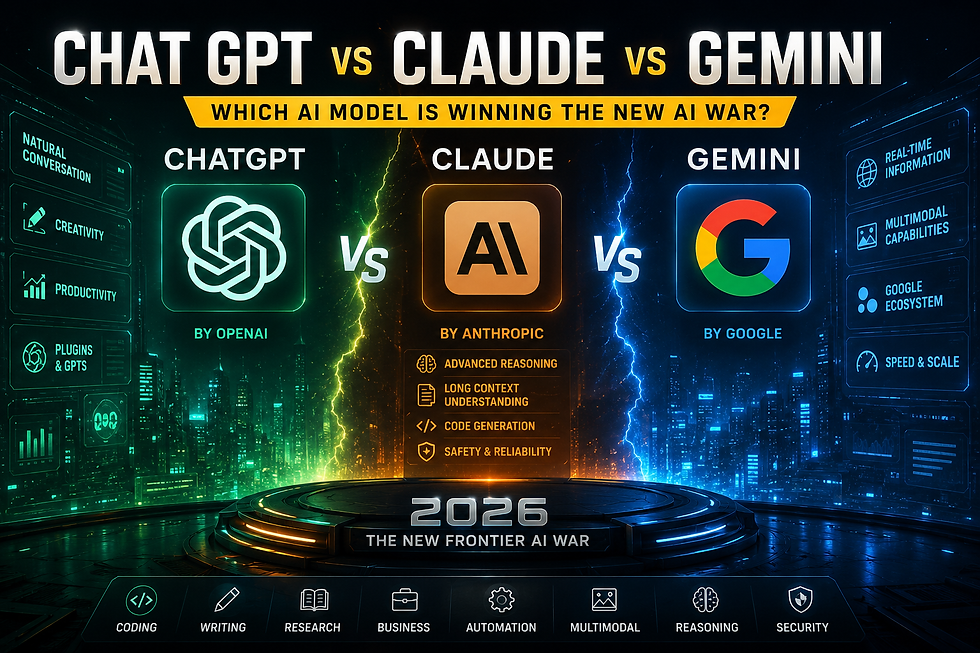
Section 1: The Three Companies Behind the War ChatGPT vs Claude vs Gemini
TL;DR: Each AI lab operates from a fundamentally different strategic philosophy. That philosophy shapes what each product is actually optimized for — and where it falls short.
Before comparing outputs, it helps to understand who built them and why.
1.1 OpenAI — The Platform Play
OpenAI was founded in 2015 with a stated mission of ensuring artificial general intelligence benefits all of humanity. By 2026, that idealism has been operationalized into the most commercially aggressive AI strategy on the market. OpenAI's bet is on ecosystem breadth: ChatGPT as the universal front-end, the Responses API as the developer backbone, Codex for autonomous engineering, and Custom GPTs as a marketplace of specialized agents.
The company's enterprise posture — deep integration with Microsoft 365, Slack, Zapier, and hundreds of third-party tools — has made ChatGPT the dominant choice in large organizations. According to Zylo's 2026 AI Cost Analysis, ChatGPT became the #1 most-expensed app by transaction volume among enterprise software tools. 92% of Fortune 500 companies now use it in some capacity.
The tradeoff is complexity. OpenAI's lineup — GPT-5.3, GPT-5.4, GPT-5.5, and the reasoning-focused o-series — can confuse buyers who are not closely following model releases. Two users on the same plan can receive meaningfully different behavior depending on load, tier, and which model is routed to them.
1.2 Anthropic — The Safety-First Precision Tool
Anthropic was founded in 2021 by former OpenAI researchers, including Dario Amodei and Daniela Amodei. The company's defining characteristic is its Constitutional AI approach — a framework for training models to be helpful, harmless, and honest through a structured principle hierarchy rather than pure human feedback.
That safety focus has translated into something unexpected: Claude has become the preferred model for engineers and analysts who need consistency over charisma.
The model does not hallucinate tool calls the way GPT-4o did. It follows system prompts with precision. It pushes back on bad ideas instead of agreeing compliantly. For agentic workflows that run overnight or across dozens of sequential steps, that reliability compounds.
Anthropic's commercial strategy is built around serious knowledge work — Claude Code for autonomous engineering, Projects for persistent workspace memory, and a multi-cloud API posture that appeals to enterprises with strict data residency requirements.
1.3 Google DeepMind — The Multimodal Native
Google DeepMind — formed by the 2023 merger of Google Brain and DeepMind — brings a structural advantage that no competitor can easily replicate: native integration with the world's most-used productivity suite. Gemini sits inside Gmail, Google Docs, Google Sheets, and Google Drive for hundreds of millions of users who never have to copy-paste a single line of text into a chat interface.
Beyond the ecosystem, Gemini 3.1 Pro has quietly become the benchmark leader in categories that matter for research: abstract reasoning (77.1% on ARC-AGI-2), graduate-level science (94.3% on GPQA Diamond), and multimodal understanding across image, audio, and video. Its 2M+ token context window and the fastest inference latency of the three flagship models make it the most efficient choice for high-volume data workflows.
The platform's weakness is consistency. Developer communities on Hacker News have praised Gemini's large-context improvements while simultaneously criticizing uneven coding quality and rate-limit behavior. Its agentic tool-use reliability still trails Claude in multi-step pipelines.
Section 2: Model Lineup and Core Architecture (2026)
TL;DR: Each company now fields a tiered model family rather than a single flagship. Understanding which tier you are actually using is more important than knowing the brand name.
Feature | ChatGPT (GPT-5.5) | Claude (Opus 4.7 / Sonnet 4.6) | Gemini (3.1 Pro) |
Developer / Lab | OpenAI | Anthropic | Google DeepMind |
Flagship Model | GPT-5.5 | Claude Opus 4.7 | Gemini 3.1 Pro |
Context Window | 1M tokens | 1M tokens (Opus 4.7) | 2M+ tokens |
Inference Speed | ~55.9 tokens/sec | ~76.3 tokens/sec | ~120.3 tokens/sec |
Multimodal Input | Text, image, audio, video | Text, image | Text, image, audio, video |
Web Search | Native | Beta (Claude browser) | Native (Google Search) |
Coding Benchmark (SWE-bench) | 75.0% (OSWorld) | 81.4% (SWE-bench Verified) | Competitive, trails Claude |
Reasoning Benchmark (ARC-AGI-2) | — | — | 77.1% |
Agentic Computer Use (OSWorld) | 75% (human: 72.4%) | Strong tool orchestration | Improving |
Primary Strength | Ecosystem + agentic execution | Coding + writing + instruction-following | Multimodal + speed + price |
Sources: Spectrum AI Labs April 2026 benchmarks; MindStudio 2026 Enterprise Guide; Medium / Cogni Down Under, April 2026

Section 3: Coding — Where the Real Stakes Are
TL;DR: Claude leads on code quality and complex debugging. ChatGPT wins on end-to-end execution and IDE integrations. Gemini is fastest but least reliable on complex logic.
For developers, the ChatGPT vs Claude vs Gemini question is not philosophical — it is measured in pull requests shipped and bugs fixed per week.
3.1 Claude — The Precision Coder
Claude Opus 4.7 currently leads SWE-bench Pro at 64.3% — a 5.7-point gap over GPT-5.5 on real GitHub issue resolution. More practically, Claude Opus 4.6 holds 81.4% on SWE-bench Verified, meaning it resolves the kind of bugs developers actually encounter in production codebases, not synthetic puzzles.
Claude Code — Anthropic's terminal-based AI agent for autonomous engineering — has become a standard tool in engineering teams. Its task horizon of approximately 14.5 hours means a single session can own work units like "ship a feature end-to-end" or "refactor a module and update its tests" without human re-entry. According to the 2025 Stack Overflow Developer Survey, Claude's adoption among developers grew to 43% as engineers actively moved toward it for coding quality.
3.2 ChatGPT — The Execution Engine
GPT-5.5 excels at end-to-end system design. It approaches prompts as systems rather than isolated queries — breaking down a problem into components, identifying dependencies, and producing outputs that fit a larger architecture. Its computer use score of 75% on OSWorld-Verified makes it the first AI to exceed human performance on that benchmark (72.4% human expert baseline), which translates into practical gains for agentic workflows involving desktop automation, form completion, and browser control.
For quick scripts, ChatGPT remains strong. GitHub Copilot — built on OpenAI models — has a mature IDE integration that Claude Code's terminal-based approach does not fully replicate for users who prefer graphical editors.
3.3 Gemini — Speed, Not Depth
Gemini 3.1 Pro's output speed of 120.3 tokens/sec — more than 2x Claude Opus 4.7 and 1.6x GPT-5.4 — makes it the fastest model for rapid code generation. Its 2M+ token context window allows it to ingest entire codebases in a single pass, which is a meaningful advantage for large legacy systems. However, its reliability on complex interconnected logic and multi-step debugging trails the other two. Most developers use it selectively: for speed-sensitive completions, Google Cloud and Firebase development, and high-volume API workflows where cost per token matters.
Coding Verdict:
Complex debugging and production codebases → Claude
End-to-end agentic execution and IDE workflows → ChatGPT
Speed, large context, Google ecosystem development → Gemini
Section 4: Writing, SEO, and Content Strategy
TL;DR: Claude produces the most natural, least "AI-sounding" prose. ChatGPT performs well on structured content. Gemini writes competently but lacks voice adaptability.
4.1 Claude — Voice, Nuance, and Instruction-Following
For long-form writing, Claude has a clear advantage that is difficult to quantify in benchmarks but immediately obvious in output. It produces prose that does not require heavy editing. It follows style instructions with precision — adjusting tone, register, and sentence structure on command. It avoids the formulaic paragraph patterns that make most AI-generated content instantly recognizable.
For SEO and content strategy, Claude Sonnet 4.6 combined with a 1M-token context window is a strong match: entire editorial calendars, competitor analyses, and brand voice guidelines can be loaded into a single session, maintaining consistency across dozens of pieces. Claude's Projects feature enables persistent workspace memory for ongoing content operations.
4.2 ChatGPT — Structure and Ecosystem
GPT-5.5's Canvas interface — with inline commenting, version tracking, and real-time revision — is a genuinely strong collaborative writing environment, particularly for teams. For SEO content, product documentation, and structured deliverables where format consistency matters as much as quality, ChatGPT performs well. Its integration with Microsoft 365 makes it the default choice in organizations already operating within that ecosystem.
4.3 Gemini — Functional, Not Polished
Gemini's writing output is accurate and structured, but it functions better as a drafting assistant than a finished writer. Teams producing brand content or editorial long-form pieces generally prefer Claude's output quality. Where Gemini adds real value in content workflows is research grounding — its native Google Search integration reduces hallucination risk on time-sensitive queries and current-events-driven content.
Section 5: Research and Deep Analysis
TL;DR: Gemini leads on abstract reasoning benchmarks and real-time search grounding. Claude is most reliable for tool-use chains and document analysis. ChatGPT offers the broadest research workflow coverage.
Research workflows stress-test every dimension of a model's capability: it is not just about generating an answer, it is about following a thread across dozens of sources, maintaining logical coherence across a long context window, and producing conclusions that hold up to scrutiny.
Gemini 3.1 Pro leads published reasoning benchmarks as of May 2026: 94.3% on GPQA Diamond (graduate-level science), 77.1% on ARC-AGI-2 (novel, memorization-resistant reasoning). Its real-time Google Search grounding is a practical advantage for researchers working on current events, regulatory changes, or fast-moving technical fields where a model's training cutoff creates blind spots.
Claude is the more reliable choice for tool-use chains — searching databases, running calculations, cross-referencing documents — where precision and step-by-step fidelity matter more than raw benchmark scores. Its 200K reliable context window (with a 1M-token option) consistently outperforms Gemini's raw context ceiling for quality of information retrieval, even if Gemini technically supports a larger window.
ChatGPT (GPT-5.5) has introduced Deep Research as a structured workflow feature, enabling multi-step research tasks with source citation. It scored 83% on OpenAI's GDPval knowledge work benchmark — a strong signal for broad-domain research tasks. Its breadth of domain knowledge remains its defining asset.
Section 6: Multimodal Workflows
TL;DR: Gemini is the clear multimodal leader. ChatGPT handles image generation natively. Claude is text and image only, with no native video or audio.
Capability | ChatGPT | Claude | Gemini |
Image Input | ✅ Yes | ✅ Yes | ✅ Yes |
Audio Input | ✅ Yes (Voice Mode) | ❌ No | ✅ Yes |
Video Input | ✅ Yes (Sora) | ❌ No | ✅ Yes (native) |
Image Generation | ✅ GPT Image 1.5 | ❌ No | ✅ Imagen (limited) |
Video Generation | ✅ Sora | ❌ No | ✅ Veo (limited) |
Live Stream Analysis | ❌ Limited | ❌ No | ✅ Yes |
Google Lens / Photos | ❌ No | ❌ No | ✅ Deep integration |
Gemini's native understanding of image, audio, and video — combined with deep integration with Google Lens, Google Photos, and YouTube — makes it the undisputed multimodal workflow leader. For fields like architecture, healthcare imaging, video content production, and scientific visualization, this advantage is structural rather than incremental.
ChatGPT competes through image generation (GPT Image 1.5, included in Plus) and voice mode, which remains the most polished conversational AI experience available. Claude's multimodal limitation — text and images only, no audio or video — is a real constraint for teams running mixed-media workflows.
Section 7: AI Agent Workflows and Autonomous Reasoning
TL;DR: All three platforms now support agentic behavior, but they differ significantly in reliability, task horizon, and the types of work they can own autonomously.
AI agents — systems that plan, execute, and adapt across multi-step tasks without constant human direction — are the true frontier of 2026 AI. This is where the gap between marketing claims and real-world performance is widest.
7.1 Claude Agents — Reliability Over Speed
Claude's agentic behavior is characterized by precise tool calls, consistent behavior across many sequential steps, and calibrated self-assessment under uncertainty. It is less likely to hallucinate a tool call than its competitors. Its 14.5-hour task horizon (extended from tens of minutes in 2024) enables genuine overnight workflows — bug patches, feature builds, and refactoring tasks that a human can assign and check at the end of a sprint.
Anthropic's agent team architecture allows multiple Claude instances to collaborate on a task, with one serving as orchestrator and others handling specialized subtasks. This is particularly effective for complex engineering or research pipelines.
7.2 ChatGPT Agents — Breadth and Computer Use
GPT-5.5 was built specifically for agentic workflows. It calls tools efficiently, maintains coherent plans across 20-30 sequential steps, and recovers from failures more reliably than earlier versions. Its computer use capability — directly controlling desktop applications, browsers, and file systems — represents genuinely new territory. OpenAI reported 78.7% on OSWorld for this capability.
For finance research, spreadsheet automation, multi-step marketing pipelines, and any workflow requiring web interaction, GPT-5.5's agentic posture is the strongest general-purpose option.
7.3 Gemini Agents — Deep Research and Workspace
Gemini's Deep Research mode is its primary agentic offering for most users — a structured, multi-step research workflow that grounds conclusions in real-time Google Search. For Google Workspace teams, Gemini Enterprise agents can connect to internal tools, query corporate data, and execute actions within the Google ecosystem without leaving the productivity suite.
Its agentic tool-use reliability still trails Claude in complex, deeply interconnected pipelines — a limitation that developer communities have flagged in independent testing.
Section 8: Enterprise Deployment
TL;DR: ChatGPT dominates enterprise adoption by volume. Claude wins on reliability and compliance precision. Gemini is the natural choice for Google-native organizations.
For enterprise buyers, the model question is secondary to the ecosystem lock-in question: which platform fits the existing infrastructure, compliance framework, and team workflow?
ChatGPT Enterprise benefits from the largest training data, the most mature data protection compliance stack, and brand recognition that shortens internal adoption cycles. Klarna has deployed ChatGPT Enterprise to power personalized communications for 150M users. Canva integrated it for design prompts and auto-generated illustrations.
Claude is the preferred choice for enterprise teams where reliability and hallucination rate matter — financial services, legal tech, and regulated industries where a confident-sounding error has real consequences. Anthropic's multi-cloud API posture and custom enterprise agreements appeal to organizations with strict data residency needs.
Gemini Enterprise — announced by Google Cloud in October 2025 — offers a unified conversational interface for internal tool access, with six core components: Google's TPU infrastructure, Gemini reasoning, agents connecting to business data, connectors for third-party apps (Slack, Salesforce, Atlassian), and Workspace deep integration. For companies already paying for Google Workspace, the marginal cost of adding Gemini Enterprise is relatively low.
Section 9: Pricing Comparison (2026)
TL;DR: Consumer tiers are uniformly priced at $20/month. The real cost differences emerge at the API level and enterprise tier, where Gemini is significantly cheaper per token.
Consumer Plans
Plan | ChatGPT | Claude | Gemini |
Free Tier | Yes (GPT-5.3, with ads) | Yes (limited) | Yes (limited) |
Go / Starter | $8/month (ChatGPT Go) | — | — |
Pro / Plus / Advanced | $20/month (Plus) | $20/month (Pro) | $19.99/month (Google AI Pro) |
Power User | $100/month (ChatGPT Pro) | $100/month (Claude Max 5×) | — |
Ultra / Max | $200/month | $200/month | $249.99/month (Google AI Ultra) |
Team / Business | $25/user/month | Custom pricing | Google Workspace add-on |
Annual Discount | — | ~$17/month (billed annually) | — |
Note: Google rebranded "Gemini Advanced" to "Google AI Pro" in early 2026. Google AI Pro subscribers received a storage upgrade from 2TB to 5TB at no additional cost in April 2026.
API Pricing (Per Million Tokens — Approximate, May 2026)
Model | Input | Output | Best For |
GPT-5.5 | $2 | $12 | General agentic workflows |
GPT-5.4 Thinking (Full) | $15 | $60 | Complex reasoning tasks |
Claude Sonnet 4.6 | $3 | $15 | Production coding, writing |
Claude Opus 4.7 | $5 | $25 | Hardest tasks, long context |
Gemini 3.1 Pro | Competitive | Competitive | High-volume, multimodal |
Gemini Flash | Very low | Very low | Speed-critical, cost-sensitive |
Sources: Anthropic API documentation; OpenAI pricing page; AIonX 2026 Cost Analysis; FindSkill.ai AI Pricing Comparison 2026
The key insight: At the consumer level, pricing is identical across all three platforms. The strategic cost decision happens at the API and enterprise levels, where Gemini Flash is the cheapest option for high-volume deployments and Claude Haiku 4.5 offers quality-at-scale for production pipelines.
Section 10: Best AI by Profession — The 2026 Matrix
TL;DR: Different professions have fundamentally different AI needs. This matrix maps each use case to the model that delivers the highest return on workflow investment.
Profession | Primary Recommendation | Secondary | Why |
Students | Gemini (free tier) | ChatGPT (free) | Free tier quality, Google Docs integration, real-time search for research |
Content Marketers / SEO | Claude Sonnet 4.6 | ChatGPT (Canvas) | Superior writing quality, instruction-following, long-context brand consistency |
Software Developers | Claude (Sonnet 4.6 / Opus 4.7) | ChatGPT | SWE-bench lead, Claude Code for agentic tasks, fewer hallucinated tool calls |
Academic Researchers | Gemini 3.1 Pro | Claude | GPQA Diamond lead, real-time search grounding, 2M+ token context for literature |
Startup Founders | ChatGPT (GPT-5.5) | Claude | Broadest tool ecosystem, agentic execution, pitch deck generation, image creation |
Enterprise Teams (Google) | Gemini Enterprise | ChatGPT Enterprise | Native Workspace integration, internal data connectors, cost efficiency |
Enterprise Teams (Microsoft) | ChatGPT Enterprise | Claude | Microsoft 365 integration, Copilot compatibility, brand recognition |
Legal / Compliance | Claude | ChatGPT | Lower hallucination rate, precise instruction-following, long document analysis |
Data Scientists | Gemini 3.1 Pro | ChatGPT | Speed, massive context window, Google Cloud / BigQuery integration |
UX / Product Designers | ChatGPT | Gemini | GPT Image generation, Canvas for collaboration, DALL-E prototyping |
Journalists / Editors | Claude | ChatGPT | Natural prose, editorial voice adaptation, no "AI-sounding" output |
Finance / Investment Research | ChatGPT (GPT-5.5) | Gemini | Agentic multi-tool workflows, web research accuracy, terminal automation |

Section 11: The Ecosystem War — Platform Lock-In Analysis
TL;DR: Each company is betting on a different form of ecosystem lock-in. Understanding which ecosystem you are already inside determines which AI gives you the lowest friction adoption.
The term ecosystem lock-in has traditionally referred to proprietary data formats and switching costs. In the AI context, it means something more subtle: the platform that sits closest to your existing data, identity, and workflow surfaces wins, because it removes the copy-paste tax.
OpenAI's API-first approach is built on the assumption that developers will build on top of ChatGPT capabilities, creating proprietary automations that make switching costly. The Custom GPT marketplace, Responses API, and Codex create a developer ecosystem with real network effects. Microsoft's distribution deal — embedding Copilot across Office 365 — extends this reach to hundreds of millions of business users.
Anthropic's safety and reasoning focus is a different kind of moat. It is not built on integrations — Claude's native integrations remain more limited than ChatGPT's. Instead, it is built on trust. For engineering teams, legal teams, and research organizations where reliability is non-negotiable, Claude's consistency record creates its own switching cost. Once a production agentic pipeline is built on Claude, the reliability data creates a high bar for changing.
Google's Workspace and multimodal dominance is the most structurally durable advantage. Google Workspace has over 3 billion users. Gemini's integration into that surface is not a feature — it is a distribution channel that no competitor can replicate through API agreements. For the majority of the world's knowledge workers, Gemini is already there, in the tool they are already using.
Section 12: Why Professionals Are Using Multiple AI Models
TL;DR: The most productive professionals in 2026 are not loyal to a single model. They run model routing strategies — using each AI for the task where it delivers the highest quality-to-cost ratio.
The data on this is increasingly clear. A 2026 analysis of developer workflows found that 53% of developers who use Claude also use ChatGPT or Gemini for different tasks. The emergence of model routing tools — platforms that automatically direct queries to the optimal model based on task type — has made multi-AI workflows practical for non-technical users.
Here is how the most effective multi-model stacks look in practice:
For Developers:
Claude Sonnet 4.6 for daily coding (best quality-to-cost ratio at $3/$15 per million tokens)
GPT-5.5 for terminal automation and computer-use agentic tasks
Gemini Flash for high-volume code completion where speed matters
For Content Teams:
Claude for drafting, editing, and brand voice consistency
GPT-5.5 Canvas for collaborative revision workflows
Gemini (free tier) for real-time research grounding
For Research Organizations:
Gemini 3.1 Pro for literature processing and abstract reasoning
Claude for tool-use chains and cross-document analysis
ChatGPT for deep research workflows with citation generation
The cost math is instructive: paying for Claude Pro ($20/month) and keeping Gemini's free tier open for research and multimodal tasks costs $40/month total — and outperforms any $200/month single-platform subscription for most professional use cases.
Section 13: Future Predictions — Infrastructure, OS, and What Comes Next
TL;DR: The competition is moving from model quality to platform architecture. The AI that becomes your operating system wins the long game.
The 2026 AI war is not really about which model scores higher on a benchmark. It is about which platform becomes the cognitive operating layer of professional work.
OpenAI's roadmap points toward a unified AI platform where ChatGPT, Codex, and enterprise connectors form a coherent workspace rather than a chat interface with plugins. GPT-5.5's launch was explicitly framed as the core reasoning engine for this integrated system.
Anthropic is positioning Claude as the most trusted workstation for engineers and analysts — a specialist tool rather than a mass-market platform. Its multi-cloud posture, transparent alignment practices, and focus on long-horizon agentic tasks suggest it is optimizing for depth of professional dependency rather than breadth of consumer reach.
Google is making the boldest infrastructure bet: Gemini as the front door for all enterprise AI, deeply embedded in the Google Cloud and Workspace ecosystem that already serves billions of users. With TPU infrastructure and the fastest inference latency in the market, Google is positioned to win on cost and speed at massive scale.
The meta-trend that cuts across all three: context windows are no longer a differentiator. Llama 4 Scout has demonstrated a 10M-token context window. What matters increasingly is what a model does with that context — how reliably it retrieves the right information, executes the right tool, and maintains coherent reasoning across a long task horizon.
The next frontier is AI as infrastructure. The model that becomes embedded in the tools professionals already use every day — without requiring them to switch to a new interface — is the one that wins by attrition.
Section 14: Final Verdict — Use Case vs. Winner
Use Case | Winner (2026) | Runner-Up |
Complex coding and debugging | Claude | ChatGPT |
Agentic computer use | ChatGPT | Claude |
Writing quality and voice | Claude | ChatGPT |
SEO and content strategy | Claude | ChatGPT |
Multimodal (image, audio, video) | Gemini | ChatGPT |
Abstract and scientific reasoning | Gemini | Claude |
Real-time research with web access | Gemini | ChatGPT |
Long-document analysis | Claude | Gemini |
Enterprise (Google Workspace) | Gemini | ChatGPT |
Enterprise (Microsoft ecosystem) | ChatGPT | Claude |
Agentic overnight workflows | Claude | ChatGPT |
Student use (cost-conscious) | Gemini | ChatGPT |
Startup execution (broadest toolkit) | ChatGPT | Claude |
Finance and investment research | ChatGPT | Gemini |
Legal and compliance work | Claude | ChatGPT |
Speed-critical high-volume API | Gemini | Claude |

Frequently Asked Questions (FAQ)
Q1: Which AI is best overall in 2026 — ChatGPT, Claude, or Gemini?
There is no single best AI in 2026. ChatGPT (GPT-5.5) is the best all-rounder with the broadest ecosystem. Claude (Opus 4.7) is the best for coding, writing quality, and instruction-following. Gemini (3.1 Pro) leads in multimodal tasks and abstract reasoning. Most professional users benefit from using two or all three based on task type.
Q2: Is Claude better than ChatGPT for coding in 2026?
Yes. Claude Opus 4.7 leads SWE-bench Pro at 64.3%, a 5.7-point gap over GPT-5.5 on real GitHub issue resolution. For complex debugging, refactoring, and agentic coding tasks, Claude is the stronger choice. ChatGPT remains competitive for quick scripts and end-to-end agentic execution.
Q3: Is Gemini free to use?
Gemini offers a capable free tier that gives access to a version of its model with real-time Google Search. The Google AI Pro plan (formerly Gemini Advanced) costs $19.99/month and provides access to Gemini 3.1 Pro with 1M-token context and 5TB cloud storage.
Q4: What is the context window for each model?
As of May 2026: GPT-5.5 supports 1M tokens. Claude Opus 4.7 supports 1M tokens (with some variants up to 1.2M). Gemini 3.1 Pro supports 2M+ tokens — the largest of the three.
Q5: Which AI model is best for writing and SEO?
Claude produces the most natural, least formulaic prose and follows style instructions with high precision. For SEO content, editorial long-form, and brand voice consistency, Claude Sonnet 4.6 is the leading choice in 2026.
Q6: How much does ChatGPT Plus cost in 2026?
ChatGPT Plus remains $20/month. ChatGPT Go launched at $8/month in January 2026 with a more limited feature set. A mid-tier ChatGPT Pro plan at $100/month was added in April 2026, and the top ChatGPT Pro Max tier is $200/month.
Q7: Which AI is best for research?
Gemini 3.1 Pro leads on abstract reasoning (ARC-AGI-2: 77.1%) and graduate-level science (GPQA Diamond: 94.3%), with real-time Google Search grounding. Claude is more reliable for tool-use chains and cross-document analysis. ChatGPT's deep research workflow is effective for broad-domain, citation-driven research.
Q8: Can I use ChatGPT, Claude, and Gemini together?
Yes. Multi-model workflows are increasingly common among professionals. Tools like MindStudio provide access to all three in a single interface. The most cost-effective stack for most users is Claude Pro ($20/month) plus Gemini free tier, which covers approximately 95% of professional use cases.
Q9: Which AI is most accurate and has the lowest hallucination rate?
Claude is widely regarded as having the lowest hallucination rate for professional tasks, particularly in legal, medical, and technical contexts. Anthropic's training approach prioritizes factual accuracy and calibrated uncertainty over confident-sounding responses. Gemini's Google Search grounding reduces hallucination on current-events queries.
Q10: What is the best AI for students in 2026?
Gemini's free tier is the best starting point for students — it provides real-time search, Google Docs integration, and strong reasoning capabilities at no cost. Google also offers Gemini Advanced free for one year to eligible students in select regions.
Q11: Which AI model is best for enterprise use?
It depends on your existing ecosystem. ChatGPT Enterprise leads in adoption (92% of Fortune 500 companies) and Microsoft 365 integration. Claude is preferred in organizations where reliability and hallucination rates are critical. Gemini Enterprise is the natural choice for Google Workspace-native organizations.
Q12: Is Gemini better than ChatGPT for multimodal tasks?
Yes. Gemini 3.1 Pro natively understands images, audio, video, and live streams from a single interface. ChatGPT handles image and audio through separate tools (GPT Image, Voice Mode). Claude supports text and images only.
Q13: What are AI agents, and which model handles them best?
AI agents are systems that plan and execute multi-step tasks autonomously, without constant human direction. Claude leads on reliability and task horizon (14.5 hours) for agentic workflows. ChatGPT (GPT-5.5) leads on computer-use agents — the ability to control desktop applications and browsers directly.
Q14: How do the three AI models compare on inference speed?
Gemini 3.1 Pro is the fastest at approximately 120.3 tokens/sec. Claude Opus 4.7 runs at approximately 76.3 tokens/sec. GPT-5.4/5.5 is the slowest of the three flagship models at approximately 55.9 tokens/sec, due to its chain-of-thought reasoning architecture.
Q15: Will one AI model win the AI war by 2027?
Unlikely. The 2026 trend is toward specialization over generalization. No single model dominates every benchmark or workflow. The platforms converging on AI-as-infrastructure — deeply embedded in existing productivity tools — will capture more users through distribution than through capability advantages. Expect Google, OpenAI, and Anthropic to each dominate in their respective ecosystem strongholds.
Q16: Which AI model is best for founders and startups?
ChatGPT (GPT-5.5) offers the broadest toolkit for startup execution: pitch deck generation, image creation, market research, agentic automation, and the widest integration ecosystem. Claude is the better choice once a startup's core product involves sustained writing, coding, or document-intensive workflows.
Q17: What is the best free AI model in 2026?
Gemini's free tier — now running on a capable version of Gemini 3.1 — is the strongest free AI option in 2026 for most users. ChatGPT's free tier has introduced ads but still provides access to GPT-5.3. Claude's free tier is the most limited of the three for heavy users.
References
This article is backed by authoritative sources and research. All claims are drawn from publicly available benchmarks, platform documentation, independent analyses, and developer community reporting as of May 2026.
DataStudios.org — ChatGPT vs Gemini vs Claude Full 2026 Comparison — https://www.datastudios.org/post/chatgpt-vs-gemini-vs-claude-full-2026-comparison-complete-analysis-features-pricing-workflow-imp
GuruSup — Claude vs ChatGPT vs Gemini: Full Comparison [2026] — https://gurusup.com/blog/claude-vs-chatgpt-vs-gemini
Playcode Blog — ChatGPT vs Claude vs Gemini for Coding 2026 — https://playcode.io/blog/chatgpt-vs-claude-vs-gemini-coding-2026
AIonX — AI Pricing Comparison 2026: ChatGPT vs Claude vs Gemini — https://aionx.co/ai-comparisons/ai-pricing-comparison/
Spliiit — ChatGPT vs Gemini vs Claude vs Grok: Which AI Should You Choose? — https://www.spliiit.com/en/blog/chatgpt-gemini-claude-grok-comparatif
YUV.AI — Gemini vs ChatGPT vs Claude 2026: Ultimate AI Comparison — https://yuv.ai/learn/compare/gemini-chatgpt-claude
Emergent.sh — ChatGPT vs Claude vs Gemini: The Ultimate AI Model Showdown — https://emergent.sh/learn/chatgpt-vs-claude-vs-gemini
IntuitionLabs — Claude vs ChatGPT vs Copilot vs Gemini: 2026 Enterprise Guide — https://intuitionlabs.ai/articles/claude-vs-chatgpt-vs-copilot-vs-gemini-enterprise-comparison
Prof. Dr. Kay Rottmann — ChatGPT vs Claude vs Gemini in 2026: Which model for which job? — https://www.kay-rottmann.de/en/blog/chatgpt-vs-claude-vs-gemini-2026/
LearnDrive.org — Claude vs ChatGPT vs Gemini: The 2026 Deep Comparison — https://learndrive.org/claude-vs-chatgpt-vs-gemini/
Glow AI — ChatGPT vs Claude vs Gemini: 2026 AI Model Report — https://www.glow-ai.co.uk/post/chatgpt-vs-claude-vs-gemini-2026-report
Tech-Insider.org — ChatGPT vs Claude vs Gemini vs DeepSeek [2026] — https://tech-insider.org/chatgpt-vs-claude-vs-deepseek-vs-gemini-2026/
Field Guide to AI — AI Tools Compared 2026: ChatGPT vs Claude vs Gemini vs Copilot — https://fieldguidetoai.com/guides/ai-tools-comparison-guide
MindStudio — ChatGPT vs Claude vs Gemini for Business in 2026 — https://www.mindstudio.ai/blog/chatgpt-vs-claude-vs-gemini-2026
MindStudio — GPT-5.5 vs Claude Opus 4.7 vs Gemini 3.1 Pro for Builders — https://www.mindstudio.ai/blog/gpt-5-5-review-developers-builders
Medium / Cogni Down Under — OpenAI GPT-5.5, Claude Opus 4.7, and Google Gemini 3.1 Pro Each Win Different Races — https://medium.com/@cognidownunder/openai-gpt-5-5-b6cf7e37668e
Medium / Sanjeev Patel — Best AI Models in 2026: GPT-5.5 vs Claude vs Gemini — Complete Ranking — https://medium.com/@sanjeevpatel3007/best-ai-models-in-2026-the-complete-honest-ranking-d67b63cf3543
FindSkill.ai — AI Pricing Compared 2026: ChatGPT vs Claude vs Perplexity vs Gemini — https://findskill.ai/blog/ai-pricing-comparison-2026/
AiZolo — ChatGPT vs Claude vs Gemini Cost: The 2026 Ultimate Price Comparison — https://aizolo.com/blog/chatgpt-vs-claude-vs-gemini-cost-the-2026-ultimate-price-comparison-spoiler-theres-a-better-way/
Spectrum AI Labs — April 2026 Benchmark Report (cited via Tech-Insider.org and LearnDrive.org analysis)
About the Author
Muizz Shaikh is an AI researcher, content strategist, and founder of FourFold AI, a platform focused on AI trends, emerging technologies, research insights, and future-focused innovation. Connect with Muizz at https://www.linkedin.com/in/muizz-shaikh-45b449403 or visit http://fourfoldai.com/.
Disclaimer: This article is for informational and educational purposes only. Benchmark figures, pricing, and product features are subject to change. The author and FourFold AI are not affiliated with OpenAI, Anthropic, or Google. For full terms and conditions, visit https://www.fourfoldai.com/disclaimer.
© 2026 FourFold AI. Unauthorized reproduction is prohibited.


Comments