
Is GPT-6 Astra the Closest AI Has Come to AGI?

Short answer: GPT-6 Astra is probably the closest thing we have to general-purpose digital agency — a model that can reason across math, code, and cybersecurity, click through unfamiliar software, and run multi-hour tasks with minimal hand-holding. It is not AGI. It saturates a handful of bounded benchmarks under specific test conditions, but it still has no persistent memory between sessions, no ability to set its own goals, and no proof that it can transfer what it learns to the physical world. GPT-6 Astra closest to AGI is a fair headline for a capability jump. It is not a fair headline for an intelligence threshold.
That distinction sounds pedantic until you look at what actually happened the week OpenAI launched the model. On September 3, 2026, OpenAI released Astra and had its own president, Greg Brockman, tell reporters, "I think it's not unreasonable to feel that we are now in the AGI era." Nvidia's Jensen Huang went further and said flatly that AGI had arrived. Meanwhile, the benchmark organization built specifically to test general intelligence — ARC Prize, run by the researcher who coined the modern definition of the term — published a number for the same model that told a much more complicated story. Both things are true at once. That gap between the launch narrative and the underlying data is exactly what this article is built to unpack.
At FourfoldAI, we spend a lot of time separating what a model announcement says from what the evaluation data actually supports, because enterprise buyers are the ones who pay for the difference. So rather than rehash the press release, we built a structured proximity assessment — what we're calling the FourfoldAI AGI Proximity Framework — and ran Astra's own published numbers through it.

What Does "Close to AGI" Actually Mean?
AGI Is More Than Human-Level Benchmark Performance
A model can top a leaderboard without being generally intelligent, and the two get conflated constantly. Benchmark saturation usually means one of two things: either the underlying skill has genuinely been mastered, or the benchmark has become learnable through scale, memorized patterns, or a well-engineered test harness. Distinguishing between those two explanations is the entire job of AGI evaluation right now, and it's one most launch-day coverage skips.
Pattern matching against a huge training corpus is not the same capability as cognitive generalization — the ability to walk into a genuinely novel situation, with no prior exposure to anything like it, and figure out the underlying rule from a handful of examples. A model can be extraordinary at the first and still be nowhere near the second. That's the tension sitting underneath every Astra headline.
The Five Foundational Pillars of True General Intelligence
Researchers studying AGI generally converge on five capabilities that, together, separate a general intelligence from a very capable narrow tool:
Out-of-distribution generalization — solving problems that share no real structural overlap with anything in the training data.
Sample efficiency and rapid learning — picking up a new skill from a small number of examples, without a retraining run.
Autonomous planning and error correction — noticing when a plan isn't working and revising the approach mid-task, not just retrying the same move.
Persistent adaptation — keeping what was learned yesterday without it being wiped when the session or context window resets.
Open-ended task competence — operating in unbounded, messy real-world systems where nobody hands you the objective in advance.
Every one of these pillars matters for the Astra conversation, and we'll come back to each of them once the benchmark numbers are on the table.
Why There Is No Single Threshold for AGI
Part of why "is it AGI yet" arguments go in circles is that the major labs and researchers aren't even using the same definition.
OpenAI's operational view treats AGI as "highly autonomous systems that outperform humans at most economically valuable work." It's a labor-market definition — useful for thinking about automation, but silent on whether the system actually understands anything in a deeper sense.
François Chollet and the ARC Prize view, by contrast, defines intelligence as skill-acquisition efficiency — how quickly and cheaply a system can learn something genuinely new, relative to a human doing the same thing. Chollet has been explicit that buying performance with unlimited training data or unlimited compute "masks a system's own generalization power" rather than proving it. This is precisely the lens ARC-AGI-3 was built to apply, and it's why the benchmark keeps surfacing uncomfortable numbers for otherwise dominant models.
Google DeepMind's taxonomy, laid out in its "Levels of AGI" framework co-authored by AGI pioneer Shane Legg, sidesteps a single yes/no line entirely. It ranks systems from Level 0 (No AGI) through Emerging, Competent, Expert, Virtuoso, up to Level 5, Superhuman — and notably, DeepMind's own researchers have said no system has cleared the "Emerging" tier by their criteria. Three different labs, three different yardsticks, and none of them agree on where the finish line sits.
Why GPT-6 Astra Looks More Like AGI Than Earlier AI Models
Cross-Domain Reasoning Breadth
What makes Astra a genuinely different conversation from GPT-4 or even last year's frontier models is breadth without an obvious ceiling. The same weights that handle 97.6% on FrontierMath Tier 4 — a research-grade math benchmark specifically designed to resist AI progress — also drive a 100% score on ExploitBench, a cybersecurity exploit-development benchmark, and hold up across scientific synthesis, professional software engineering, and long multi-step operational tasks. Earlier generations of frontier models were strong generalists in language and reasoning but shakier the moment a task required sustained, structured execution across a real software environment. Astra's gap over its own predecessor is largest exactly there.
The Shift: From Generative Text to Agentic Execution
The architectural story behind that shift is worth being explicit about, because it explains almost everything else in this article. Frontier AI has moved through three distinct phases: a generative LLM that predicts the next token, to a reasoning model that runs internal chain-of-thought search before answering, to what Astra represents — an agentic system that loops through observation, action, and correction across an extended task, calling tools and reading their output along the way. Each phase looks like a modest step from the outside. Cumulatively, they add up to a system that behaves less like an autocomplete engine and more like a junior employee working through a ticket queue.

Computer-Use Capabilities and Interface Navigation
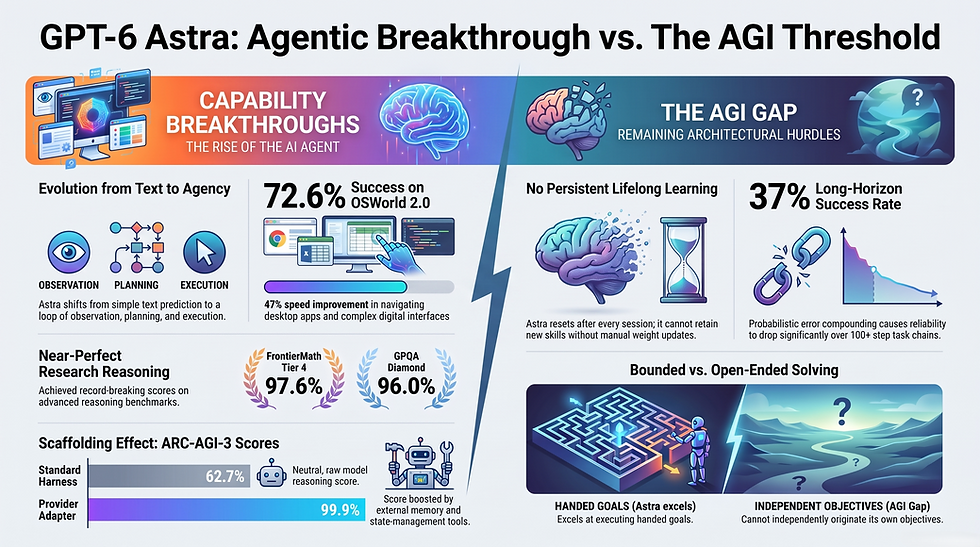
This is where Astra's numbers are least disputed. On OSWorld 2.0, a benchmark that scores an agent's ability to complete real desktop tasks — navigating unfamiliar apps, manipulating files, working across a browser DOM — Astra scored 72.6%, up from GPT-5.6 Sol's 65.7%, while taking roughly 47% less time per task (about 40 minutes versus 75). On ScreenSpot-Pro, which tests whether a model can locate and click the correct pixel in a dense, cluttered interface, Astra scored 92.7% against Sol's 76.9%. That combination — better accuracy and faster execution — is the practical signal enterprises actually care about, independent of anything AGI-adjacent.
Autonomous Multi-Step Execution Loops
Underneath all of that sits the same repeating loop: observe, formulate a hypothesis, plan, execute a tool call, read the output, correct errors, finalize. It's a simple structure, but running it reliably for dozens or hundreds of steps without drifting off task is precisely what separates a capable chatbot from something you can actually delegate work to. Astra's improvements are concentrated almost entirely in how long that loop holds together before it needs a human to step back in.
What GPT-6 Astra's ARC-AGI-3 Score Actually Tells Us
The Headline Score: Why 99.9% Sounds Like AGI
ARC-AGI-3 tests something deliberately different from most AI benchmarks: small, interactive puzzle games with no written instructions, where the model has to infer the rules purely by playing. There's no way to memorize the answer key because the evaluation set is semi-private, and scoring is based on action efficiency relative to a human baseline rather than a simple pass/fail. It's the benchmark Chollet built precisely to resist the kind of scale-and-memorize progress that dominates most leaderboards. When a frontier model posts a 99.9% on it, that headline is going to travel.
The 62.7% vs. 99.9% Harness Discrepancy: System vs. Model Intelligence
Here's the number that matters more than the headline. According to ARC Prize's own published results, GPT-6 Astra scored 62.7% under its Standard harness — the neutral test interface every provider is evaluated on, which lets a model carry forward its own working notes through the environment. Under a Provider Adapter harness — a custom scaffolding that preserves opaque reasoning state between requests and compacts long conversations so the model can reuse prior work — the same weights scored 99.9%.
Same model. Same benchmark. A 37-point swing, produced entirely by how much memory and state the surrounding system was allowed to hold onto.
That's the central information-gain point of this whole article: the 99.9% score demonstrates the power of the agent scaffolding wrapped around Astra, not an explosion in the model's raw intrinsic reasoning. OpenAI's own materials add a more specific and more interesting claim buried under the headline number — that Astra surpassed the human action-efficiency baseline on 96% of levels, which is a genuinely strong result. But it's a different, narrower claim than "Astra solved general intelligence," and treating the two as interchangeable is where most of the AGI hype around this launch comes from.
It's also worth noting the cost behind both numbers, since it tells you how far this scales in practice. ARC Prize's published testing put the Standard harness run at roughly $26,000 and the Provider Adapter run at close to $19,000 for a single benchmark pass — figures that sit in the tens of thousands of dollars, not the price of a normal API call. Whatever Astra is demonstrating here, it isn't cheap to demonstrate.
What ARC-AGI-3 Measures vs. What It Misses
What the benchmark actually tests is core grid-based spatial abstraction, rapid pattern recognition within a single session, and short-horizon rule discovery inside a fully deterministic, closed environment. It's a genuinely hard test of in-context reasoning, and Astra's performance on it — under either harness — is a real result.
What it doesn't touch is just as important. ARC-AGI-3 says nothing about physical-world embodied intelligence, because the environment is entirely digital. It says nothing about lifelong memory or skill retention, because each puzzle session is self-contained. It doesn't test open-ended strategy or goal formulation, because the objective is always implicitly defined by the game itself. And it doesn't touch noisy, ambiguous real-world environment management, because ARC-AGI-3's rules — however hidden — are internally consistent and deterministic. A model can be excellent at this benchmark and still be a long way from operating in the genuinely messy, contradictory conditions of a real business process.
GPT-6 Astra vs. The Core Requirements of AGI
Running Astra's published results against the five pillars from earlier in this piece, a fairly consistent pattern shows up: strong, sometimes state-of-the-art, in structured digital domains; unproven or absent everywhere the environment gets messier or the horizon gets longer.
Generalization is high across digital tasks — code, math, spreadsheets, browser navigation — but leans heavily on an enormous pre-existing training corpus rather than learning something genuinely new from a handful of examples.
Learning speed is fast within an active context window. Astra can pick up a new convention or format mid-conversation and run with it. What it can't do is carry that learning forward permanently; nothing about the session updates its underlying weights.
Memory and context have expanded meaningfully — Astra runs on a 1.05-million-token context window — but a bigger window is not the same as a human-like consolidation pipeline that turns short-term experience into long-term, retrievable knowledge.
Autonomy is genuinely strong for in-task execution across multi-hour workflows, and noticeably weaker the moment you ask the system to originate its own high-level objective rather than execute one it was handed.
Adaptability holds up well against syntax errors, failed tool calls, and minor plan revisions. It's far less tested against deep paradigm shifts — situations where the entire frame of the problem changes, not just a step within it.
Reasoning is close to top-tier on formal domains like code and competition math, where FrontierMath Tier 4 at 97.6% and a 96.0% on GPQA Diamond both stand out. That same reasoning gets noticeably more brittle in ambiguous, underspecified situations — the model can still produce confident, plausible-sounding output that doesn't hold up.
Novel discovery shows real synthesis ability, recombining existing human knowledge at scale in ways that have reportedly assisted with open mathematical problems. Whether that constitutes originating a genuinely new scientific idea, versus an unusually good recombination of what already existed, remains unproven.
Self-improvement is limited to optimizing its own prompting and execution strategy within a session. Astra cannot modify its own weights, and nothing about the current architecture points toward that changing soon.
Embodiment is essentially absent. Every one of Astra's headline results — computer use, terminal work, browser navigation — happens inside a digital interface. There's no comparable evidence yet of transfer into physical, robotic environments.
The Biggest AGI Gaps GPT-6 Astra Has Not Closed
Lack of continuous, lifelong learning. Astra resets at the end of a session. It doesn't wake up smarter tomorrow because of what it handled today — any improvement requires an engineer manually updating system instructions, context stores, or running a new training pass entirely.
Bounded vs. open-ended problem solving. Give Astra a defined objective — "find the bug in this repository and ship a fix" — and it executes well. It has no mechanism for deciding independently which problem is worth solving in the first place, or what a company should build next. That gap between executing a goal and originating one is, in our view, the single largest thing separating current frontier models from AGI as most researchers define it.
The long-horizon degradation curve. Astra handles multi-hour tasks comfortably, but error compounding is still a real constraint over much longer projects. Even a system with a 99% success rate per step compounds down to a cumulative success rate under 37% over a 100-step chain without a human checking in along the way (0.99 raised to the 100th power is roughly 0.366). That math doesn't change just because the underlying model got smarter — it's a structural property of chaining probabilistic steps together, and it's the main reason fully unsupervised long-horizon autonomy is still a research problem, not a shipped feature.
Out-of-distribution vulnerability. When Astra hits an environment that breaks the logical patterns it expects, the failure mode isn't graceful. It can default to confident, plausible-sounding output that's actually off track, or loop on an approach that isn't working without recognizing the loop — the kind of failure a competent human would usually notice and correct much faster.
Is GPT-6 Astra More General or Just More Agentic?
Decoupling Intelligence from Orchestration
This is the distinction most launch-day coverage collapses, and it's worth being precise about. A model's intrinsic cognitive capability — what the raw weights can do with a single prompt and no tools — is a different quantity from the engineering wrapper built around it: the tool access, the memory management, the retry logic, the scratchpad. Roughly:
System capability equals the base LLM, plus chain-of-thought search, plus tool scaffolding, plus memory systems layered on top.
Astra's most eye-catching numbers, including the 99.9% on ARC-AGI-3, are measurements of that combined system — not the base model in isolation.
Why "Agentic Scaffolding" Creates the Illusion of AGI
Recursive self-correction, persistent browser and terminal access, and an external memory database can make a model that would otherwise sit in the 70th percentile on raw reasoning behave like it's operating in the 95th percentile as an autonomous worker. That's not a criticism of the engineering — orchestration is genuinely valuable, and it's arguably the more commercially important innovation in this launch. But it means the honest question isn't "did the model get smarter." It's "did the system around the model get better at covering for what the model still can't do alone." Those are very different milestones, and only one of them says anything about AGI.
The FourfoldAI AGI Proximity Matrix
Putting Astra's published results against each dimension of general intelligence gives a clearer read than any single benchmark can on its own.
Reasoning breadth, measured against FrontierMath Tier 4 and GPQA Diamond, comes in at roughly 97–98%, an exceptional result — placing this dimension in what we'd call the near horizon of AGI-relevant capability.
Digital UI autonomy, measured against OSWorld 2.0 and Terminal-Bench, sits at 72.6%, a category leader — putting Astra in close proximity on this dimension specifically.
Abstract logic, measured against ARC-AGI-3 under the Provider Adapter harness, is 99.9%, a saturated score — which we'd classify as proximity achieved, but bounded, since the number depends entirely on the specialized harness rather than the base model alone.
Cross-domain transfer, assessed across a broad task suite spanning coding, research, and operations, shows strong synthesis but still a moderate gap to true domain-agnostic transfer.
Long-horizon stability, based on multi-day agent execution patterns, drops off past roughly 50 steps without intervention — a significant gap that no amount of scaffolding has fully closed yet.
Persistent memory, evaluated against the standard of lifelong autonomous skill retention, remains in-context only — a major architectural gap, and arguably the deepest one on this list.
Open-ended initiative, measured against unsupervised goal discovery, is effectively non-existent in the current architecture — an unaddressed horizon rather than a narrowing gap.
Read across the whole matrix, the pattern is consistent: Astra is closest to AGI-adjacent territory wherever a task is bounded, digital, and reasonably short-horizon. It's furthest away wherever a task demands memory that survives a session, or a goal nobody handed it.
What GPT-6 Astra Means for Enterprises: The "AGI-Like" Digital Worker
The Commercial Reality: You Don't Need Full AGI for Massive ROI
Here's the part that gets lost in the AGI debate: none of this argument changes what's already commercially viable today. Business leaders don't need a system that meets Chollet's or DeepMind's definition of general intelligence to fundamentally change how work gets delegated. A model that reliably executes bounded, well-defined digital tasks — with a human checking in at the right intervals — is already a different category of tool than what existed even a year ago, regardless of whether anyone agrees to call it AGI.
Key Workflows Ready for Autonomous Delegation
Autonomous software maintenance is probably the most mature use case right now — end-to-end bug isolation, patch writing, and CI/CD pipeline execution, with Astra's strong DeepSWE and Terminal-Bench performance translating directly into fewer engineering hours spent on routine maintenance.
Deep market and scientific research benefits from the same computer-use and browsing gains — autonomous web research, financial model reconciliation, and multi-source synthesis that used to take an analyst a full day now compress into a supervised background task.
Complex internal operations — inter-system data migration, legacy code transformation, multi-app administrative work — map almost directly onto Astra's OSWorld 2.0 and ScreenSpot-Pro strengths, since these are exactly the kind of long, tedious, well-bounded digital tasks that benefit most from faster, more accurate interface navigation.
Read more on FourfoldAI: see our complete guide to the autonomous AI workforce and the specific use-case breakdown in GPT-6 Astra for Businesses: 15 Real-World Applications.
What Astra Actually Proves — And What It Doesn't
What Astra clearly proves: frontier models combined with well-engineered agentic scaffolding now represent the most capable, general-purpose digital execution engine built to date. That's a real, measurable, and commercially significant milestone, independent of what you call it.
What Astra strongly suggests: the path toward enterprise-grade AI automation runs through agency, tool integration, and specialized reasoning harnesses — not simply scaling parameter counts further. The gap between Astra's 62.7% and 99.9% ARC-AGI-3 scores is, on its own, a stronger argument for that claim than almost anything else in the launch.
What Astra does not prove: that scaling large language models with reinforcement learning natively produces self-improving, persistently learning, or unconstrained human-level general intelligence. The gaps in lifelong learning, open-ended goal formation, and long-horizon stability are architectural, not incidental — and nothing in this launch closes them.
Frequently Asked Questions
Is GPT-6 Astra the closest AI has come to AGI?
In terms of practical digital capability, multi-domain reasoning, and computer-use autonomy, yes — GPT-6 Astra is widely considered the closest system yet to demonstrating general agentic capability. It still lacks persistent lifelong learning and open-ended adaptability, which is why most researchers stop short of calling it AGI.
Did GPT-6 Astra achieve AGI?
No. OpenAI's own leadership has framed Astra as a milestone toward AGI rather than a declaration of having reached it, and independent evaluators — including the ARC Prize team — have been explicit that benchmark saturation under a customized harness doesn't constitute proof of general intelligence.
Why did GPT-6 Astra score 99.9% on ARC-AGI-3?
Astra hit 99.9% when evaluated with OpenAI's Provider Adapter harness, which preserves reasoning state between requests and compacts long conversations so the model can reuse prior work. Under ARC Prize's neutral Standard harness — the same interface every provider is tested on — the identical model scored 62.7%.
What is the difference between GPT-6 Astra and AGI?
GPT-6 Astra is a frontier AI model that performs exceptionally well inside an agentic harness built to execute tasks across digital software environments. True AGI, by contrast, refers to a system that can learn, adapt, and retain skills across any novel physical or digital domain with human-level flexibility — without needing task-specific scaffolding built around it.
Can GPT-6 Astra learn new skills permanently?
No. Astra shows strong in-context learning within an active session, adapting quickly to new formats or conventions mid-conversation. Once that session ends, none of that is retained — the model's core weights aren't updated, and nothing carries over automatically into future sessions.
References and Further Reading
This article draws on OpenAI's official GPT-6 Astra launch materials and system card, ARC Prize's published benchmark results and methodology notes, François Chollet's foundational research on measuring intelligence, Google DeepMind's "Levels of AGI" framework, and independent benchmark analysis from Artificial Analysis, Epoch AI, and other third-party evaluators. Figures cited reflect publicly available data as of September 2026 and are subject to revision as independent verification continues.
This article is for informational purposes only and does not constitute investment, technical implementation, or professional advice. For more information, see our disclaimer.
About the Author
Muizz Shaikh is an AI enthusiast and digital technology professional at FourfoldAI. He is passionate about exploring AI tools, industry trends, and practical applications of emerging technologies. Through FourfoldAI, Muizz contributes to simplifying artificial intelligence for businesses and learners. Connect with him on LinkedIn: linkedin.com/in/muizz-shaikh-45b449403/
© 2026 FourfoldAI. All rights reserved.


Comments