
The Rise of AI-Native Startups and AI-First Companies

For the last three years, most companies added AI the way offices added Wi-Fi routers — bolted onto an existing structure, useful, but never load-bearing. A support team got a chatbot. A sales team got a summarization tool. Nothing about the underlying company changed shape. A different category of company is now emerging alongside that pattern, and it is built the other way around. AI-native startups are companies whose product, workflow, and organizational structure cannot function without generative or agentic inference at the core — not as a feature, but as the load-bearing wall. This shift connects to a broader discipline gaining attention across the industry: Agent Engine Optimization, the practice of structuring digital presence for AI systems that now do the discovering, comparing, and recommending on a user's behalf.
An AI-native startup, in the clearest working definition, is a company founded after the emergence of capable foundation models whose core product experience, internal operations, and cost structure are architected around AI agents performing real work — not around software assisting humans who still do the work themselves. That distinction matters more than it sounds. It changes how these companies hire, how they price, how they defend their market position, and how fast they can move from an idea to a nine-figure revenue line. This guide breaks down what makes a company genuinely AI-native, why this category is accelerating now, what its economics actually look like, and how to tell the real thing from a well-marketed imitation.

What Is an AI-Native Startup?
AI-native startup definition
An AI-native startup is a company built after the rise of generative AI whose core product, internal workflows, and cost structure depend on AI agents executing real tasks rather than assisting human operators. Unlike traditional software companies that added AI features to existing products, AI-native companies could not exist in their current form without model inference sitting at the center of the value they deliver to customers.
What does "AI-first" mean?
"AI-first" and "AI-native" get used interchangeably in press coverage, but they describe different things. AI-first is a design philosophy — a company commits, as a matter of strategy, to defaulting to an AI-driven approach whenever it builds something new. AI-native is the architectural result of that philosophy carried all the way through: the product cannot be unwound from its AI core without collapsing the business. A company can claim to be AI-first in its roadmap while still running an AI-enabled product underneath. Genuine AI-native status shows up in the balance sheet and the org chart, not just the pitch deck.
AI-native vs AI-first vs AI-enabled
Four company archetypes are worth separating clearly, because the terms are used loosely across VC memos and marketing pages.
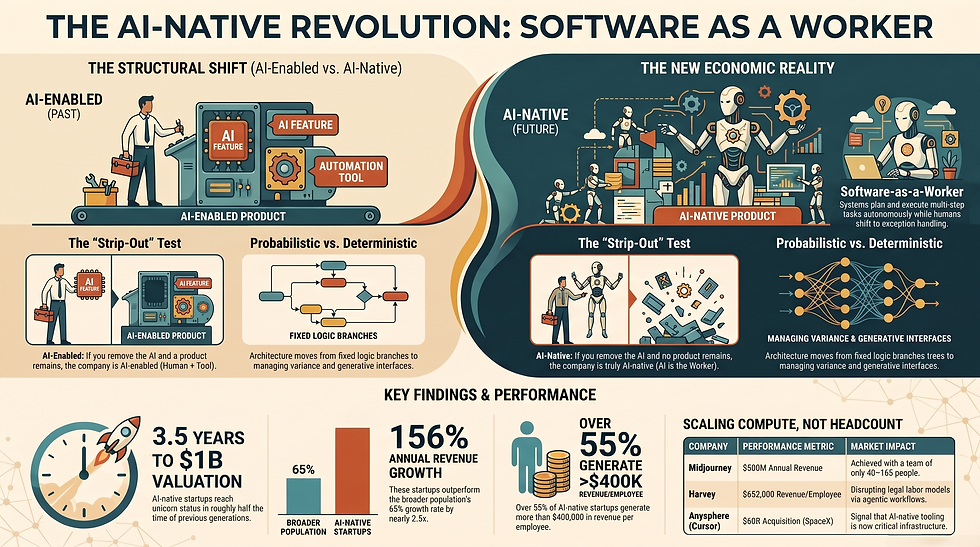
Traditional companies run on human-executed workflows with software as a passive support tool — a CRM stores data, a human decides what to do with it. AI-enabled companies layer AI features onto an otherwise unchanged product, typically a chatbot widget or a summarization button bolted onto existing screens. AI-first companies commit to AI-default thinking across new initiatives but often still carry legacy architecture and headcount patterns underneath. AI-native companies are structured from the ground up so that agentic execution is the default operating mode, human review is the exception path, and the product's core value proposition would not exist without live model inference. The practical test is simple: strip out the AI layer, and see what's left. For a traditional or AI-enabled company, the product survives in a diminished form. For an AI-native company, there is no product left to run.

Why Are AI-Native Startups Rising Now?
The timing is not accidental — it's the product of several structural shifts converging in the same eighteen-month window.
Foundation models lowered the cost of building AI products. A founding team in 2026 no longer needs a research lab or a nine-figure training budget to ship a credible AI product. Frontier-grade capability is available through an API call, which means the barrier to entry moved from "can you train a model" to "can you build the product, workflow, and data loop around one."
AI agents can now perform genuinely multi-step work. Early chatbots answered a single question and stopped. Current agentic systems plan a task, call tools, check their own output, and iterate — closer to a junior employee working through a checklist than a search box answering a query. That shift is what makes "software-as-a-worker" a coherent business model rather than a marketing phrase.
AI coding tools compressed development timelines. Teams that once needed a dozen engineers to ship a product in a year are shipping comparable scope with a fraction of the headcount, using tools like Cursor and Claude Code to handle a meaningful share of implementation work. That compression cascades through every other part of the business — faster iteration, faster customer feedback, faster pivots.
Cloud infrastructure removed the experimentation tax. Spinning up a serious AI prototype used to require provisioning GPUs and managing infrastructure most small teams had no business owning. Managed inference and serverless AI infrastructure turned that into a metered expense rather than a capital outlay.
Distribution and iteration cycles shortened. Product feedback that once took a quarterly release cycle to incorporate can now be tested, deployed, and measured within days, because agent-assisted teams can rebuild and redeploy faster than teams gated by traditional QA and release processes.
Investors are actively rewarding this cohort. AWS Startups' Engines of Growth report, an independent study of more than 3,400 founders and senior leaders across 20 countries published on June 30, 2026, found that AI-native startups — companies under five years old building products with AI at their core — are reaching
billion-dollar valuations in an average of 3.5 years, roughly half the time it took the previous generation of startups before generative AI matured. The same study found these companies posting 156% average annual revenue growth, compared with 65% across the broader startup population, and reported that more than 55% of AI-native startups generate over $400,000 in revenue per employee. That last figure is the one worth sitting with, because it's the clearest signal that something structural has changed, not just something cyclical.
How AI-Native Startups Are Different From Traditional Startups
The differences run deeper than "they use more AI." Six structural distinctions separate the two categories.
Product architecture in a traditional company is deterministic — the same input produces the same output every time, and engineering effort goes toward eliminating variance. An AI-native product is probabilistic by design; the team's job shifts from eliminating variance to managing and constraining it, through evaluation harnesses, guardrails, and confidence thresholds rather than fixed logic branches.
User experience moves from static interfaces with predefined paths to generative, conversational surfaces that adapt to what the user is actually trying to accomplish, often producing a different interface for every session rather than one fixed screen.
Business operations shift from software that supports human task execution to agents that directly execute the cognitive labor — drafting the contract, writing the code, triaging the support ticket — with humans reviewing outcomes rather than performing the underlying task.
Team structure compresses dramatically. A traditional software company scales headcount roughly in proportion to feature surface area and customer volume. An AI-native company scales compute consumption instead, keeping a small core team that oversees a much larger volume of agent-executed output — the leverage-per-engineer figures at companies like Anysphere and Harvey are simply not achievable under a traditional staffing model.
Decision-making in AI-native companies increasingly runs on live machine metrics — token consumption per task, agent success rates, evaluation scores — feeding directly into product and pricing decisions, rather than quarterly retrospective analysis.
Data flywheels are built into the product rather than bolted on afterward. Every user interaction — every accepted suggestion, every corrected output, every abandoned session — becomes training signal that tightens the next iteration of the model or the retrieval pipeline behind it, in a way that traditional software's static feature set never captured.
How AI-Native Companies Operate With Lean Teams
AI agents function as digital workers, not tools that wait to be invoked. In a mature AI-native operation, an agent is assigned a queue of work — draft this brief, triage this ticket, reconcile this dataset — the same way a manager would assign work to a new hire, complete with defined scope and escalation rules.
Humans move toward exception handling. The center of gravity for human labor shifts from executing the routine case to catching and correcting the edge case the agent got wrong, reviewing high-stakes decisions, and setting the judgment calls the system can't yet make on its own.
AI-assisted software development compounds this effect inside engineering teams specifically. Tools like Cursor and Claude Code now handle a substantial share of routine implementation, letting a five-person engineering team maintain a codebase that would have needed twenty people three years ago.
Automated customer support and operations absorb the repetitive share of service volume — first-response drafting, ticket categorization, refund processing within policy — while human agents handle the ambiguous or emotionally sensitive cases that still need judgment.
AI-driven sales and marketing personalize outreach and content generation at a volume no human team could sustain manually, though the strongest AI-native companies still keep a human closing high-value enterprise deals, because trust still transfers person-to-person at that tier.
Fewer employees does not automatically mean a better company, and this distinction matters enormously for anyone evaluating this space. Raw output per employee is a productivity metric, not a competitive advantage on its own — a lean team producing a commodity output at high volume is still building a commodity business. The advantage only compounds into a real moat when that leverage is paired with proprietary data, deep workflow integration, or genuine domain expertise the model alone can't replicate. A three-person team and a chatbot wrapper is not a company. A three-person team compounding a decade of proprietary domain data is.
The New Economics of AI-Native Startups
Revenue per employee is the single most cited efficiency metric in this category, and the numbers from real companies are striking rather than theoretical. AWS's 2026 research put more than 55% of AI-native startups above $400,000 in revenue per employee. Individual companies push well past that baseline: Harvey, the legal AI platform, was running at roughly $652,000 in revenue per employee across 460 staff by mid-2026. Midjourney, still bootstrapped with no outside funding, generates an estimated $500 million in annual revenue with a team commonly cited in the 40-to-165 range depending on the source and date — a revenue-per-employee ratio that dwarfs most enterprise software incumbents regardless of which headcount estimate is used.
Inference costs replace predictable SaaS COGS. A traditional SaaS company's cost of goods sold is largely fixed — hosting, storage, a support headcount that scales in rough steps. An AI-native company's largest cost line is dynamic: every customer interaction consumes tokens, and token consumption scales with usage in a way that traditional per-seat software never did. That makes gross margin a live variable tied to model pricing and usage patterns rather than a number that holds steady quarter to quarter.
Model and infrastructure dependency becomes a genuine financial exposure. A company built on top of a third-party foundation model is exposed to that provider's pricing changes, capability shifts, and — in the more uncomfortable scenarios — feature overlap, where the model provider ships a native version of what the startup built as a wrapper.
Gross margins vs. traditional SaaS tell an interesting story right now. Classic SaaS businesses commonly ran 75–85% gross margins because software delivery costs were nearly fixed. AI-native companies often run thinner margins in their early stage — sometimes in the 50–65% range — because inference is a genuine variable cost, though the strongest operators are closing that gap through smaller fine-tuned models, aggressive caching, and hybrid routing between expensive frontier models and cheaper specialized ones for routine tasks.
Usage-based pricing is becoming the default rather than the exception. Charging per seat made sense when software capacity was fixed regardless of how much a person used it. Charging by outcome, task, or token consumption makes more sense when the underlying cost structure is itself usage-based — Glean's shift toward consumption pricing alongside its subscription tiers is a clear example of this transition already happening inside a company with hundreds of millions in ARR.
AI-native unit economics, taken together, mean the old SaaS mental model — fixed cost base, high fixed margin, linear headcount growth with revenue — doesn't transfer cleanly. The new model treats compute consumption the way SaaS treated headcount: a lever to manage actively, not a background cost to ignore.
Token consumption is becoming an operating metric boards actually track, alongside revenue and churn — because it is now the leading indicator of both cost and usage depth, in the same way monthly active users became the north-star metric of the mobile app era.
What Makes an AI-Native Startup Defensible?
The industry conversation about AI moats has mostly stalled at "proprietary data is a moat," which is true but incomplete. A more precise way to think about defensibility is as a progression, where each stage only holds value if the stage before it was actually built:
Model → Proprietary Data → Workflow Integration → Distribution → Feedback Loops → High Switching Costs.
Access to a frontier model is table stakes, not a moat — every well-funded competitor has the same API key. Proprietary data starts to matter once a company has accumulated a dataset a competitor cannot simply purchase or scrape, built from real customer interactions over time. Workflow integration compounds that advantage: once a company becomes the system its customer's team works inside daily — the system of execution, not just the system of record — replacing it means retraining an entire team's habits, not just switching a subscription. Distribution determines whether that integrated product reaches enough customers to generate meaningful data volume in the first place. Feedback loops turn ongoing usage into continuous model or retrieval improvement, so the product actually gets better the longer a customer stays, rather than staying static. High switching costs are the compounding result of all five prior stages holding at once — not a standalone tactic a company can bolt on.
Newer forms of workflow ownership are also emerging at the technical layer. Standards like WebMCP — a browser-native protocol, previewed by Google in Chrome in February 2026 and co-developed with Microsoft through the W3C, that lets websites expose structured, callable functions directly to AI agents — are starting to determine which companies control the interaction layer between agents and the open web, adding a new dimension to distribution and integration depth that didn't exist eighteen months ago.
Why access to the same foundation model is not a moat deserves its own emphasis, because it's the most common mistake in how founders and investors describe defensibility. Two companies calling the same underlying model are functionally interchangeable at the model layer. Everything that separates a durable business from a thin wrapper happens in the layers above the model — the proprietary data, the workflow depth, the evaluation infrastructure that catches failures before customers do, and the network effects that make the product genuinely better as more people use it.
Examples of AI-Native and AI-First Companies
AI-native software companies offer the clearest proof points. Cursor, built by Anysphere, is an AI-native code editor whose core product cannot function without live model inference generating and reasoning about code in real time — its growth from roughly $1 million in recurring revenue in 2023 to a multi-billion-dollar run rate by 2026 is one of the fastest revenue ramps recorded for an application-layer software company. In a development that underscores how strategically important this category has become, SpaceX announced an all-stock acquisition of Anysphere for approximately $60 billion in June 2026, a deal expected to close later in the year pending regulatory approval — a signal that AI-native tooling is now viewed as core infrastructure worth acquiring outright, not just a category worth investing in. Harvey, the legal AI platform, is another clear case: its agents draft, review, and execute legal workflows for law firms directly, reaching roughly $300 million in annualized revenue by mid-2026 on a valuation near $11 billion. Glean rounds out the enterprise software examples, having tripled its annual recurring revenue to roughly $300 million within about fifteen months by building a permissions-aware knowledge graph that agents query directly rather than a static search index humans browse.
AI-native creative companies are best represented by Midjourney, which has never raised outside venture funding and generates an estimated $500 million in annual revenue with a team that has stayed remarkably small relative to that output — a structure only possible because the product's entire value proposition is generative inference, with almost no traditional software layer sitting between the model and the customer.
AI-native enterprise and infrastructure companies are increasingly the ones building the orchestration, evaluation, and observability layers that other AI-native startups depend on rather than building customer-facing products themselves — a quieter but structurally important part of this ecosystem.
AI-native service companies represent perhaps the most interesting shift of all: a growing number of firms are explicitly selling completed work rather than software licenses — legal memos delivered rather than legal software rented, marketing campaigns delivered rather than marketing tools rented — a pricing philosophy that only makes sense once agents are doing enough of the actual labor to make outcome-based pricing viable.
AI-Native Startups Are Changing the Traditional SaaS Model
From software-as-a-tool to software-as-a-worker is the single sentence that captures the entire shift. Traditional software waited for a human to operate it. AI-native software increasingly operates itself, with a human setting direction and reviewing results.
From seats to outcomes marks the slow death of per-seat licensing as the default enterprise pricing model. Charging per named user made sense when software capacity had nothing to do with how much value a person extracted from it. It makes much less sense when a single seat can trigger an agent that completes the equivalent of ten people's daily output.
From dashboards to agents describes the interface shift happening across enterprise software categories — instead of a dashboard a human interprets and acts on, the product increasingly interprets the data itself and either acts directly or recommends the specific action to take.
From workflows to autonomous execution extends that same logic to entire business processes, not just single tasks — an agent doesn't just flag an anomaly in an expense report, it resolves the routine cases end to end and escalates only the ones that need judgment.
From headcount growth to compute growth closes the loop on the economic story. Scaling a traditional company meant scaling people. Scaling an AI-native company increasingly means scaling compute budget, which grows at a very different rate, and a very different cost curve, than a payroll ever could.
The Role of AI Agents in AI-Native Companies
What AI agents actually do, stripped of hype, is plan a sequence of steps toward a goal, call tools to gather information or take action, evaluate the result against the goal, and iterate — a fundamentally different capability from a single-turn chatbot that answers one prompt and stops.
Agentic workflows vs. AI assistants is a distinction worth holding onto. An assistant waits for a person to ask something. An agentic workflow is assigned an outcome and works toward it across multiple steps with limited supervision, checking in only at defined decision points.
Human-in-the-loop systems remain the norm for anything with real financial, legal, or safety consequences — the agent proposes, drafts, or executes the low-risk path, and a human approves before anything irreversible happens.
Tool calling and external systems are what turn a language model from a conversational interface into something that can actually get work done — the ability to query a database, send an email, or update a record is what separates a demo from a production system.
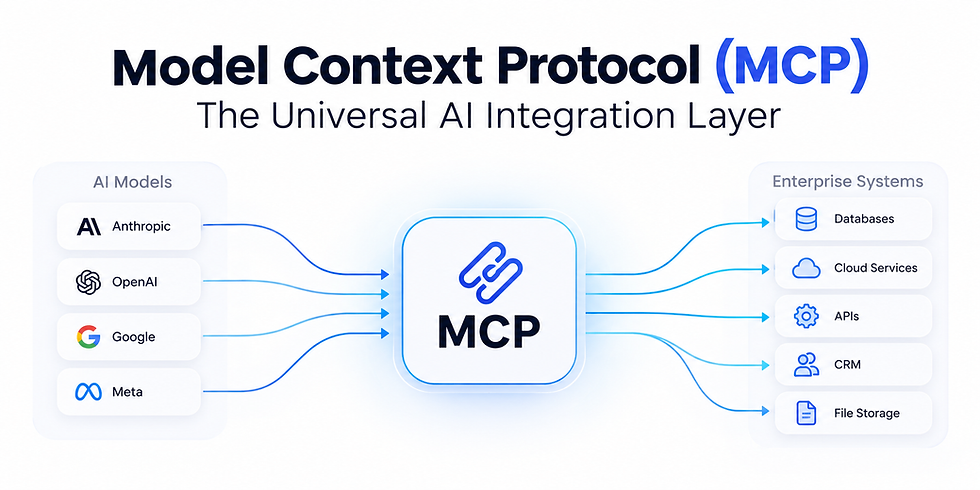
MCP and interoperable AI systems matter here specifically because the Model Context Protocol (MCP), introduced by Anthropic in late 2024, gave the industry a standardized way for AI models to connect to external tools and data sources without every company building a bespoke integration for every system it touches. That standardization is a large part of why agentic workflows became commercially viable as fast as they did — teams stopped rebuilding the same plumbing for every new data source and started building on a shared protocol instead.
Agent evaluation and observability have become their own discipline inside AI-native companies, because an agent that occasionally hallucinates a fact or takes an unintended action in production is a liability, not a curiosity. Tracking latency, task success rate, and hallucination frequency at the agent level is now treated with the same seriousness enterprise software teams once reserved for uptime monitoring.
The Technology Stack Behind an AI-Native Startup
The modern AI-native stack is best understood as a set of layers, each doing a distinct job, stacked from raw model capability up to the governance layer that makes the whole system safe to run in production.
Foundation models sit at the base — the frontier or open-weight models from providers like OpenAI and Anthropic that supply the underlying reasoning and generation capability.
The data layer sits above that, structuring a company's proprietary information — documents, interaction logs, structured records — into a form the rest of the stack can actually use.
Retrieval and vector databases connect that data layer to the model at inference time, using semantic distance between vector embeddings to pull the most relevant context into a model's token window rather than relying on the model's static training data alone. FourfoldAI has covered this pattern in depth in a dedicated piece on Retrieval-Augmented Generation (RAG) vs. Memory-Based AI Systems.
Agent orchestration sits on top of retrieval, managing the actual agentic loop — planning steps, calling tools, checking outputs, and deciding when a task is complete or needs escalation.
Tools and APIs, increasingly standardized through protocols like MCP and the emerging WebMCP standard for the open web, give orchestrated agents a consistent way to reach outside their own reasoning and take real action in external systems.
Evaluation systems run continuously against that stack, scoring agent outputs against defined success criteria before and after deployment, catching regressions before customers do.
Observability extends that discipline into live production traffic, tracking latency, cost per task, and failure patterns across every agent run, the same way traditional software teams track application performance.
Security and governance sit at the top of the stack as a cross-cutting layer rather than a final step — permissioning what data an agent can access, auditing what actions it took, and constraining what it's allowed to do autonomously versus what requires human sign-off.
The Biggest Risks Facing AI-Native Startups
Foundation-model dependency is the risk that gets discussed most, and for good reason — a startup built entirely on top of a model provider's API is exposed if that provider ships a native feature that overlaps with the startup's core product, a pattern the industry often shorthands as being "sherlocked."
High inference costs can quietly erode margins as usage scales, particularly for companies that haven't yet invested in caching, model routing, or smaller fine-tuned models for routine tasks.
Model commoditization threatens any company whose differentiation lives primarily at the model layer rather than in proprietary data or workflow depth — as frontier model capability converges across providers, the gap between "good enough" models narrows every quarter.
Reliability and hallucinations remain a live operational risk in any agentic system operating with real autonomy, which is exactly why evaluation and observability infrastructure has become non-negotiable rather than optional tooling.
Data privacy concerns intensify once agents are handling sensitive customer or employee data across multiple connected systems, raising the stakes on every access-control decision a company makes.
Cybersecurity exposure grows with every new tool an agent is authorized to call, since each connection is a potential attack surface a malicious actor could exploit through prompt injection or credential misuse.
Regulatory uncertainty continues to shape how AI-native companies can operate, particularly in regulated verticals like legal, financial services, and healthcare, where rules governing automated decision-making are still being written in real time.
AI-washing — marketing a fundamentally traditional product as AI-native — creates real reputational and competitive risk once customers and investors start applying frameworks like the Reality Check model below to separate substance from packaging.
Lack of sustainable differentiation is the risk underlying most of the others: a company whose only advantage is being early to a widely available API has no durable position once three well-funded competitors ship the same wrapper within a year.
Are AI-Native Startups Really the Future of Business?
Where AI-native models have the strongest advantage is concentrated in knowledge work — legal, financial analysis, software development, research-heavy operations — where the core task is manipulating and reasoning over information rather than manipulating the physical world.
Where traditional organizational structures remain valuable is just as real, particularly anywhere physical execution, deep regulatory relationships, or high-trust human judgment in ambiguous, high-stakes situations still determines the outcome more than information processing does.
Why AI-native does not mean human-free is worth stating directly, because the framing gets overstated constantly in press coverage. Every credible AI-native company in this article — Cursor, Harvey, Glean, Midjourney — still employs skilled people making judgment calls the agents can't yet make. The shift is in ratio and role, not in elimination.
The likely hybrid future looks less like every company becoming AI-native and more like every company adopting AI-native principles selectively, in the parts of the business where probabilistic execution genuinely outperforms deterministic process, while keeping traditional structure where it still works better.
What AI-Native Companies Mean for Established Enterprises
How enterprises can learn from AI-native startups starts with studying the operating model, not just the product — the lesson isn't "buy more AI tools," it's "redesign the workflow assuming an agent does the first draft."
Which workflows should become AI-native first tends to be the ones with high volume, well-defined success criteria, and low tolerance for the kind of latency human review introduces — document review, first-line support triage, and internal knowledge search are common early candidates.
Build vs. buy decisions increasingly favor buying from a focused AI-native vendor over building in-house, given how quickly the underlying model layer moves and how much evaluation infrastructure a genuinely reliable in-house agent requires.
AI-native transformation vs. AI adoption is a distinction worth enterprises internalizing early — installing an AI-enabled feature into an existing process is adoption; redesigning the process around agentic execution from scratch is transformation, and only the latter captures the efficiency gains this article has described.
How enterprises should evaluate AI-native vendors comes back to the same Reality Check questions covered below — whether the vendor's core product would survive without live model inference, and whether their pricing and data practices actually reflect an AI-native cost structure or a traditional SaaS model with an AI feature bolted on.
How to Identify a Truly AI-Native Company
The clearest way to separate a genuinely AI-native company from one that is simply AI-enabled or AI-washed is to run it through five evaluation dimensions.
On product core, ask whether the product would exist at all without API access to a language model — a genuinely AI-native company fails this test immediately, because the interface and value are fundamentally generative or agentic, not a sidebar chatbot bolted onto an unchanged product. On workflow, ask whether AI is assumed to be the default executor of the work, with humans acting primarily as exception handlers and quality gates, rather than humans still doing the work with AI assistance nearby. On org structure, ask whether job descriptions are built around managing AI agents, with small teams overseeing large volumes of agent output, instead of headcount scaling linearly with growth the way it always has. On unit economics, ask whether gross margins and cost of goods sold are actively modeled around token and inference consumption, treated as a live operating metric, rather than folded into a standard SaaS cost structure as a minor line item.
On data loop, ask whether user interaction dynamically improves the pipeline through continuous evaluation and fine-tuning, rather than sitting on top of a static, generic third-party model with no feedback mechanism at all.
Seven concrete traits tend to show up together in companies that pass this test:
The core product breaks completely if model API access is removed
A small team manages output volume that would traditionally require a much larger headcount
Pricing reflects usage or outcomes rather than a flat per-seat structure
Token or inference cost appears as a tracked operating metric, not a footnote
Customer data measurably improves the product over time through a real feedback loop
Job descriptions are written around agent oversight and exception handling, not manual task execution
The company can articulate its defensibility beyond "we have access to a good model"
The Future of AI-Native Startups
The next phase of this shift moves from AI-assisted work to what's increasingly described as agent-native operation — companies where autonomous, multi-agent systems handle entire workflows end to end, with humans setting strategy and reviewing outcomes rather than supervising individual steps. Expect the rise of genuinely micro-scale companies — two- and three-person teams running meaningful revenue lines by orchestrating fleets of specialized agents, in the pattern Midjourney and Anysphere have already demonstrated at a larger scale. The more structurally interesting development on the horizon is agent-to-agent commerce, where one company's AI system negotiates, transacts, and settles directly with another company's AI system, using emerging protocols to handle discovery, negotiation, and payment with minimal human involvement in the individual transaction. None of this replaces the fundamentals — the companies that win will still be the ones with real proprietary data, real workflow depth, and a real reason customers can't easily leave. AI-native architecture just changes how fast that advantage can be built and how few people it takes to build it.
Conversational Search & AI-Native Startups FAQs
What is an AI-native startup? An AI-native startup is a company built after the rise of generative AI whose core product, workflows, and cost structure depend on AI agents performing real work rather than assisting humans who still do the work manually. The product cannot function without live model inference at its center.
What is the difference between an AI-native and AI-first company? AI-first describes a strategic commitment to defaulting to AI-driven design in new initiatives. AI-native describes the architectural result when that commitment is carried all the way through — the product, workflow, and economics are built around AI execution, not layered with it.
What are examples of AI-native companies? Cursor (Anysphere), Harvey, Glean, and Midjourney are widely cited examples. Each has a product that cannot function without live model inference, unusually high revenue per employee, and a business model shaped directly around AI execution rather than human-operated software.
How do AI-native startups differ from traditional startups? They differ in product architecture (probabilistic vs. deterministic), team structure (compute-scaled vs. headcount-scaled), decision-making (live machine metrics vs. quarterly review), and cost structure (dynamic inference cost vs. fixed SaaS delivery cost).
Why can AI-native companies operate with smaller teams? Because AI agents handle a large share of routine execution — coding, drafting, triage, support — while humans focus on exception handling and judgment calls, allowing output volume to scale with compute rather than headcount.
Are AI-native startups more profitable than traditional SaaS? Not automatically. Many run thinner early-stage gross margins than classic SaaS due to variable inference costs, though leaders like Midjourney and Harvey post very high revenue per employee. Profitability depends heavily on how well a company manages token consumption and pricing.
What makes an AI-native startup defensible? Defensibility follows a progression: proprietary data built from real usage, deep workflow integration that makes the product hard to remove, strong distribution, feedback loops that improve the product continuously, and the high switching costs that result from all four combined — not access to a model alone.
What is an AI-native business model? It's a business model where usage-based or outcome-based pricing reflects a genuinely variable, inference-driven cost structure, and where revenue scales with agent-executed output rather than with headcount or seat count.
What role do AI agents play in AI-native companies? Agents function as the primary executors of routine work — planning steps, calling tools, evaluating their own output, and completing tasks with limited supervision — while humans review outcomes and handle exceptions rather than performing the underlying task themselves.
Can an existing company become AI-native? Yes, though it typically requires redesigning workflows around agentic execution from the ground up rather than adding AI features to an unchanged process — the difference between AI-native transformation and simple AI adoption.
Are AI-native companies replacing SaaS? Not replacing it outright, but reshaping its default assumptions — moving pricing from seats to outcomes, interfaces from dashboards to agents, and workflows from human-executed to autonomously executed wherever the task allows it.
What are the biggest risks of AI-native startups? Foundation-model dependency, rising inference costs, model commoditization, hallucination and reliability risk, data privacy exposure, cybersecurity surface area, regulatory uncertainty, and the reputational risk of AI-washing without genuine differentiation.
What does AI-native mean for enterprise businesses? It means evaluating vendors and internal workflows against whether AI execution is genuinely load-bearing or simply a feature — and prioritizing AI-native transformation of high-volume, well-defined workflows over surface-level AI adoption.
Conclusion — The Rise of AI-Native Startups Is Bigger Than a Technology Trend
What's happening across this category is not a wave of companies adding a smarter feature to last decade's software. It's a rebuild of what a company is structurally allowed to look like — how few people it needs, how its costs actually move, and how it earns the right to keep a customer. The AWS data on unicorns forming in half the previous time frame, the $60 billion strategic acquisition of an AI-native coding company, and a bootstrapped image-generation company outperforming venture-backed giants on revenue per employee all point at the same underlying shift: leverage has moved from headcount to compute, and the companies that understood that first are the ones setting the pace for everyone else. The distinction between AI-enabled and AI-native will keep mattering more, not less, as the easy AI features become table stakes and the real advantage moves to who built their company around this shift earliest and most completely. For a closer look at the tools, protocols, and model landscape powering this shift, explore the latest coverage of AI systems and agent architectures on FourfoldAI.com.
References
This article draws on live research from the following primary and industry sources:
Editorial note on sourcing: The original brief for this article referenced an AWS 2026 statistic describing AI-native startups reaching product-market fit "40% faster." Live research located the actual, verifiable AWS Engines of Growth findings instead — unicorn status in 3.5 years (roughly half the previous timeline), 156% average annual revenue growth, and 55%+ of companies exceeding $400K in revenue per employee — and this article uses those confirmed figures rather than the unverified one, flagged here for transparency. Research also surfaced that Cursor's parent company, Anysphere, agreed to a roughly $60 billion all-stock acquisition by SpaceX in June 2026, which is reflected in the company example above since it materially updates that case study.
Disclaimer:
This article is intended for informational and educational purposes only and does not constitute financial, legal, or investment advice. Company valuations, revenue figures, and funding data cited above reflect publicly reported estimates as of mid-2026 and are subject to change. For our full disclaimer, visit fourfoldai.com/disclaimer.
About the Author
Muizz Shaikh is an AI enthusiast and digital technology professional at FourfoldAI. He is passionate about exploring AI tools, industry trends, and practical applications of emerging technologies. Through FourfoldAI, Muizz contributes to simplifying artificial intelligence for businesses and learners. Connect with him on LinkedIn: linkedin.com/in/muizz-shaikh-45b449403/
© 2026 FourfoldAI. All rights reserved.


Comments