
AI Agents Explained: Architecture, Use Cases, and Future Potential

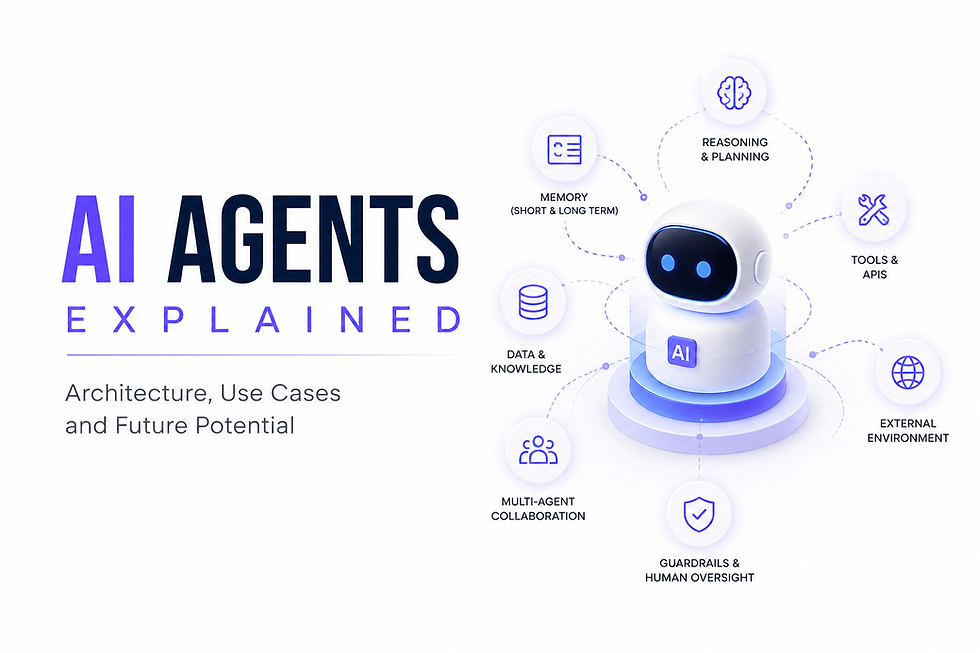
AI agents are autonomous software systems powered by foundation models that perceive their environment, make decisions, plan multi-step actions, and execute tools to achieve specific goals without continuous human intervention. That definition sounds simple. The engineering underneath it isn't.
A raw language model is a stateless prediction engine — brilliant at pattern completion, useless at remembering what happened five minutes ago unless you paste it back into the prompt. An AI agent is something else entirely: a stateful, goal-driven operational system that wraps that same model in memory, planning logic, and the ability to act on the world through tools. Somewhere between "smart autocomplete" and "runs your accounting department," there's a whole spectrum most people never see.
This guide walks that spectrum end to end — from the four architectural pillars that make an agent tick, through reasoning frameworks like ReAct and Tree-of-Thoughts, into memory systems, the Model Context Protocol (MCP), multi-agent orchestration, real enterprise deployments, and where this is all heading next.
What Is an AI Agent?
AI agent definition
An AI agent is an autonomous system built on a large language model that perceives context, retains memory across steps, plans a sequence of actions, and executes tools or APIs to complete a goal — adjusting its own behavior based on the results it observes, largely without step-by-step human direction.
Five things separate a genuine agent from a chatbot with extra steps: perception of its task environment, persistent memory, autonomous decision-making, access to external tools, and the ability to execute multi-step plans on its own.
LLM vs AI Agent: Understanding the Fundamental Difference
A base LLM responds. You send a prompt, it predicts the next tokens, the conversation ends there unless you feed it more context by hand. There's no internal loop, no self-initiated action, no persistent goal.
An AI agent runs an execution loop. It receives an objective, breaks it into steps, calls tools, reads the results of those tool calls, and decides — on its own — what to do next. That loop can run for seconds or for hours. The model is still the reasoning core, but the agentic architecture wrapped around it is what actually gets work done.
Here's the framing worth internalizing: intelligence alone doesn't create business value. It's the combination of memory, planning, and tool access — the agentic loop — that turns a static model into something that can close a support ticket, reconcile a spreadsheet, or ship a pull request unsupervised.
Standard LLM vs Function-Calling LLM vs Autonomous AI Agent
Dimension | Standard LLM | Function-Calling LLM | Autonomous AI Agent |
Execution Model | Single prompt-response | Guided API triggering | Multi-step autonomous loop |
State Management | Stateless within turn | Ephemeral within session | Persistent across workflows |
Tool Access | None | Pre-defined functions | Dynamic tool selection & execution |
Reasoning Depth | One-shot inference | Structured function routing | Iterative planning, reflection & error recovery |
Human Intervention | 100% human-driven | Prompt-triggered | Goal-driven (human-in-the-loop optional) |
Reading that table left to right is basically reading the industry's last three years of progress. Each column adds autonomy; each column removes a human decision point from the loop.
How Do AI Agents Work? The 4 Core Pillars of Agent Architecture
Strip away the marketing and every AI agent — whether it's a $10 open-source script or an enterprise deployment running on Claude or GPT-4o — reduces to the same equation:
Agent = Brain (LLM) + Memory + Planning + Tools/Action Engine
Miss one pillar and you don't have an agent. You have a chatbot, a script, or a very expensive API call.
Pillar 1 — The Brain: Large Language Models and Reasoning
The foundation model is the agent's central processing unit. It evaluates incoming context, classifies intent, and decides — token by token — what the next reasoning step should be. Whether that's Claude, GPT-4o, or DeepSeek-R1, this is the component doing the actual "thinking."
What the brain does not do on its own is remember your last conversation, execute code, or know when to stop. That's everything else.
Pillar 2 — The Memory Module: Short-Term vs Long-Term Memory
Short-term memory lives in the context window — the working buffer of recent messages, tool outputs, and intermediate reasoning the model can directly attend to. It's fast but finite; fill it up and older information gets pushed out or compressed.
Long-term memory is different. It lives outside the model entirely, in vector databases, episodic logs, or key-value stores that get queried on demand. An agent handling a multi-day research project can't hold everything in context — it needs to write findings to persistent storage and retrieve them later through semantic search. This is where the line between agent memory and Retrieval-Augmented Generation (RAG) vs memory-based systems gets genuinely interesting, since the two approaches solve overlapping but distinct problems.
Pillar 3 — The Planning and Reasoning Engine
Planning is what turns "write a market analysis report" into a sequence of concrete, executable sub-tasks: gather data, verify sources, draft sections, check formatting, compile output. Without task decomposition, an agent either freezes on ambiguous instructions or attempts the entire goal in one uninterpretable leap.
Good planning modules also handle re-planning. If step three fails, a well-architected agent doesn't crash — it re-evaluates and adjusts the remaining steps.
Pillar 4 — The Tool and Action Layer
This is where the agent stops being a conversation and starts touching the real world. APIs, web browsers, code execution sandboxes, database drivers, file systems — the tool layer is the agent's hands. Function calling is the mechanism; Model Context Protocol (MCP) is increasingly the standardized wiring behind it, a topic worth its own deep section further down.

Reasoning and Planning Frameworks in AI Agents
The ReAct Framework (Reasoning + Acting)
ReAct interleaves reasoning traces with concrete actions in an explicit loop: Thought → Action → Observation → Repeat. The agent thinks about what it needs, takes an action (a tool call, a search, an API request), observes the result, and folds that observation back into its next thought.
This loop is deceptively simple and remarkably effective. It's the backbone pattern underneath most production agent frameworks today, precisely because it forces the model to ground its reasoning in real feedback rather than hallucinated assumptions about what a tool "probably" returned.
Chain-of-Thought (CoT) and Tree-of-Thoughts (ToT)
Chain-of-Thought reasoning walks a single linear path — step one leads to step two leads to step three. It's efficient and works well for problems with one clear solution route.
Tree-of-Thoughts branches. Instead of committing to one reasoning path, the model explores multiple candidate paths in parallel, evaluates which ones look promising, and prunes the weaker branches. For tasks with genuine ambiguity — complex debugging, multi-constraint planning — ToT's search-based approach tends to outperform a single committed chain, at the cost of more tokens and more latency.
Reflection and Self-Correction Mechanisms
An agent that can't recognize its own mistakes is an agent that fails silently, which is far worse than one that fails loudly. Reflection mechanisms have the agent evaluate its own tool outputs against the original goal — did the API call return an error code? Did the code execution throw an exception? Does the retrieved document actually answer the question?
When something's off, a reflective agent doesn't push forward blindly. It backtracks, revises its plan, and tries an alternate approach. This self-correction loop is one of the biggest practical differences between a demo-quality agent and one you'd trust in production.
Memory Architecture: How AI Agents Retain State
Short-term memory and context window management
Context windows aren't infinite, and even the generous ones degrade in retrieval accuracy as they fill. Production agents manage this through sliding windows that drop the oldest messages, message compression that summarizes earlier turns, and careful token budget preservation so the model always has room to reason about the current step.
Long-term memory: Vector stores and semantic indexing
For knowledge that needs to persist across sessions, agents lean on vector databases — Pinecone, Qdrant, Chroma, and similar systems — that store text as embeddings and retrieve semantically related content on demand. Instead of re-reading an entire document library on every query, the agent pulls only the passages relevant to its current sub-task.
This is where large reasoning models increasingly intersect with retrieval architecture: the reasoning engine decides what to look for, and the vector store decides where to find it.
Episodic vs Semantic Memory in AI Agents
Episodic memory is the agent's record of specific past interactions — what a particular user asked last Tuesday, what decision was made and why. Semantic memory is general domain knowledge — product documentation, company policy, technical reference material — that doesn't change based on who's asking.
Conflating the two is a common architecture mistake. An agent that treats every fact as equally durable ends up either forgetting things it should remember or stubbornly holding onto context that's no longer relevant.
Tools, Function Calling, and the Model Context Protocol (MCP)
How AI agents interact with the real world
Tool use is the mechanism by which an agent stops talking and starts doing. That covers a wide range: triggering REST APIs, executing SQL queries against a live database, browsing the web for current information, or running arbitrary code inside a sandboxed execution environment. Each tool call is an opportunity for the agent to gather new information or change something in the outside world — and each one is also a potential failure point that needs guardrails.
What is the Model Context Protocol (MCP)?
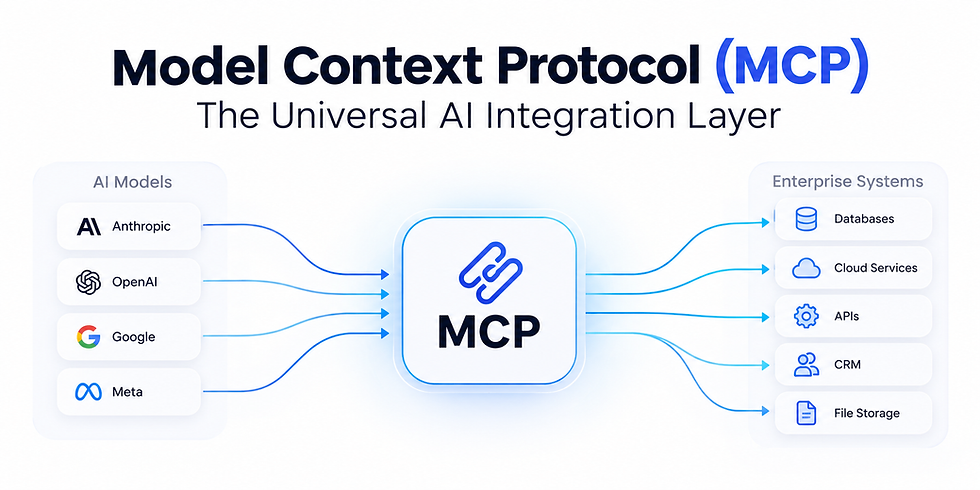
The Model Context Protocol (MCP) is an open standard, originally introduced by Anthropic in November 2024, that gives AI models a uniform way to connect to external tools, data sources, and file systems — so a single integration works across any compliant client instead of requiring custom glue code for every tool.
MCP has moved fast since launch. In December 2025, Anthropic donated the protocol to the Agentic AI Foundation under the Linux Foundation, turning it into a vendor-neutral, community-governed standard rather than a single-vendor spec. By mid-2026 it had native support across Claude, ChatGPT, Gemini, Copilot, and major IDE tools, with tens of thousands of public servers indexed across community registries.
The protocol itself kept evolving too. The 2026-07-28 specification revision — described by Anthropic's own team as the most substantial overhaul since MCP added authorization — moved the architecture toward a stateless core, dropping some of the session-based design that had caused scaling headaches for enterprise deployments running MCP servers in the cloud rather than on a single laptop.
Why standardized protocols matter for enterprise agent tool integration
Before protocols like MCP, every agent-to-tool connection was custom-built: a bespoke integration for the CRM, another for the ticketing system, another for internal databases. That doesn't scale past a handful of tools. A standardized protocol means an enterprise can add a new data source once and have it usable by every agent in the organization, with consistent authorization, rate limiting, and audit logging applied uniformly — rather than re-solving the security model for every new integration.
Multi-Agent Systems and Orchestration Frameworks
Why single agents break down on complex tasks
A single agent handling a genuinely complex workflow accumulates problems fast. Context windows fill with irrelevant history. Errors from step four compound into step nine. And a monolithic prompt trying to hold "research this, then write that, then verify accuracy, then format for publication" in one reasoning pass tends to produce shallow results across the board — cognitive overload, essentially, for a system with no actual cognition to overload.
Multi-agent architecture patterns
Splitting responsibility across specialized agents solves a lot of this. Three patterns show up repeatedly:
Hierarchical (Manager + Sub-agents): A coordinating agent delegates sub-tasks to specialized workers and synthesizes their output.
Sequential (Assembly Line): Agents hand off work in a fixed order — researcher, then writer, then editor — each adding value before passing forward.
Peer-to-Peer Swarms: Agents communicate directly with each other, negotiating task ownership without a central coordinator.
Leading multi-agent frameworks compared
Framework | Core Architecture | Ideal Use Case | Complexity |
LangGraph | Graph-based state machine | Deterministic, complex cyclic enterprise workflows | High |
CrewAI | Role-based collaborative agent "crews" | Fast multi-agent task delegation and prototyping | Medium |
Microsoft Agent Framework | Unified successor merging Semantic Kernel and AutoGen | Enterprise-grade orchestration on Microsoft/Azure stacks | High |
It's worth a direct note here for accuracy: AutoGen, Microsoft's original conversational multi-agent framework, entered maintenance mode in October 2025. Its lineage split two ways — the community-led AG2 fork, which continues active development under an independent governance structure, and the Microsoft Agent Framework, which reached general availability in April 2026 as the official enterprise successor, combining AutoGen's multi-agent patterns with Semantic Kernel's production tooling. Teams evaluating frameworks in 2026 are generally better served choosing between LangGraph, CrewAI, AG2, or Microsoft Agent Framework rather than building new production systems on legacy AutoGen directly.
Agentic Workflows: Transforming How AI Operates
The shift from zero-shot prompting to iterative refinement
A single well-crafted prompt gets you a single well-crafted response — and nothing more if that response happens to be wrong. Agentic workflows replace that one-shot bet with iteration: draft, critique, revise, verify, repeat. The output quality gain from adding even one reflection pass is often larger than the gain from switching to a more powerful underlying model.
Human-in-the-Loop (HITL) architecture
Full autonomy isn't always the goal, and for high-stakes actions it usually shouldn't be. Human-in-the-loop design inserts approval gates before an agent executes anything irreversible — a financial transaction, an external email, a database write that can't be easily rolled back. The agent still does the reasoning and drafts the action; a human simply confirms before it fires. This is less a limitation than a deliberate safety boundary, and it's one of the first things enterprise security teams ask about before greenlighting any agent deployment.
Real-World Enterprise Use Cases for AI Agents
Automated software engineering and code generation. Coding agents like Devin from Cognition Labs plan, write, test, and debug code across full engineering tickets rather than single autocomplete suggestions, with performance increasingly tracked against benchmarks like SWE-bench that test real-world GitHub issue resolution rather than synthetic coding puzzles.
Customer support and autonomous service operations. Agents triage incoming tickets, pull account context from connected systems, resolve routine requests independently, and escalate genuinely complex cases to human agents with full context already assembled.
Financial analysis, compliance auditing, and reporting. Agents reconcile transactions, cross-reference regulatory requirements, and flag anomalies across data volumes no analyst could review manually in the same timeframe — with human sign-off retained for anything that triggers a compliance threshold.
Supply chain optimization and logistics scheduling. Multi-agent systems coordinate demand forecasting, inventory positioning, and shipment routing simultaneously, adjusting in near real time as conditions on the ground change.
Autonomous research and competitive intelligence gathering. Research agents scan public filings, news, and technical documentation, synthesizing findings into structured briefs — a workflow that increasingly overlaps with how AI answer engines themselves retrieve and synthesize information for end users.
The Complete AI Agent Technology Stack
Base Model Layer — Claude, GPT-4o, DeepSeek-R1, and comparable foundation models providing the core reasoning.
Orchestration Layer — LangGraph, CrewAI, LlamaIndex Workflows, and similar frameworks managing multi-step and multi-agent execution.
Memory Layer — Qdrant, Pinecone, Mem0, and comparable vector and state-persistence systems.
Protocol & Tool Layer — Model Context Protocol (MCP), OpenAPI specifications, and standardized function-calling interfaces.
Infrastructure & Sandbox Layer — E2B, Modal, Docker containers, and other isolated execution environments for safe code and tool execution.
Evaluation & Observability Layer — LangSmith, Arize Phoenix, Helicone, and similar tooling for tracing, debugging, and monitoring agent behavior in production.
Every layer matters. Skip observability and you're deploying a system you can't debug when it inevitably does something unexpected at 2 a.m.
The Economics of AI Agents: Token Budgets, Latency, and Costs
Why agent loops consume significantly more tokens than simple chat
A single chat response might cost a few hundred tokens. An agent working through a multi-step task — thinking, calling a tool, reading the result, thinking again, calling another tool — can burn through tens of thousands of tokens for one completed objective. Every reasoning step and every tool observation gets fed back into context, and that adds up fast across a long execution loop.
Latency considerations in multi-step reflection loops
Each reasoning-action-observation cycle adds real wall-clock time. An agent running ten sequential tool calls with reflection between each one isn't going to feel instantaneous, and workflows involving external APIs add network latency on top of model inference time. Designing for acceptable latency often means deciding, deliberately, which steps genuinely need agentic reasoning and which can be handled by simpler, deterministic code.
Calculating ROI: Token costs vs human labor substitution
The comparison that actually matters isn't "agent cost vs. zero." It's agent cost — tokens, infrastructure, monitoring — against the fully loaded cost of the human hours the agent replaces or augments. For high-volume, well-scoped tasks (ticket triage, document processing, first-pass code review) the math tends to favor agents clearly. For low-volume, high-ambiguity work, the calculation gets murkier fast, and that's usually where human-in-the-loop hybrid models outperform either pure automation or pure manual effort.
Key Technical and Operational Challenges of AI Agents
Non-determinism and reliability issues. The same prompt can produce different execution paths on different runs. That's manageable in a chatbot; it's a genuine engineering problem when an agent's non-deterministic behavior affects a financial transaction or a production deployment.
Infinite execution loops and budget depletion. An agent stuck re-attempting a failed action without recognizing the failure pattern can burn through a token budget fast — or worse, take repeated unintended actions against a live system. Hard step limits and budget caps aren't optional extras; they're baseline safety infrastructure.
Security risks: Prompt injection and unauthorized tool execution. An agent that reads untrusted content — a webpage, an email, a document — can have malicious instructions embedded in that content and mistake them for legitimate commands. Prompt injection defense and strict tool permissions are non-negotiable for any agent with real-world write access.
State degradation and context drift in long-running tasks. The longer an agent runs, the more its working context accumulates noise, and the higher the risk that early instructions get diluted or forgotten entirely. Structured memory management — not just a bigger context window — is the actual fix.
The Future of AI Agents: What Lies Ahead
The Autonomous AI Workforce. Enterprises are moving from single-purpose bots toward coordinated teams of agents handling entire functional workflows — not replacing departments outright, but absorbing the repetitive execution work inside them while humans focus on judgment calls and exceptions.
The Agentic Web: Agents negotiating directly with agents. As agent-to-agent protocols mature alongside MCP, a growing share of routine commerce and coordination — price negotiation, scheduling, resource allocation — may happen between agents representing different parties, with humans setting the boundaries rather than executing every transaction.
Embodied AI agents in robotics and physical operations. The same planning-memory-tool architecture underpinning software agents is extending into physical robotics, where "tools" become actuators and "observations" come from sensors rather than API responses.
Zero-shot self-improving agent architectures. Research is pushing toward agents that refine their own prompting strategies, tool selection, and planning approaches based on accumulated performance data — narrowing the gap between "agent that was configured well" and "agent that configures itself well." This connects closely to the broader trajectory covered in our piece on emerging AI technology trends.
AI Agent Adoption in India and Global Enterprise Markets
Scaling agentic software development in global tech hubs
India's software services and product engineering sector has moved quickly on agentic adoption, partly because the ROI case for automating well-scoped, repetitive engineering and support workflows is unusually direct in outsourcing-heavy markets. Global tech hubs — Bangalore, Pune, Hyderabad alongside established centers in the US and Europe — are increasingly building agentic layers on top of existing SaaS and enterprise IT stacks rather than replacing them outright.
Local language support and regional agent deployments
Multilingual reasoning and regional data residency requirements are shaping how agents get deployed outside English-first markets. Enterprises operating across India's linguistic diversity, in particular, are pushing vendors toward agents that can plan and communicate in regional languages without losing reasoning quality — a demand that's steadily becoming a standard evaluation criterion rather than a nice-to-have.
How to Choose an AI Agent Architecture for an Enterprise
Step 1: Define deterministic vs non-deterministic requirements. Some workflows need guaranteed, repeatable outcomes — compliance reporting, financial reconciliation. Others tolerate variability in exchange for flexibility. Know which one you're building before choosing an architecture.
Step 2: Evaluate tool permission boundaries. Map exactly which systems the agent can read from and which it can write to, and treat every write permission as a security decision, not a convenience default.
Step 3: Select single-agent vs multi-agent topology. A single well-scoped agent is easier to debug and monitor than a swarm. Only add multi-agent complexity when task decomposition genuinely benefits from specialized roles.
Step 4: Implement robust observability and human approval gates. Instrument every reasoning step and tool call before deployment, not after the first incident. Build human-in-the-loop checkpoints into any workflow touching money, customer communication, or irreversible system state.
AI Agent Architecture Explained in One Diagram
User Goal → Reasoning Engine (LLM) ←→ Memory Module (Vector DB / State)
Reasoning Engine → Tool Execution (MCP / APIs / Code Sandbox) → Environment
Environment Output → Reflection & Self-Correction Loop → Final Goal Output

[ Enclosed within: Human-in-the-Loop Gate + Guardrails + Token Cost Monitor ]
Read it left to right: a goal enters the reasoning engine, which consults memory, triggers tools against the real environment, evaluates what comes back, and loops until the goal is met — all inside a security boundary that keeps a human and a budget monitor in the picture.

Frequently Asked Questions About AI Agents
What is an AI agent? An AI agent is an autonomous software system built on a large language model that perceives its environment, plans multi-step actions, retains memory across steps, and executes tools to reach a goal — with limited or no continuous human direction required.
What is the difference between an LLM and an AI agent? An LLM is a stateless model that responds to a single prompt. An AI agent wraps that model in memory, planning, and tool access, running an autonomous execution loop that can take multiple actions toward a goal without repeated human prompting at every step.
How does an AI agent use memory? Agents use short-term memory (the context window) for immediate reasoning and long-term memory (vector databases, episodic logs) for information that needs to persist across sessions, retrieving relevant context on demand rather than holding everything at once.
What is the ReAct framework in AI agents? ReAct (Reasoning + Acting) is a loop where an agent generates a thought, takes an action like a tool call, observes the result, and repeats — grounding each reasoning step in real feedback rather than assumptions.
What is the Model Context Protocol (MCP)? MCP is an open standard, introduced by Anthropic in 2024 and now governed by the Linux Foundation's Agentic AI Foundation, that gives AI models a uniform way to connect to external tools, data sources, and file systems across any compliant client.
What is a multi-agent system? A multi-agent system coordinates several specialized AI agents — often in hierarchical, sequential, or peer-to-peer patterns — to handle complex tasks that a single agent would struggle to manage inside one context window.
What is an agentic workflow? An agentic workflow is an iterative process — draft, critique, revise, verify — that replaces a single one-shot prompt response with multiple reasoning and action cycles, typically producing higher-quality outcomes on complex tasks.
Are AI agents non-deterministic? Yes. The same input can produce different execution paths across runs because the underlying model's outputs vary probabilistically, which is why production agent deployments need guardrails, budget caps, and human approval gates for high-stakes actions.
How do you prevent AI agents from getting stuck in infinite loops? Production systems set hard step limits, token budget caps, and timeout thresholds, combined with reflection logic that detects repeated failed actions and halts execution rather than retrying indefinitely.
What are the best frameworks for building AI agents? LangGraph and CrewAI are widely used for orchestration in 2026, alongside the Microsoft Agent Framework for enterprise Microsoft stacks; the right choice depends on whether the workflow needs deterministic graph control, rapid role-based prototyping, or deep enterprise integration.
Conclusion: Navigating the Agentic AI Paradigm Shift
The shift underway isn't really about smarter models. It's about architecture — memory that persists, planning that adapts, and tools that let reasoning translate into action. A base LLM answers questions. An agent, wired correctly through frameworks like LangGraph or CrewAI and standardized protocols like MCP, gets things done end to end, with a human watching the boundaries that matter.
That's the real distinction between passive text generation and active autonomous operation, and it's the lens worth applying to every "AI agent" claim you'll see in a vendor pitch deck this year.
References & Citations
If you're building an enterprise AI strategy and want to go deeper on the surrounding landscape — from large reasoning models to AI-native startups reshaping how software gets built — explore more research and technology guides on FourfoldAI.
This article is intended for informational and educational purposes. AI tools, frameworks, and protocols evolve rapidly, and readers should verify current specifications and vendor documentation before making enterprise architecture decisions. For more information, please read our full disclaimer at fourfoldai.com/disclaimer.
About the Author
Muizz Shaikh is an AI enthusiast and digital technology professional at FourfoldAI. He is passionate about exploring AI tools, industry trends, and practical applications of emerging technologies. Through FourfoldAI, Muizz contributes to simplifying artificial intelligence for businesses and learners. Connect with him on LinkedIn: linkedin.com/in/muizz-shaikh-45b449403/
© 2026 FourfoldAI. All rights reserved.


Comments