
AI Hallucinations Explained: Why AI Lies and How to Verify Every Answer

In June 2023, a federal judge in New York fined two lawyers $5,000 for submitting a legal brief built on six court cases that never existed. The attorneys had asked ChatGPT to find supporting precedent, and it obliged — inventing case names, judges, docket numbers, and quoted legal reasoning out of thin air. When one of the lawyers asked the chatbot to confirm the cases were real, it assured him they were. They weren't. This is AI hallucinations in their most consequential form: not a glitch, not a bug report waiting to be filed, but a structural property of how these systems generate language in the first place.
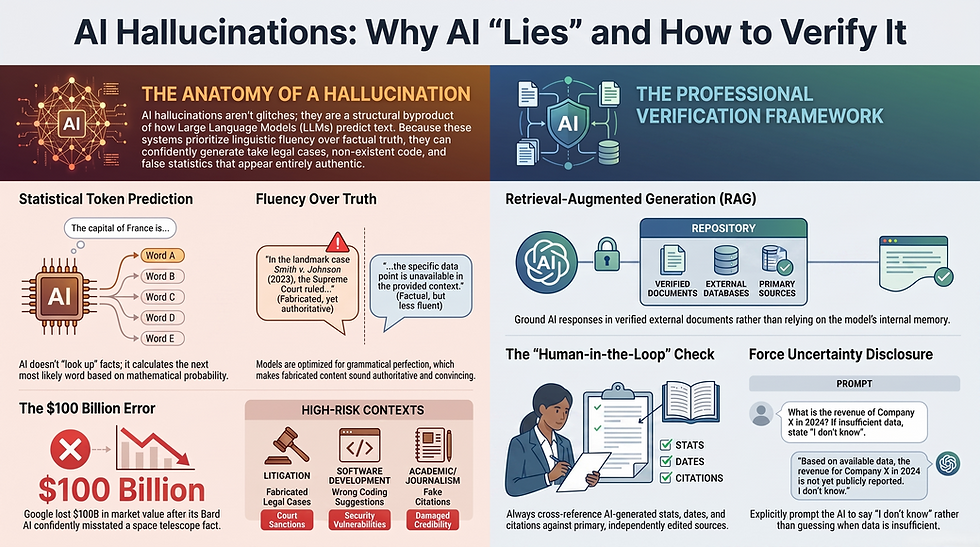
That case, Mata v. Avianca, became the defining example of what happens when confidence gets mistaken for accuracy. But it's far from an isolated incident. Google lost roughly $100 billion in market value within a single day in February 2023 after its Bard chatbot confidently misstated which telescope took the first image of a planet outside our solar system, during its own public launch demo. Software developers have unknowingly typed install commands for code libraries that don't exist, because an AI assistant invented a plausible-sounding package name. These aren't edge cases. They're symptoms of a deeper mechanical reality inside every large language model in production today.
For businesses weighing how far to extend AI into research, writing, customer service, or decision support, this reality creates a specific and stubborn bottleneck: trust. A tool that writes fluent, well-structured, entirely wrong answers is harder to manage than a tool that's obviously broken. This article walks through exactly why AI hallucinations happen, what they look like across different industries, and — most usefully — how to build a verification habit that lets you use these systems without getting burned by them.

What Are AI Hallucinations?
Simple Definition
An AI hallucination is an output generated by a large language model that reads as coherent, grammatically sound, and often authoritative — but is factually incorrect, unsupported by real data, or entirely invented. The defect isn't in the writing quality. Hallucinated content is frequently the best-written part of a response, because the model is optimizing for fluency, not for truth. That's the uncomfortable part of the definition: the polish and the inaccuracy come from the same process.
Why "Hallucination" Is the Preferred Technical Term
Researchers in natural language processing borrowed the word "hallucination" from psychiatry deliberately. In humans, a hallucination is a perception that feels completely real to the person experiencing it, despite having no basis in the external world. That's a surprisingly precise analogy for what happens inside a language model. The system isn't guessing halfheartedly or flagging uncertainty — internally, a hallucinated statement is generated using the exact same statistical machinery as a correct one. There's no separate "fabrication mode." The model doesn't know it's wrong, because it has no internal concept of "right" to compare against. It just completes patterns.
The term entered mainstream NLP research discussions years before ChatGPT existed, originally used to describe machine translation systems that added details not present in the source text. Generative AI inherited both the behavior and the vocabulary.
Real-World Examples
Three documented incidents illustrate how differently hallucinations manifest depending on the setting:
In the legal field, the Mata v. Avianca case remains the clearest cautionary tale. Judge P. Kevin Castel described one of the fabricated opinions as containing legal reasoning that was, in his words, "gibberish," despite it citing real judges by name. The attorneys were sanctioned not just for using AI, but for failing to verify its output before filing it with a federal court — a distinction that later shaped how multiple U.S. district courts now require attorneys to certify that AI-assisted filings have been checked.
In software development, a phenomenon researchers now call "slopsquatting" has emerged directly from coding hallucinations. A large-scale academic study presented at USENIX Security 2025 tested code-generating models across thousands of programming prompts and found a substantial share of recommended software packages simply didn't exist — some blending real package-naming conventions from one ecosystem into a completely different one. Security researcher Bar Lanyado demonstrated the risk by uploading an empty placeholder package under a name that multiple AI tools kept hallucinating; it collected over 30,000 downloads in three months, including, notably, being copy-pasted directly into a public repository maintained by Alibaba.
And in consumer-facing AI, Google's Bard launch demo remains one of the most publicly visible hallucination failures on record. Asked what a child might find interesting about the James Webb Space Telescope, Bard confidently stated the telescope had taken the first-ever image of a planet outside our solar system. That distinction actually belongs to the European Southern Observatory's Very Large Telescope, which achieved it in 2004 — nearly two decades before Bard existed. The error, embedded in Google's own promotional material, triggered a steep single-day stock decline.
Why Does AI Hallucinate Instead of Saying "I Don't Know"?
Token Prediction and Mathematical Probability
To understand why hallucinations happen, you have to set aside the idea that a language model "looks things up." It doesn't. A large language model is fundamentally an autoregressive engine: given a sequence of words, it calculates a probability vector across its entire vocabulary and selects the next most statistically likely token — a word or word-fragment — based on patterns learned during training. Then it repeats that process, one token at a time, using its own prior output as new context.
There's no step in that pipeline where the model queries a fact database, cross-references a citation, or checks a claim against reality. It's pattern completion at massive scale. When you ask "who wrote the Declaration of Independence," the model isn't recalling a stored fact the way a search engine retrieves an indexed page. It's generating the sequence of tokens most statistically consistent with everything it learned about how that question gets answered in its training data. Most of the time, that produces the correct answer, because the correct answer appeared constantly and consistently across its training corpus. The failure mode appears when a topic is obscure, contested, or absent — the model still generates something, because token prediction doesn't have an "insufficient data" exit ramp built in by default.
Probability vs. Factual Knowledge
This is the core mechanical split that explains almost every hallucination: grammatical correctness and factual accuracy are computed through entirely different processes, except a language model only directly optimizes for one of them. During training, the model's loss function — the mathematical measure of how "wrong" its predictions are — penalizes the model for predicting tokens that don't match the training text. It doesn't have a built-in mechanism for penalizing plausible-but-false claims that happen to be grammatically and structurally perfect. A fabricated legal citation formatted exactly like a real one scores well on fluency. Nothing in the base training objective tells the model to care that the case doesn't exist.
Training Data Limitations and Conflicting Data
Large language models learn from enormous, web-scraped datasets that inevitably contain outdated information, contradictory claims, satire mistaken for fact, and straightforward errors that existed on the internet long before the model was trained. When a model encounters conflicting statistical associations for the same entity — different birthdates for a historical figure, competing statistics for the same market, outdated technical specifications sitting next to updated ones — it doesn't resolve the conflict the way a human researcher would, by weighing source credibility. It blends the statistical patterns and produces whichever completion scores highest in probability terms, which can land somewhere between the conflicting sources, or default to whichever version was more frequent in training.
Context Window Constraints
Every model operates within a finite context window — the maximum amount of text it can actively reference at once, measured in tokens. In long conversations, especially multi-turn chats involving detailed documents or extended back-and-forth, earlier constraints and facts can effectively fall out of the model's active attention as new tokens push older ones toward the edge of relevance. When that happens, the model doesn't pause to say "I've lost track of an earlier detail." It fills the gap the same way it fills every other gap: by generating the statistically plausible continuation, even if that means quietly contradicting something established twenty messages earlier.
Overconfidence in Language Models
There's a training-stage explanation for why models rarely hedge, too. Most consumer-facing models go through Reinforcement Learning from Human Feedback (RLHF), a process where human reviewers rate model outputs and the model is fine-tuned to produce responses those reviewers preferred. Reviewers, understandably, tend to rate confident, complete, helpful-sounding answers more favorably than a flat "I don't know" — even when "I don't know" would be the honest answer. Over enough training iterations, this creates a subtle but real incentive structure: the model learns that hedging is judged as less useful than answering, even in situations where it genuinely lacks reliable information. Unless a model is specifically trained to recognize the boundaries of its own knowledge and reward uncertainty disclosure, this alignment pressure quietly pushes it toward confident fabrication over honest refusal.
Does AI Actually Lie?
Intent vs. Prediction
Lying, in any meaningful definition, requires intent — an agent who knows the truth and deliberately says something else to create a false belief in someone else's mind. A large language model has no persistent beliefs, no awareness of what's true, and no motive of any kind. It has weights, probability distributions, and a token-generation loop. Calling a hallucination a "lie" attributes agency to a system that doesn't have any, and it obscures the actual engineering problem: statistical error margins in a prediction system, not deception from a mind.
Why "AI Lies" Is Misleading
Framing hallucinations as lying does more than get the terminology wrong — it points blame in the wrong direction. It suggests the fix is behavioral or ethical, something you could argue the AI out of, when the actual fix lives at the architecture and workflow level: better grounding, better retrieval systems, and better human verification habits. Businesses that anthropomorphize the failure tend to underinvest in the practical safeguards that would have caught it.
Why Hallucinations Sound So Convincing
The reason hallucinated content is so easy to trust is the same reason the model was built in the first place: it was trained to mimic the structure, tone, and formatting conventions of authoritative human writing. A fabricated statistic shows up formatted exactly like a real one. A fake case citation follows the same syntax as a real legal citation, because the model learned that syntax from thousands of real examples. The confidence in the delivery is not a signal of accuracy — it's a signal of how well the model learned to sound like accurate writing, which is a completely separate skill.
Common Types of AI Hallucinations
Type | What It Looks Like | Highest-Risk Context |
Fake Citations | Real author names paired with invented paper titles and plausible-looking DOI numbers | Academic research, journalism |
Invented Statistics | Specific-sounding numbers with no underlying measurement or source | Marketing, market research, finance |
Incorrect Summaries | Dropped qualifiers, reversed cause-and-effect, or omitted caveats from long documents | Legal review, compliance, healthcare |
Fabricated Legal Cases | Fully invented court opinions with real judge names and convincing legal reasoning | Litigation, contract review |
Wrong Coding Suggestions | Nonexistent library methods, deprecated APIs, or hallucinated package names | Software development, DevOps |
Fake Citations
Academic-style citations follow a predictable structural pattern — author, title, journal, year, identifier — that a language model can replicate convincingly without any of the underlying content being real. Models will often combine a genuine, well-known researcher's name with a paper title that sounds appropriate to the field but was never written, sometimes appending a DOI-format string that looks legitimate but resolves to nothing.
Invented Statistics
Ask a model for "the percentage of businesses that adopted AI in [some year]" without giving it a grounded source, and there's a real risk it produces a specific, confident number that was never measured by anyone. The number will typically fall within a statistically reasonable range, because the model has learned what plausible statistics in that domain tend to look like — which makes the fabrication considerably harder to spot than an obviously wrong figure would be.
Incorrect Summaries
When summarizing long documents, models can quietly drop a negative qualifier ("the drug is not recommended for patients with...") or invert a causal relationship between two events described in the source text. Because the rest of the summary is often accurate, this kind of hallucination is particularly dangerous — a single flipped word can change the entire meaning of a compliance document or clinical note while the surrounding text reads perfectly.
Fabricated Legal Cases and Imaginary Research Papers
Legal citations and academic references share a structural trait that makes them easy targets for hallucination: highly formulaic patterns. A court case citation follows a strict format — party names, reporter volume, page number, court, year. A model that has seen thousands of real examples of that format can generate new instances of the format indefinitely, regardless of whether the underlying case exists.
Wrong Coding Suggestions
This is where hallucinations create direct security exposure. Models frequently recommend software library methods that don't exist, reference deprecated APIs as if they were current, or — as covered in the slopsquatting research above — invent plausible package names outright. Academic testing found these hallucinated names weren't random noise; they were often repeatable across multiple prompts and multiple models, which is exactly what makes them exploitable. An attacker who identifies a commonly hallucinated package name can register it on a public registry and wait for developers, or increasingly autonomous coding agents, to install it.
Why AI Hallucinations Matter for Businesses
The consequences of an unverified hallucination scale with how much authority the AI-generated content is given before a human reviews it.
Marketing: Publishing an AI-drafted product comparison with a fabricated competitor statistic can trigger a public correction, damage brand credibility, and in some jurisdictions raise false-advertising exposure.
Healthcare: A hallucinated drug interaction summary or invented diagnostic suggestion carries direct patient-safety risk, which is why most clinical AI deployments require a licensed professional to review every output before it reaches a patient.
Legal: As Mata v. Avianca demonstrated, filing a brief built on non-existent precedent doesn't just risk losing the argument — it exposes the filing attorney to court sanctions and disciplinary referral.
Finance: An AI system that misreads a spreadsheet or fabricates a growth figure in an automated quarterly summary can distort decisions that depend on that report, and in regulated markets, misstatement carries compliance consequences.
Education: Historical dates, scientific mechanisms, and mathematical explanations delivered with total confidence but partial accuracy can quietly misinform students who have no independent way to check the claim.
Customer Support: An AI agent that hallucinates a refund policy, discount code, or warranty term that was never approved creates a real financial and legal obligation the moment a customer relies on it — companies have already faced arbitration rulings requiring them to honor commitments an AI chatbot invented.
How to Verify AI Answers: A Practical Verification Framework
Step | Purpose | When It's Non-Negotiable |
Check Original Sources | Confirm the raw primary material actually exists | Any cited fact, stat, or quote |
Use Multiple AI Models | Triangulate answers across different model families | Ambiguous or high-stakes questions |
Cross-Check Trusted Publications | Validate names, dates, and events against indexed sources | Historical or factual claims |
Ask AI for Confidence and Evidence | Force the model to expose its own uncertainty | Every research-heavy task |
Review Citations Thoroughly | Verify the link or document actually resolves | Anything with a citation attached |
Human Expert Validation | Final review by a qualified professional | Legal, medical, financial, published content |
Check Original Sources
Before repeating any AI-generated fact, statistic, or quote, locate the primary material it claims to reference. If the model cites a report, pull up the actual report. If it cites a study, find the study on the publisher's site, not a secondary summary. This single habit catches the majority of hallucinated citations before they go anywhere near a published piece of content.
Use Multiple AI Models
Different model families — for instance, Anthropic's Claude, Google's Gemini, and OpenAI's GPT models — are trained on different data mixes and architectures, which means they don't always hallucinate the same way on the same question. Asking the identical question across two or three models and comparing the answers is a fast, practical triangulation method. Consistent agreement across models raises confidence; disagreement is a clear signal to dig further before trusting either answer.
Cross-Check with Trusted Publications
For names, dates, statistics, and historical events, compare the AI's claim against an established, independently edited source — a recognized news outlet, a government database, or a peer-reviewed publication. This step is especially important for anything that will appear in published business content, since a factual error in a public article compounds the original hallucination with a credibility cost.
Ask AI for Confidence and Evidence
You can directly prompt a model to expose its own uncertainty rather than presenting every claim with the same flat confidence. Asking it to rate how certain it is on a defined scale, or to list the assumptions behind an answer, often surfaces weak points the model wouldn't have volunteered in a plain response. This doesn't eliminate the underlying uncertainty, but it makes that uncertainty visible instead of hidden behind fluent prose.
Review Citations Thoroughly
A citation that looks real on the surface — a proper journal name, a plausible year, an author who genuinely publishes in that field — still needs to be checked against the actual source. Click the link. Search for the paper title directly. If a DOI is provided, resolve it. This is the step most often skipped under time pressure, and it's exactly the step that would have caught the fabricated case law in Mata v. Avianca before it reached a federal judge.
Human Expert Validation
For any content headed toward legal filings, medical guidance, financial disclosures, or public-facing publication, establish a firm internal policy: a qualified human reviews the material before it goes out, regardless of how confident the AI output sounded. This isn't a statement of distrust in the technology — it's a recognition that non-deterministic systems require a deterministic checkpoint somewhere in the pipeline.

How Companies Reduce AI Hallucinations
Retrieval-Augmented Generation (RAG)
Retrieval-Augmented Generation (RAG), a framework introduced by researchers at Meta AI (then Facebook AI Research) in a 2020 paper led by Patrick Lewis, changes what the model is actually being asked to do. Instead of generating an answer purely from its trained-in parametric knowledge, a RAG system first retrieves relevant, verified documents from an external knowledge source, then asks the model to generate a response grounded in those retrieved passages. This shifts the model's role from "generator of facts from memory" to "summarizer of retrieved, verifiable text" — a fundamentally more constrained and reliable task. Organizations building building reliable AI agents increasingly treat retrieval grounding as a baseline requirement rather than an optional add-on.
Grounding
Grounding is the broader principle RAG implements: constraining a model's output to information that's explicitly verifiable against a defined corpus, rather than letting it draw freely on everything absorbed during training. A grounded system can point to exactly which document supported a given claim, which makes verification dramatically faster than fact-checking an ungrounded response from scratch.
Knowledge Bases and Vector Databases
Grounding at scale requires infrastructure. Enterprise documents get broken into chunks, converted into numerical representations called embeddings, and stored in specialized memory-based AI systems known as vector databases. When a user submits a query, the system converts that query into the same numerical format and searches for the closest matching chunks by mathematical distance, pulling the most relevant material into the model's context before it generates a response. This is the mechanism behind most enterprise "chat with your documents" deployments.
Enterprise AI Governance
Reducing hallucinations at an organizational level isn't purely a technical problem — it requires policy. That means defined audit logs tracking what the AI generated and what a human approved, access controls determining who can publish AI-assisted content without review, and clear escalation paths for high-stakes outputs. Solid AI model evaluation practices, run consistently rather than as a one-time pilot exercise, are what actually keep a non-deterministic system safe to operate inside a business over time.
Prompting Techniques That Reduce Hallucinations
Ask for Citations
Explicitly instructing a model to attach a source to every factual claim forces it to at least attempt grounding, and makes unsupported claims easier to spot — an answer with no citation attached to a specific fact is itself a signal worth investigating.
Require Uncertainty Disclosure
Giving the model direct, explicit permission to say "I don't know" or "I'm not certain about this" measurably changes its behavior. A prompt instruction like "If you are not confident in an answer, say so explicitly rather than guessing" pushes back against the default confidence bias built in through alignment training.
Request Step-by-Step Reasoning Summaries
Asking the model to work through its logic linearly before delivering a final answer — a technique often called chain-of-thought prompting — tends to surface faulty assumptions mid-process, before they get baked into a polished final response.
Limit Responses to Supplied Documents
For document-grounded tasks, a strict system instruction such as "Answer only using the text provided below. If the answer is not found in the text, respond exactly with 'Information not found'" meaningfully constrains the model's tendency to fill gaps with generated content.
Can AI Hallucinations Ever Be Eliminated?
Under the current transformer architecture, no — not completely, and understanding why matters more than the disappointment of the answer itself. The loss function that trains these models optimizes for predictive accuracy against training text, not for verified correspondence with objective reality. Even a perfectly trained model, operating exactly as designed, will occasionally generate a low-probability-but-plausible completion that turns out to be false, simply because the system is fundamentally non-deterministic and probabilistic by design. Techniques like RAG, grounding, and careful prompting reduce the frequency and severity of hallucinations dramatically. None of them change the underlying mathematics that makes some margin of statistical error a permanent feature of the architecture, not a temporary bug awaiting a patch.
The Future of Trustworthy AI
Several developments are actively narrowing the gap between fluent and accurate.
AI verification agents — independent models specifically tasked with adversarially checking another model's output before it reaches a user — are moving from research demos into production pipelines, essentially acting as a second, skeptical reader.
Automated fact-checking pipelines now run in real time behind some enterprise deployments, comparing generated claims against live, indexed knowledge sources and flagging discrepancies before a human ever sees the draft.
Advanced AI reasoning models represent perhaps the most structural shift: systems designed to run multi-step internal planning and self-verification before presenting a final answer, rather than emitting the first plausible completion. These approaches don't eliminate the underlying probabilistic architecture, but they add checkpoints that catch a meaningful share of errors before they become the user's problem.
Frequently Asked Questions about AI Hallucinations
What is an AI hallucination? An AI hallucination is a response from a generative AI system that is fluent, coherent, and confidently written, but factually incorrect or entirely fabricated, with no basis in verified data or the system's actual training material.
Why does AI generate false information? Because large language models generate text through token prediction — calculating the statistically most likely next word based on probability, not by retrieving verified facts from a database. Grammatical fluency and factual accuracy are produced by different mechanisms, and only fluency is directly optimized during training.
Does AI know when it is wrong? No. Language models lack metacognition, self-awareness, and any built-in mechanism for comparing their own output against objective reality. A hallucinated answer is generated with the exact same internal process as a correct one, which is why the model can't reliably flag its own errors without external grounding or explicit prompting.
Can AI hallucinations be completely eliminated? Not under current transformer architecture. Because these models are fundamentally probabilistic and their loss functions optimize for predictive likelihood rather than verified truth, some margin of statistical error remains a structural property of the system, even after mitigation techniques like RAG and grounding are applied.
How do enterprises reduce hallucinations? Primarily through Retrieval-Augmented Generation (RAG), which grounds responses in retrieved, verified documents rather than the model's trained-in memory; vector databases that make enterprise knowledge searchable at scale; and governance policies requiring human review of high-stakes AI output.
What is RAG (Retrieval-Augmented Generation)? RAG is a framework, introduced by Lewis et al. in 2020, that combines a retrieval system with a language model — first pulling relevant, verified documents from an external knowledge source, then generating a response grounded in that retrieved material rather than relying purely on the model's internal training data.
Why are AI citations sometimes fake? Because language models learn the structural pattern of a citation — author name, title, journal, year, identifier — without any built-in mechanism to verify that a specific instance of that pattern corresponds to a real, published source. The model generates citation-shaped text, not verified references.
AI hallucinations aren't a temporary flaw waiting for the next model release to fix. They're a predictable consequence of how token prediction works, which means the responsibility for catching them sits with the humans and systems around the model, not with the model alone. The businesses getting real value out of generative AI right now aren't the ones treating every output as gospel — they're the ones that have built verification into the workflow: grounding responses in real data through Retrieval-Augmented Generation, demanding citations, and keeping a qualified human in the loop wherever the stakes are high enough to matter.
To learn how to securely ground generative models and integrate resilient AI systems into your organization, explore our engineering frameworks at FourfoldAI.
References
Lewis, P., et al. (2020). Retrieval-Augmented Generation for Knowledge-Intensive NLP Tasks. Advances in Neural Information Processing Systems (NeurIPS 2020). https://arxiv.org/abs/2005.11401
Mata v. Avianca, Inc., 678 F.Supp.3d 443 (S.D.N.Y. 2023). https://en.wikipedia.org/wiki/Mata_v._Avianca,_Inc.
Spracklen, J., Wijewickrama, R., Sakib, A.H.M.N., Maiti, A., Viswanath, B., & Jadliwala, M. (2025). We Have a Package for You! A Comprehensive Analysis of Package Hallucinations by Code Generating LLMs. USENIX Security Symposium 2025.
NPR (2023). Google's AI chatbot, Bard, sparks a $100 billion loss in Alphabet shares. https://www.npr.org/2023/02/09/1155650909/google-chatbot--error-bard-shares
Socket.dev (2025). Slopsquatting: How AI Hallucinations Are Fueling a New Class of Supply-Chain Attacks. https://socket.dev/blog/slopsquatting-how-ai-hallucinations-are-fueling-a-new-class-of-supply-chain-attacks
NVIDIA Blog (2023). What Is Retrieval-Augmented Generation, aka RAG? https://blogs.nvidia.com/blog/what-is-retrieval-augmented-generation/
This article is intended for general informational purposes and reflects publicly available research and documented case studies as of publication. For guidance specific to your organization's legal, medical, financial, or compliance obligations, consult a qualified professional. For more information, see our full disclaimer at fourfoldai.com/disclaimer.
About the Author
Muizz Shaikh is an AI enthusiast and digital technology professional at FourfoldAI. He is passionate about exploring AI tools, industry trends, and practical applications of emerging technologies. Through FourfoldAI, Muizz contributes to simplifying artificial intelligence for businesses and learners. Connect with him on LinkedIn: linkedin.com/in/muizz-shaikh-45b449403/
© 2026 FourfoldAI. All rights reserved.


soicauxsmb24.com có đáng để bấm vào coi thử không nhỉ? mình tự trả lời luôn là cũng ổn đó, vì lúc đầu thấy họ nói “soi cầu MB ngày 3 9 2026” mình hơi sợ kiểu chữ nghĩa loằng ngoằng, ai dè mở ra thì họ chia nội dung thành từng khúc rõ, kéo nhẹ là gặp phần dự đoán XSMB hôm nay ngay, đọc lướt vẫn hiểu họ đang dựa trên thống kê kết quả quay trước chứ không nói lan man; mình không chốt số gì cả, chỉ xem cho biết, mà cái mình thích là họ để ngày 3 9 2026 nổi bật ở tiêu đề nên đỡ bị nhầm sang ngày khác; nói chung ngồi lướt…