
AI and Intellectual Property: Who Owns AI-Generated Content and What Courts Are Deciding in 2026

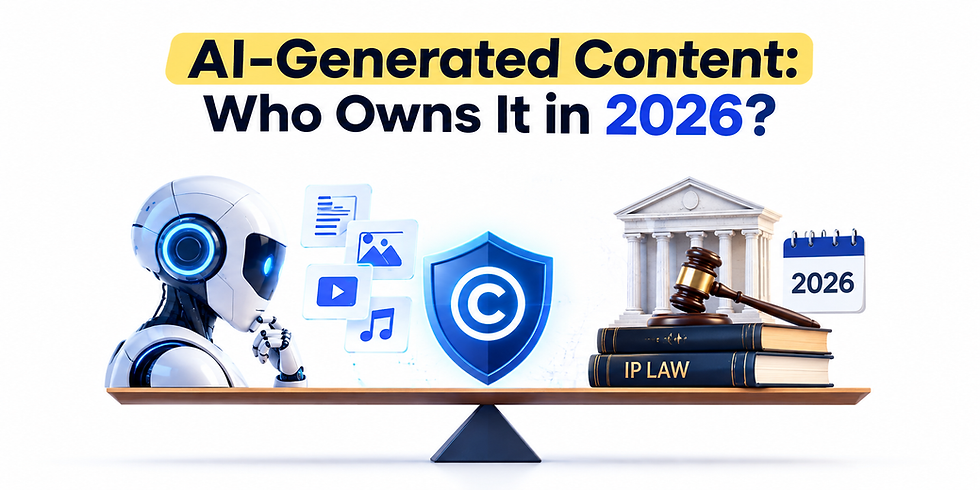
In 2026, AI and intellectual property ownership depends on human creative contribution, platform terms of service, third-party IP risk, and local jurisdiction. AI systems cannot legally own copyright. However, humans and businesses can hold IP rights in AI-assisted works if sufficient human authorship, creative selection, arrangement, or modification is present.
That single paragraph settles more disputes than most legal memos twice its length. But it also raises the real question business leaders are actually asking. Not "does AI own what it makes," because courts answered that one a while ago. The real question is messier: when your marketing team runs a prompt through ChatGPT, or your design lead touches up a Midjourney render, or your dev team ships code Copilot half-wrote — who actually owns the result, and what happens if a court somewhere decides otherwise?
2026 is the year this stopped being a law-school hypothetical. A Delhi High Court ruling in July gave OpenAI its first real win on training data. The U.S. Supreme Court quietly closed the door on AI-as-author in March. The New York Times accused OpenAI of hiding evidence in a case that's been grinding through discovery since 2023. None of these rulings tell you, specifically, whether your company owns the blog post your intern generated last Tuesday. But together, they draw the map you need to make that call yourself.
This guide breaks AI intellectual property into five layers that actually matter for a business: human contribution, platform contracts, infringement exposure, documentation, and internal governance. We'll walk through what's settled, what's still being litigated, and what to do about it regardless of how the pending cases land.
AI Intellectual Property Definition
AI intellectual property refers to the legal rights and obligations associated with artificial intelligence outputs, training datasets, algorithm architectures, patents, trade secrets, trademarks, and digital replicas, governing both ownership protection and third-party infringement risks.
That's a mouthful, so here's the plain version. It covers two separate conversations that people constantly mix together. One is offensive: can I protect what my AI-assisted work produces? The other is defensive: does what I published infringe on someone else's rights? A marketing team asking "can we copyright this AI-generated ad campaign" is having the first conversation. A legal team asking "could this AI-generated logo get us sued" is having the second. Most enterprise AI policies fail because they only think about one.
Who Owns AI-Generated Content? The Short Answer
There's no single owner category for "AI content." Ownership shifts depending on how much creative control a human actually exercised, and who that human works for.
If AI Creates the Work With Minimal Human Creative Input
Nobody owns it. Not the platform. Not the prompter. Not the AI itself. Fully autonomous AI output — text, image, or code generated from a bare instruction with no meaningful human shaping afterward — sits in the public domain by default, at least under U.S. law. Using a tool isn't the same as authoring a work. A camera doesn't own the photo, but the photographer's framing, timing, and choices do earn protection. Generative AI, according to the U.S. Copyright Office, breaks that analogy: the system, not the user, determines the actual expressive elements once a prompt is entered.
If a Human Uses AI as a Creative Tool
This is where ownership gets interesting, and where most real-world business use actually lives. If a person selects, arranges, edits, or substantially modifies AI output, the human-authored portions become copyrightable. Write a first draft with an LLM, then restructure the argument, cut half the paragraphs, and rewrite the voice? That's yours. Generate ten AI images and hand-composite three of them into a single layered design with your own color grading? The compilation and the edits are yours, even if the raw AI elements underneath aren't.
If an Employee Creates AI Content for a Company
Work-for-hire doctrine still applies, but it applies to the human-authored slice, not the AI-generated slice. If an employee produces AI-assisted content within the scope of employment, the employer typically owns whatever portion is copyrightable — same as with any employee-created work. The complication is upstream: what did the employee agree to when they clicked "accept" on the AI vendor's terms of service, and did the company's own AI usage policy authorize that tool in the first place? A marketing associate pasting confidential campaign data into a free-tier chatbot account can create a trade secret problem that has nothing to do with copyright at all.
Ownership, Copyright and Commercial Rights Are Not the Same Thing
Businesses conflate four distinct concepts constantly, and the confusion causes real legal exposure.
Copyright Ownership is legal protection over expressive elements against unauthorized copying. It's a right you either have or don't, decided by human authorship.
Platform Contract Rights are what the vendor's Terms of Service (ToS) actually grants you. OpenAI, Anthropic, and Midjourney all give paying users broad commercial usage rights to outputs — but a contractual right to use something commercially is not the same as owning a copyright in it. You can have full permission to sell an output and still not hold an enforceable copyright that stops someone else from copying it.
Commercial Use Rights are the contractual permission to sell, license, publish, or otherwise monetize an output, granted by the vendor's terms rather than by copyright law.
Infringement Risk is the part everyone forgets. Vendor permission to use an output commercially does not protect you if that output happens to reproduce someone else's copyrighted material. If a model spits out something substantially similar to existing protected work, "but the platform said I could use it" is not a defense against the original rights-holder's infringement claim.
The AI Ownership Decision Tree
Walk through these five questions in order before you publish, license, or sell anything AI-assisted:
Step one — Human expression contributed? If no meaningful human creative input exists, stop. The output is likely uncopyrightable and unprotectable, regardless of what happens next.
Step two — AI-assisted or fully generated? If a human selected, arranged, or substantially edited the output, the human-authored elements move forward toward protection. Fully generated, unedited output does not.
Step three — Vendor terms reviewed? Confirm the platform's ToS actually grants commercial use rights for your specific plan tier. Free tiers frequently restrict commercial use in ways paid enterprise tiers do not.
Step four — Third-party IP cleared? Check the output against known copyrighted characters, trademarks, distinctive styles, and existing published work, especially for image and music generation where memorization risk is highest.
Step five — Commercial deployment approved. Only after all four checks clear should the output move to publication, sale, or client delivery.

Can AI-Generated Content Be Copyrighted in 2026?
The Human Authorship Requirement
U.S. copyright law has required a human author since long before generative AI existed. The Copyright Office defines an author as the "originator" who translates a mental conception into fixed, tangible form — language traced back to an 1884 Supreme Court case, Burrow-Giles Lithographic Co. v. Sarony. That 19th-century photography case is now doing heavy lifting in 21st-century AI disputes, because it established that the human behind the tool, not the tool itself, is the legal author.
What the U.S. Copyright Office Says About AI Outputs
The Copyright Office's Part 2 report, released January 29, 2025, is the single most cited document in this entire field. Its core finding: prompts alone, no matter how long or detailed, are instructions rather than expression, and don't confer authorship. The report drew a specific line — a user "controlling" expressive elements through iterative refinement is different from a user simply describing a desired outcome and accepting whatever the model returns. The Office registered more than a thousand works following its disclosure guidance, where applicants disclosed AI involvement and claimed only the human-authored portions.
When AI-Assisted Content May Receive Protection
Four scenarios regularly clear the bar in practice.
A rewritten article where an AI draft gets restructured, fact-checked, and substantially rewritten in the author's own voice earns protection for the final human-authored text.
A hybrid graphic design combining multiple AI-generated elements, arranged and color-corrected by a human designer, can earn protection for the selection and arrangement, similar to how a photo collage is protected even if the underlying images have separate rights.
Edited AI video frames, where a human director selects specific generated frames, sequences them, and adds original transitions or effects, can support copyright in the edited sequence.
Complex code arrangements, where a developer takes AI-suggested snippets and integrates them into an original architecture with substantial human-written logic around them, can be protected as a compilation — though the individual AI-suggested lines remain a gray area.
Why Prompting Alone Is Not a Universal Ownership Test
Trace the actual chain of events: intent forms in a person's head, gets compressed into a text prompt, the model performs algorithmic inference nobody fully controls, and an output appears. Human creative control sits at the start and, if the human edits afterward, at the end — but the middle step, where the actual expressive choices get made, belongs to the model. The Copyright Office treats this like commissioning a work rather than authoring one. You can commission a portrait and own the physical painting, but you don't hold the artist's copyright in it unless you did the painting yourself.
What Courts Are Deciding About AI and Intellectual Property in 2026
This is the fastest-moving part of the entire field, so treat every status below as a snapshot, not a final word. None of these rulings — including the ones that sound decisive — have settled the underlying questions nationally. Trial-court and single-judge decisions bind the parties in front of them, not the rest of the industry.
AI Cannot Simply Be Treated as a Human Copyright Author
Thaler v. Perlmutter is as close to settled as this field gets. Stephen Thaler sued the Copyright Office after it denied registration for a work he claimed was created "autonomously" by an AI system with no human author. The D.C. Circuit affirmed against Thaler in March 2025, holding that human authorship is an essential, bedrock element of copyright. The full appeals court denied rehearing in May 2025. In March 2026, the Supreme Court of the United States declined to review the case, closing off the last available appeal and cementing the human-authorship requirement at the highest level the American legal system currently offers. This doesn't resolve every downstream question about how much human input is enough — that fight continues in cases like Allen v. Perlmutter — but it settles, for now, that AI itself will not be recognized as a legal author in the U.S.
The AI Training Data Cases
Every training-data lawsuit actually contains two separate legal questions that get collapsed together in press coverage, and separating them is the single most useful thing a business reader can do here.
The input layer asks whether training a model on copyrighted material was fair use or unauthorized reproduction. The output layer asks whether what the model actually generates reproduces protected expression closely enough to count as substantial similarity. A model can win decisively on the input question and still lose badly on the output question if it starts spitting out near-verbatim passages.
Bartz v. Anthropic delivered the most instructive split of any 2026-relevant ruling. In June 2025, Judge Alsup found that training Claude on lawfully acquired books was "exceedingly transformative" fair use — but that acquiring and retaining a central library of roughly 500,000 pirated books from shadow libraries like LibGen was a separate, non-transformative act that wasn't protected. Anthropic settled for $1.5 billion, covering the pirated works at roughly $3,000 per book, with final court approval entered on July 20, 2026. The lesson for enterprises building or fine-tuning models isn't "training is fine" — it's "training may be fine, but how you acquired the data is a separate legal question with its own exposure."
Kadrey v. Meta, decided two days after Bartz by a different judge in the same courthouse, reached a similar fair-use outcome through different reasoning — and pointedly criticized Alsup's approach for underweighting market harm, the fourth and often decisive factor in fair use analysis. The Kadrey case remains active over separate BitTorrent-related distribution claims even after the core fair-use ruling favored Meta.
Publishers, News Organizations and Generative AI
The New York Times v. OpenAI is the case most business readers have actually heard of, and it remains firmly unresolved. Filed in December 2023 in the Southern District of New York, the suit is now consolidated with other publisher claims and sitting in active discovery as of mid-2026. In July 2026, a coalition of publishers led by the Times filed a sanctions motion alleging OpenAI misrepresented its ability to search training data and chat logs for infringing content, and had deleted or made unsearchable billions of ChatGPT conversations relevant to the case. Nothing has been decided on the merits. What matters for enterprise readers is the theory at the center of it: memorization and near-verbatim output reproduction, not just training-data acquisition, as the basis of the claim — the output-layer question that training-fair-use wins like Bartz and Kadrey don't automatically answer.
Books, Authors and Training Data
The lawful-acquisition-versus-piracy distinction from Bartz has become the default battlefield in nearly every new book-related AI suit. Plaintiffs' firms have largely stopped arguing that training itself is inherently infringing — courts haven't been receptive to that theory — and instead focus on how the underlying dataset was acquired. If a developer purchased and scanned physical books, that acquisition path has fared far better in court than downloading from shadow libraries like LibGen or Books3.
Music, Lyrics and AI Models
Music litigation adds a layer conventional text and image cases don't have: composition rights and master recording rights are separately owned and often separately litigated, and melodic memorization can trigger infringement even when lyrics are original. Major music publishers and labels have pursued AI developers on both fronts simultaneously, and structural output replication — an AI-generated song that mirrors the chord progression, arrangement, and production choices of an existing track without copying lyrics — remains a live and technically difficult question that current case law hasn't fully resolved.
India's AI Copyright Question: Why the ANI-OpenAI Dispute Matters
For businesses operating regionally, ANI Media Pvt. Ltd. v. OpenAI OpCo LLC is the ruling to watch. On July 24, 2026, the Delhi High Court, in a 135-page order following 32 hearings, refused Asian News International's request for an interim injunction against OpenAI. Justice Amit Bansal held, on a prima facie basis, that OpenAI's storage of ANI's news content to train ChatGPT fell within the fair dealing exception under Section 52(1)(a) of the Copyright Act, 1957 — India's research and private-use carve-out, a closed statutory list rather than the flexible multi-factor test American courts use. The court also rejected ANI's argument that commercial AI companies should be automatically barred from claiming fair dealing, noting Parliament chose not to write that limitation into the statute. On the output claim, the court found copyright protects expression, not underlying facts, and that ANI hadn't shown ChatGPT reproduced its protected expression at a substantial level.
Two details matter more than the headline win for OpenAI. First, the court accepted jurisdiction over a U.S.-based AI company on the theory that the effects of the disputed activity were felt in India — meaning Indian courts can and will hear these disputes even when training happens entirely on foreign servers. Second, the ruling is explicitly interim and prima facie; the underlying suit continues toward a full hearing, and ANI retains a right to appeal to a Division Bench. For Indian publishers and enterprises, the practical signal is that licensing negotiations, not injunctions, are the realistic path forward under current Indian jurisprudence.
2026 AI Court Decision Tracker
Thaler v. Perlmutter — Parties: Stephen Thaler v. U.S. Copyright Office. Jurisdiction: U.S. (D.C. Circuit, cert. denied by SCOTUS). Core issue: Can AI alone be a copyright author? Status: Final — Supreme Court denied review, March 2026. Holding: Human authorship is a bedrock constitutional and statutory requirement; AI cannot be a copyright author. Enterprise impact: Confirms fully autonomous AI output cannot be registered — human editing is not optional if you want protection.
Bartz v. Anthropic — Parties: Andrea Bartz et al. v. Anthropic PBC. Jurisdiction: N.D. California. Core issue: Is training an LLM on books fair use, and does source of acquisition matter? Status: Settled, final approval July 20, 2026. Holding: Training on lawfully acquired books is transformative fair use; retaining pirated books is not. Enterprise impact: $1.5B settlement shows real financial exposure exists specifically around data acquisition, separate from training itself.
Kadrey v. Meta — Parties: Richard Kadrey et al. v. Meta Platforms. Jurisdiction: N.D. California. Core issue: Same as Bartz, different acquisition-and-training theory. Status: Partially resolved — fair use granted on training; BitTorrent distribution claims still active. Holding: Training was fair use even where underlying materials came from shadow libraries, given the record presented. Enterprise impact: Shows fair-use outcomes are fact-specific and not uniform even on similar underlying conduct.
NYT v. OpenAI & Microsoft — Parties: The New York Times et al. v. OpenAI, Microsoft. Jurisdiction: S.D.N.Y. (consolidated MDL). Core issue: Does training on news content and reproducing it in outputs infringe? Status: Pending — active discovery, sanctions motion filed July 2026. Holding: None yet; motion to dismiss largely denied April 2025. Enterprise impact: Central test case for whether training on paywalled journalism is defensible; outcome will shape media licensing norms broadly.
ANI Media v. OpenAI — Parties: Asian News International v. OpenAI OpCo LLC. Jurisdiction: Delhi High Court, India. Core issue: Does training on Indian news content and reproducing it violate the Copyright Act, 1957? Status: Interim ruling issued, main suit pending, July 24, 2026. Holding: Training prima facie qualifies as fair dealing under Section 52(1)(a); no substantial output reproduction shown. Enterprise impact: First major Indian precedent; signals licensing over litigation for regional publishers.
Thomson Reuters v. ROSS Intelligence — Parties: Thomson Reuters v. ROSS Intelligence. Jurisdiction: D. Delaware (on appeal to Third Circuit). Core issue: Is training a competing legal-research AI on copyrighted headnotes fair use? Status: On appeal after February 2025 ruling against fair use. Holding: No fair use — the output was a direct market substitute for the original product. Enterprise impact: The clearest example so far of training that failed fair use because the resulting tool competed head-on with the source.

AI-Generated Content Can Still Create Legal Risk Even If You "Own" the Output
Ownership and risk exposure are separate conversations, and enterprises that only think about the first one get burned by the second.
Copyright Infringement Risk arises from unintentional memorization. Generative models can, under certain conditions, reproduce chunks of their training data closely enough to infringe, regardless of whether you personally wrote the prompt innocently.
Trademark Risk shows up in AI-generated logos, packaging, and marketing collateral that unintentionally resembles a protected mark, or in outputs that create misleading impressions of affiliation with an existing brand.
Right of Publicity and Likeness risk arises when AI-generated images or video use a recognizable person's features without consent — a growing exposure area as image and video generation tools improve.
Digital Replicas and Voice Cloning occupy a legal space the Copyright Office treats as distinct from ordinary copyright. Its Part 1 report identified an urgent need for new federal protection specifically for voice and likeness replicas. The NO FAKES Act, which would create a federal digital-replica right, advanced unanimously through the Senate Judiciary Committee in June 2026 but has not yet passed both chambers or been signed into law as of this writing — meaning protection currently still runs through a patchwork of state right-of-publicity statutes rather than a single federal standard.
Confidential and Trade Secret Data exposure is the risk enterprises underestimate most. An employee pasting unreleased source code, unannounced financials, or a client database into a public LLM endpoint can destroy trade secret protection instantly — trade secret law requires reasonable efforts at secrecy, and voluntarily feeding confidential material to a third-party platform can be read as abandoning exactly that.
Who Owns AI-Generated Content Inside a Business?
Employee vs Employer. Standard work-for-hire principles extend to AI-assisted work an employee produces within the scope of their job — the employer typically owns the human-authored portion, provided the company's AI usage policy actually authorized the tool the employee used.
Company vs AI Vendor. Enterprise-tier agreements with vendors like Anthropic Claude, OpenAI, or Midjourney typically grant broader, clearer commercial rights than free consumer tiers, which often carry usage restrictions, data-training opt-ins, or narrower commercial permissions that can quietly undercut a business's ownership assumptions.
Agency vs Client. Agencies working with AI tools on client deliverables need explicit disclosure and IP indemnification language in their contracts — a client discovering after the fact that "their" campaign assets were AI-generated, with unclear ownership status, is a relationship-ending surprise that a single contract clause prevents.
Contractor vs Company. Freelance and contract work needs explicit AI work-for-hire provisions, since default contractor IP assignment clauses were written before generative tools existed and may not clearly capture AI-assisted deliverables.
The Enterprise AI IP Governance Checklist
Document all human creative contributions and prompts. Preserve raw source files and version generation histories. Review AI vendor platform terms before commercial deployment. Audit outputs for third-party copyright and trademark risks. Apply substantial human editing and creative modification. Establish explicit enterprise AI governance and approval workflows. Track system identification and log which specific tool, model, and version produced each asset. Maintain provenance logging that ties every published output back to its full generation and editing history.
AI Intellectual Property by Content Type
Who owns AI-generated images? Purely prompt-generated images without further human editing generally can't be copyrighted under current U.S. Copyright Office guidance. Substantial post-generation editing — compositing, hand-painting, selective retouching — can support protection for the edited result.
Who owns AI-generated articles and text? The same rule as images applies: raw generated text is unprotectable, but human rewriting, restructuring, and voice editing can earn copyright in the final piece.
Who owns AI-generated code? This category carries an extra risk layer beyond ownership: open-source license contamination. Tools like GitHub Copilot are trained on enormous quantities of public repositories, some under copyleft licenses that require derivative works to be released under the same license. A developer unknowingly accepting AI-suggested code that closely mirrors GPL-licensed source can inadvertently trigger copyleft obligations for proprietary software — a risk most engineering teams don't think to audit for.
Who owns AI-generated music? Composition and master rights complicate this further than most content types, since AI-generated tracks can implicate both the underlying composition and the sonic characteristics of a specific recording or performer's style.
Who owns AI-generated videos? Video inherits every risk category above simultaneously — image rights, music rights, and potential likeness issues — making it the highest-complexity content type for IP clearance.
Who owns AI-assisted business designs and presentations? Internal decks and business documents carry lower public-facing risk than published creative content, but the same human-authorship principle still determines whether the final document itself is protectable if it's ever repurposed as a licensable template or product.
Content Type Ownership and Risk Table
Images — Main ownership question: Was the output substantially edited or composited by a human after generation? Primary legal risk: Style mimicry and near-identical reproduction of protected visual works.
Text and articles — Main ownership question: How much of the final piece reflects human rewriting versus raw output? Primary legal risk: Memorized passages reproducing copyrighted source material.
Code — Main ownership question: Was AI-suggested code integrated into an original human-written architecture? Primary legal risk: Open-source copyleft license contamination.
Music — Main ownership question: Did a human meaningfully compose, arrange, or produce beyond the AI draft? Primary legal risk: Melodic and structural reproduction of existing compositions or recordings.
Video — Main ownership question: Did a human direct, sequence, and edit the generated frames? Primary legal risk: Combined image, music, and likeness exposure in a single asset.
Business designs and decks — Main ownership question: Is the final document substantially human-arranged and edited? Primary legal risk: Trademark and brand-identity conflicts in AI-suggested visual elements.
AI and Intellectual Property Around the World
United States
The U.S. framework centers entirely on human authorship, reinforced most recently by the Supreme Court's refusal to hear Thaler in March 2026. Fair use governs the training-data question, and that doctrine is being actively reshaped case by case rather than through a single unifying statute.
European Union
The EU takes a structurally different approach. Under the EU AI Act, general-purpose AI providers face two specific copyright obligations under Article 53: a policy to comply with EU copyright law, including honoring rights-holder opt-outs under the Copyright Directive's text-and-data-mining exception, and a public summary of training content. Enforcement authority activated on August 2, 2026, with the AI Office able to request information and issue penalties up to €15 million or 3% of global turnover for non-compliance. Early compliance has been uneven — some major providers filled the Commission's disclosure template in detail, while others submitted vaguer prose summaries, and no confirmed enforcement action had landed as of early August 2026.
India
India's framework runs through the existing fair dealing exception in Section 52 of the Copyright Act, 1957, rather than a purpose-built AI statute. The Delhi High Court's ANI ruling is the first substantive judicial test of that framework against AI training, and it applied existing copyright principles rather than creating a new, AI-specific legal category — a stance India's Department for Promotion of Industry and Internal Trade has separately proposed complicating with a centralized statutory licensing regime still under discussion.
Why Global Businesses Cannot Use One AI IP Policy Everywhere
A U.S.-style "human authorship or nothing" policy doesn't map onto the EU's disclosure-and-opt-out framework, and neither maps cleanly onto India's fair-dealing analysis. A multinational publishing AI-assisted content across all three needs jurisdiction-specific review, not a single global template — what clears in one market can create exposure in another.
How Businesses Should Protect AI-Assisted Intellectual Property
Document all human creative contributions and prompts. Preserve raw source files and version generation histories. Review AI vendor platform terms before commercial deployment. Audit outputs for third-party copyright and trademark risks. Apply substantial human editing and creative modification. Establish explicit enterprise AI governance and approval workflows.
Maintain a Human Contribution Record
Keep a record of what a human actually changed, added, or arranged beyond the raw AI draft — this is the evidence that supports a copyright claim if one is ever challenged.
Keep Source and Version History
Preserve the generation prompts, the raw outputs, and every subsequent edit as a version trail, not just the final published asset.
Create an AI Usage Policy
Define which tools employees can use, for which purposes, and under what disclosure requirements — before a policy vacuum lets untracked AI use create liability.
Review AI Vendor Terms Before Deployment
Confirm the specific plan tier in use actually grants the commercial rights the business needs; free and paid tiers frequently differ substantially.
Use Human Review for High-Value Content
Flagship campaigns, published articles, and client-facing deliverables warrant a mandatory human editorial pass, both for quality and for the legal protection that editing provides.
Separate Low-Risk and High-Risk AI Use Cases
Not every AI use case carries the same exposure, and treating them identically wastes review resources on low-risk work while under-scrutinizing high-risk work.
Risk Classification Matrix
Low risk — internal brainstorming, first-draft ideation, meeting notes, and other material never intended for external publication.
Medium risk — marketing drafts and internal presentations that may later be published or shared externally after human review.
High risk — customer-facing campaigns, commercial code shipped in products, and AI-assisted music intended for commercial release.
Critical review — legal contracts, any content involving confidential or trade secret data, and any content involving a real person's likeness or voice.
The Biggest AI Intellectual Property Questions Still Unresolved in 2026
Several genuinely open questions will shape enterprise AI policy for years to come. How much human control over expressive elements is actually enough — a question Allen v. Perlmutter is testing directly. Whether fair use survives at true frontier scale, where training corpora span effectively the entire public internet, remains contested even after Bartz and Kadrey, both of which were fact-specific rulings rather than blanket rules. Courts still disagree sharply on where substantial similarity actually sits for AI outputs, as the divergent reasoning in Bartz and Kadrey shows. Statutory licensing models — something closer to India's proposed centralized framework or a music-industry-style compulsory license — remain under active policy discussion but unenacted anywhere at scale. Output liability distribution between AI vendor, platform, and end user is still being worked out contract by contract rather than through settled law. And C2PA provenance tracking — the technical standard for embedding verifiable origin metadata into AI-generated content — is gaining adoption as a practical tool but has no binding legal force yet in most jurisdictions.
The Future of AI and Intellectual Property
Expect the practical landscape to keep shifting toward licensing infrastructure rather than pure litigation. AI licensing clearinghouses, modeled loosely on the music industry's existing rights-collection societies, are being discussed as a way to compensate publishers and authors without forcing every dispute through a multi-year lawsuit. Automated provenance watermarking is likely to become closer to a default expectation as C2PA-style standards mature and platforms compete on trust signals. Vendor indemnification caps — the dollar limits on how much an AI provider will cover if a customer gets sued over generated output — are becoming a real negotiating point in enterprise contracts rather than boilerplate. And AI governance is steadily moving from a side conversation in legal departments into standard corporate governance, sitting alongside data privacy and cybersecurity as a board-level concern.
Conclusion: Who Really Owns AI-Generated Content?
Stop asking whether AI and intellectual property law lets a machine own its output — that question is closed, and has been since the Supreme Court let Thaler stand in March 2026. The far more useful question, and the one this guide has tried to answer, is three-part: what genuine human authorship exists in this specific piece of content, what do the platform's actual terms allow you to do with it commercially, and what third-party infringement risk still sits underneath it regardless of who owns what.
None of the five layers — human contribution, contract terms, infringement risk, documentation, and governance — resolve on their own. But together, they're a workable framework you can apply today, whether the ANI appeal, the NYT sanctions motion, or the NO FAKES Act resolve this year or drag into the next. The businesses handling this well aren't the ones waiting for perfect legal clarity. They're the ones building documentation habits and review workflows now, so that whichever way these pending cases land, they're already positioned to adapt.
Frequently Asked Questions About AI and Intellectual Property
Can AI-generated content be copyrighted? Fully AI-generated content with no meaningful human creative input generally cannot be copyrighted under current U.S. law, following the Copyright Office's Part 2 report and the Supreme Court's 2026 refusal to hear Thaler v. Perlmutter. Content becomes copyrightable when a human contributes substantial creative selection, arrangement, or editing on top of the raw AI output — it's the human-authored portion specifically that receives protection, not the AI-generated elements underneath it.
Who owns content created using ChatGPT or other AI tools? Ownership depends on the platform's terms of service combined with how much a human edited the output afterward. Most major platforms, including ChatGPT and Claude, grant paying users commercial usage rights to what they generate, but that contractual permission is separate from copyright ownership. A business only holds an enforceable copyright in the portions a human meaningfully shaped, selected, or rewrote.
Do I own an AI-generated image I created with a prompt? Under current U.S. Copyright Office guidance, a prompt alone — no matter how detailed or iterated — does not establish authorship, because the system rather than the user determines the actual visual expression. You gain a stronger ownership claim by substantially editing, compositing, or hand-modifying the generated image afterward, since that additional human creative work is what becomes protectable.
Can I use AI-generated content commercially? In most cases, yes, provided your platform's terms of service grant commercial usage rights for your specific plan — free tiers often restrict this more than paid enterprise tiers do. Commercial permission from the vendor does not, however, protect you from third-party infringement claims if the output happens to closely reproduce someone else's existing copyrighted work.
Can someone copy my AI-generated content? If the content has no qualifying human authorship, it likely isn't protected by copyright at all, meaning others could legally reuse it without infringing anything. If you substantially edited or arranged the AI output, the human-authored elements of your work carry the same copyright protection as any other creative work, and copying those specific elements without permission would infringe.
Can AI-generated content infringe copyright? Yes. Generative models can, under certain conditions, reproduce content closely resembling material in their training data, and publishing an output that's substantially similar to existing protected work can constitute infringement regardless of your intent. This output-layer risk exists independently of the separate question of whether the model's training itself was lawful.
Does an AI company own the content I generate? Generally, no — most major AI vendors' terms of service explicitly disclaim ownership of user-generated outputs and instead grant the user rights to use them, subject to the platform's specific usage policies. It's worth confirming this directly in your vendor's current terms, since policies vary by company and by plan tier, and free-tier terms sometimes differ meaningfully from paid enterprise agreements.
Are AI prompts protected by copyright? Generally not on their own. The Copyright Office treats prompts as instructions rather than expressive content, similar to describing an idea to a commissioned artist rather than creating the artwork yourself. An unusually long, creative, or literary prompt could theoretically receive narrow protection as a piece of writing in its own right, but that protection wouldn't extend to the AI output the prompt produced.
What are the biggest AI copyright cases in 2026? The most consequential 2026 developments include the Supreme Court's March 2026 refusal to review Thaler v. Perlmutter, cementing the human-authorship requirement; the Delhi High Court's July 2026 interim ruling in ANI Media v. OpenAI, India's first major AI training-data decision; the ongoing New York Times v. OpenAI litigation, including a July 2026 sanctions motion over alleged evidence withholding; and the final court approval of Anthropic's $1.5 billion Bartz settlement over pirated training data, entered in July 2026.
References and Sources
This article draws on primary legal sources and contemporaneous legal reporting, including the U.S. Copyright Office's Copyright and Artificial Intelligence reports, federal and Indian court filings, and coverage from established legal publications. Key sources include:
U.S. Copyright Office — Copyright and Artificial Intelligence, Part 2: Copyrightability
Congress.gov — Generative Artificial Intelligence and Copyright Law (CRS)
Reuters — New York Times-Led Group Asks Court to Sanction OpenAI
Mondaq / Chambers and Partners — ANI Media v. OpenAI OpCo LLC, Delhi High Court
National Law Review — Court Approves Historic Anthropic Settlement
Artificial Intelligence Act — Article 53: Obligations for Providers of General-Purpose AI Models
Morgan Lewis — U.S. Supreme Court Declines to Consider Whether AI Alone Can Create Copyrighted Works
This article is backed by authoritative legal sources and current research current as of August 2026. AI and intellectual property law is evolving rapidly — always confirm current status with qualified counsel before making binding business decisions.
Want more practical breakdowns on AI adoption, governance, and enterprise strategy? Explore more guides at fourfoldai.com, where we simplify AI for business leaders and learners alike.
Disclaimer:
This article is provided for general informational and educational purposes only and does not constitute legal, financial, or professional advice. AI and intellectual property law is a rapidly evolving field, and case outcomes referenced here may change on appeal or through further proceedings. Readers should consult a qualified intellectual property attorney before making decisions based on this content. For our full disclaimer, visit fourfoldai.com/disclaimer.
About the Author
Muizz Shaikh is an AI enthusiast and digital technology professional at FourfoldAI. He is passionate about exploring AI tools, industry trends, and practical applications of emerging technologies. Through FourfoldAI, Muizz contributes to simplifying artificial intelligence for businesses and learners. Connect with him on LinkedIn: linkedin.com/in/muizz-shaikh-45b449403/
© 2026 FourfoldAI. All rights reserved.


Comments