
AI and IoT Convergence: How Intelligent Devices Are Creating the Next Wave of Industrial Automation

A bearing starts vibrating slightly out of pattern on a Tuesday afternoon. Nobody walks past it. No operator hears it over the line noise. But a vibration sensor picks up the shift, an edge model flags the anomaly against thousands of hours of historical baseline, and a work order lands in a technician's queue before the part ever fails. That sequence — sense, understand, decide, act — is what AI and IoT convergence actually looks like on a factory floor, and it's a long way from the marketing slide version of "smart sensors."
For plant directors and OT leaders, the pitch around connected devices has been circling for over a decade. What's different now is that the sensors finally have something intelligent to talk to. AI and IoT convergence isn't about bolting more sensors onto old machines — it's about closing the loop between sensing, real-time inference, automated decision-making, physical action, and continuous model learning. Each of those five stages used to sit in a different department, on a different system, often years apart in maturity. AIoT collapses them into one operating loop.
This guide walks through what that loop looks like in practice: the architecture behind it, where edge computing earns its keep versus the cloud, how digital twins fit into the picture, the maturity curve most plants are actually on, and a realistic roadmap for getting from scattered sensors to distributed operational intelligence — without the inflated efficiency claims that tend to follow this topic around.

What Is AI and IoT Convergence?
AI and IoT convergence — often shortened to AIoT — is the integration of artificial intelligence directly into connected industrial devices and the networks that link them, so that sensor data isn't just collected and stored but interpreted and acted on close to where it's generated. Instead of a one-way stream of readings flowing up to a historian for someone to review next quarter, AIoT systems detect anomalies, forecast failures, and trigger responses inside the same operational cycle the data came from.
AI and IoT explained in simple terms
IoT, on its own, is a connectivity story. Sensors, gateways, and networks move data from Point A to Point B. AI, on its own, is a reasoning story — it needs data to learn from and act on. Put them together and you get a system that can sense a physical condition and respond to it without a person manually connecting those dots every time.
What is AIoT?
AIoT is shorthand for the Artificial Intelligence of Things — machine learning models, computer vision, and time-series analysis embedded directly into industrial IoT infrastructure, running either at the edge or in coordination with cloud platforms, so that inference happens close to the point of data collection rather than after the fact.
How AI transforms IoT data into decisions
A traditional IoT sensor reports a temperature reading. An AIoT system compares that reading against a learned model of normal operating behavior for that specific asset, under those specific load conditions, and recognizes when a pattern — not just a single value — signals degradation. That's the difference between a threshold alarm and genuine inference.
AIoT vs traditional IoT
The gap between the two shows up clearest when you line up how each one actually behaves in production. Traditional IoT is built around a primary objective of connectivity and monitoring — get the data off the machine and somewhere visible. Its data processing model is largely batch or scheduled, with dashboards refreshing on intervals rather than reacting instantly. The intelligence layer, where one exists at all, is rule-based: static thresholds, fixed alarm limits, if-this-then-that logic written once and rarely revisited. Decision speed tracks accordingly — reactive, after a person reviews the data or a threshold trips. The operational model stays centered on human interpretation at every step.
AIoT shifts every one of those dimensions. Its primary objective is autonomous, continuous optimization rather than passive visibility. Data processing happens in real time or near-real time, often at the edge, because waiting for a scheduled batch job defeats the purpose. The intelligence layer is adaptive — models trained on historical failure patterns that improve as more operational data accumulates. Decision speed becomes predictive and, in mature deployments, prescriptive: the system doesn't just flag a problem, it recommends or triggers the fix. And the operational model moves toward closed-loop automation, with humans supervising exceptions instead of reviewing every reading.
How Does AI and IoT Convergence Work? The FourfoldAI Industrial Intelligence Loop
We at FourfoldAI think about AIoT as a closed loop rather than a pipeline, because a pipeline implies an endpoint. This loop never really stops — every action it produces becomes training data for the next cycle. It breaks into eight stages.
Step 1 — Sense. IoT devices capture physical-world signals at the source: vibration, temperature, pressure, acoustic emissions, current draw, optical images. This is where data quality gets decided; a poorly calibrated sensor poisons everything downstream.
Step 2 — Connect. Industrial networks move that raw signal off the device. This is the domain of MQTT, OPC UA, Modbus, and increasingly private 5G, each suited to different latency and bandwidth needs.
Step 3 — Contextualize. Raw signals on their own don't mean much. A vibration reading needs to be tied to which asset, which shift, which product batch, and what the historical baseline looks like for that exact configuration before it becomes usable information.
Step 4 — Infer. This is where AI does its actual work — pattern recognition against the contextualized data, whether that's anomaly detection on a time series, defect classification on a camera feed, or a remaining-useful-life estimate on a rotating asset.
Step 5 — Decide. The system weighs the inference against operational rules and confidence thresholds, then selects a recommended action — schedule maintenance, adjust a setpoint, flag for human review.
Step 6 — Act. A human technician, a PLC-controlled actuator, or an automated software workflow carries out the response. Which one depends entirely on the risk profile of the decision and how much autonomy the plant has been willing to grant.
Step 7 — Verify. The system checks whether the action actually produced the intended outcome — did the vibration signature return to baseline, did the defect rate drop.
Step 8 — Learn. Every outcome, successful or not, feeds back into model retraining and process refinement, which is what separates AIoT from a one-time analytics project.
Picture it as a continuous circuit rather than a straight line: sensors feed an edge gateway, which feeds a contextual layer, which feeds AI inference, which feeds a decision engine, which triggers an actuator or PLC, and the resulting outcome data flows straight back into the sensing layer to sharpen the next cycle. No stage in that circuit is optional, and no stage works in isolation from the ones on either side of it.

Why AIoT Is Changing Industrial Automation
The shift from data collection to intelligent decision-making sounds abstract until you compare it to what most plants were actually doing five years ago: collecting terabytes of sensor data that nobody had time to analyze. AIoT changes the economics of that data by making analysis automatic instead of optional.
Scheduled maintenance is the clearest casualty. Time-based maintenance intervals are a compromise — they replace parts before failure but also, routinely, before the part has used up its useful life, because nobody can know the actual wear state without measuring it. Predictive maintenance, built on AIoT, replaces the calendar with the asset's actual condition.
Centralized systems are giving ground to distributed intelligence for a practical reason: a plant floor can't wait on a round trip to a data center for a safety-critical decision. Sub-10-millisecond latency is often the threshold for closed-loop control on fast-moving lines, and that number rules out cloud-only architectures for anything touching real-time actuation. This is exactly why edge AI has become non-negotiable rather than a nice-to-have for latency-sensitive industrial environments — a vision system inspecting parts moving at high line speed simply cannot tolerate a 100-millisecond round trip to the cloud.
Fixed automation — rigid, rule-based sequences that behave identically regardless of context — is giving way to adaptive operations that respond to live conditions: ambient temperature, material variability, tool wear, upstream process drift. None of that adaptability is possible without the sensing and inference layers working together in real time, which is the whole premise of AI in manufacturing as it's practiced today rather than as it was pitched a decade ago.
The 7-Layer AIoT Architecture for Industrial Automation
Every AIoT deployment, regardless of industry, runs on some version of the same seven-layer stack. Skipping a layer, or underinvesting in one, tends to be exactly where pilots stall.
Layer 1 — Physical assets and IoT sensors. This is the instrumentation layer: acoustic emission sensors for early-stage crack detection, thermal imaging for electrical and mechanical hotspots, three-axis vibration sensors for rotating equipment, pressure transducers for hydraulic and pneumatic systems, and motion sensors for material handling. The sensor mix should match the failure modes that actually matter for that asset class, not a generic checklist.
Layer 2 — Connectivity and industrial communication. MQTT handles lightweight, publish-subscribe telemetry well suited to constrained devices. OPC UA brings a standardized, secure data model that's become the default for interoperability between OT equipment and IT systems. Modbus TCP still runs a huge share of legacy PLCs. Industrial Ethernet and private 5G networks are increasingly the physical layer underneath all of it, especially where mobility — AGVs, mobile robots — is part of the picture.
Layer 3 — Edge computing and local AI inference. Industrial PCs, ruggedized micro data centers, and edge accelerators (NPUs and TPUs designed for industrial environments) run quantized models locally, so inference doesn't depend on network availability. Containerized deployment has become the standard way to push model updates to distributed edge nodes without a truck roll.
Layer 4 — Cloud platforms and large-scale analytics. This is where historical data lakes live, where models get trained on aggregated data across multiple plants, and where cross-site benchmarking happens. The cloud's job in an AIoT stack isn't real-time control — it's scale.
Layer 5 — AI models and decision intelligence. Time-series anomaly detection for condition monitoring, computer vision for quality inspection, and increasingly reinforcement learning for process optimization all live here, translating contextualized data into recommendations.
Layer 6 — Digital twins and simulation. A live virtual representation of the physical asset or process, continuously synchronized with sensor data and layered with predictive physics models, so operators can simulate a change before making it on the real line.
Layer 7 — Enterprise integration. None of the above matters commercially until it connects to MES, ERP, and SCADA systems — generating a work order in SAP or Maximo automatically, or triggering a SCADA-level setpoint change, is where AIoT stops being an analytics dashboard and starts being an operational system.
Edge AI vs Cloud AI: Architectural Decision Matrix
This is the decision plant architects get asked about most, and the honest answer is that it's rarely either/or. Edge AI wins on latency — inference happening locally means single-digit-millisecond response times, which matters enormously for anything feeding a closed-loop control system. It also wins on resilience: a network outage doesn't halt production if the model is running on the machine itself. Its tradeoff is compute capacity — edge hardware is constrained by power, heat, and footprint, so the models running there tend to be smaller and more heavily optimized (FP16 or INT8 quantized weights, typically) than what you'd train in the cloud.
Cloud AI wins on scale. It's where model training happens against aggregated data from every connected asset across every plant, where compute isn't power-constrained, and where cross-plant benchmarking and fleet-wide model improvements get calculated. Its tradeoff is exactly what edge avoids: internet dependency and round-trip latency that make it unsuitable for safety-critical, millisecond-scale control loops.
When edge AI is the better choice: any scenario with a hard latency ceiling — vision-based reject detection on a fast-moving line, safety interlocks, closed-loop process control — or any site where network connectivity isn't guaranteed.
When cloud AI is the better choice: model training itself, cross-site trend analysis, long-horizon forecasting, and anything that benefits from aggregating data across dozens or hundreds of connected sites rather than a single line.
Why hybrid edge-cloud AIoT will dominate enterprise deployments: the practical pattern that's emerged across 2026 deployments is training in the cloud against the full historical dataset, then compressing and pushing quantized model weights down to edge devices for inference. The edge handles the moment-to-moment decision; the cloud handles the long-term learning. This hybrid split is also the backbone of how modern AI infrastructure gets architected for industrial workloads specifically, rather than repurposed from general enterprise cloud patterns.
Seven Real-World AIoT Use Cases Transforming Industrial Automation
1. Predictive maintenance and machine health monitoring. Vibration and thermal sensors feed models trained on historical failure signatures; the AI capability is remaining-useful-life estimation; the recommended decision is a scheduled maintenance window rather than a reactive shutdown; the action is typically a technician dispatch or, in more autonomous deployments, an automatically generated work order; the business outcome tracks against reduced unplanned downtime and extended mean time between failures (MTBF). BMW's Regensburg plant runs an AI-supported conveyor monitoring system that has reportedly helped avoid more than 500 minutes of unplanned downtime annually — a concrete, production-scale result rather than a pilot claim.
2. AI-powered visual quality inspection. High-resolution cameras feed the data source; computer vision models trained on labeled defect images provide the AI capability; the recommended decision is pass, flag, or reject; the action is an automated reject-diverter or a human inspector alert; the outcome KPI is scrap rate and first-pass yield.
3. Real-time anomaly detection in process manufacturing. Continuous process sensors (flow, pressure, temperature) supply the data; time-series models detect deviation from learned normal operating envelopes; the decision is an alert or automated setpoint correction; the action ranges from operator notification to closed-loop adjustment; the outcome KPI is off-spec batch reduction.
4. Adaptive process optimization and dynamic tuning. Live process and environmental data feed reinforcement-learning or optimization models; the decision is a recommended parameter adjustment (speed, temperature, feed rate); the action is either automated or operator-approved; the outcome KPI is throughput and energy consumption per unit.
5. Energy and resource optimization across plant operations. Utility meters and equipment-level power sensors supply the data; AI models identify waste patterns and peak-load risk; the decision is a load-shifting or setpoint recommendation; the action is automated HVAC or compressor control; the outcome KPI is energy cost per unit produced.
6. Digital twins for simulation and predictive scenario planning. Live IoT streams from across the process supply the digital twin; predictive physics models provide the AI capability; the decision is a "what-if" scenario recommendation before a real change is made; the action is a validated process change pushed to the physical line; the outcome KPI is reduced commissioning time and fewer costly trial-and-error changes.
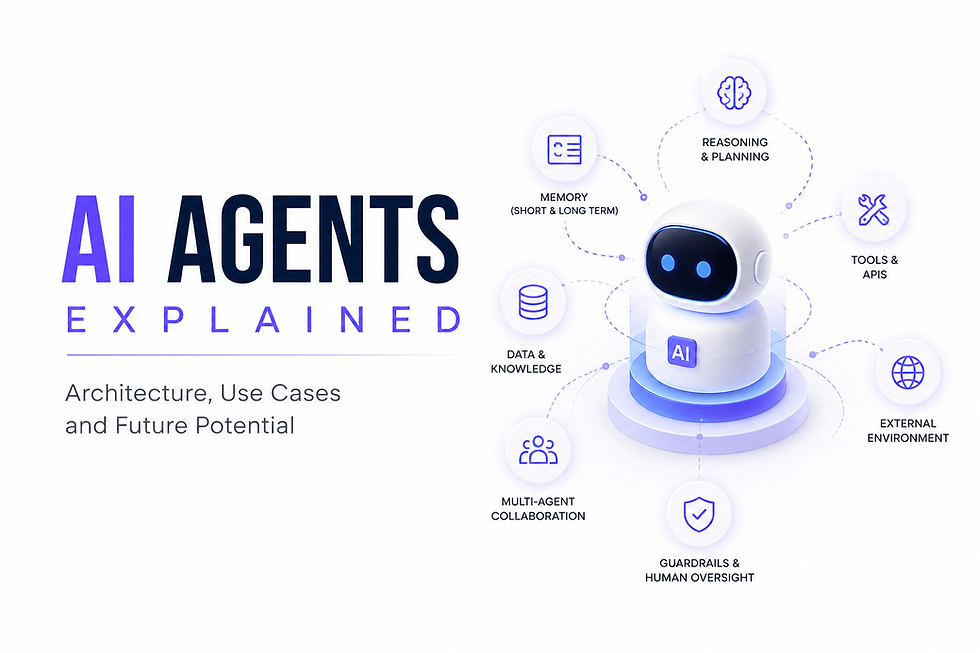
7. Intelligent logistics, AGV fleets, and automated asset tracking. RFID, UWB, and vision sensors track material and vehicle position; path-optimization and coordination models provide the AI capability; the decision is route or task assignment; the action is autonomous fleet movement; the outcome KPI is material handling cycle time. Fleet coordination like this increasingly overlaps with broader AI agents for orchestrating multi-step logistics decisions across a facility rather than a single vehicle.
AIoT vs Traditional Industrial Automation
Automation is not the same as autonomy. Traditional industrial automation runs on deterministic, rule-based logic — if this input occurs, execute that output, exactly as programmed, every time. It's dependable and predictable, which is precisely why so much of the installed base still runs on it. But that same rigidity means it can't handle variability it wasn't explicitly programmed for: a slightly different raw material batch, gradual tool wear, an unusual combination of environmental conditions. AIoT-driven automation is built to handle exactly that kind of non-deterministic variability, continuous process drift, and unscripted operating conditions, because it's reasoning from learned patterns rather than executing a fixed script.
Where human oversight remains necessary. None of this argues for removing people from the loop. Safety-critical decisions, novel failure modes the model hasn't seen before, and any action with irreversible consequences still warrant a human in — or at minimum, immediately adjacent to — the decision path. The plants getting AIoT right in 2026 aren't the ones chasing full autonomy; they're the ones being deliberate about where autonomy earns its keep and where it doesn't.
The Role of Digital Twins in AI and IoT Convergence
What makes a digital twin different from a 3D dashboard? A static 3D model is a visualization. A digital twin is a live, continuously updated representation, synchronized with real sensor data, capable of running forward simulations against current conditions rather than just displaying them.
How live IoT data keeps the digital twin synchronized. Every layer of the seven-layer stack feeds the twin — sensor readings update its state in near-real time, so the virtual model tracks the physical asset's actual condition rather than a design-time assumption of how it should be behaving.
How AI adds predictive and prescriptive capabilities. Once the twin is synchronized, AI models layered on top can forecast degradation trajectories and test process changes virtually before they're applied on the physical line — catching a bad setpoint change in simulation instead of in production.
From descriptive simulation to closed-loop industrial intelligence. The most mature digital twin deployments don't stop at "here's what's happening" — they close the loop, feeding twin-derived recommendations back into the decision engine automatically, which is the same principle behind AI digital twins more broadly.
Measurable Business Benefits of AIoT
It's worth being blunt about this: nobody credible is claiming 100% efficiency gains, and any pitch that does deserves skepticism. What the documented deployments actually show is more modest and more believable.
Reduced unplanned downtime. Unplanned downtime across global manufacturing has been estimated in the hundreds of billions of dollars annually, and industry analysts covering IIoT deployments have reported reductions of up to 30% in unplanned downtime at manufacturers running mature predictive maintenance programs — tracked through MTTR and MTBF metrics rather than vague "efficiency" claims.
Maximized asset utilization and OEE. Overall Equipment Effectiveness improves incrementally as unplanned stoppages, changeover delays, and quality losses each get chipped away by AIoT-driven visibility — not as a single dramatic jump, but as a compounding effect across the metric's three components (availability, performance, quality).
Accelerated defect detection and scrap reduction. Vision-based inspection catches defects at the point of production rather than downstream, which shortens the feedback loop between a process drift and a corrected setpoint — typically translated into single-digit-to-low-double-digit percentage reductions in scrap rate, depending on the baseline defect rate going in.
Operational energy waste reduction. Load-shifting and setpoint optimization tend to deliver realistic savings in the 15 to 30 percent range on the specific processes being optimized, rather than plant-wide, which is a distinction worth holding onto when evaluating vendor claims.

The Nine Biggest Deployment Challenges of AIoT
Getting the technology right is rarely the hard part. The obstacles that actually stall AIoT programs tend to cluster around nine recurring issues: fragmented industrial data sitting in incompatible formats across decades of equipment vintages; interoperability gaps between legacy OT machinery never designed to talk to modern IT systems; the cultural friction of merging IT and OT teams that have historically operated with different priorities and different risk tolerances; industrial cybersecurity exposure that grows every time IT/OT convergence connects a previously isolated control system to the broader network; edge compute hardware and power constraints that limit how sophisticated an on-device model can realistically be; AI model drift as environmental and process conditions change faster than retraining cycles catch up; explainability gaps that make operators reluctant to trust a black-box recommendation on a safety-relevant decision; the well-documented drift from a single successful pilot into what practitioners call "pilot purgatory" — never scaling past that first line; and, tying it all together, the difficulty of establishing credible baseline ROI metrics before committing to a multi-site rollout.
On the cybersecurity point specifically, this isn't a minor footnote. Manufacturing has recently ranked among the most ransomware-targeted sectors globally, and IT/OT convergence is precisely why: connecting control systems that were built assuming physical isolation to enterprise networks and cloud platforms expands the attack surface in ways traditional IT security models weren't designed to defend. Segmentation frameworks like ISA/IEC 62443 have become close to mandatory reading for anyone scoping an AIoT rollout, not optional hardening.
Step-by-Step AIoT Implementation Roadmap
Step 1 — Target a specific operational bottleneck. Don't start with "we want AIoT." Start with "unplanned downtime on Line 3 costs us X per incident."
Step 2 — Establish clear baseline KPIs. You can't measure improvement against a benchmark you never captured.
Step 3 — Audit existing sensor capabilities and connectivity. Most plants already have more usable sensor data than they realize; the gap is usually in the connectivity and contextualization layers, not raw sensing.
Step 4 — Add targeted instrumentation where gaps exist. Instrument for the specific failure modes tied to Step 1's bottleneck, not a generic sensor blanket.
Step 5 — Design the hybrid edge-cloud compute model. Decide, asset by asset, where inference needs to run locally and where cloud-scale training makes more sense.
Step 6 — Construct robust ingestion data pipelines. Time-series databases like InfluxDB or TimescaleDB are the practical backbone here — built specifically for the kind of high-frequency sensor data AIoT generates.
Step 7 — Select appropriate AI model architectures. Match the model to the problem: anomaly detection for condition monitoring, computer vision for inspection, reinforcement learning for optimization — resist the urge to force one architecture onto every use case.
Step 8 — Connect AI outputs to operational MES/ERP workflows. A prediction that doesn't automatically generate a work order is still just a dashboard.
Step 9 — Define human-in-the-loop governance boundaries. Decide explicitly, before deployment, which decisions the system can execute autonomously and which require sign-off.
Step 10 — Validate ROI against baseline before enterprise rollout. Prove it on one line with real numbers before committing capital to a plant-wide or multi-site expansion.
The FourfoldAI AIoT Maturity Model
We built this five-level model to give plant leaders a quick diagnostic for where they actually stand, since most self-assessments overstate maturity.
Level 1 — Connected. The diagnostic question: are your machines collecting data centrally, but running without any real-time analysis layered on top? If so, the priority action is upgrading gateways and standardizing on consistent communication protocols before anything else.
Level 2 — Observable. The diagnostic question: can operators see real-time dashboards, but are they still reacting after failures happen rather than before? The priority action is deploying automated anomaly detection with threshold-based alerts as the first real intelligence layer.
Level 3 — Predictive. The diagnostic question: can your systems accurately forecast component failure days in advance? The priority action is integrating those predictions directly into automated maintenance scheduling instead of leaving them as advisory reports.
Level 4 — Adaptive. The diagnostic question: does your facility automatically tune operating parameters based on live conditions, rather than requiring a person to make that call? The priority action is implementing genuine closed-loop machine-to-machine control.
Level 5 — Semi-Autonomous. The diagnostic question: can entire production lines self-optimize within defined safety guardrails, escalating exceptions to human teams rather than every decision? The priority action is establishing enterprise-wide multi-agent orchestration spanning both OT and supply chain systems — a level very few plants have actually reached as of 2026, regardless of what vendor marketing implies.
Emerging Technologies Powering the Future of AIoT
A handful of technical shifts are actively reshaping what's possible at the edge. Compact, quantized edge AI models are shrinking the gap between what a cloud-trained model can do and what an edge device can actually run. Specialized NPU and TPU accelerators purpose-built for industrial edge deployment are making that quantization practical rather than a lossy compromise. Federated learning is starting to let multiple facilities improve a shared model without ever centralizing raw operational data — a meaningful answer to the data-sovereignty concerns that slow down multi-site AI programs. Autonomous decision agents are beginning to take on OT workflow tasks that used to require a person reviewing a queue. Computer vision on edge cameras keeps getting cheaper and more accurate for inspection tasks that used to require dedicated vision-system hardware. And physical AI — AI-driven robotics operating directly on the factory floor — is where AIoT's sensing-and-decision loop starts extending into actual physical manipulation rather than monitoring alone.
Future Outlook: Distributed Industrial Intelligence
The direction of travel is fairly consistent across the analyst reports and the deployments we track: connected devices are giving way to distributed intelligence, where each node in the system carries enough local reasoning to act independently while still contributing to a shared, plant-wide (and eventually enterprise-wide) model. That shift is also starting to bridge gaps that used to be organizational as much as technical — design engineers, factory-floor operators, and field service teams working off the same live operational picture instead of three disconnected data sources. As that intelligence scales across global supply chains, the plants that treat AIoT as infrastructure rather than a point solution are the ones positioned to keep compounding the gains instead of plateauing after the first successful pilot.
Conclusion
AI and IoT convergence isn't a product you purchase off a shelf — it's an operating discipline built around a closed loop of sensing, inference, decision, action, and continuous learning. The plants seeing real results in 2026 aren't necessarily the ones with the most sensors or the newest edge hardware. They're the ones that got the architecture right: matching edge and cloud to the right workloads, building the data pipelines to support it, and being deliberate about where human oversight stays in the loop. The value was never really in the hardware. It's in mastering that loop, end to end.
If you're mapping out where your own operation sits on this maturity curve, FourfoldAI's other guides on AI in manufacturing, edge AI, and AI infrastructure go deeper into the specific technical decisions covered here.
Frequently Asked Questions About AI and IoT Convergence
What is AI and IoT convergence? AI and IoT convergence combines connected physical devices that collect real-world operational data with artificial intelligence systems capable of analyzing that data to detect anomalies, predict failures, and automate decisions. In industrial settings, this convergence (AIoT) transforms static machinery into intelligent, adaptive systems capable of real-time operational optimization. Rather than storing sensor data for later human review, AIoT systems interpret and act on that data within the same operational cycle, closing the loop between physical events and automated responses.
What is AIoT? AIoT stands for the Artificial Intelligence of Things. It represents the integration of AI algorithms — machine learning, computer vision, and time-series analysis — directly into IoT infrastructure to process data and trigger actions at the point of collection. In practice, that means models running on edge gateways or industrial PCs rather than exclusively in a distant cloud data center, so decisions happen fast enough to matter on a live production line.
How does AI improve traditional IoT systems? Traditional IoT systems collect and transport data mainly for historical human review, whereas AI adds real-time reasoning, pattern recognition, anomaly detection, and automated decision-making on top of that same data stream. This transforms passive data gathering into proactive operational control, shifting the value of the sensor network from a monitoring tool into an active part of the automation system itself.
What is the primary difference between IoT and AIoT? IoT focuses on connectivity and data transmission across physical assets, while AIoT focuses on intelligence and autonomous action built on top of that connectivity. IoT tells you what is happening; AIoT tells you what's likely to happen next and recommends, or in more mature deployments executes, a response — turning raw telemetry into an operational decision rather than a static reading.
How is AIoT used in modern industrial automation? Industrial AIoT powers predictive maintenance, automated visual quality inspection, energy usage optimization, real-time process tuning, operational digital twins, and autonomous AGV fleet management. Across each of these applications, the common pattern is the same closed loop: sensors capture a physical condition, AI models interpret it, and either a human or an automated system carries out a response that gets measured and fed back into future decisions.
What is the role of edge AI in AIoT deployment? Edge AI executes machine learning models directly on local hardware near the machine sensor, enabling latency often under 10 milliseconds, preserving local operational resilience during network outages, and reducing the volume of raw data that needs to be transmitted to the cloud. It's the piece of the architecture that makes real-time, safety-relevant automation possible, since cloud round-trip latency is simply too slow for many closed-loop control scenarios.
How do digital twins function alongside AIoT? IoT sensors stream live operational data into digital twin representations of physical assets, while AI algorithms process that data to run real-time simulations, forecast degradation, and prescribe optimal operating parameters. The twin becomes more than a visualization tool once it's continuously synchronized with real sensor data and layered with predictive models capable of testing a process change before it's applied to the physical line.
What are the main obstacles when implementing AIoT? Key challenges include fragmented legacy data formats, complex IT/OT integration, network security risks introduced by connecting previously isolated control systems, edge compute hardware and power constraints, model drift over time as operating conditions change, and the common struggle of moving successful single-line pilots into scalable, multi-plant deployments without losing momentum along the way.
Is AIoT the same as Industry 4.0?
No. Industry 4.0 is a broad strategic framework for digital transformation in manufacturing, encompassing everything from supply chain digitization to workforce upskilling, whereas AIoT is a specific technical architecture that combines AI algorithms with connected devices to deliver intelligent automation as one component within that broader Industry 4.0 strategy.
What is the future outlook for AI and IoT convergence?
The future of AIoT centers on distributed edge intelligence, privacy-preserving federated learning across multiple facilities, physical AI and robotics extending the automation loop into direct action, and deeper integration between factory-floor operational technology and enterprise planning systems, so that data generated on the shop floor informs decisions all the way up to supply chain and business planning.
References and Further Reading
This article draws on 2026 industry research and reporting from the following sources:
IIoT World — AI Predictive Maintenance 2026: A Manufacturing Guide
The Future of Things — How AIoT Is Reshaping Industrial Automation in 2026
Technavio — Industrial Internet of Things Market Growth Analysis 2026–2030
Precedence Research — Industrial IoT Market Size to Hit USD 2,430.21 Billion by 2035
Grand View Research — Digital Twin Market Size and Share Report
IoT Analytics — How AI & IT/OT Convergence Shift OT Cybersecurity
This article is backed by current industry research and is intended for general informational purposes. For guidance specific to your facility's architecture, risk profile, and compliance requirements, consult a qualified industrial automation or OT security professional. Read our full disclaimer here.
Want to go deeper on AI in the enterprise? Explore more guides on AI infrastructure, agentic systems, and industrial AI adoption at fourfoldai.com.
About the Author
Muizz Shaikh is an AI enthusiast and digital technology professional at FourfoldAI. He is passionate about exploring AI tools, industry trends, and practical applications of emerging technologies. Through FourfoldAI, Muizz contributes to simplifying artificial intelligence for businesses and learners. Connect with him on LinkedIn: linkedin.com/in/muizz-shaikh-45b449403/
© 2026 FourfoldAI. All rights reserved.

Comments