
AI and Sustainability: The Carbon Cost of Training and Running Large AI Models in 2026

Every time someone opens a chatbot and types a question, they are pulling on a physical thread that runs through a silicon fab in Taiwan, a substation in Virginia, a cooling tower in Arizona, and a power plant burning natural gas somewhere on a regional grid. AI and sustainability has become one of the defining operational questions of 2026, not because AI suddenly got dirtier, but because the world finally started measuring what was always there. We at FourfoldAI think the conversation has been stuck on the wrong question for years.
People keep asking "how much carbon does training a model produce?" when the more useful question is "what does it cost, in electricity, water, and hardware, to keep that model running for the next three years?"
That shift in framing matters. A frontier model's training run is a headline-grabbing spike, but it is bounded. It starts, it ends, and it produces a number. What happens after launch is a different animal entirely: millions of people prompting that model every hour, an ever-growing swarm of AI agents making dozens of internal calls to complete a single task, and data centers drawing more electricity per rack than an entire city block once did. When your team deploys an LLM into production, you are not signing off on a training bill. You are signing up for a multi-year operational footprint that most procurement processes still don't ask about.
This guide walks through where AI's environmental cost actually comes from, why the old training-versus-inference framing undersells the real picture, and what a practical sustainability strategy looks like for a business that has no intention of giving up AI. It won't. Nobody's is. The point is measuring what gets deployed.

What Does AI and Sustainability Mean?
A Simple Definition of Sustainable AI
Sustainable AI refers to the design, training, deployment, and governance of artificial intelligence systems in ways that minimize resource consumption — electricity, water, carbon emissions, and critical hardware materials — across the system's full operational lifecycle, while still delivering the business and societal value the AI was built to provide.
Notice what that definition does not say. It doesn't say "use less AI." It says measure and manage what the AI actually costs, physically, from the moment a chip is manufactured to the moment it's recycled. That distinction separates a serious sustainability program from a marketing slide.
Why AI Is Both a Sustainability Problem and a Sustainability Tool
AI occupies an uncomfortable dual role, and pretending otherwise doesn't help anyone.
On the problem side: massive compute scaling is straining local power grids, evaporating water in regions that can't spare it, and generating hardware that becomes e-waste within a few years. Ireland is the clearest cautionary tale here — data centres accounted for 21% of the country's metered electricity in 2023, and the national grid operator has paused new approvals around Dublin until 2028.
On the solution side, AI genuinely helps. It optimizes power grids in real time, runs industrial digital twins that cut wasted energy in manufacturing, accelerates climate modeling, and speeds up the discovery of better battery chemistries and carbon-capture catalysts.
The honest enterprise reality sits between those two poles: AI is only a net environmental positive when the emissions it helps avoid exceed the operational and embodied emissions of the infrastructure running it. That's not a slogan. It's an equation, and most organizations have never actually run the numbers on their side of it.
How Much Energy Do Large AI Models Use?
Direct Energy Metrics and the Scale Problem
AI energy consumption varies by several orders of magnitude depending on model size and task, ranging from a fraction of a watt-hour for a short text query on an efficient small model to tens of watt-hours for a long, reasoning-heavy request, and gigawatt-hours for training a frontier-scale model from scratch. There is no single number that represents "AI energy use" — and anyone quoting one without context is oversimplifying.
Here's why the range is so wide. According to the International Energy Agency's April 2026 report, global data centre electricity consumption grew 17% in 2025, while electricity going specifically to AI-focused facilities surged 50% in that same year — more than three times faster than the growth of overall data centre demand. Major model providers reported a threefold increase in active users and a fivefold increase in revenue over the past year, which tells you something important: the story isn't really about individual queries getting more expensive. It's about volume compounding on top of volume.
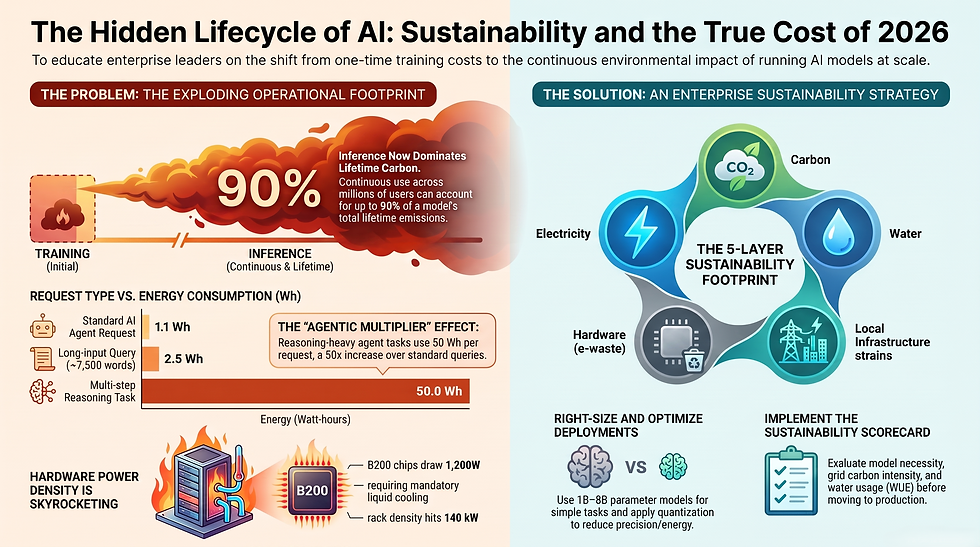
Per-query numbers illustrate the spread nicely. Research aggregated by Our World in Data, drawing on Epoch AI and IEA figures, put a standard AI agent request at roughly 1.1 Wh, a long-input query (around 7,500 words) at about 2.5 Wh, and an agentic request involving multi-step reasoning at closer to 50 Wh. That's a nearly 50x spread depending entirely on what kind of "prompt" you're talking about.
Why Model Size Matters — But Doesn't Tell the Whole Story
Parameter count used to be the go-to shorthand for "how expensive is this model to run." It's an incomplete proxy now, and dense-versus-sparse architecture is the reason.
A dense model activates every one of its parameters for every token it generates. A Mixture-of-Experts (MoE) architecture, by contrast, routes each token through only a small subset of specialized "expert" sub-networks, meaning a model that looks enormous on paper — hundreds of billions of parameters — might only activate a fraction of that during any given inference pass. This is why comparing two models purely by parameter count and calling the smaller one "greener" is often wrong. What actually matters is FLOPs per token generated, not headline parameter size.
The Role of GPUs, TPUs, and AI Accelerators
The hardware layer is where the abstraction of "the cloud" collapses into very concrete engineering numbers. An NVIDIA H100 draws up to 700W under sustained load. The newer B200 (Blackwell generation) pushes that to 1,000W air-cooled and up to 1,200W with liquid cooling — a jump of roughly 43% per chip. NVIDIA's rack-scale GB200 NVL72 system, which packs 72 Blackwell GPUs into a single interconnected rack, draws 120–140 kW, compared with the 8–10 kW that a traditional enterprise server rack pulled just a few years ago.
That's not a rounding difference — it's a different category of infrastructure. Air cooling becomes physically inadequate above roughly 35 kW per rack, which is why liquid cooling has gone from "nice to have" to mandatory at the frontier end of AI deployment.
GPU Generation | Typical TDP | Rack-Level Power Density | Cooling Requirement |
NVIDIA H100 (Hopper) | 700W | 35–40 kW per rack | Air cooling (upper limit) |
NVIDIA B200 (Blackwell) | 1,000–1,200W | 40–60 kW per rack | Liquid cooling required |
NVIDIA GB200 NVL72 (rack-scale) | ~2.7 kW per module | 120–140 kW per rack | Direct liquid cooling mandatory |
Why Data-Center Location Changes the Environmental Impact
Two identical AI workloads, run on identical hardware, can produce wildly different carbon footprints purely because of where the electricity comes from. A data center drawing power from a coal- or gas-heavy grid can emit 5 to 10 times more carbon per kilowatt-hour than the same workload run on a grid dominated by hydro, nuclear, or geothermal generation. This is why grid carbon intensity — measured in grams of CO₂ equivalent per kilowatt-hour — deserves as much attention in enterprise AI procurement as the price per token.
The Carbon Cost of Training Large AI Models
What Happens During AI Model Training?
Training a large model is a sustained, multi-stage process: data gets ingested and tokenized, then the model runs repeated forward and backward passes across thousands of interconnected GPUs, adjusting billions of parameters with each pass. This continues for weeks or months at near-peak electricity draw, not the bursty on-off pattern typical of most enterprise IT workloads.
What Determines Training-Related Carbon Emissions?
A handful of variables decide whether a training run's carbon footprint lands in the tens of tons or the hundreds:
Total compute volume (FLOPs) — the total mathematical operations the training run requires
Hardware efficiency — how much useful compute each GPU or TPU delivers per watt
Data center efficiency (PUE) — Power Usage Effectiveness, or how much overhead electricity the facility burns beyond what reaches the actual chips
Grid carbon intensity — the gCO₂e/kWh of the electricity at the data center's location
Training duration and iterations — how many hours or weeks the cluster runs continuously
Experimental R&D overhead — the hyperparameter sweeps, architecture searches, and failed runs that rarely make it into a published paper

Why Failed Experiments and Repeated Training Runs Matter
Here's something the published papers tend to leave out. Research emissions figures almost always describe the final training run — the one that produced the shipped model. What they routinely omit is everything that happened before that: the dozens of failed runs, restarted checkpoints, hyperparameter tuning passes, and fine-tuning experiments an engineering team goes through to get there. In our experience advising teams on AI infrastructure decisions, that hidden R&D overhead can plausibly double or triple the true carbon cost of getting a model to deployment — a gap that essentially never appears in a model card.
Operational Emissions vs. Embodied Emissions
Two very different kinds of carbon get lumped together under "AI emissions," and separating them matters for anyone trying to actually reduce a footprint.
Operational carbon is the electricity consumed while the computation is running — the part everyone thinks of first. Embodied carbon is everything that happened before the chip was even plugged in: mining the rare-earth elements and copper, manufacturing the silicon wafers, assembling the servers, and constructing the data center itself. Embodied carbon doesn't show up on an electricity bill, but it's real, and it's amortized across however long the hardware stays in service — typically just 2 to 4 years before replacement.
Is Running an AI Model Worse Than Training It?
Training vs. Inference: The Lifecycle Shift
Training creates a large, concentrated emissions spike. But once a model ships, continuous inference across millions of users typically accumulates emissions that overtake the training footprint well within the model's operational life — the exact timeline depends on how popular the model becomes.
Estimates on the exact inference share vary by methodology and by how "popular" the deployed model is. Google has previously estimated that roughly 60% of AI's combined training-and-inference energy goes to inference and 40% to training. Other analyses of high-traffic consumer AI services report inference shares running considerably higher — Meta researchers found inference accounted for roughly a third of their end-to-end ML footprint, while more recent industry commentary from AWS and NVIDIA has described inference as accounting for as much as 90% of the cost of large-scale AI workloads. A widely cited academic analysis found that for a low-volume deployment, training still dominates at 85%+ of lifetime emissions — but at billion-query scale, per-query emissions can vary by a factor of 70 across models, and inference becomes the primary driver. The honest takeaway: the training-versus-inference split isn't a fixed ratio — it's a function of how many people end up using the model, which is precisely why lifecycle thinking matters more than a single upfront number.
Training vs. Inference Lifecycle Comparison
Compute Execution. Training runs heavy, continuous, upfront batch compute. Inference is ongoing — real-time or batched requests that never really stop.
Time Horizon. Training is one-time or periodic, lasting weeks to months. Inference runs continuously across the model's entire deployment life, often years.
Scaling Factor. Training scales with dataset size and model architecture, fixed once the run is designed. Inference scales directly with user queries and token volume — it grows with adoption, not with engineering decisions.
Grid Load Profile. Training produces a predictable, sustained high-density load that can be scheduled around cheap or clean power. Inference produces variable peak demand that has to match real user traffic, in real time, with far less flexibility to shift.
Carbon Share. Training dominates the emissions picture at product launch. At scale, inference dominates the model's total lifetime carbon footprint.
The Environmental Cost of AI Agents in 2026
This is arguably the most underappreciated shift of the past year. A simple chatbot exchange is one prompt, one response. An agentic AI workflow is nothing like that. Agents run continuous reasoning loops, call external tools, execute code, and make repeated API retrieval calls to complete a single user-facing goal — and a single agentic task can trigger anywhere from 15 to 50 internal LLM calls, multiplying the inference footprint per task by roughly 10x to 50x compared with a single-turn query. IEA's 2026 estimates put a standard agentic request at around 1.1 Wh and an agentic request involving multi-step reasoning at roughly 50 Wh — a spread that lines up with that multiplier. As enterprises lean further into AI agents and their growing compute demands, this is the single biggest variable reshaping inference-side emissions right now, and it's growing faster than almost anyone's sustainability model accounts for.
Why There Is No Single Carbon Footprint for an AI Prompt
What Changes the Footprint of an AI Request?
Ten variables, working together, decide what a single AI prompt actually costs the planet: the model's architecture and parameter scale, prompt length (input tokens), response length (output tokens), reasoning complexity and chain-of-thought depth, modality (text versus high-resolution image versus video), server load and GPU allocation density, the data center's location and grid carbon intensity at the hour of the request, cooling system efficiency (PUE and WUE), whether speculative decoding or cache hits reduce redundant computation, and the model's quantization level. Change any one of these and the footprint shifts, sometimes by an order of magnitude.
Why Viral "One Prompt Equals X" Claims Are Misleading
You've probably seen the headline: "one AI prompt equals a bottle of water" or "running a lightbulb for three hours." Treat these with real skepticism. They typically collapse dozens of unstated assumptions — a specific model, a specific data center's PUE and WUE, a specific grid mix, sometimes peak rather than average hardware draw — into a single number presented as universal. Published per-prompt water figures alone span three orders of magnitude across companies, largely because they count entirely different things: Google's reported figure for a median Gemini text prompt covers only on-site cooling water, while Mistral's published figure for its Le Chat assistant includes both direct and indirect consumption. Comparing those two numbers as if they measure the same thing is comparing apples to a different fruit entirely.
AI's Environmental Impact Goes Beyond Carbon Emissions
Carbon gets the headlines, but it's one layer of a larger physical footprint. We use this framework internally at FourfoldAI when we walk enterprise teams through AI infrastructure decisions:
THE 5-LAYER AI SUSTAINABILITY FOOTPRINT
Electricity — baseline and peak kilowatt-hour draw
Carbon — operational and embodied greenhouse gas emissions
Water — data center cooling and power generation usage
Hardware — critical minerals, e-waste, silicon supply chain
Infrastructure — land, substation access, local grid capacity
Layer 1 & 2: Electricity & Carbon
These two are tightly coupled — carbon emissions are essentially a function of how much electricity gets consumed multiplied by how dirty that electricity's grid mix happens to be. Everything covered in the sections above feeds directly into this layer.
Layer 3: AI and Water Consumption
Water shows up in two forms. Direct water use is on-site — evaporative cooling towers that keep GPU clusters from thermal-throttling under sustained load. Indirect water use happens off-site, at the thermoelectric power plants generating the electricity the data center consumes, since most conventional power generation also relies on water for cooling.
The scale here is no longer a niche concern. A UN University report published in June 2026 — the first UN-commissioned study to specifically quantify AI's water and land footprint alongside its carbon impact — found that 2025 data center water consumption was already equivalent to 1.8 million Olympic-sized pools, and projected that by 2030, the associated water footprint could equal the basic annual domestic water needs of 1.3 billion people in Sub-Saharan Africa. The report's lead author, Miriam Aczel, made a point worth sitting with: choices that look greenest from a carbon lens can be worse for water or land — solving one problem while quietly creating another somewhere else, often in a community that had no say in the decision.
Industry water disclosures back up how uneven this picture is across providers. Amazon reported a 0.12 L/kWh water usage effectiveness (WUE) figure for 2025, versus a broader industry average closer to 0.59 L/kWh based on a 2026 peer-reviewed comparison across companies that disclose both electricity and direct water figures.
Layer 4: The Hardware and Critical-Material Footprint of AI
Every AI accelerator carries an embedded supply chain: cobalt, lithium, copper, neodymium, high-bandwidth memory, and chips manufactured through advanced photolithography processes concentrated in a handful of facilities worldwide. With hardware replacement cycles running just 2 to 4 years — driven by the pace of new GPU generations — this layer generates a steady, compounding stream of electronic waste that rarely factors into a sustainability conversation focused only on kilowatt-hours.
Layer 5: Land and Infrastructure Strains
Data centers aren't abstract — they're physical buildings competing for physical land, transmission corridors, and electrical substation capacity alongside residential and industrial users. The UNU report projected that by 2030, the land footprint of AI-driving data centres could exceed 14,500 square kilometers, roughly twice the size of the Jakarta metropolitan area. Grid connection queues in some markets already stretch five to ten years, and power availability — not permitting or land — has become the leading cause of construction delay for new AI data centers.
The AI Sustainability Paradox: More Efficient Models Can Still Increase Total Energy Use
What Is the AI Rebound Effect (Jevons Paradox)?
The AI rebound effect occurs when engineering breakthroughs reduce the energy or cost required per query, making AI cheaper and faster to deploy — and that reduction in cost drives such a large surge in total usage that overall resource consumption rises, even though each individual query is more efficient than before.
This isn't theoretical. The IEA's 2026 analysis notes that per-query energy use has dropped by at least an order of magnitude annually in recent years, while total AI-focused data center electricity demand still surged 50% in a single year. As one UNU-INWEH co-author put it plainly: more efficient and affordable AI means more consumption of AI, making the overall footprint bigger than what efficiency gains alone saved.
Why Efficiency Per Query Does Not Guarantee Lower Total Emissions
Picture a 30% reduction in energy per token, achieved through quantization or a smarter serving stack. That sounds like a clean win — until enterprise query volume grows 500% in the same period, which is not a hypothetical; it's roughly the trajectory major model providers have reported over the past year in active users and revenue. The per-unit efficiency gain gets swamped by the adoption curve.
How AI Adoption Outpaces Infrastructure Efficiency Gains
The IEA frames this as three competing trends running simultaneously: efficiency improving, adoption surging, and use cases themselves getting more energy-intensive as agentic and reasoning-heavy workloads spread. All three are accelerating at once, which is precisely why hardware efficiency gains alone will not be the thing that stabilizes AI's total energy footprint.
How AI Data Centers Are Changing Global Energy Demand
Why AI Workloads Differ from Traditional Cloud Computing
Traditional cloud computing — web servers, databases, storage — produces relatively steady, distributed demand spread across many facilities. AI training and inference clusters concentrate enormous, continuous compute demand into localized, ultra-high-density footprints. It's a fundamentally different load profile for a grid to plan around.
The Connection Between AI Growth and Grid Capacity
Data center hubs are increasingly straining regional electrical utilities. In some U.S. states, grid zones already exceed 39% of local electricity consumption going to data centers. That strain shows up as power utility interconnection queues, delayed decommissioning of fossil-fuel plants needed to cover baseload demand, and, in places like Ireland, outright moratoria on new data center approvals.
Can Renewable Energy Keep Up with AI Demand?
The honest answer requires distinguishing between two very different kinds of "clean" claims. Annual net-zero accounting means a company buys enough renewable energy certificates over the course of a year to offset its total consumption — even if, on any given hour, the actual electricity flowing into its servers came from a coal plant. 24/7 Hourly Carbon-Free Energy (CFE) matching is the stricter standard: matching a facility's actual, hour-by-hour operational grid draw with clean power generation in real time. Most corporate sustainability claims today still lean on the annual model, which is considerably easier to hit and considerably less meaningful.
How Can Companies Reduce the Carbon Footprint of AI?
An actionable checklist for enterprise AI architects and decision-makers:
Right-size your models. Don't default to a 70B+ parameter frontier model for simple sentiment analysis, classification, or extraction tasks. Specialized 1B–8B smaller and more efficient AI models often handle these with a fraction of the compute.
Implement intelligent task routing. Route queries dynamically — simple tasks to small models, complex reasoning to frontier models — instead of sending everything through the biggest available model by default.
Optimize context windows and prompt engineering. Trim unnecessary tokens, cut context bloat, and cap runaway generation lengths. Shorter prompts and responses translate directly into lower per-query energy draw.
Apply quantization and distillation. Compress FP16 models down to INT8 or INT4 precision, and use model distillation for AI efficiency to transfer knowledge into smaller, faster student models.
Batch non-urgent workloads. Delay asynchronous or offline batch processing to run during off-peak hours, when the local grid mix is often cleaner and cheaper.
Leverage carbon-aware computing. Schedule heavy compute jobs in regions and time windows where renewable generation is currently highest.
Select high-efficiency hardware and cloud providers. Prioritize data centers with PUE below 1.15, and modern GPU or TPU architectures over legacy hardware.
Track inference emissions alongside training. Deploy telemetry that measures token volume, compute hours, and inference energy across departments — not just the one-time training bill.
Separate carbon, water, and hardware metrics. Avoid collapsing sustainability into a single number. Track WUE and hardware lifecycle span independently from carbon.
Embed sustainability into AI procurement. Make energy efficiency and provider carbon disclosures a mandatory evaluation criterion alongside latency, accuracy, and cost — not an afterthought bolted on later.
A Practical AI Sustainability Framework for Enterprises
The FourfoldAI Enterprise AI Sustainability Scorecard gives decision-makers a structured way to evaluate AI deployments before they ship, not after the electricity bill arrives.
Scorecard Dimension | Key Evaluation Criteria | Enterprise Action Item |
1. Model Necessity | Is a high-parameter generative model strictly required? | Replace with deterministic code or specialized SLMs where possible |
2. Compute Efficiency | FLOPs per request, memory bandwidth requirements | Quantize models (INT8/INT4) and implement prompt compression |
3. Energy Draw | kWh per million tokens processed | Benchmark hardware power consumption across cloud providers |
4. Grid Carbon Intensity | gCO₂e/kWh of regional data center grid | Shift asynchronous jobs via carbon-aware scheduling APIs |
5. Water Usage (WUE) | Liters of water consumed per compute hour | Choose facilities using closed-loop dry cooling systems |
6. Hardware Longevity | Embodied carbon amortized over asset lifetime | Extend server refresh cycles and mandate supplier recycling |
7. Scale Multiplier | Projected environmental impact at 10x volume | Stress-test architecture choices against long-term cost and carbon projections |
Run a deployment through all seven rows before it goes to production, and most of the surprises that show up in a year-two sustainability audit simply don't happen.
Can AI Help Solve Climate and Sustainability Problems?
This deserves a balanced answer, not a greenwashed one. AI is genuinely useful in several concrete ways:
Energy grid optimization — predictive AI helps balance volatile renewable inputs like wind and solar across national grids in ways manual forecasting can't match.
Smart infrastructure and digital twins — simulating industrial supply chains and building HVAC systems to cut wasted energy, an approach covered in more depth in AI-powered digital twins.
Climate science and materials discovery — accelerating battery chemistry iteration and carbon-capture catalyst research, which we explore further in AI applications for sustainable materials discovery and in our broader look at large-scale scientific AI models.
The caveat that has to accompany all of this: net avoided emissions have to explicitly exceed the raw compute emissions generated to run the models doing the avoiding. An AI system that saves a factory 5% on energy use isn't a win if the AI system itself consumes more than it saved. That math has to be shown, not assumed.
The Future of AI and Sustainability: What Changes After 2026?
A few trends are already visible heading into the next few years, explored further in our broader look at AI trends shaping the next decade:
A gradual shift from monolithic, do-everything LLMs toward leaner, domain-specific small language models and energy-efficient on-device AI that skips the data center round-trip entirely for simpler tasks.
Wider adoption of carbon-aware scheduling APIs built natively into orchestration platforms like Kubernetes and Ray, rather than bolted on as an afterthought.
Movement toward standardized regulatory reporting requiring Scope 1, 2, and 3 greenhouse gas disclosures specifically for AI compute — something the UN's June 2026 AI Environmental Transparency Initiative is already pushing hyperscalers toward.
Hardware breakthroughs in neuromorphic computing, optical interconnects, and specialized low-power silicon that could meaningfully shift the efficiency curve, though these remain earlier-stage relative to the GPU architectures dominating deployment today.
Final Thoughts: AI and Sustainability Require Lifecycle Thinking
AI and sustainability is no longer a CSR talking point that lives in a separate slide deck from the engineering roadmap. It's a core operational and financial discipline, the same way security or uptime became non-negotiable line items a decade ago. The path forward does not require abandoning AI — nobody serious is proposing that, and the technology's upside is real. It requires measuring what gets deployed, honestly, across electricity, carbon, water, and hardware, rather than stopping the accounting the moment a training run finishes. Businesses that build this measurement discipline now — before regulation forces it — will be the ones making procurement and architecture decisions with real numbers instead of guesses.
Frequently Asked Questions
Q1: How much carbon does AI produce? AI carbon emissions vary widely based on model parameter size, compute duration, hardware efficiency, and data-center electricity sources. A single text response can emit a small fraction of a gram of CO₂, while large training runs generate hundreds of metric tons, and global high-volume inference adds up to a substantial and rapidly growing annual total.
Q2: Does AI training use more energy than AI inference? Not necessarily, and it depends heavily on how popular the deployed model becomes. Training creates a concentrated upfront surge of energy consumption, but for widely used models, continuous inference across millions of daily users can account for well over half of a model's total lifetime emissions — sometimes considerably more at very large scale.
Q3: Why do AI models use so much electricity? AI models require millions of complex matrix multiplication operations performed simultaneously across specialized processors like GPUs and TPUs. Supplying continuous high-wattage power to thousands of these chips, plus the power needed to cool high-density data center racks, drives substantial electricity demand.
Q4: What is the carbon footprint of a single AI prompt? There is no universal number. Depending on model size, reasoning complexity, data center location, and grid energy source, a simple text query might use a fraction of a watt-hour, while a multi-step reasoning or agentic task can use tens of watt-hours — a difference of one to two orders of magnitude.
Q5: Is AI bad for the environment? AI has a real physical footprint spanning electricity, carbon emissions, water use for cooling, and hardware e-waste. It also has genuine potential to optimize energy grids, accelerate sustainable materials discovery, and reduce industrial waste. Its net impact depends heavily on how responsibly it's built, deployed, and measured.
Q6: What is sustainable AI? Sustainable AI is the practice of designing, training, and deploying artificial intelligence models to minimize environmental costs — carbon, water, energy, and hardware waste — across their entire lifecycle, while preserving the practical performance the application needs.
Q7: How can companies make AI operations more sustainable? Companies can deploy smaller specialized models where appropriate, route prompts dynamically by task complexity, apply quantization and distillation, use carbon-aware scheduling for batch workloads, choose energy-efficient cloud regions, and track ongoing inference metrics with the same rigor usually reserved for training metrics.
Q8: Do smaller AI models have a lower environmental impact? Generally yes. Smaller language models in the 1B–8B parameter range require far fewer floating-point operations per generated token, running efficiently on less power and memory bandwidth, and are often capable of running directly on edge devices with minimal data center overhead.
Q9: Will more efficient AI hardware solve the energy crisis? Hardware efficiency alone is unlikely to resolve AI's growing energy footprint, because of the rebound effect. As compute becomes cheaper and more efficient, total adoption and query volume tend to expand rapidly enough to offset — and in many cases exceed — the per-query energy savings.
References
This article draws on primary data and research from the following sources:
International Energy Agency — Key Questions on Energy and AI (2026)
International Energy Agency — Energy and AI Special Report, Executive Summary
UN News — AI's environmental costs threaten water, land and climate
Our World in Data — How much energy do data centers and artificial intelligence use?
Carbon Brief — AI: Five charts that put data-centre energy use and emissions into context
NVIDIA HGX Platform: Data Center Physical Requirements Guide
This article is based on publicly available research, industry reports, and technical documentation current as of August 2026. Figures on emerging AI energy and water use are estimates drawn from multiple methodologies that differ in scope and boundary conditions; readers should treat comparisons across sources with appropriate caution.
Ready to think through your organization's AI infrastructure strategy with sustainability built in from day one? Explore more practical AI guides at FourfoldAI.com, where we break down the technology, the trade-offs, and the numbers that actually matter for business decisions.
Disclaimer: This article is intended for general informational purposes and reflects publicly available data at the time of writing. It does not constitute environmental, legal, or financial consulting advice. For the full disclaimer, please visit fourfoldai.com/disclaimer.
About the Author
Muizz Shaikh is an AI enthusiast and digital technology professional at FourfoldAI. He is passionate about exploring AI tools, industry trends, and practical applications of emerging technologies. Through FourfoldAI, Muizz contributes to simplifying artificial intelligence for businesses and learners. Connect with him on LinkedIn: linkedin.com/in/muizz-shaikh-45b449403/
© 2026 FourfoldAI. All rights reserved.


Comments