
Short Narrative Writing Prompt: Complete Guide to Better Story Ideas with AI

Every writer knows the specific dread of a blank page. The cursor blinks, the deadline creeps closer, and somehow the one thing you're supposed to be good at — coming up with ideas — refuses to show up. A short narrative writing prompt is the fastest way out of that trap. It's a small, structured spark: a character, a setting, a hint of conflict, just enough to get your hands moving on the keyboard again.
What's changed in the last few years isn't the concept of a writing prompt. Teachers have used them for decades, and journal apps have been shipping them since the early 2000s. What's changed is who's generating them. Large language models like Claude and ChatGPT can now produce dozens of tailored, genre-specific prompts in seconds, adapting tone, setting, and character complexity to whatever a writer actually needs that day.
This guide treats AI as exactly that — a collaborator, not a replacement. Great writing still starts with a great question, and increasingly, that question comes from a conversation between a human's intent and a machine's pattern recognition. Below, you'll find a working definition of narrative prompts, the psychology behind why they work, over 150 ready-to-use ideas across ten genres, copyable prompt templates for tools like Claude and ChatGPT, and an honest look at where AI-generated fiction still falls short.
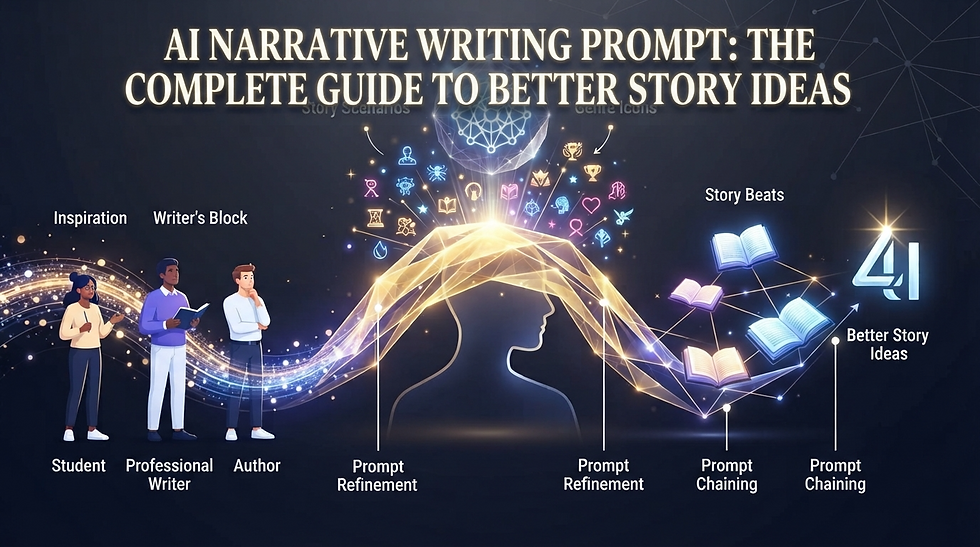
What Is a Short Narrative Writing Prompt?
Definition
A short narrative writing prompt is a brief scenario, question, or premise — usually one to three sentences — that gives a writer a starting point for a story. It typically names a character, establishes a setting, and hints at a conflict or decision the character has to face, leaving the actual plot, dialogue, and resolution entirely up to the writer.
Think of it as scaffolding, not a script. A prompt hands you the frame of a house; you still decide what color to paint the walls and who lives inside.
Purpose
There's a specific psychological reason prompts work as well as they do: constraint reduces decision fatigue. When a writer faces an entirely open page — "write anything you want" — the brain has to evaluate infinite possibilities before committing to one. That evaluation process is exhausting, and it's often where writer's block actually originates.
A prompt narrows the field. Once you know your protagonist is a retired lighthouse keeper who just found a message in a bottle addressed to her by name, your brain stops asking "what should I write about?" and starts asking "what happens next?" That second question is far easier to answer, and it's the one that actually produces pages.
Common Use Cases
Narrative prompts show up in more places than most people realize:
Novelists use them to draft side stories, test a character's voice before committing to a full manuscript, or break through a stuck chapter by writing an unrelated scene first.
Students use them in creative writing classrooms to practice pacing, dialogue, and narrative arc without the pressure of an entire assignment.
Copywriters and marketers borrow narrative structure to build case studies, brand stories, and customer testimonials that read like stories instead of bullet-pointed feature lists.

Why Narrative Writing Prompts Improve Creativity
Overcoming Writer's Block
Writer's block isn't usually a lack of imagination — it's decision paralysis dressed up as a lack of imagination. Every open-ended writing session requires the brain to choose a genre, a character, a setting, and a conflict simultaneously, and that's a lot of analytical overhead before a single word gets typed.
A well-built prompt handles three or four of those decisions for you. It doesn't just make writing easier; it bypasses the part of the brain that overthinks and hands control to the part that just wants to tell a story.
Developing Storytelling Skills
Prompts are also one of the most efficient tools for practicing individual craft skills in isolation. Instead of trying to master an entire novel at once, a writer can use a prompt to isolate one specific muscle:
Writing tense dialogue between two characters who can't say what they actually mean.
Building sensory description in a scene where nothing dramatic happens yet.
Practicing a plot twist that recontextualizes everything the reader assumed in the first paragraph.
This kind of deliberate, narrow practice tends to build skill faster than attempting full stories every time, the same way a musician practices scales before performing a concerto.
Classroom Applications
For educators, narrative prompts solve a very practical problem: getting a room of reluctant writers to actually start. A ten-minute prompt-based warmup at the start of a creative writing class does more than fill time — it builds a low-stakes habit of fast ideation, gives students permission to write badly on the way to writing well, and reinforces narrative arc comprehension one small exercise at a time.
Teachers increasingly pair this with AI tools to generate differentiated prompts on the fly — an easier, character-driven prompt for a struggling writer and a more structurally demanding one for an advanced student, without having to write twenty separate handouts. This mirrors a broader shift happening across digital tools, where how AI models are learning tool usage and computer interaction in 2026 is making classroom software far more adaptive than it was even two years ago.
Professional Writing
Marketers and brand strategists have quietly become some of the heaviest users of narrative prompting techniques, even if they'd never call themselves fiction writers. A customer case study built around a clear inciting incident — "the moment everything broke" — and a resolution reads more persuasively than one built around a feature list. Narrative prompts help copywriters draft that structure quickly, then layer in real customer details afterward.
How AI Generates Better Narrative Writing Prompts
Pattern Recognition
Large language models have been trained on enormous volumes of published fiction, which means they've effectively absorbed the recurring shapes of classical story structure — the three-act arc, the hero's journey, the tragic reversal — without being explicitly taught any of them as rules. When you ask an LLM for a prompt, it's drawing on that pattern library to construct a setup that already has the bones of a working story: a character with a want, an obstacle in the way, and a ticking clock of some kind.
This is genuinely useful for writers who haven't internalized story structure yet. The AI's default output tends to be structurally sound even when a beginner wouldn't know to build it that way on their own.
Context Awareness
Where this gets more interesting is in how well a modern LLM can hold multiple constraints simultaneously without drifting off course. Ask for "a mystery set in a coastal town in 1923, written in a gothic realism tone, where the detective is afraid of water," and a capable model will actually track all four of those variables through the entire response — not just the setting, and not just the fear, but the interaction between them.
Older or weaker models tend to lose track of secondary details a few sentences in. Larger context windows and more careful instruction-following have made this kind of layered prompt generation far more reliable than it was just a couple of years ago.
Genre Adaptation
One of the more practical party tricks of AI-assisted prompting is genre transposition — taking a single narrative core and reskinning it across completely different settings. A mystery prompt about a stolen inheritance can become a space opera about a stolen terraforming contract, or a fantasy story about a stolen bloodline claim, while keeping the same underlying tension between characters. This is genuinely helpful for writers stuck in one genre who want to test whether their core idea has legs elsewhere.
Character Generation
AI models are particularly strong at generating psychologically coherent character setups quickly — giving a character a want, a flaw, and a secret that contradicts each other in interesting ways. A prompt that hands you "an ambitious junior lawyer who secretly sabotages her own cases out of guilt over her father's wrongful conviction" gives you far more to work with than a flat description like "a lawyer with a troubled past."
Plot Creation
Finally, AI tools are useful for mapping the mechanical skeleton of a short story — the inciting incident, the implicit conflict, and the decision point the character is heading toward — directly into the prompt itself. This doesn't replace the writer's job of actually developing that plot, but it does hand over a workable starting shape instead of a vague premise.
150+ Short Narrative Writing Prompt Ideas
Each prompt below is written as a two-to-three sentence setup with a clear character, setting, and stake — not a one-line premise. Pick one, change a detail if it doesn't quite fit, and start writing.
Adventure
A cartographer discovers her latest map doesn't match the territory anymore — an entire valley has vanished, and the locals insist it was never there.
A retired mountain guide is hired to lead one final expedition, only to realize the client is searching for the same peak that killed his brother twenty years ago.
A smuggler's ship runs aground on an island that isn't on any chart, and the crew finds evidence that someone has been waiting for them.
Two rival treasure hunters are forced to share a single working compass, and neither trusts the other enough to sleep first.
A city courier discovers her usual delivery route now leads through a district that officially stopped existing three years ago.
A washed-up explorer is offered one last chance at redemption: guide a stranger to a location he swore he'd never return to.
A young sailor inherits her grandfather's logbook and realizes the final, unfinished entry describes a storm that hasn't happened yet.
A desert caravan guide takes on a passenger who refuses to explain why every settlement they pass through seems to already know her name.
A river pilot navigating a flooded city finds a locked door floating in the current — still upright, still locked, with no house attached.
An amateur climber summits a mountain alone and finds a tent already pitched at the top, recently used, with no way anyone could have beaten her there.
A courier pigeon returns to its handler carrying a message in handwriting that matches her own, dated a week into the future.
A lighthouse keeper's replacement arrives to find the previous keeper's boots still by the door, and the logbook ends mid-sentence.
A group of urban explorers breaks into a sealed subway station and finds the platform lights still working, and still warm.
A bounty hunter tracks her target to a town that has no residents older than thirty, and no one will say why.
A young stowaway aboard a cargo airship discovers the crew isn't hiding from pirates — they're hiding from something already on board.
Mystery
A detective investigating a burglary realizes nothing was stolen — instead, something was left behind that shouldn't exist yet.
A small-town librarian notices the same book has been checked out and returned by twelve different people, all claiming they've never been to the library before.
A forensic accountant finds a decade-old expense report that perfectly predicts a crime that hasn't been committed yet.
A night-shift hotel clerk realizes the guest in room 214 has checked in every night for a month, always alone, and never leaves.
A retired detective is asked to reopen her own unsolved case, only to discover she wrote the original file in handwriting that isn't hers.
A locksmith is called to a house where every lock has been changed from the inside, and the family swears they never touched them.
A journalist investigating a cold case finds a matching case file from thirty years earlier, identical down to the exact time of the crime.
A pawnbroker takes in a watch that keeps perfect time except for one missing hour, every single day, at the exact moment of a local disappearance.
A crime scene photographer notices the same figure standing in the background of every photo she's taken for the past two years.
A courtroom stenographer realizes she's been transcribing testimony that hasn't been spoken yet, word for word, every single trial.
An insurance investigator flags a claim where the "accident" matches an unsolved case from before the claimant was born.
A private investigator is hired to follow a man who turns out to already know her exact schedule, down to the minute, before she's decided it herself.
A museum curator discovers a security tape showing an empty gallery, except for a single exhibit case that keeps appearing and disappearing between frames.
A coroner's assistant finds identical, unexplained bruising on three unrelated bodies delivered on the same night, each marking the same date.
A retired code-breaker is handed an intercepted message that, once decrypted, turns out to be a warning addressed specifically to her.
Fantasy
A blacksmith discovers her forge only produces flawless blades on nights when she dreams of a war she's never fought in.
A minor court scribe realizes the kingdom's official history changes slightly every time she falls asleep, and only she seems to notice.
A young apprentice witch's spellbook keeps writing new pages in her handwriting, describing spells she hasn't learned to cast yet.
A dragon-keeper's newest hatchling refuses to breathe fire — instead, it hums a lullaby the keeper's mother used to sing.
A wandering bard collects a story from every town she visits, unaware that the stories are slowly stitching themselves into a single prophecy about her.
A castle gardener discovers a single tree in the royal orchard that grows a different fruit depending on who's watching it.
An exiled prince is offered a crown by a kingdom that insists he's already ruled it once before, in a life he doesn't remember.
A village healer's remedies work perfectly on strangers but fail completely on anyone she loves, and no one can explain the pattern.
A thief steals a mirror from a wizard's tower, only to find it reflects the room she's standing in — one day into the past.
A young squire discovers his sword only draws itself from its sheath in the presence of someone who's about to lie.
A hedge witch is asked to lift a curse from a well-off merchant, only to discover the curse is protecting the town from something worse.
A cartographer for the royal court is tasked with mapping a forest that rearranges itself every time someone tries to leave it.
A retired knight is summoned back to guard a princess who insists she remembers a version of the knight who died defending her, decades ago.
A traveling merchant discovers his enchanted lantern only lights paths that lead toward danger, never away from it.
A young oracle realizes her prophecies have started coming true in reverse order, and the final one has already happened.
Romance
A florist keeps receiving anonymous orders for funeral arrangements delivered to a woman who, according to the address, doesn't exist yet.
Two rival chefs are forced to co-host a cooking show after their restaurants are destroyed in the same fire, on the same night.
A wedding photographer keeps photographing the same couple at other people's weddings, years apart, never aging.
A translator hired for a diplomatic dinner realizes she's falling for the one guest whose words she's specifically forbidden to translate honestly.
A widow renovating her late husband's bookstore finds love letters in the margins of every book, addressed to a name she doesn't recognize — her own, in twenty years.
A struggling musician is hired to write a wedding song for a stranger, only to realize the wedding is his own, years from now.
Two competing app developers, both building rival dating apps, are matched by a third, unrelated dating app neither of them uses.
A letter carrier delivers the same unopened love letter to the same address for six months, until she finally decides to read it herself.
A divorce lawyer is hired by a client to end a marriage that, according to every record, never legally began.
A ghostwriter hired to complete a dead romance novelist's final manuscript realizes the unfinished love story is her own, thinly disguised.
A grief counselor falls for a client whose wife supposedly died — except the wife keeps sending him messages the counselor can somehow see.
A perfumer creates a custom scent for a client's late spouse, only to discover the formula matches a scent she wore on a first date she doesn't remember having.
Two estranged childhood friends reunite through an anonymous pen-pal program, unaware they're writing to each other.
A wedding planner discovers her latest client is marrying the fiancé she left at the altar a decade earlier — under a different name.
A radio host who takes late-night call-in confessions realizes one recurring caller has been describing, in perfect detail, a relationship the host hasn't had yet.
Science Fiction
A terraforming engineer discovers the planet's atmosphere is adjusting itself to match a climate report she hasn't filed yet.
A generation ship's historian finds a passenger manifest listing crew members who haven't been born.
An AI maintenance technician discovers the station's central intelligence has started writing letters to its own predecessor, which was decommissioned years ago.
A colony's sole doctor is asked to treat a patient whose medical records describe injuries that won't happen for another six months.
A deep-space courier pilot finds a distress signal on a loop, broadcasting from a ship that hasn't launched yet.
A memory archivist is hired to catalog a dying man's uploaded consciousness, only to find memories of a life the man swears he never lived.
A synthetic caretaker raising an orphaned child begins receiving instructions from a version of itself that claims to be from ten years in the future.
A xenobiologist studying an alien organism realizes it's slowly reconstructing itself into the shape of her own childhood home.
A colony ship's navigator discovers the star charts have been quietly rewriting themselves to avoid a planet that doesn't officially exist.
A quantum physicist working on faster-than-light communication receives a reply to a message she hasn't sent yet.
A cybernetics technician repairing an old combat android finds it's been dreaming — and drawing sketches of a war that ended before it was built.
A planetary evacuation officer is told to prioritize a family that, according to every database, was never registered as living on the planet at all.
An orbital gardener maintaining a station's only greenhouse notices the plants only thrive on days she doesn't think about her sister back on Earth.
A first-contact linguist realizes the alien signal she's decoding is a translation of a book she wrote, but hasn't published yet.
A salvage crew recovers a derelict ship's black box containing a recording of their own current conversation, timestamped a week ago.
Horror
A night-shift security guard notices the cameras in the empty east wing are recording footage from a night that already happened.
A new homeowner discovers a locked room the realtor swore didn't exist, and every night it moves one door closer to the bedroom.
A hospice nurse realizes her patients keep describing the same recurring dream — of her, standing at the foot of their beds, before they've met.
A children's book illustrator starts finding pages in her sketchbook she doesn't remember drawing, each one depicting her own house from outside, at night.
A small town's new schoolteacher discovers the class photo from fifty years ago includes a student who looks exactly like her.
A radio DJ taking overnight calls starts receiving the same caller every night, describing, in growing detail, the exact contents of the DJ's apartment.
A cave researcher's expedition camera captures something walking past the tent at 3 a.m. — wearing her own jacket.
A grieving widower keeps receiving voicemails from his dead wife's phone, each one referencing conversations they haven't had in this timeline.
A house-sitter finds a family photo album that updates itself overnight, slowly adding her into every picture.
A night janitor at an old theater keeps hearing applause from an audience that isn't there — growing louder each night, closer to opening night of a play that closed decades ago.
A new parent notices the baby monitor occasionally picks up a lullaby being sung in a voice that sounds exactly like their own, from the empty nursery.
A rural mail carrier finds the same abandoned farmhouse mailbox filling with letters addressed to her, postmarked from a town that burned down thirty years ago.
A photo restorer working on an old family album notices a figure in the background of every photo, slowly walking closer to the camera across generations.
A late-night rideshare driver picks up the same passenger every week, who never speaks and always asks to be dropped at an address that doesn't exist on any map.
A groundskeeper at an old estate finds a gravestone freshly carved with tomorrow's date and a name he doesn't recognize — until he checks his own reflection.
Historical
A telegraph operator during the war intercepts a message meant for someone with her exact name, in a unit she's never heard of.
A seamstress hired to alter a soldier's uniform finds a letter sewn into the lining, addressed to a wife who hasn't been born yet.
A ship's doctor crossing the Atlantic in 1912 keeps a private log describing a disaster the captain refuses to acknowledge is coming.
A young apprentice in a Renaissance workshop discovers her master's unfinished painting depicts a building that won't be constructed for another century.
A railway clerk during the gold rush notices the same unclaimed parcel arriving on every train, addressed to a name that matches the town's founder.
A nurse during a wartime epidemic keeps a diary that a descendant, generations later, will use to identify her own great-grandmother.
A cartographer mapping the American frontier finds a settlement marked on an older map that the current expedition insists has never existed.
A printer's apprentice in 1850s London sets type for a newspaper story describing an event that hasn't happened, only for it to occur exactly as printed.
A lighthouse keeper's daughter during a coastal war keeps a signal log that later historians will use to prove a battle happened differently than recorded.
A midwife in a plague-era village is asked to deliver a child whose birth record already exists in the parish register, dated a year in advance.
A young clerk at a colonial trading post discovers ledger entries describing goods that won't arrive for another six months, in his own handwriting.
A soldier's wife during a long siege keeps receiving letters that describe battles before they're fought, always in her husband's hand.
A schoolteacher in a segregated 1950s town keeps a private record of a student whose achievements she knows, somehow, will matter to history.
A dockworker during a wartime blackout finds a message chalked on a crate, warning of a raid hours before the sirens sound.
A royal court painter is commissioned to paint a queen's portrait and finds the finished canvas depicts her holding a crown she hasn't been given yet.
Children's Stories
A shy young fox discovers a paintbrush that turns everything gray back to color, but only if she believes it will work.
A little robot built to water the garden accidentally waters a seed no one planted, and it grows into something that talks back.
A girl who's afraid of the dark finds a firefly that only glows when she tells the truth.
A boy's paper airplane flies out the window and comes back carrying a tiny passenger who needs help getting home.
A young dragon who can't breathe fire discovers he can breathe bubbles instead, and the whole village needs exactly that today.
A snail who thinks she's too slow for adventure finds out the race she's entering rewards the slowest, most careful traveler.
A little girl's lost mitten starts a chain of animals passing it along, each one needing it more than the last, until it finds its way home.
A boy who collects broken toys discovers that fixing them wakes them up, one at a time, with stories to tell.
A shy new student at animal school discovers her "boring" talent — patience — is the one skill nobody else in class has.
A young mouse afraid of cats befriends one, and together they solve the mystery of the missing cheese wheel.
A little girl's grandmother teaches her a recipe that only works if she adds a memory instead of an ingredient.
A boy who talks to his houseplants discovers one of them has been quietly listening to his worries and growing taller because of it.
A young owl who's afraid of heights has to help a lost owlet learn to fly before winter arrives.
A little girl's imaginary friend turns out to be real, and has been waiting years for her to finally believe in him again.
A boy who's always last picked for games discovers the one game where being picked last means getting the best position on the team.
School Assignments
Write about a character who finds an old object in an attic that reveals a family secret.
Write a scene where two characters disagree about what really happened at an event they both witnessed.
Write a story where the weather itself becomes an obstacle the character must overcome.
Write about a character who has to make a decision before a deadline, knowing either choice will disappoint someone.
Write a scene set entirely in a waiting room, where the tension comes from what isn't being said.
Write about a character who receives a letter that changes their plans for the day.
Write a story where the setting (a school, a bus, a kitchen) becomes almost like a character itself.
Write about two siblings who remember the same childhood event completely differently.
Write a scene where a character has to apologize for something they don't think was their fault.
Write about a character who overhears a conversation they weren't meant to hear.
Write a story that takes place over the course of exactly one hour.
Write about a character moving to a new town who has to make one important first impression.
Write a scene where a character finally tells the truth after keeping a secret for the entire story.
Write about a character who loses something small but meaningful and has to retrace their steps to find it.
Write a story where the ending reveals something the reader should have suspected from the first paragraph.
Flash Fiction
She read the last line of the letter twice before realizing it was addressed to someone else entirely.
The elevator stopped between floors, and for exactly ninety seconds, both strangers told the truth.
He'd rehearsed the apology for six years and forgot every word the moment she opened the door.
The house sold in one day. Nobody mentioned why the previous owners left everything, including the dog.
She kept the voicemail for a year before finally deleting it — and immediately regretted it.
The last customer of the night asked for directions to a street that had been renamed decades ago.
He signed the divorce papers with the same pen he'd used at the wedding.
The photograph was labeled "family reunion, 1998" — a year before anyone in the photo was born.
She found her own obituary in a box of her mother's things, dated for next year.
The waiter brought the check before either of them had ordered.
He'd memorized the eviction notice so well he could recite it in his sleep, which he did, out loud, every night.
The last entry in the diary was written in someone else's handwriting.
She kept the porch light on for a guest who'd stopped visiting years ago.
The GPS kept rerouting them toward a town that wasn't on the map.
He found the ring in his coat pocket a week after calling off the engagement — and it wasn't the one he'd proposed with.
Prompt Templates You Can Copy
These are ready-to-paste prompts for tools like Claude or ChatGPT. Copy the text, swap in your own details where brackets appear, and send it directly into the chat window.
Beginner Template
Write a short story of about 500 words. The main character is [character description]. The setting is [setting]. Something happens that forces them to make a decision. Keep the tone [tone], and end the story with a small but meaningful resolution rather than a dramatic twist.
Advanced Template
Write a short narrative set in [Setting], following [Protagonist], whose defining conflict is [Conflict]. The protagonist is hiding [Protagonist's Secret] from the other characters. Write the story in [Genre] conventions, using close third-person point of view, showing emotion through action and dialogue rather than direct narration. Keep the piece under 800 words and end on an image rather than a summary.
Emotional Storytelling Template
Write a short story where the emotional core is grief disguised as routine. The character should not directly state what they've lost. Instead, show the loss through one small, repeated action they can't stop doing, and let the reader piece together why. Avoid melodrama — keep the prose restrained and specific.
Plot Twist Template
Write a short story where the final paragraph recontextualizes everything the reader assumed about the main character in the opening paragraph. Do not use a supernatural twist. Make sure every detail needed to guess the twist is present earlier in the story, even if it reads as ordinary the first time.
Character-First Template
Before writing any plot, describe a character in detail: their core want, their core fear, and one contradiction between how they see themselves and how others see them. Once that's established, write a 400-word scene that puts this character under pressure without stating their internal conflict directly — let the pressure reveal it.
Dialogue-First Template
Write a scene told almost entirely through dialogue between two characters, with minimal narration. The characters should be discussing something ordinary on the surface, while an unspoken tension drives every line underneath it. Do not explain the subtext directly — let the reader infer it from what's left unsaid.
For writers experimenting with longer, multi-step workflows rather than single prompts, it's worth understanding how AI models are learning tool usage and computer interaction in 2026, since the same underlying techniques that let AI models chain actions together are what make multi-turn prompt refinement so much more effective than a single one-shot request.
How to Write Better AI Narrative Prompts
Add Constraints
Counterintuitively, giving an AI model fewer options tends to produce better creative output, not less. A prompt like "write a story about a lonely man" invites generic results because the model has nothing specific to push against. A prompt like "write a story about a lonely man, using no adverbs, set entirely within a single room" forces more deliberate word choice and tighter pacing, because the constraint eliminates the model's easiest, most predictable paths.
Define Characters
Instead of describing a character by profession or appearance alone, hand the model a contradiction. "A firefighter who's terrified of small spaces" or "a therapist who's never told anyone about her own panic attacks" gives the AI an actual engine for tension, rather than a flat descriptor it has to invent motivation for on its own.
Specify Tone
Vague tonal instructions like "make it dark" or "make it funny" tend to produce whatever the model considers the statistically average version of dark or funny — often a cliché. Naming a specific reference point works far better: "written in the dry, understated style of Raymond Carver" or "paced like an early Coen Brothers script" gives the model something concrete to model its sentence rhythm and restraint against.
Control Story Length
Length control comes down to being explicit about word count and understanding that longer generation requests draw more heavily on the model's context window — the working memory it uses to track everything it's already written. Asking for "a complete 300-word story" tends to produce a tighter, more deliberate structure than an open-ended request, since the model has to plan an ending from the very first sentence instead of drifting.
Request Writing Style
If you want prose that shows rather than tells, say so directly: "avoid stating emotions directly; show them through physical action, dialogue, or environmental detail instead." Left to its own devices, a model will often default to naming an emotion outright ("she felt sad") rather than dramatizing it, so this instruction alone tends to noticeably improve output quality.

Common Mistakes When Writing Narrative Prompts
Too Vague
"Write a story about a detective" gives the AI almost nothing to differentiate itself from a thousand other generic detective stories it's absorbed in training. Add one specific, unusual detail — a fear, a flaw, an object she can't part with — and the output improves immediately.
Too Restrictive
The opposite failure is just as common: over-specifying every plot beat leaves the model no room to contribute anything of its own. If your prompt already dictates the ending, the twist, the dialogue, and the theme, you haven't asked the AI to write a story — you've asked it to transcribe one you've already written in your head.
Missing Conflict
A prompt without an implicit decision or obstacle tends to produce flat, descriptive passages instead of a story. "A woman walks through a garden" isn't a story yet. "A woman walks through the garden she's about to sell, trying to decide what to tell her children" is.
Weak Setting
Treating the setting as passive scenery instead of an active pressure on the character is one of the most common prompt weaknesses. A storm that traps characters together, a house too small for the family living in it, a town that's slowly emptying out — these settings do narrative work instead of just sitting in the background.
No Emotional Stakes
If the reader — or the AI — doesn't know what the character stands to lose, the resulting story tends to drift without urgency. Naming the stakes directly in the prompt, even briefly, gives every subsequent sentence somewhere to point.
Best AI Tools for Narrative Writing
Strength Comparison
Different tools bring genuinely different strengths to narrative work. Claude tends to produce prose with strong emotional nuance, subtler pacing, and less repetitive sentence structure over longer passages. GPT-4-class models are often praised for logical plot structuring and consistency across longer, multi-scene narratives. Specialized platforms like Sudowrite and NovelAI build entire interfaces around fiction specifically, with features like persistent story bibles, character consistency tracking, and genre-tuned custom models rather than general-purpose chat.
Tool | Best For | Notable Feature | Typical Starting Price* |
Claude | Nuanced tone, emotional subtext, longer coherent scenes | Strong instruction-following across layered constraints | Free tier available; paid plans vary |
ChatGPT | General-purpose brainstorming, fast iteration | Broad accessibility and plugin ecosystem | Free tier available; Plus around $20/month |
Sudowrite | Fiction-specific drafting and revision | Story Bible for character/plot consistency | Roughly $10–$59/month depending on plan and billing cycle |
NovelAI | Long-form collaborative fiction and roleplay | Lorebook memory system for world consistency | Roughly $10–$25/month across tiers |
Jasper | Marketing and brand-driven narrative copy | Brand voice training for consistent tone at scale | Roughly $39+/month for professional plans |
*Pricing changes frequently across all AI platforms. Always confirm current rates directly on each provider's website before subscribing.
Best Use Cases & Pricing Overview
Hobbyists and students experimenting with short prompts generally get the most value out of free-tier chat tools like Claude or ChatGPT, since the cost of entry is zero and the flexibility is high. Novelists working on full-length manuscripts tend to benefit more from Sudowrite or NovelAI's persistent memory features, which track character details and world rules across dozens of chapters — something a standard chat interface isn't built to do automatically. Classroom settings usually do fine with free-tier general models, since the goal is short, varied practice rather than long-form consistency.
Prompt Quality Comparison
The same prompt fed into different models can produce meaningfully different results, largely because of how each model interprets ambiguity. Models trained with a stronger emphasis on instruction-following tend to respect explicit constraints (word count, tone references, banned words) more reliably, while models optimized for raw fluency sometimes drift toward their most statistically common output instead. This is one reason writers often test the same prompt across two or three tools before settling on a favorite — the underlying literary instincts genuinely differ.
Expert Tips from FourfoldAI
Prompt Refinement
The first output from any AI tool is rarely the final version — treat it as a rough sketch instead of a finished draft. If the tone is off, say so specifically: "make the protagonist less self-aware about her own sadness" produces a meaningfully different rewrite than a vague "make it sadder."
Prompt Chaining
Rather than asking for an entire story in a single request, break the process into stages: generate the setting first, then the character, then the plot, then the actual prose. Each stage gives you a chance to steer before committing to a full draft, and the final result tends to be far more specific than anything a single mega-prompt could produce. This layered approach is closely related to the broader shift toward RAG vs memory-based AI systems to determine which architecture is best suited for execution persistence, where breaking a task into retrievable, persistent steps consistently outperforms asking a model to hold everything in one pass.
Iterative Prompting
Treat your first few generations as a sandbox, not a commitment. Change one variable at a time — swap the setting, adjust the character's flaw, shift the point of view — and compare results side by side. This kind of deliberate re-rolling often surfaces narrative directions a writer wouldn't have reached by drafting alone.
Maintaining Originality & Human Editing
An AI-generated draft is raw material, not a finished piece. Clichés, repetitive sentence rhythms, and overly tidy resolutions are common structural weaknesses in machine-generated fiction, and it's the writer's job to cut, reorder, and sharpen what the model produces. Think of the AI's first pass as a block of marble — the actual sculpting still belongs to you.
Conclusion
A short narrative writing prompt does one job well: it turns an overwhelming blank page into a manageable first decision. Whether that prompt comes from a classroom worksheet, a dog-eared writing guide, or a few seconds of back-and-forth with an AI model, the underlying mechanism is the same — constraint frees up creativity instead of limiting it.
AI tools have made this process faster and more tailored than ever, generating layered prompts with specific settings, contradictions, and stakes on demand. But the actual story — the sentence-level choices, the emotional truth, the ending that actually lands — is still built by the person doing the writing. Used well, AI is an amplifier for human imagination, not a replacement for it.
If you're looking to go deeper into prompt engineering, generative AI workflows, and practical ways to use these tools in your own creative or professional writing, explore the rest of the guides on fourfoldai.com.
Frequently Asked Questions (FAQ)
What is a short narrative writing prompt? A short narrative writing prompt is a brief, structured scenario or question designed to trigger a writer's imagination and serve as the starting point for a story. It typically introduces a main character, a specific setting, and an implicit conflict or decision to help the writer bypass creative blocks and begin writing immediately.
How do narrative prompts help writers? Narrative prompts help writers by removing the cognitive burden of starting from a blank page. By establishing predefined boundaries — such as specific characters, settings, or thematic constraints — prompts narrow the creative focus, allowing the writer's mind to freely explore character reactions, dialogue, and plot resolution within a stable sandbox.
Can AI generate creative writing prompts?
Yes, generative AI excels at creating highly customized writing prompts. Because Large Language Models are trained on massive corpuses of literature, they can synthesize diverse genres, tropes, and character archetypes to build fresh, highly specific prompts based on any constraints or stylistic instructions you provide.
What makes a good narrative prompt? A great narrative prompt consists of three core elements: an intriguing protagonist with a clear motivation, an evocative or limiting setting, and immediate emotional or physical stakes. Without an underlying conflict or difficult choice, a prompt risks producing flat, descriptive passages rather than dynamic story action.
How long should a narrative writing prompt be? A narrative writing prompt is typically between 1 to 3 sentences long. It needs to be long enough to establish a character, setting, and conflict, but brief enough to leave the actual development, worldbuilding details, and resolution entirely up to the writer's imagination.
Which AI tool is best for story prompts? Anthropic's Claude is widely regarded as a strong general-purpose option for generating nuanced, stylistically varied story prompts, thanks to its handling of pacing, tone, and emotional subtext. Specialized tools like Sudowrite and NovelAI, however, offer purpose-built interfaces for plotting, story expansion, and long-form prose generation that general chat tools don't replicate.
How do teachers use narrative prompts? Educators use narrative prompts to develop students' reading comprehension, stylistic adaptation, and critical thinking skills. By starting creative writing classes with 10-minute prompt-based warmups, teachers can encourage rapid ideation, focus on specific skills like dialogue or sensory details, and make writing exercises feel less intimidating.
Are AI-generated prompts original? Yes, in the sense that generative AI models synthesize prompts on the fly using probabilistic pattern matching rather than copying existing text. While they may draw on familiar tropes and classical narrative structures, the specific combination of characters, conflicts, and constraints they generate in response to a unique request is not directly copied from any single source.
How can I improve a narrative prompt? You can improve a narrative prompt by introducing highly specific constraints, deeper emotional contradictions, or dialogue-first scenarios. Instead of generic setups, force characters into difficult moral choices, add tight time limits, or request a specific, understated prose style rather than a vague tonal instruction.
What genres work best with AI-generated prompts? AI-generated prompts tend to work especially well across speculative fiction genres — science fiction, fantasy, mystery, and thriller — because these genres rely on strong, structured hooks and clear rules. With the right stylistic instructions, AI can also generate effective prompts for literary fiction, historical drama, and romance.
References
This article draws on publicly available documentation and industry analysis regarding AI writing tools and creative writing pedagogy. Key sources include:
Anthropic — Claude Documentation https://docs.claude.com
OpenAI — ChatGPT Documentation https://help.openai.com
Sudowrite — Product Documentation and Pricing https://docs.sudowrite.com
NovelAI — Subscription and Feature Documentation https://docs.novelai.net
Jasper — Plans and Pricing https://www.jasper.ai/pricing
Note: Pricing and feature details for third-party AI tools are subject to frequent change. Always verify current information directly on each provider's official website before making a purchasing decision.
Disclaimer
This article is intended for general informational and educational purposes only. It does not constitute professional publishing, legal, or financial advice. AI tool names, features, and pricing referenced above may change over time; readers should verify current details directly with each provider. For full terms, please see our complete disclaimer at fourfoldai.com/disclaimer.
About the Author
Muizz Shaikh is an AI enthusiast and digital technology professional at FourfoldAI. He is passionate about exploring AI tools, industry trends, and practical applications of emerging technologies. Through FourfoldAI, Muizz contributes to simplifying artificial intelligence for businesses and learners. Connect with him on LinkedIn: linkedin.com/in/muizz-shaikh-45b449403/
© FourfoldAI. All rights reserved.



Comments