
AI Personal Assistants for Search: Complete Guide to Ranking in AI Answers (2026)

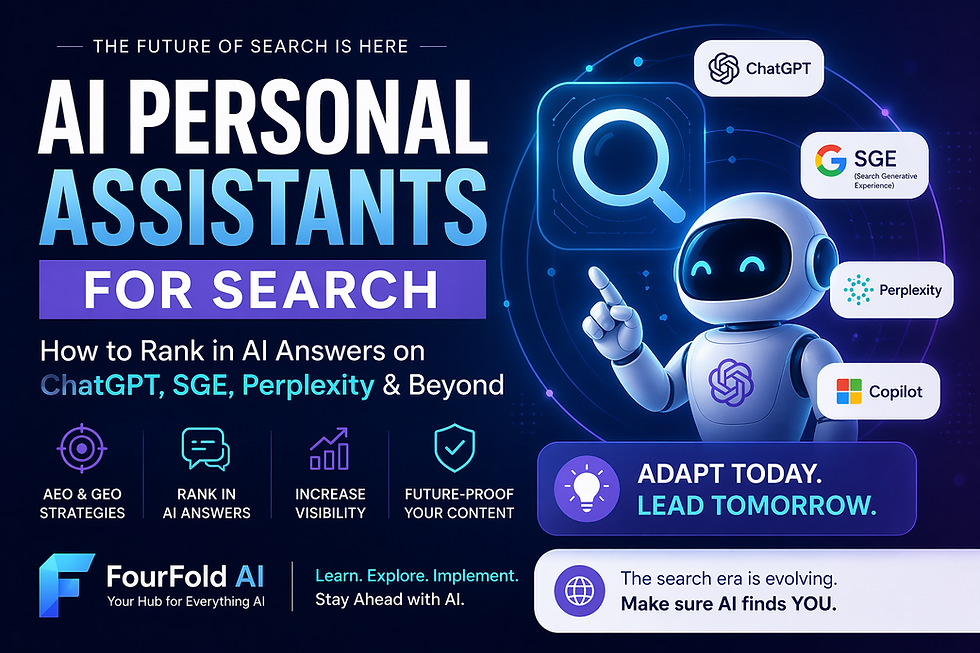
The way people search for information online has changed more in the last two years than in the previous decade. AI personal assistants — tools like ChatGPT, Perplexity AI, Google SGE (Search Generative Experience), and Microsoft Copilot — are no longer just novelties. They are becoming the primary interface between curious users and the information they need. According to Conductor's 2026 AEO/GEO Benchmarks Report, ChatGPT alone drives 87.4% of all AI referral traffic to websites today. If your content is not showing up inside these AI-generated answers, a growing share of your potential audience will simply never find you.
This guide breaks down exactly what AI personal assistants for search are, how they choose content to cite, and what you need to do — step by step — to be part of those answers. Whether you run a small business, freelance, or just want your work to reach more people, this is where your next content strategy begins.

What Are AI Personal Assistants for Search?
AI personal assistants for search are systems that process a user's question in natural language and return a direct, synthesized answer — often without requiring the user to click through to any website. Unlike traditional search engines that return a list of links, these tools interpret your query, pull information from multiple sources, and present a single, consolidated response.
The most prominent players right now include:
• ChatGPT (OpenAI) — the dominant AI search assistant with over 900 million weekly active users globally as of early 2026
• Perplexity AI — a real-time search-focused AI assistant that cites sources directly
• Google SGE / AI Overviews — Google's integrated generative answer layer, now reaching 1.5 billion monthly users
• Microsoft Copilot — embedded across Microsoft's ecosystem, including Bing Search
These tools are fundamentally different from a keyword search. They reward content that answers questions clearly, authoritatively, and in a format they can extract and trust. Optimizing for them requires a different mindset — one built around answers, not just rankings.
How Are AI Personal Assistants for Search Changing SEO?
The shift is significant and measurable. Traditional SEO aimed to get your page into the top 10 results so users would click on it. Today, users are increasingly getting their answers before they ever click anything at all.
Consider this: according to Semrush data cited in Superlines' 2026 AI Search Statistics report, around 93% of AI search sessions end without a visit to a website. This is what the industry calls zero-click search dominance — the user gets the answer directly from the AI, and the source website receives no traffic.
What does this mean in practice?
• Traditional click-through rates are falling. Some studies show organic CTR declines of over 30% as AI summaries absorb the answer.
• Brand mentions inside AI answers are becoming the new currency. If ChatGPT or Perplexity references your brand, even without a click, that is a visibility and trust signal.
• Conversational queries are rising. Users are phrasing their searches as full questions: 'What is the best digital marketing strategy for a small business in 2026?' — not just 'digital marketing strategy.'
• AI Overviews have doubled in prevalence. They now appear in 25.11% of Google searches, up from 13.14% in early 2025 (Conductor, 2026).
The content that survives and wins in this new environment is structured, concise, authoritative, and written with a clear answer-first approach.
Why AI Personal Assistants for Search Are Replacing Traditional Search Engines?
This is not about replacement — it is about behavioral shift. According to a survey by Mango Thrive (March 2026), around 3 in 4 American respondents say they search with AI weekly, with top use cases including quick facts, shopping research, and health information.
The key difference between Google's traditional ten blue links and AI-generated answers lies in how they handle intent:
Factor | Traditional Google Search | AI Personal Assistants (SGE, ChatGPT) |
Result Format | List of clickable links | Single synthesized answer |
User Action Required | Click and read multiple pages | Read the answer inline |
Content Rewarded | Keyword-rich, backlink-heavy pages | Clear, structured, authoritative answers |
Search Query Type | Short keyword strings | Full conversational questions |
Click-Through Behavior | High CTR possible | ~93% sessions end without a click |
Ranking Signal | Backlinks, technical SEO | E-E-A-T, brand mentions, structure |
Google SGE specifically blends both worlds — it still shows traditional links below the AI-generated answer block. But the AI block gets seen first. If your content is not structured to be extracted into that block, you are competing for attention that many users have already stopped looking for.
How Do AI Personal Assistants Choose Which Content to Show?
AI assistants do not select content randomly. They follow a structured reasoning process. Understanding this process is the foundation of everything else in this guide.

Stage | What Happens | What It Means for You |
1. Query Interpretation | The AI identifies the user's intent and key entities (topics, brands, concepts) | Use clear entity language — name real topics, tools, and concepts explicitly |
2. Source Retrieval | The model pulls from indexed web content, trained data, or live search | Your content must be crawlable, trustworthy, and well-structured |
3. Credibility Scoring | The AI evaluates source authority, freshness, and trust signals (E-E-A-T) | Build domain authority, get cited by others, keep content updated |
4. Answer Extraction | The AI extracts the most concise, clear answer that fits the query | Write direct, answer-first paragraphs under every heading |
5. Response Generation | The AI compiles the response, sometimes citing sources | Structured content with clear facts is more likely to be cited |
The key takeaway: AI systems prefer content that is clear in its meaning, structured for extraction, and trusted by the broader web. Thin, vague, or poorly formatted content gets passed over — no matter how well it ranks on traditional Google.
What Is the Difference Between SEO, AEO, and GEO in AI Personal Assistants for Search?
These three terms are often used interchangeably, but they are distinct disciplines — and you need all three working together.

Discipline | Full Name | Primary Goal | Key Tactics |
SEO | Search Engine Optimization | Rank pages in traditional search results | Keywords, backlinks, technical site health |
AEO | Answer Engine Optimization | Get your content selected as a direct AI answer | Answer-first writing, FAQ schema, featured snippet targeting |
GEO | Generative Engine Optimization | Ensure your brand is mentioned, cited, or recommended within AI-generated content | Brand mentions, digital PR, entity reinforcement across the web |
A May 2025 study by Ahrefs found that branded web mentions — not just backlinks — were the highest-correlating metric with appearing in Google AI Overviews. This is the core insight behind GEO: your brand's presence across the web, in articles, forums, and third-party sites, teaches AI models that you are an authority worth referencing.
[Internal Link: FourFold AI — What Is Generative Engine Optimization (GEO)?]
How to Optimize Content for AI Personal Assistants for Search? (Step-by-Step)
This is the section where understanding turns into action. Follow these steps in sequence for the highest impact.
Step 1: Write with an Answer-First Approach (BLUF)
BLUF stands for Bottom Line Up Front. Under every heading in your article, write 2–4 sentences that directly answer the question implied by that heading. This is the format AI models are trained to extract. Do not bury your answer three paragraphs in.
Step 2: Target Conversational, Long-Tail Queries
AI search favors natural language questions. Research the exact phrases your audience asks: 'How do I get my website mentioned in ChatGPT answers?' performs better than a vague keyword like 'AI SEO tips.' Use tools like Answer the Public or Perplexity itself to find real questions.
Step 3: Build Entity Richness
Entities are the named concepts, tools, people, and organizations that AI systems recognize. In your content, explicitly name real tools (ChatGPT, Google SGE, Perplexity AI, Microsoft Copilot), real statistics from named sources, and real methodologies. This increases the semantic clarity of your content for AI extraction.
Step 4: Structure for Extraction
Use H2 and H3 headings for every major section. Use bullet points for lists of 3 or more items. Use tables to compare options. Use short paragraphs — 3 to 4 lines maximum. Avoid walls of text that make it harder for AI to isolate relevant information.
Step 5: Build Topical Authority
Publish a cluster of related articles around your core topic — not just one piece. AI models trust sources that demonstrate comprehensive expertise across a subject area, not just one viral post. Link your articles to each other logically.
Step 6: Earn Brand Mentions Through Digital PR
Get your brand or content cited by high-authority third-party websites. This is the GEO play. A study by Airops (October 2025) found that brands are 6.5x more likely to be cited in AI answers through third-party sources than through their own domains.
Real Example: Traditional SEO Article vs AI-Optimized Article
Here is a concrete side-by-side comparison of how the same information looks in a traditional SEO format versus one optimized for AI personal assistants.
Element | Traditional SEO Format | AI-Optimized (AEO/GEO) Format |
Opening | "In today's digital world, SEO is more important than ever..." | "AEO is the practice of structuring content so AI assistants select it as a direct answer. It differs from traditional SEO by prioritizing answer clarity over keyword density." |
Headings | Keyword-stuffed: "Best SEO Tips You Need To Know" | Question-driven: "What Is AEO and How Does It Differ from SEO?" |
Paragraphs | Long, narrative blocks of 6–8 lines exploring a broad topic | Short, 3-line paragraphs with a direct fact or answer in every block |
Lists | Rarely used; information buried in prose | Used for all multi-item content; each bullet is a standalone insight |
Data | Vague: "Studies show SEO is important for traffic" | Specific: "ChatGPT drives 87.4% of AI referral traffic (Conductor, 2026)" |
FAQ Section | Absent or generic | Dedicated FAQ with H3 questions and direct 2–4 line answers |
Brand Mentions | None — focuses on the topic abstractly | Explicitly references authoritative tools and sources by name |
The AI-optimized format is not worse writing — it is sharper writing. It respects the reader's time and makes it significantly easier for an AI model to extract and cite the right information.
What Are the Key Ranking Factors for AI Personal Assistants for Search?
AI ranking is not identical to traditional Google ranking. Here are the factors that matter most, backed by current research:
• Content Depth & Specificity — Superficial overviews are ignored. AI models prioritize content that goes deep on a topic, uses real data, and demonstrates expertise.
• Domain Authority & Traffic — An SE Ranking study of 2.3 million pages found that high-traffic sites earn 3x more AI citations than low-traffic ones. Domain authority remains a strong signal.
• Brand Mentions Across the Web — The Ahrefs May 2025 study confirms unlinked brand mentions as a top AI ranking signal. Getting mentioned on Reddit, Wikipedia, and industry publications carries significant weight.
• Structured Formatting — Blog content is the #1 page type cited in AI Overviews (Conductor, 2026). Well-structured blogs with clear H2s, bullets, and tables outperform walls of text.
• E-E-A-T Compliance — Demonstrating real Experience, Expertise, Authoritativeness, and Trustworthiness. Author bios, cited statistics, and original research all contribute.
• Content Freshness — AI Overviews content changes 70% of the time for the same query (Profound, November 2025). Updated content that reflects current data performs better.
• Conversational Query Alignment — Content written to match how real people ask questions in natural language is consistently prioritized over keyword-optimized content.
What Does the Future of AI Personal Assistants for Search Look Like?
The trajectory is clear, and the numbers support it. Gartner projects that search volume via traditional engines will drop 25% by 2026, while AI search tools continue rapid expansion. By 2028, 50% of all online searches are expected to involve an AI assistant, according to Gartner.
Three major shifts are defining the next phase:
• The Decline of Website Clicks — Around 60% of searches are already completed without a click (Bain & Company). As AI answers improve, this will increase further. Brands must adapt their KPIs from traffic to citation frequency and brand recall.
• Brand Mentions as the New Currency — The future of search visibility is not about being on page one. It is about being the brand an AI naturally reaches for when answering a relevant question. This requires sustained content output, digital PR, and entity building.
• AI-First Content Strategies — The GEO market is projected to grow from $848 million in 2025 to $33.7 billion by 2034 at a 50.5% CAGR (Dimension Market Research). Businesses that build AI-first content strategies now will hold a compounding advantage as the market matures.
Companies that treat AI search as a side project rather than a core channel will find themselves increasingly invisible to the users who matter most.
How FourFold AI Helps You Rank in AI Search
FourFold AI is one of the early players building a practice specifically around AI search visibility — not retrofitting old SEO services into new branding, but building from the ground up around how ChatGPT, Perplexity AI, Google SGE, and Microsoft Copilot actually select and cite content.
The FourFold AI approach covers all four layers of modern search visibility:
• SEO Foundation — Technical health, crawlability, and traditional ranking signals
• AEO Content Architecture — Answer-first writing, FAQ schema, structured data, and featured snippet targeting
• GEO Brand Authority — Entity optimization, digital PR, and building brand mentions across authoritative third-party sources
• AI Performance Monitoring — Tracking citation frequency, prompt coverage, and AI referral traffic across platforms
If you want your content to show up not just in search results but in the answers that AI tools deliver to millions of users daily, FourFold AI is building the framework to make that happen.
Explore FourFold AI's AI Search Optimization services: Connect with Tauseef Ahmed Ansari on LinkedIn
AI Search Optimization Checklist
Use this before publishing every piece of content:
✓ Write a direct 2–4 sentence answer immediately under every H2 heading
✓ Include at least one real statistic with a named source per major section
✓ Use H3 headings formatted as questions for FAQ sections
✓ Add a dedicated FAQ section with 5+ questions relevant to your topic
✓ Keep all paragraphs to 3–4 lines maximum for mobile readability and AI extraction
✓ Explicitly name key entities: tools, brands, people, methodologies
✓ Include a comparison table for any 'X vs Y' or multi-option topic
✓ Build internal links to related content to establish topical authority
✓ Ensure the article has a published author with visible credentials
✓ Publish supporting content around the same topic cluster (minimum 3 related articles)
✓ Pursue at least 2–3 third-party brand mentions (guest posts, expert quotes, digital PR)
✓ Include schema markup (FAQ Schema, HowTo Schema, Article Schema)
Frequently Asked Questions (FAQ)
How do AI assistants like ChatGPT find answers?
ChatGPT and similar tools use a combination of trained knowledge and (increasingly) live web retrieval. They scan content for clarity, authority, and direct answers to the user's query. Content that is well-structured, entity-rich, and written by recognized authors or organizations is more likely to be extracted and cited.
Is SEO still relevant in 2026?
Yes — but it is no longer sufficient on its own. Traditional SEO remains the foundation for discoverability and crawlability. However, without AEO and GEO layers, your content may rank in Google but still be invisible inside AI-generated answers, which now dominate user attention for an expanding share of queries.
How do I get my website mentioned in AI answers?
Focus on three things: write structured, answer-first content that AI can easily extract; earn brand mentions on high-authority third-party websites through digital PR; and build a topical cluster of content that signals deep expertise in your subject area. Brands are 6.5x more likely to be cited through third-party sources than through their own domains (Airops, 2025).
What is Generative Engine Optimization (GEO)?
Generative Engine Optimization (GEO) is the practice of influencing how AI systems like ChatGPT, Perplexity AI, and Google SGE generate and cite content. Unlike AEO, which targets individual answer extraction, GEO operates at the brand and entity level — building the web-wide signals that teach AI models your brand is a reliable, authoritative source. The GEO market is projected to reach $33.7 billion by 2034.
Can AI assistants replace Google search completely?
Not completely, and not soon. Current data shows 95% of Americans still use traditional search engines (SparkToro, 2025), even as AI adoption grows rapidly. The more likely outcome is a hybrid environment where AI tools handle synthesized answer queries while traditional search handles discovery, validation, and detailed research — at least through the late 2020s.
Why is my content not showing in AI tools?
The most common reasons are: content is structured for keywords rather than direct answers; the domain lacks sufficient authority or web presence for AI models to trust it; there are no third-party brand mentions teaching AI that the source is credible; or the content lacks specific entities and named data points that AI models use to evaluate relevance. Start with the AI Search Optimization Checklist above and work through each item systematically.
References & Sources
This article is backed by authoritative sources and research. All statistics and claims have been verified against the publications listed below.
1. Conductor (2026). The 2026 AEO / GEO Benchmarks Report. https://www.conductor.com/academy/aeo-geo-benchmarks-report/
2. Superlines (March 2026). AI Search Statistics 2026: 60+ Data Points on Visibility, Citations, and Traffic. https://www.superlines.io/articles/ai-search-statistics/
3. Position Digital (April 2026). 150+ AI SEO Statistics for 2026 (Updated April). https://www.position.digital/blog/ai-seo-statistics/
4. Green Flag Digital (October 2025). AI & LLM Search Ranking Factors — A Working List for AEO and GEO. https://greenflagdigital.com/ai-ranking-factors/
5. Evergreen Media (February 2026). Answer Engine Optimization (AEO): AI Visibility in 2026. https://www.evergreen.media/en/guide/answer-engine-optimization/
6. ITXITPro (February 2026). AEO & GEO in 2026: Trends & AI Search Optimization Guide. https://itxitpro.com/blog/aeo-geo-trends-ai-search-optimization-guide
7. GenOptima (2026). How to Evaluate an AEO-as-a-Service Provider: 7-Point Checklist. https://www.gen-optima.com/geo/how-to-evaluate-aeo-as-a-service-provider-checklist-2026/
8. Ahrefs (May 2025). Brand Mentions and AI Overviews Correlation Study. Referenced via Green Flag Digital. https://ahrefs.com/blog/
Written by Tauseef Ahmed Ansari | FourFold AI Research Team
© 2026 FourFold AI. All rights reserved.


Comments