
Best AI Tools for Marketing in 2026: The Complete Buyer's Guide

A marketing manager opens six browser tabs before 9 a.m.: one for the content calendar that's three posts behind, one for the ad account that overspent on a campaign nobody double-checked, one for the analytics dashboard nobody trusts anymore, and three more for tools that were supposed to talk to each other but don't. This is the actual starting point for most conversations about AI in marketing — not some abstract debate about the future of the profession, but a practical question: which of the hundreds of AI marketing tools on the market will actually close these gaps without creating new ones?
This guide answers that question directly. We're covering the Best AI Tools for Marketing in 2026 across content, SEO, social, email, design, video, automation, and analytics — evaluated on what they cost, where they break down, and who they genuinely fit. By 2026, generative artificial intelligence in marketing has moved well past producing a paragraph of blog copy on request. The tools in this guide increasingly run agentic workflows — multi-step sequences where an AI system plans, executes, and adjusts a task with limited human intervention, whether that's drafting a campaign brief, publishing a social post, or re-optimizing an ad budget mid-flight.
This buyer's guide is built for three kinds of readers: startup founders who need to run marketing without a marketing department, digital agencies juggling multiple client accounts and needing tools that scale across them, and enterprise marketing teams evaluating whether their current stack still makes sense. Whichever camp you're in, the goal here is the same — save you the weeks of trial subscriptions and comparison spreadsheets it would otherwise take to figure out which AI marketing tools are worth paying for in 2026.
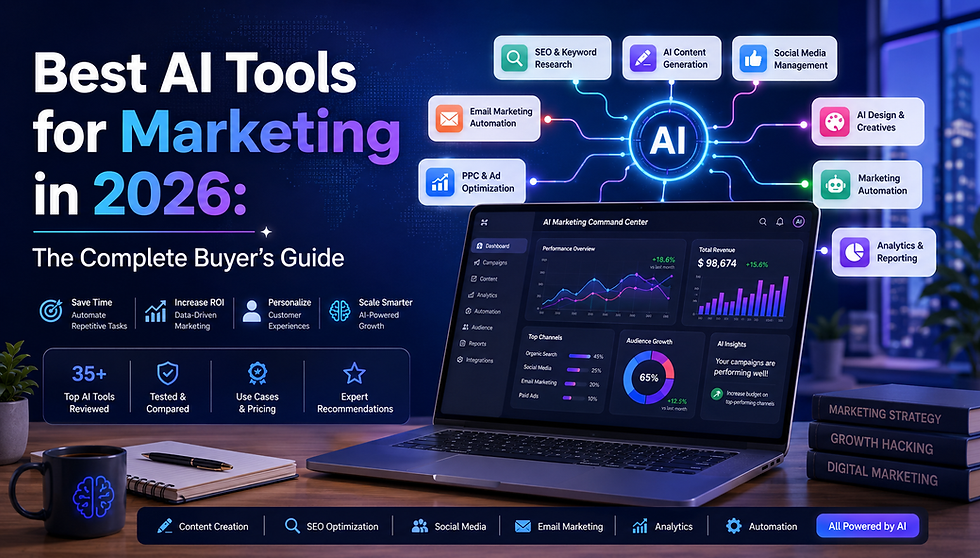
What Are AI Marketing Tools?
AI marketing tools are software applications that use artificial intelligence, natural language processing, and machine learning to automate data analysis, generate content and creative assets, personalize customer communication, and optimize marketing decisions such as ad targeting or send timing — with the general aim of increasing output and return on marketing spend.
That definition covers a wide range of products, from a chatbot that drafts email subject lines to a full AI marketing platform that runs multi-channel campaigns with minimal manual input. What ties them together is the underlying technology, and increasingly, the way that technology is applied.
How Modern Marketing AI Works
Most tools in this category run on Large Language Models (LLMs) — the same family of models behind ChatGPT and Claude — combined with more specialized machine learning systems for prediction and pattern recognition. In practice, that breaks down into three overlapping capabilities.
Natural language processing lets a tool read a brief, a product description, or a customer support ticket and understand intent well enough to generate a relevant response. Predictive modeling uses historical data — past campaign performance, purchase behavior, engagement patterns — to forecast outcomes like which subject line will get opened or which lead is likely to convert. And agentic workflows take this a step further: instead of just generating a draft for a human to review, an AI agent can be given a goal (say, "schedule this week's social content") and complete a multi-step task on its own, checking in only when it hits a decision it isn't confident about.
Some of the more advanced platforms also use Retrieval-Augmented Generation (RAG), which lets an AI model pull in current, specific information — your product catalog, your brand guidelines, live pricing — before generating content, rather than relying purely on what it learned during training. This matters enormously for accuracy, and it's one of the biggest differentiators between a tool that produces generic copy and one that produces copy your legal and compliance team won't flag.
Core Use Cases and Enterprise Benefits
The practical value shows up in a few consistent places. Content teams use AI to scale output without linearly scaling headcount — not by replacing writers, but by handling first drafts, repurposing, and localization. Analysts use predictive models to flag which leads are worth a sales call today versus next quarter. Ops teams use automation to handle the tedious middle of a campaign: tagging leads, scheduling posts, syncing data between a CRM and an ad platform. None of this eliminates the need for marketing judgment. It removes the parts of the job that shouldn't require judgment in the first place.
If you're building a broader software stack, it's worth reading our breakdown of the best AI tools for business alongside this guide, since marketing tools rarely operate in isolation from the rest of your operations.
How We Evaluated These AI Marketing Tools
FourfoldAI's evaluation process is built to stay independent of vendor marketing claims. We didn't rank tools by feature count or by how loudly a company markets its AI capabilities. Instead, every tool on this list was assessed against five practical criteria, using official pricing pages, product documentation, and independent third-party reviews current as of mid-2026.
Features & Capabilities. Does the tool run on genuinely advanced, current-generation LLMs, or is it a thin wrapper around an older API with a nicer interface? Several "AI-powered" tools in this space still route requests through outdated models — we checked.
Accuracy & Reliability. How often does the tool produce factually wrong output, and how transparent is the vendor about that? Hallucination rates vary meaningfully across providers, and platform uptime matters more than most buyers realize once a tool is embedded in a live campaign.
Ease of Use. How steep is the onboarding curve, and how much of the interface makes sense without a support ticket? A tool with excellent capabilities is worth little if only one person on the team can operate it.
Pricing & ROI. Is pricing transparent on the vendor's own site, or does it require a sales call to find out what you'll actually pay? We looked specifically at whether advertised starting prices reflect real-world costs once seats, credits, and add-ons are included — a pattern that trips up buyers across this entire category.
Security & Compliance. Does the platform address data privacy compliance obligations like GDPR, SOC 2, or data residency requirements? This matters more for tools handling customer data (email, CRM, analytics) than for pure content-generation tools, but it's relevant across the board for any business operating in regulated markets.

Quick Comparison of the Best AI Marketing Tools
Tool | Primary Best For | Starting Price | Free Plan? | Key Integration | Enterprise Support |
ChatGPT | General content & research | $20/mo (Plus) | Yes | 60+ app connectors, API | Yes (Enterprise, custom) |
Claude | Long-form writing & analysis | $20/mo (Pro) | Yes | Microsoft 365, Google Drive, API | Yes (Team/Enterprise) |
Semrush | SEO & competitive research | ~$117–140/mo (Pro) | Limited free tier | Google Data Studio, WordPress | Yes (Business tier) |
Surfer SEO | Content optimization | ~$79–99/mo | No (Chrome extension only) | Google Docs, WordPress, Jasper | Yes (Enterprise, custom) |
Buffer | Social scheduling | Free / paid from ~$5–6 per channel | Yes | Instagram, LinkedIn, TikTok, X | Limited (small-team focus) |
Mailchimp | Email marketing | $13/mo (Essentials) | Yes (500 contacts) | Shopify, WordPress, Zapier | Yes (Premium tier) |
Canva AI | Design & social graphics | $15/mo (Pro) | Yes | Buffer, HubSpot, Google Drive | Yes (Enterprise, custom) |
Runway | AI video generation | $12–15/mo (Standard) | Yes (one-time credits) | Adobe Premiere, After Effects | Yes (Enterprise, custom) |
Zapier | Workflow automation | $19.99/mo (Starter, annual) | Yes (100 tasks/mo) | 9,000+ apps | Yes (Enterprise) |
HubSpot | Marketing automation & CRM | Free CRM / $20/mo (Marketing Starter) | Yes | 200+ integrations | Yes (Enterprise, custom) |
Best AI Tools for Marketing in 2026 for Content Marketing
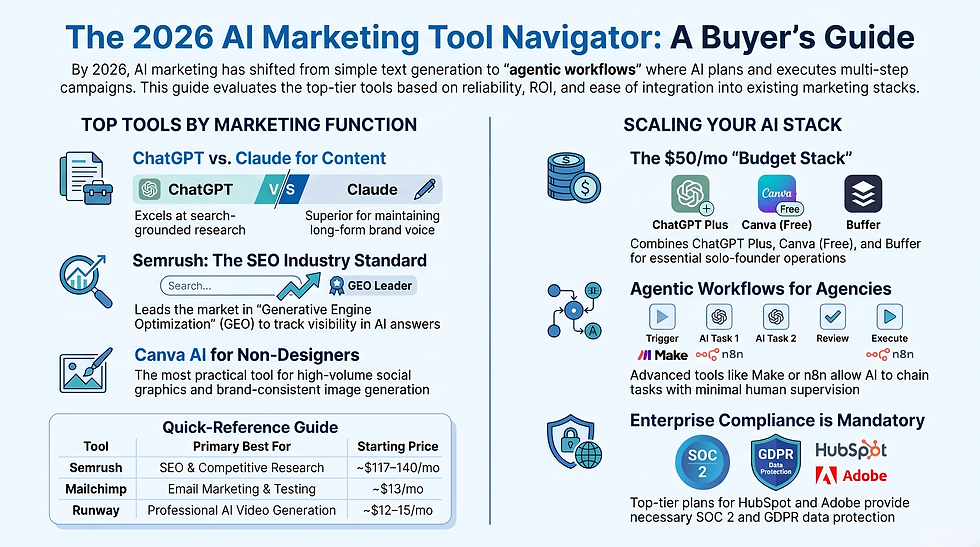
ChatGPT (OpenAI) remains the most widely used general-purpose AI writing tool, and for good reason — its Plus plan at $20/month includes GPT-5.5 access, image generation, Deep Research for source-backed drafts, and Agent Mode for multi-step tasks. Its real strength for content marketers is search-grounded research: it can pull current information into a draft rather than relying purely on training data. The tradeoff is brand consistency — out of the box, ChatGPT doesn't retain a distinct brand voice the way a purpose-built marketing tool does, and heavy users report that OpenAI's automatic model routing means a $20/month subscriber doesn't always get the flagship model for every query.
Claude (Anthropic) trades some of ChatGPT's breadth for depth. Its Pro plan, also $20/month, is built around long-context handling — Claude's paid tiers support context windows large enough to hold an entire brand style guide, a set of past articles, and a new brief in a single conversation, which makes it particularly strong for maintaining a consistent editorial voice across a long-form content calendar. Where ChatGPT leans on live web retrieval and a wider app ecosystem, Claude tends to produce more consistent long-form prose with fewer generic transitions — a meaningful difference for anyone publishing editorial content at scale. For a deeper side-by-side, see our full ChatGPT vs Claude comparison.
Jasper is built specifically for marketing teams rather than general use. Its Pro plan runs roughly $59–69/month per seat and centers on "Brand Voice" — you feed it a style guide or existing content, and it applies that tone consistently across a team. That consistency is genuinely valuable for agencies managing multiple client brands, but Jasper doesn't have a permanent free tier (only a 7-day trial), and at scale — a five-person team can run $3,500+ per year — it's a real budget line item versus a general-purpose chatbot subscription.
Copy.ai sits in the middle ground: a usable free tier, then a Pro plan around $49/month with workflow automation features that go beyond simple text generation. It's a reasonable fit for small teams that want some of Jasper's collaboration features without the premium price tag.
Writesonic leans hardest into SEO-specific content generation, with tiers from roughly $19 to $99/month depending on volume. For bloggers and affiliate marketers publishing high volumes of search-optimized content on a tight budget, it's often the most cost-efficient option on this list — though output quality for nuanced, brand-voice-heavy writing tends to lag Jasper and Claude.
Explore more in our dedicated roundup of AI content creation tools.
Best AI SEO Tools
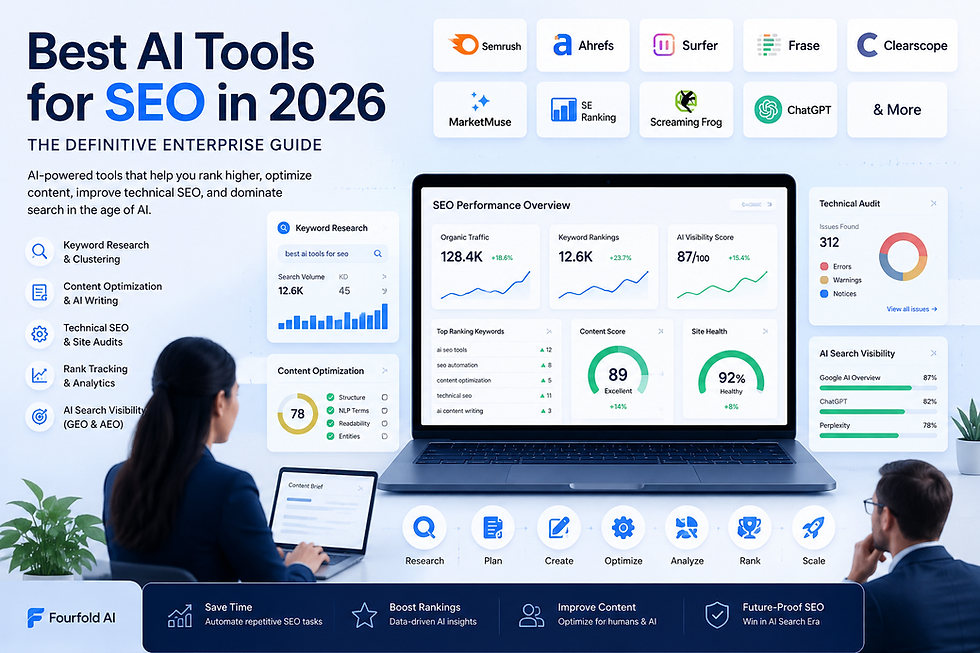
Semrush is the closest thing this category has to an industry standard, and its 2026 pricing reflects that positioning: Pro starts around $117–140/month, Guru (which adds the Content Marketing Toolkit and historical data) runs roughly $208–250/month, and Business scales to $417–500/month for agencies managing 20+ clients. The platform's semantic gap analysis and search intent mapping tools are genuinely strong for identifying content opportunities competitors haven't covered, but the pricing structure has a real learning curve — add-ons for AI visibility tracking, local SEO, and extra seats can push a "Pro" subscription well past its sticker price.
Ahrefs is Semrush's closest rival, with entry pricing around $129/month for its Lite tier. Ahrefs is generally considered stronger on backlink index depth, while Semrush edges ahead on PPC data and AI visibility tracking — the newer discipline of monitoring how a brand appears in AI answer engines like ChatGPT, Gemini, and Perplexity.
Surfer SEO takes a narrower, more affordable approach, focused specifically on content optimization rather than full-suite SEO. Its Essential plan runs about $79–99/month and analyzes top-ranking pages for a target keyword to guide word count, headings, and semantic coverage while you write. It's a natural pairing with a general writing tool like ChatGPT or Claude, rather than a replacement for a full research platform like Semrush.
Frase and Clearscope occupy similar territory to Surfer, with Frase generally positioned as the more budget-friendly option for content briefs and Clearscope commanding a premium price for its content grading accuracy — both worth trialing if Surfer's credit limits feel restrictive for your publishing volume.
Read more in our guide to AI SEO tools.
Best AI Social Media Tools
Buffer AI remains the simplest, most affordable entry point for social scheduling — its free plan covers a handful of channels, and paid tiers scale per social channel rather than forcing an all-or-nothing upgrade. Buffer's AI features handle caption generation and basic content repurposing, but it deliberately stays lightweight rather than trying to compete with full marketing suites on automation depth.
Hootsuite AI offers a more comprehensive feature set — deeper analytics, sentiment analysis, and broader team collaboration tools — at a correspondingly higher price point, making it a better fit for agencies managing several client accounts than for a solo marketer.
Metricool and Predis.ai both target a similar mid-market niche: affordable, AI-assisted scheduling with cross-platform auto-generation, useful for small businesses that need to maintain a consistent posting cadence without a dedicated social media hire. Predis.ai in particular focuses on turning a single input (a URL, a product photo) into multiple platform-native post formats automatically, which is a genuine time-saver for e-commerce accounts posting daily.
Best AI Email Marketing Tools
Mailchimp remains the category's default choice, with Essentials starting at $13/month for 500 contacts and Standard at $20/month adding send-time optimization and multi-step automation. Its AI-driven predictive send times and subject line testing are solid, and its integration ecosystem (Shopify, WordPress, Zapier, Canva) is hard to match. The catch worth knowing before you sign up: Mailchimp bills on total contacts, including unsubscribed and unconfirmed ones, so real-world costs often run higher than the advertised starting price once a list has accumulated a year or two of inactive contacts.
Brevo (formerly Sendinblue) is generally the more budget-conscious alternative, pricing by email volume rather than pure contact count — a better fit for businesses with large lists but modest send frequency.
HubSpot and ActiveCampaign both push further into behavioral automation — triggering emails based on specific actions (a cart abandonment, a pricing page visit) rather than just scheduled sends. HubSpot's email tools come bundled into its broader Marketing Hub (more on pricing below), while ActiveCampaign positions itself as a dedicated automation specialist at a lower entry cost than HubSpot's Professional tier.
Best AI Image & Design Tools
Canva AI continues to be the most practical starting point for non-designers, at $15/month for Pro (or $10/month annual). Its Magic Studio suite handles background removal, brand kit enforcement, and text-to-image generation inside the same editor used for everyday social graphics — and its built-in scheduler can genuinely replace a standalone tool like Buffer for teams with simple posting needs. Commercial-use licensing is included on paid plans, which matters for any business publishing generated images at scale.
Adobe Firefly is the strongest choice for teams already inside the Adobe ecosystem, with plans starting around $10/month for the Standard tier. Firefly's biggest 2026 advantage is deep integration with Photoshop and Premiere Pro, plus recently added access to third-party models (including Runway's video generation) inside the same subscription — reducing the need for a separate video tool for basic use cases.
Midjourney still produces some of the most stylistically distinctive AI imagery on the market, but it operates through Discord rather than a conventional app interface, which creates a real onboarding curve for non-technical marketing teams. Ideogram has carved out a niche specifically around text rendering inside generated images — a persistent weak point for most AI image generators — making it useful for creating ad creative or product mockups that require legible in-image copy.
Best AI Video Marketing Tools
Runway leads this category for marketers who need control, not just generation. Its credit-based pricing starts around $12–15/month (Standard, annual billing) and scales to $28–35/month for Pro, with credits consumed based on model and resolution rather than a flat per-video charge. Runway's Gen-4 and Aleph models are strong for generating coherent product scenes and making targeted edits to existing footage, and commercial use is permitted even on the free tier — though the free allocation is a one-time credit grant, not a renewing monthly amount, so it functions more as a trial than a workable free plan.
Synthesia is the category leader for a different use case entirely: realistic AI avatars delivering scripted video in dozens of languages, which makes it the default choice for corporate training and localized product explainer videos rather than social-first content.
Pika undercuts Runway on price with simpler plans starting around $8/month, but trades away Runway's longer clip lengths and precise camera control — a reasonable choice for short-form social clips where production polish matters less than volume.
Veo (Google) is increasingly available through Gemini subscriptions and select third-party platforms including Runway itself, and is generally regarded as strong on native audio generation, reducing the need for separate voiceover tools.
Best AI Marketing Automation Tools
Zapier remains the broadest no-code automation platform, connecting over 9,000 apps. Its free plan includes 100 tasks per month, sufficient only for light testing, while the Professional plan (around $20–30/month annual) unlocks multi-step "Zaps" with conditional logic. Zapier's core tradeoff is cost at scale: because pricing is based on individual task volume, high-frequency workflows can get expensive quickly compared to alternatives.
Make (formerly Integromat) and n8n both target the same automation use case at a lower cost per operation, appealing to teams with the technical comfort to build more complex visual workflows — n8n in particular offers a self-hosted option that can cut costs dramatically for high-volume automation, at the expense of needing in-house technical setup.
HubSpot's Operations Hub takes a different approach entirely, building automation natively into a CRM rather than connecting separate tools. For teams already committed to HubSpot's ecosystem, this eliminates a layer of integration complexity; for smaller teams, standalone tools like Zapier or Make remain considerably cheaper.
Building real agentic workflows — where an AI system chains several of these tools together with minimal supervision — is one of the fastest-growing use cases in this category. See our explainer on AI agents explained for a deeper look at how this works in practice, and our broader guide to AI automation tools for platform-by-platform comparisons.
Best AI Analytics Tools
Google Analytics has steadily added AI-driven features for anomaly detection and predictive audience insights, and remains the default for most marketing teams simply because it's free and already connected to existing ad accounts.
HubSpot's native analytics layer benefits from being built on the same data as its CRM and email tools, making attribution reporting more coherent than stitching together separate platforms — though this convenience is part of what pushes HubSpot's Professional and Enterprise pricing considerably higher than standalone alternatives.
Tableau and Microsoft Power BI both serve a different function: less about marketing-specific automation, more about giving analysts a way to build custom dashboards and run conversational, natural-language queries against large datasets. Power BI's advantage for many businesses is straightforward — if the organization already runs on Microsoft 365, the integration and per-seat cost tend to be more favorable than adding Tableau as a separate platform.
Best AI Tools by Marketing Role
For SEOs & Bloggers: Semrush or Ahrefs for research, Surfer SEO for on-page optimization, and Claude for long-form drafting that holds a consistent voice across a large content calendar.
For Marketing Agencies: Multi-client capability is the deciding factor. Semrush Guru's included seats, Jasper's Business tier for multi-brand voice management, and Make or n8n for building repeatable client reporting automations without per-client tool sprawl.
For E-commerce Brands: Copy.ai or Writesonic for high-volume product description generation, paired with Canva AI for on-brand product imagery and social creative at a fraction of a design team's cost.
For Startups & Freelancers: Budget efficiency matters most. ChatGPT Plus or Claude Pro for content and research, Buffer's free or entry tier for scheduling, and Canva's free plan for design — a genuinely usable stack for under $50/month total.
For Enterprise Teams: Security and compliance move to the front of the decision. HubSpot Enterprise for unified CRM and marketing data, Adobe Firefly for design teams needing enterprise licensing clarity, and Claude or ChatGPT's Enterprise tiers for SOC 2 compliance and data residency guarantees.
Best AI Marketing Tool Stacks for Every Business Phase
The Budget Stack (roughly $50–80/month): ChatGPT Plus or Claude Pro for content, Canva's free or Pro tier for design, Buffer's free plan for scheduling, and Zapier's free tier for basic automation. This covers the essentials for a solo founder or a two-person team without meaningful compromise on quality.
The Growth Stack (roughly $300–500/month): Add Semrush Pro for SEO research, Surfer SEO for content optimization, Mailchimp Standard for email automation, and a Zapier Professional plan to connect the pieces. This is the point where most scaling teams start feeling the value of dedicated, category-specific tools over general-purpose ones.
The Agency Stack (roughly $800–1,500/month): Semrush Guru for multi-client SEO reporting, Jasper Business for managing distinct brand voices across accounts, Make or n8n for client-specific automation, and a shared Canva Teams or Business plan for design consistency across accounts.
The Enterprise Stack (custom pricing, typically $3,000+/month): HubSpot Enterprise as the CRM and marketing hub, Claude or ChatGPT Enterprise tiers for compliance-grade AI access across departments, Adobe Firefly Enterprise for design governance, and Tableau or Power BI for organization-wide reporting. At this tier, the conversation shifts from tool cost to integration cost — the API work and internal training required to make everything function as a single system.
For teams evaluating adjacent categories, our guides to best AI productivity tools and AI for small business cover overlapping ground worth checking before finalizing a stack.
How to Choose the Right AI Marketing Tool
Start with budget as a hard constraint, not an afterthought. It's easy to get pulled toward the most feature-rich option in a category and end up paying for capabilities a two-person team will never touch. Map your actual monthly content and campaign volume first, then match tools to that volume rather than to a hypothetical future scale.
Next, audit your existing software stack before adding anything new. A surprising number of marketing teams pay for overlapping AI features — Canva's built-in scheduler duplicating Buffer, Semrush's Content Toolkit duplicating a standalone Surfer subscription — simply because nobody checked what was already included in a plan they were already paying for.
Team size should drive collaboration features, not brand preference. A solo marketer rarely needs Jasper's multi-brand-voice features or HubSpot's role-based permissions; a ten-person team almost always does. And compliance requirements — GDPR, SOC 2, industry-specific data handling rules — should be confirmed before a contract is signed, not discovered during a security review six months in. If your business handles EU customer data or operates in a regulated industry, this single factor can eliminate several otherwise-attractive tools from consideration.
Common Mistakes When Using AI for Marketing
The most common and costly mistake is auto-publishing AI output without human review. Every tool in this guide can produce a factually wrong claim, an off-brand tone, or a genuinely embarrassing sentence, and the businesses that get burned publicly are almost always the ones that removed the editing step entirely to save time.
A close second is ignoring brand voice consistency. Feeding a generic prompt into ChatGPT without a style guide, without examples of past content, without guardrails, produces content that reads like it came from nowhere in particular — technically correct, but forgettable. Tools like Jasper and Claude's Projects feature exist specifically to solve this, and skipping that setup step defeats much of their value.
Publishing low-effort AI content at volume is a related but distinct problem: search engines and readers alike have gotten noticeably better at detecting formulaic, unedited AI output, and a strategy built purely on volume over depth tends to underperform even a smaller amount of genuinely useful content.
Data privacy is a mistake that's easy to make without realizing it. Pasting a client's confidential campaign data, unreleased product details, or customer PII into a public AI chatbot without checking that provider's data handling policy is a real and recurring risk — one that enterprise-tier plans (which typically guarantee your inputs aren't used for model training) are specifically designed to address.
Finally, paying for overlapping software subscriptions is the quiet budget killer across this entire category. Auditing a typical mid-sized marketing team's AI tool spend after six months almost always turns up at least one subscription nobody remembers actively deciding to keep.
The Future of AI Marketing
The most significant shift on the immediate horizon is the move toward autonomous AI marketing agents operating via Model Context Protocol (MCP) — a standard that allows AI systems to securely connect to and act across multiple tools and data sources without custom integration work for each one. In practical terms, this means the gap between "AI drafts a post" and "AI plans, drafts, schedules, and reports on a campaign with a human checking in at key decision points" is closing faster than most marketing teams have adjusted their workflows for.
Predictive trend models are also becoming more accessible outside of enterprise budgets, giving smaller teams earlier visibility into shifting search and social behavior rather than reacting after a trend has already peaked. Hyper-personalization — tailoring not just an email subject line but an entire customer journey to individual behavior in real time — is moving from a Fortune 500 capability to something achievable with mid-market tool budgets.
Perhaps the most consequential shift for anyone reading this guide for SEO purposes specifically: the discipline is visibly shifting from traditional SEO toward Generative Engine Optimization (GEO) — optimizing content not just to rank on a search results page, but to be accurately cited and recommended by AI answer engines like ChatGPT, Gemini, Perplexity, and Claude. Several tools covered in this guide, including Semrush and HubSpot, have already built dedicated AI visibility tracking features in direct response to this shift, and that trend line is likely to define the next major wave of tool development in this space. For more on where the industry is headed, see our ongoing coverage of AI trends.
Final Recommendations: Build Your Workflow, Not Your Tool Count
The teams getting real value from AI marketing tools in 2026 aren't the ones with the longest subscription list. They're the ones who picked a small number of tools that integrate cleanly into an actual workflow, learned them properly, and resisted the pull to add a new tool every time a new feature launches. Choose based on how a tool fits into what your team already does — not on feature counts, not on which platform has the loudest marketing, and not on what a competitor happens to be using.
If you're building out an AI-powered marketing operation from scratch, or trying to figure out where autonomous agents and workflow automation fit into your existing stack, explore more coverage on custom model deployments, AI agents, and workflow automation on FourfoldAI.com.
Frequently Asked Questions About AI Marketing Tools
What are the best AI tools for marketing? The best AI marketing tools depend on function, but the strongest overall picks across categories are ChatGPT and Claude for content, Semrush for SEO research, Canva AI for design, and HubSpot for full-funnel marketing automation. Most effective marketing stacks combine tools from at least three of these categories rather than relying on a single all-in-one platform.
Which AI marketing tool is best for small businesses? For small businesses, a combination of Canva's free or Pro plan, Buffer's entry-tier social scheduling, and either ChatGPT Plus or Claude Pro for content covers most core needs for under $60/month. This stack scales reasonably well before a business needs to consider a heavier platform like HubSpot.
Is ChatGPT good for marketing? Yes, ChatGPT is genuinely useful for marketing tasks including content drafting, research, and brainstorming, particularly with its Deep Research and Agent Mode features on the Plus plan. It's less specialized than purpose-built marketing tools like Jasper for maintaining a consistent brand voice across a large team, so many marketing teams pair it with a dedicated brand-voice tool rather than using it standalone.
Which AI tool is best for SEO? Semrush is generally considered the most comprehensive AI-assisted SEO platform, covering keyword research, site audits, and AI visibility tracking in one subscription. Surfer SEO is a strong, more affordable complement specifically for on-page content optimization once target keywords are identified.
What AI tools do digital marketers use? Most digital marketers in 2026 use a combination of a general-purpose AI assistant (ChatGPT or Claude) for content and research, an SEO platform (Semrush or Ahrefs) for research, a design tool (Canva AI) for creative assets, and an automation layer (Zapier or HubSpot) to connect everything together.
Can AI replace digital marketers? No, current AI marketing tools are built to accelerate specific tasks — content drafting, data analysis, scheduling — rather than replace the strategic judgment, brand understanding, and stakeholder management that marketing roles require. The more accurate framing is that AI is reshaping which tasks require a human's direct attention, not eliminating the need for marketers.
Which AI marketing tools offer free plans? ChatGPT, Claude, Buffer, Mailchimp, Canva, Zapier, and Runway all offer functional free tiers, though each comes with meaningful limits on volume, features, or usage frequency. Jasper and Surfer SEO are notable exceptions that offer only free trials rather than permanent free plans.
What is the best AI tool for social media marketing? Buffer is the most cost-effective starting point for straightforward scheduling and basic AI-assisted captions, while Hootsuite AI and Predis.ai offer deeper automation and cross-platform content generation for teams managing higher posting volume or multiple client accounts.
How can AI improve email marketing? AI improves email marketing primarily through predictive send-time optimization (sending each contact an email when they're statistically most likely to open it), automated subject line testing, and behavioral automation sequences that trigger based on specific actions like cart abandonment or page visits. Tools like Mailchimp, HubSpot, and ActiveCampaign all build these capabilities directly into their platforms.
Are AI marketing tools safe for business data? Most reputable AI marketing tools offer enterprise-tier plans with data privacy compliance protections, including SOC 2 certification and guarantees that customer inputs aren't used to train underlying models. The risk typically isn't the platform itself but how it's used — feeding confidential client or customer data into a free-tier or consumer-grade AI tool without checking its data handling policy is the most common way businesses expose themselves unnecessarily.
Which AI tool is best for PPC advertising? Semrush's advertising toolkit and HubSpot's ad management tools both offer AI-assisted campaign optimization and reporting, though most PPC-specific optimization still happens natively within Google Ads and Meta Ads Manager's own AI-driven bidding systems, with third-party tools layered on top for cross-platform reporting and budget allocation.
How do AI agents help marketers? AI agents can handle multi-step marketing tasks with limited supervision — for example, researching a topic, drafting content, formatting it for a specific channel, and scheduling it for publication as a single automated sequence. This differs from a standard AI chatbot, which requires a new prompt for each individual step. Learn more in our full breakdown of AI agents explained.
What is the difference between AI writing tools and AI marketing platforms? AI writing tools like ChatGPT, Claude, and Jasper focus specifically on generating and editing text content. AI marketing platforms like HubSpot combine content tools with CRM data, campaign automation, analytics, and multi-channel distribution in a single connected system, generally at a significantly higher price point that reflects that broader scope.
Which AI marketing tools integrate with CRM software? HubSpot includes its own native CRM, while tools like Mailchimp, ActiveCampaign, and Zapier all offer direct integrations with major CRM platforms including Salesforce, Pipedrive, and HubSpot's CRM itself. Zapier in particular can connect nearly any AI marketing tool to a CRM even without a native integration, using its broader library of over 9,000 supported apps.
References
OpenAI. "ChatGPT Pricing." openai.com/chatgpt/pricing
Anthropic. "Claude Plans & Pricing." claude.com/pricing
Semrush. "SEO Toolkit Plans and Pricing." semrush.com/pricing/seo
Surfer SEO. "Pricing." surferseo.com/pricing
Mailchimp. "About Mailchimp Pricing Plans." mailchimp.com/help/about-mailchimp-pricing-plans
Canva. "Canva Pricing." canva.com/pricing
Runway. "AI Image and Video Pricing." runwayml.com/pricing
Zapier. "Plans & Pricing." zapier.com/pricing
HubSpot. "Marketing Software Pricing." hubspot.com/pricing/marketing
Jasper. "Plans & Pricing." jasper.ai/pricing
Pricing figures throughout this article reflect publicly available vendor pricing as of mid-2026 and are subject to change. Always verify current pricing directly with each provider before making a purchasing decision.
Disclaimer
Disclaimer: This article is intended for general informational purposes only and does not constitute professional, financial, or legal advice. Tool pricing, features, and availability are subject to change without notice. For full details, please read our complete disclaimer at fourfoldai.com/disclaimer.
About the Author
Muizz Shaikh is an AI enthusiast and digital technology professional at FourfoldAI. He is passionate about exploring AI tools, industry trends, and practical applications of emerging technologies. Through FourfoldAI, Muizz contributes to simplifying artificial intelligence for businesses and learners. Connect with him on LinkedIn: linkedin.com/in/muizz-shaikh-45b449403/
© 2026 FourfoldAI.com. All rights reserved.


Comments