
Deep Learning Frameworks: Complete Guide to Choosing the Right AI Framework in 2026

Picking a framework used to be simple. You learned TensorFlow because it was the only serious option, or you learned PyTorch because your lab used it. That comfortable simplicity is gone. In 2026, choosing among deep learning frameworks means weighing research momentum against production maturity, weighing hiring pools against hardware roadmaps, and increasingly, weighing how well a framework plays with tools it wasn't originally built for, like Apple Silicon chips or agentic pipelines.
This guide walks through what these frameworks actually do under the hood, how the major players stack up against each other, and which one fits your specific situation, whether that's a weekend project, a PhD thesis, or a production system serving millions of requests.

Quick Answers
What is a deep learning framework? A deep learning framework is a software library that provides pre-built mathematical modules, automatic differentiation, and hardware acceleration for training neural networks. It handles the tedious plumbing, tensor math, gradient calculation, GPU memory management, so developers can focus on model architecture instead of writing CUDA kernels by hand.
Which deep learning framework is best? There isn't a single "best" one. PyTorch is the strongest overall pick for flexibility and general-purpose work, JAX leads for high-performance research and custom numerical computing, and TensorFlow still earns its keep in legacy enterprise pipelines and mobile deployment through LiteRT.
PyTorch vs TensorFlow: Which is better? PyTorch is generally preferred for research, prototyping, and modern LLM development because of its dynamic graph execution and debugging ergonomics. TensorFlow remains a reasonable choice for teams with established production pipelines already built around TFX and TensorFlow Serving.
Is JAX better than TensorFlow? JAX is faster and more flexible for custom, high-performance computing, particularly at Google-scale TPU training, but it carries a steeper functional-programming learning curve than either PyTorch or TensorFlow.
Which framework is best for LLMs? PyTorch, mainly because of its native integration with Hugging Face Transformers, Megatron-LM, and PyTorch FSDP, all of which sit at the center of how modern large language models actually get trained.
Which deep learning framework is easiest to learn? Keras, since it acts as a high-level API layer that now runs on top of TensorFlow, PyTorch, or JAX, letting beginners write simple code without picking a backend up front.
What framework do enterprises use? PyTorch is dominant for new development, especially anything touching generative AI, while TensorFlow is still heavily used to maintain older, already-deployed systems.
What Are Deep Learning Frameworks?
Definition
Think of a deep learning framework as the plumbing beneath every modern AI system. It's the layer that sits between your Python code and the raw silicon doing the math. Every chatbot, image generator, and recommendation engine you've used runs on top of one of a handful of these frameworks. Without them, teams would still be hand-coding matrix multiplication routines for every new model.
Why AI Engineers Use Frameworks
Nobody wants to write raw CUDA code to multiply matrices on a GPU. Frameworks abstract away that low-level programming, along with memory allocation across devices and the linear algebra operations that make neural networks work in the first place. A framework decides how a tensor gets copied from your CPU's memory to a GPU's memory, how that operation gets scheduled, and how the result comes back, all without you writing a single line of device-specific code.
This abstraction is not just convenience. It's what makes deep learning accessible to a data scientist who understands the math but has never touched systems programming. It's also what lets the same Python script run, with minor tweaks, on an NVIDIA GPU, an AMD accelerator, or a Google TPU.
Core Components
Every major framework is built around three abstractions. Tensors are multidimensional arrays, essentially souped-up NumPy arrays that know how to live on a GPU. Computation graphs describe how those tensors flow through operations, either built ahead of time (static) or built on the fly as your code runs (dynamic). And optimizer routines handle the actual learning, adjusting a model's weights step by step based on the gradients the framework calculates automatically.
How Deep Learning Frameworks Work
Tensor Operations
A tensor is just an array with a shape. A single number is a zero-dimensional tensor. A list of numbers is one-dimensional. An image is typically a three-dimensional tensor: height, width, and color channels. A batch of images pushes that to four dimensions. Frameworks store these tensors in contiguous blocks of memory and lay them out in ways that make matrix multiplication fast on parallel hardware.
That's the real trick behind GPU acceleration. A GPU has thousands of small cores built to do simple arithmetic in parallel, which happens to be exactly what matrix multiplication needs. When you multiply a 1,000×1,000 matrix by another, a CPU works through it largely sequentially. A GPU splits the work across thousands of threads at once. Frameworks handle the scheduling so you never manually assign work to individual cores.
Automatic Differentiation
Here's the plain-English version of backpropagation: to train a neural network, you need to know how much each weight in the network contributed to the final error, so you can nudge it in the right direction. That "how much" is a gradient, and calculating it by hand across a network with billions of parameters is not something any human should attempt.
Automatic differentiation, or autograd, solves this by tracking every operation performed on a tensor as your code runs, building an internal record of the math. When you call .backward() in PyTorch or use jax.grad() in JAX, the framework walks that record backward, applying the chain rule from calculus at every step, and produces exact gradients for every parameter in the network. You never write the calculus yourself. The framework computed the Jacobian matrix, the grid of all those partial derivatives, without you ever seeing it.
GPU Acceleration
Underneath the Python code, frameworks talk to hardware through low-level interfaces. CUDA is NVIDIA's programming platform, and it's still the dominant path for most training workloads. ROCm is AMD's answer, gaining ground but still behind in library maturity. Google's TPUs use their own APIs, generally accessed through JAX or TensorFlow rather than PyTorch, though PyTorch/XLA has narrowed that gap.
Moving a tensor from CPU host memory to GPU device memory isn't free. It takes time, and badly written training loops waste enormous amounts of it shuffling data back and forth unnecessarily. Well-optimized code loads a batch onto the GPU once, runs the entire forward and backward pass there, and only pulls results back to the CPU when it actually needs them, like for logging a loss value.
Model Training Pipeline
Every training loop, regardless of framework, follows the same basic rhythm. Data loading pulls a batch of examples, usually with some parallel prefetching so the GPU never sits idle waiting on disk I/O. The forward pass runs that batch through the network to produce predictions. Loss calculation compares those predictions against the correct answers and produces a single number representing how wrong the model was. The backward pass uses automatic differentiation to compute gradients for every parameter based on that loss. And the weight update step, handled by an optimizer like Adam or SGD, nudges every parameter slightly in the direction that should reduce the loss next time. Repeat that cycle millions of times and you get a trained model.
Key Features to Look for in a Deep Learning Framework
Ease of learning varies more than people expect. PyTorch's Pythonic, object-oriented syntax reads like ordinary Python, which is a big reason it dominates onboarding for new ML engineers. JAX asks you to think in terms of pure functions and stateless transformations, a functional programming paradigm that's powerful but genuinely harder for someone coming from standard imperative code.
Documentation quality shapes how fast a team can actually ship. PyTorch and TensorFlow both maintain extensive, versioned documentation with API stability guarantees between minor releases. JAX's documentation has improved considerably but still assumes more background knowledge, and breaking changes show up more frequently given its faster-moving research orientation.
Community support is measurable in concrete ways: GitHub issues resolved per month, how quickly new model architectures land as native Hugging Face integrations, and general StackOverflow activity. PyTorch currently leads on nearly every one of these metrics, which matters more than it sounds like, because a stuck developer with no community answer loses days, not minutes.
Performance comes down to a tradeoff between eager execution overhead and compiled execution speed. Eager mode, PyTorch's default, runs operations immediately as your code executes, which makes debugging trivial but leaves some performance on the table. Compiled execution, whether through torch.compile, TensorFlow's @tf.function, or JAX's jit, traces your code once and generates optimized machine code, often delivering 30 to 60 percent speedups at the cost of debugging convenience and occasional compilation quirks.
Scalability separates frameworks meant for a single GPU from those built for genuine distributed training. Data parallel training splits a batch across multiple devices. Pipeline parallel training splits the model itself across devices by layer. Tensor parallel training splits individual layers across devices when a single layer is too large to fit on one GPU. PyTorch's FSDP and JAX's native sharding both handle all three patterns, though the tooling maturity differs.
Model deployment is where the frameworks diverge most sharply from their training-time reputations. Inference servers like NVIDIA Triton, TensorRT integration for optimized inference, and ONNX export stability all matter enormously once a model needs to serve real traffic. TensorFlow's production tooling here remains genuinely ahead, a legacy of its enterprise-first design.
Hardware support now spans well beyond NVIDIA GPUs. AMD Instinct accelerators, Google TPUs, and Apple Silicon through MLX each have different levels of native support across frameworks. JAX and TensorFlow have the most mature TPU support, while PyTorch leads on NVIDIA GPU support and is closing the TPU gap through PyTorch/XLA.
Ecosystem depth is arguably PyTorch's biggest current advantage. The sheer volume of pre-trained weights on Hugging Face, combined with packages like PyTorch Lightning for training orchestration and Diffusers for generative image models, means a PyTorch developer rarely starts from scratch.
Enterprise readiness hinges on long-term support branches and backward compatibility guarantees. TensorFlow's LTS releases and careful versioning history give risk-averse organizations more confidence than PyTorch's historically faster release cadence, though PyTorch has tightened its own compatibility practices considerably in recent years.
Best Deep Learning Frameworks Compared
PyTorch
Pros: Eager execution that makes debugging feel like ordinary Python, the largest share of new research implementations, and a mature ecosystem of debugging and visualization tools built around it.
Cons: Native deployment historically required extra steps through TorchScript or export to TensorRT, and static-graph compilation, while much improved with torch.compile, still trails TensorFlow's production polish in some enterprise contexts.
Best For: Modern research, generative AI and LLM development, and fast-moving software prototyping where iteration speed matters more than deployment polish on day one.
TensorFlow
Pros: A genuinely robust production ecosystem through TFX and TensorFlow Serving, strong static-graph compilation for inference-time efficiency, and a unified toolchain that spans training through mobile deployment.
Cons: A fragmented API history left over from the rocky v1-to-v2 transition, a more rigid overall structure compared to PyTorch's flexibility, and a clear decline in academic research adoption over the past several years.
Best For: Established enterprise deployment pipelines already built on TensorFlow infrastructure, and edge applications through TF Lite's successor, LiteRT.
JAX
JAX isn't really a neural network library in the traditional sense, it's an autograd and XLA compiler engine that happens to be extraordinarily good for building neural networks on top of. Where PyTorch gives you objects and stateful layers, JAX gives you pure functions: given the same inputs, a JAX function always produces the same outputs, with no hidden internal state to track.
That statelessness is what makes JAX's function transformations so powerful. jax.grad() turns any function into its gradient. jax.jit() compiles it. jax.vmap() automatically vectorizes it across a batch dimension without you rewriting a single line. Google DeepMind has built much of its research infrastructure around JAX, and Google Cloud's TPU stack treats it as a first-class citizen. The tradeoff is a genuinely steeper learning curve; functional programming patterns don't come naturally to most developers trained on object-oriented Python.
Keras
Keras 3 changed its entire identity. It's no longer a TensorFlow-only convenience wrapper, it's a multi-backend API that can run the exact same model code on top of TensorFlow, PyTorch, or JAX, letting you swap the underlying engine without rewriting your model definitions. For beginners, this is arguably the gentlest on-ramp into deep learning available today, and for teams migrating away from legacy TensorFlow codebases, it's become a practical bridge rather than a dead end.
ONNX
ONNX, the Open Neural Network Exchange format, isn't a training framework at all. It's an interoperability standard, a common file format that lets you train a model in PyTorch and then export it to run in a completely different runtime, whether that's a mobile app, a browser, or a specialized inference server. Think of it as the universal adapter plug for deep learning models, not the model itself.
MXNet
Apache MXNet was once a serious contender, backed heavily by AWS and known for its hybrid imperative-symbolic execution model. That chapter has closed. MXNet was officially retired by the Apache Software Foundation, with the project moved to the Apache Attic and no further active development. Existing MXNet deployments continue to function, but nobody should be starting a new project on it in 2026.
MLX
Apple MLX is a purpose-built array framework for Apple Silicon, and its defining idea is unified memory: the CPU and GPU on an Apple Silicon chip share a single physical memory pool, so tensors move between them with zero copying. That architecture has a genuinely practical consequence. A Mac with 64GB of unified memory can fine-tune a model that would run out of memory on a 24GB discrete NVIDIA GPU, even though raw training throughput still favors dedicated GPU hardware. MLX ships native LoRA and QLoRA fine-tuning support, and recent releases have even added early CUDA backend support, extending it cautiously beyond Apple hardware. For local, on-device inference and fine-tuning workflows, particularly for developers already inside the Apple ecosystem, it has become the fastest practical option available.
Deep Learning Framework Comparison Table
Framework | Language | GPU Support | TPU Support | Deployment Options | Research Share | Enterprise Share | Learning Curve | Community Size | LLM Support |
PyTorch | Python, C++ | Excellent (CUDA, ROCm) | Good (via PyTorch/XLA) | TorchServe, ONNX export, TensorRT | Dominant | Growing fast | Moderate | Very large | Excellent (Hugging Face native) |
TensorFlow | Python, C++ | Strong (CUDA, ROCm) | Excellent (native) | TF Serving, TFX, LiteRT | Declining | Strong, legacy-heavy | Moderate | Large | Fair |
JAX | Python | Strong (CUDA) | Excellent (native) | Via export or Tunix | Rising fast | Niche, Google-centric | Steep | Growing | Good (via MaxText, Tunix) |
Keras 3 | Python | Depends on backend | Depends on backend | Depends on backend | Low direct use | Moderate | Easy | Large | Good (backend-dependent) |
ONNX | Multi-language runtime | Broad | Limited | Primary use case | N/A (not a training framework) | High for interoperability | Easy | Large | Good (export target) |
MLX | Python, Swift | Apple Silicon native; early CUDA | None | mlx-lm, Swift API | Niche, growing | Low, emerging | Moderate | Growing fast | Good (local inference/fine-tuning) |
MXNet | Multi-language | Legacy support only | Legacy | Legacy | Effectively none | Legacy only | N/A | Inactive | Poor |
Market share figures vary by tracker and methodology; treat percentages in the surrounding text as directional rather than precise, since research-paper counts, job postings, and installed-base surveys each measure something different.
Which Framework Should You Choose?
For Beginners
Start with Keras if you want the gentlest possible introduction, or go straight to PyTorch if you know you'll eventually want more control. PyTorch's tensor operations map closely to NumPy, which most beginners already know, so the mental leap is smaller than it looks.
For Researchers
PyTorch remains the default for most academic labs, mainly because most reference implementations, course materials, and paper code releases assume it. JAX is worth learning alongside it if your research touches large-scale training, custom optimization algorithms, or anything where you need fine-grained control over parallelization.
For Enterprises
New generative AI initiatives increasingly default to PyTorch. Teams with substantial existing infrastructure already built around TensorFlow Serving or TFX have a legitimate case for staying put and maintaining, rather than rewriting, that infrastructure.
For Startups
PyTorch tends to win on pure speed-to-market. It's also simply easier to hire for right now, which matters enormously when a five-person engineering team can't afford a long ramp-up period.
For Computer Vision
PyTorch, largely through the torchvision library, remains the practical default, with a huge library of pre-trained backbones and detection architectures ready to fine-tune.
For NLP
PyTorch, almost entirely because of how deeply Hugging Face Transformers is built around it. If your work touches text, this is the path of least resistance.
For LLM Development
Both PyTorch and JAX show up at the frontier here. PyTorch dominates through Megatron-LM and DeepSpeed for large-scale training; JAX shows up through Google's MaxText and newer tools like Tunix, particularly for teams training on TPU infrastructure.
For Edge AI
TensorFlow Lite, now transitioning into the standalone LiteRT project, and ONNX Runtime are the practical choices for squeezing models onto phones and embedded devices. If you're targeting Apple hardware specifically, MLX has become a genuinely strong option too.
For Robotics
PyTorch, generally paired with ROS (Robot Operating System) integration, is the common choice for teams building perception and control models that need to interact with real-world robotic systems.
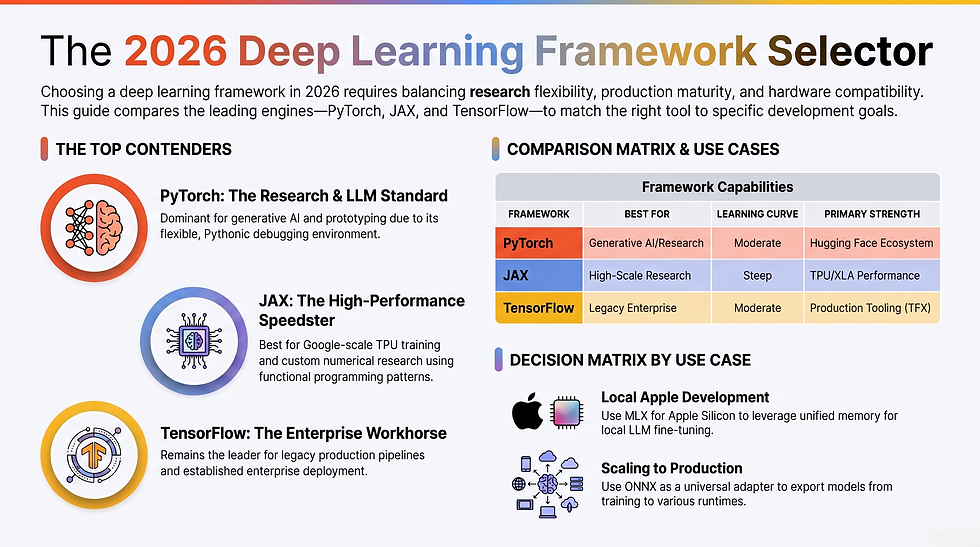
PyTorch vs TensorFlow vs JAX
Performance and speed. Eager execution gives PyTorch and TensorFlow 2.x their debugging-friendly reputation but leaves performance on the table compared to compiled execution. JAX's design forces JIT compilation through XLA from the start, which tends to produce excellent raw throughput once code is written in JAX's functional style, though the compilation step itself can be slower to iterate against during development.
Community and ecosystem. By most measures, including GitHub activity, package downloads, and repository integrations, PyTorch currently leads by a wide margin. JAX's ecosystem is smaller but growing quickly, concentrated heavily around Google Research, DeepMind, and TPU-centric infrastructure teams.
Deployment and inference. TensorFlow's production tooling remains the most mature end-to-end option. PyTorch has closed much of this gap through ONNX export and integration with NVIDIA's Triton Inference Server, to the point where the practical difference matters less than it did a few years ago.
Learning and flexibility. PyTorch's dynamic computation graphs mean the code you write is the code that executes, step by step, which is why debugging feels so natural. JAX's functional transforms are more powerful for certain classes of research problems, custom gradient computations, differentiable simulations, but they require a genuine shift in how you think about writing code.
Real-world usage. As a general pattern, organizations building on generative AI and LLM infrastructure lean heavily on PyTorch. Google's own research and infrastructure teams make significant use of JAX, particularly for TPU-scale training, alongside continued TensorFlow investment for production and mobile use cases. Framework choice inside any single large AI lab is rarely monolithic. Teams mix and match based on what a specific project actually needs.
Deep Learning Frameworks for Enterprise AI
Healthcare teams use deep learning frameworks to process high-resolution medical imaging, including DICOM-formatted scans, for diagnostic support tools, and to accelerate drug discovery pipelines that model molecular interactions at scale.
Finance applies these frameworks to real-time credit risk scoring models that need to return decisions in milliseconds, and to quantitative trading systems where latency directly affects profitability.
Retail relies heavily on sparse embedding models for personalized recommendation engines, the kind of system deciding what shows up on a homepage based on a shopper's history.
Manufacturing increasingly runs edge inference directly on the factory floor, using computer vision models for real-time visual inspection on assembly lines, catching defects faster than a human inspector could.
Automotive teams building Advanced Driver Assistance Systems (ADAS) rely on end-to-end training configurations that combine massive datasets of driving footage with the safety-critical inference requirements of running that model inside an actual vehicle.
Businesses evaluating vendors for any of these use cases often benefit from working through a structured AI model evaluation guide before committing resources to a specific framework and architecture combination.
Emerging Trends in Deep Learning Frameworks
OpenXLA has become the connective tissue between frameworks and hardware. It's a multi-framework compilation layer that lets PyTorch, TensorFlow, and JAX all target the same underlying XLA compiler, reducing the amount of framework-specific optimization work hardware vendors need to do.
Apple MLX continues expanding what local fine-tuning and inference look like on unified-memory hardware, and its cautious move toward CUDA support suggests it may not stay Apple-exclusive forever.
Model compression techniques, quantization methods like AWQ, GPTQ, and GGUF, along with pruning and knowledge distillation, are increasingly built directly into framework tooling rather than bolted on as separate libraries. This matters enormously for anyone trying to run capable models on consumer hardware.
Distributed training keeps advancing on both major fronts. PyTorch's FSDP (Fully Sharded Data Parallel) has matured into the standard approach for training models too large for a single GPU's memory, while JAX's native multi-node sharding, particularly through tools built for Google's Pathways infrastructure, targets similar problems from a different architectural angle.
AI agents are reshaping how frameworks get used in practice. Chaining model outputs together into semantic workflows, an area sometimes described under agentic AI solutions, increasingly treats the underlying framework as an implementation detail rather than a primary design decision.
Multimodal AI support is becoming a baseline expectation rather than a specialty feature. Native handling of image, audio, and video tensors inside standardized dataloaders is showing up across all the major frameworks, not just research-specific forks.
Edge AI and inference optimization continue pushing toward lower latency compilation engines, driven by the practical reality that more inference is happening on phones, laptops, and embedded devices rather than exclusively in the cloud.
Common Mistakes When Choosing a Framework
Teams frequently underestimate deployment costs until after a model is already trained, discovering too late that their chosen framework's production tooling doesn't match their infrastructure. Choosing a framework purely because it's trending on social media or in conference talks, rather than because it fits the actual problem, is a persistent and expensive mistake. Ignoring developer talent availability in your hiring market can leave a technically sound framework choice stuck with an empty job req for months. And neglecting compiler compatibility issues, assuming torch.compile or XLA will "just work" with every custom operation, tends to surface painful debugging sessions right before a launch deadline.
Final Recommendation
Decision Matrix:
Building a research prototype or exploring generative AI → PyTorch
Training at Google Cloud TPU scale or doing custom numerical research → JAX
Maintaining an existing enterprise pipeline built years ago → TensorFlow
Want the easiest possible entry point → Keras 3
Need to move a trained model across runtimes → ONNX
Building for Apple Silicon, on-device inference → MLX

Framework Recommendation by Use Case:
Research and LLM development lean PyTorch or JAX. Enterprise legacy systems lean TensorFlow. Beginners lean Keras. Cross-platform deployment leans ONNX. Apple-native local AI leans MLX.
There's no framework that wins on every axis, and that's fine. The right choice depends on your team's existing skills, your deployment target, and how much your infrastructure is already locked into a particular ecosystem. Deep learning frameworks are tools, not identities, and the healthiest engineering teams treat framework choice as a practical decision revisited periodically, not a permanent allegiance. If you're weighing this decision for a real project, working through FourfoldAI's collection of advanced AI tools alongside your framework shortlist can help you evaluate the surrounding tooling, not just the training library itself. FourfoldAI also works with teams directly on architectural optimization questions like this one, if you'd like a second set of eyes on your specific stack.
FAQ
What is a deep learning framework? It's a software library that provides the building blocks for creating and training neural networks, tensors, automatic differentiation, optimizers, and hardware acceleration, so developers don't need to write low-level GPU code from scratch for every project.
Which deep learning framework is best for beginners? Keras is generally the easiest starting point, thanks to its high-level, readable API. PyTorch is a close second and arguably the better long-term investment, since most tutorials, courses, and open-source model code default to it.
Is PyTorch better than TensorFlow? "Better" depends on the job. PyTorch tends to win for research, prototyping, and generative AI work because of its dynamic graphs and debugging ergonomics. TensorFlow still holds real advantages in mature production environments, particularly ones already built around TFX and TensorFlow Serving.
Which framework is used for ChatGPT-style models? Large language models in the GPT family and most comparable open-weight models are trained primarily using PyTorch, often combined with libraries like Megatron-LM or DeepSpeed for distributed training across large GPU clusters.
Can one framework handle computer vision and NLP? Yes. PyTorch in particular handles both extremely well, with torchvision covering vision tasks and Hugging Face Transformers covering NLP, often within the same codebase and training pipeline.
Which framework is best for enterprise AI? It depends on whether you're building something new or maintaining something old. New enterprise AI initiatives increasingly choose PyTorch, while organizations with substantial existing TensorFlow infrastructure often have good reasons to keep extending it rather than migrating.
Do deep learning frameworks require GPUs? Not strictly. All major frameworks run on CPUs, and that's fine for small models or early prototyping. But training anything beyond a toy model at reasonable speed genuinely requires GPU or TPU acceleration; CPU-only training on modern architectures can take orders of magnitude longer.
Which framework is best for production deployment? TensorFlow, through TFX and TensorFlow Serving, still has the most mature end-to-end production tooling. That said, PyTorch has closed much of the gap through ONNX export and Triton Inference Server integration, making it a genuinely viable production choice today.
Is JAX replacing TensorFlow? Not exactly replacing it, more like specializing alongside it. JAX is gaining ground fast in research and TPU-scale training, and Google's own teams increasingly favor it for new research work. TensorFlow's production and mobile deployment strengths remain intact for now.
What is the future of deep learning frameworks? Expect continued convergence around shared compiler infrastructure like OpenXLA, deeper native support for quantization and model compression, tighter integration with agentic AI workflows, and growing relevance for on-device frameworks like MLX as more inference moves to personal hardware rather than the cloud.
References
This article is backed by current framework release notes, official project documentation, and industry adoption research current as of mid-2026.
Disclaimer:
This article is for informational and educational purposes only and does not constitute technical, financial, or professional consulting advice. Framework benchmarks, market share figures, and version details evolve quickly in the AI industry; readers should verify current specifications against official documentation before making architectural decisions. For full details, see our disclaimer page.
About the Author
Muizz Shaikh is an AI enthusiast and digital technology professional at FourfoldAI. He is passionate about exploring AI tools, industry trends, and practical applications of emerging technologies. Through FourfoldAI, Muizz contributes to simplifying artificial intelligence for businesses and learners. Connect with him on LinkedIn: linkedin.com/in/muizz-shaikh-45b449403/
© 2026 FourfoldAI. All rights reserved.


Comments