
Scientific Foundation Models: The New Engine of Research

Every major scientific breakthrough used to run into the same wall: simulation. Modeling how a protein folds, how a hurricane forms, or how a battery electrolyte degrades over time meant feeding equations into a supercomputer and waiting — sometimes for weeks — for the physics to finish playing out. Scientific Foundation Models are changing that equation, literally. Instead of solving physical systems from first principles every single time, these models learn the underlying patterns from vast scientific datasets and generate predictions in seconds rather than days. That shift, from rigid computation to data-driven physical intuition, is quietly becoming one of the more consequential developments in applied AI, and it's worth understanding on its own terms rather than as a footnote to the general AI boom.
This guide breaks down what scientific foundation models actually are, how they differ from the general-purpose AI tools most people already use, and where they're already reshaping drug discovery, climate science, and materials research in 2026.

What Are Scientific Foundation Models?
Simple Definition
Scientific Foundation Models are specialized AI systems pretrained on multi-modal scientific data — including molecular structures, physics equations, and genomic sequences — that can generalize across a wide array of downstream scientific tasks without needing to be trained from scratch.
That single capability, generalizing across tasks instead of being built for one narrow job, is what separates this generation of models from the machine learning tools scientists have used for the past decade.

Why They Matter
Science has moved through three broad eras of method. The first was observation-led: researchers watched the natural world, recorded what happened, and built theories from patterns. The second, arriving with modern computing, was simulation-led — physicists, chemists, and climatologists translated those theories into equations and ran them on increasingly powerful hardware. That approach works, but it's expensive. A single high-fidelity climate simulation or a protein-folding calculation using traditional methods like density functional theory (DFT) can consume days of high-performance computing (HPC) time for a single candidate.
Scientific foundation models introduce a third era: prediction-led science. Once a model has been trained on enough physical and chemical data, it can generate a plausible structure, forecast, or property estimate almost instantly, then hand off only the most promising candidates for expensive, high-precision validation. Researchers aren't replacing the lab or the supercomputer; they're using the model to decide where to point them.
Evolution from Foundation Models
The lineage here runs directly back to the general-purpose transformer models that popularized the term "foundation model" in the first place — systems like GPT-4 that were pretrained on broad text corpora and then adapted to countless downstream tasks. Scientific foundation models borrow that same pretrain-then-adapt architecture but swap the training data. Instead of tokenizing words and sentences, these systems tokenize atoms, molecular coordinates, gene sequences, or atmospheric variables. The underlying idea, that a sufficiently large model trained on a sufficiently broad dataset develops transferable internal representations, turned out to work for physical reality nearly as well as it worked for language. It's a distinct branch from general-purpose foundation models, built specifically to reason about physical and biological systems rather than human text.
How Scientific Foundation Models Differ From Traditional AI Models
Traditional machine learning in science has historically meant building one narrow model per task: a classifier trained only to predict whether a specific protein binds to a specific receptor, or a regression model tuned to estimate the melting point of one class of alloys. Every new question meant a new dataset, a new training run, and a new model. Standard large language models sit at the opposite end of the spectrum — broadly capable with text and code, but with no grounding in physical law, which means they'll happily generate a chemically implausible molecule if it sounds linguistically reasonable.
Scientific foundation models occupy the middle ground, and it's a genuinely useful place to sit. A comparison across the three approaches makes the distinction clearer.
Training data is the first divide. Traditional ML models typically train on narrow, task-specific, labeled datasets — often just thousands of examples. Standard LLMs train on internet-scale text and code, measured in trillions of tokens. Scientific foundation models train on structured physical and biological data at similarly massive scale: molecular databases, genomic sequences, satellite imagery, and simulation outputs.
Generalization tells a similar story. A traditional ML model generalizes only within the narrow task it was built for. A standard LLM generalizes broadly across language tasks but poorly on physical reasoning. A scientific foundation model generalizes across a wide range of related scientific tasks within its domain — structure prediction, property estimation, and generative design, for instance — without retraining from scratch each time.
Scientific reasoning and physics awareness are where the gap becomes most visible. Traditional ML models have no reasoning capacity beyond their trained function. Standard LLMs can describe physics in natural language but frequently violate real physical constraints, since they're optimizing for linguistic plausibility, not molecular validity. Scientific foundation models are architecturally constrained, often through physics-informed loss functions, to respect conservation laws and structural rules, which makes their outputs far more reliable for real research use.
Multimodal capability rounds out the picture. Traditional ML tools are typically single-modality. Standard LLMs are increasingly multimodal across text, images, and audio. Scientific foundation models are multimodal across scientific formats specifically — sequence data, 3D structures, spectrometry readouts, and satellite bands — which lets a single model draw connections a narrower system simply can't see. This is a meaningfully different flavor of domain-specific AI models than the task-specific tools that dominated scientific computing before 2023.
Why Scientific Foundation Models Are Transforming Research
Faster Discoveries
The most visible impact is timeline compression. Processes that once took years of iterative lab work can now be narrowed to weeks of computational screening followed by targeted validation. Google DeepMind's materials-discovery system GNoME is a striking illustration: in roughly two weeks of computation, it proposed 2.2 million candidate inorganic crystal structures, of which about 380,000 were predicted to be stable enough for further study — a figure researchers described as comparable to centuries of traditional discovery work.
Better Simulations
Neural network "surrogates" are increasingly standing in for the dense partial differential equations (PDEs) that govern fluid dynamics, heat transfer, and atmospheric behavior. Rather than numerically integrating those equations at every grid point, a trained model learns to approximate the solution directly. Weather forecasting is the clearest example: DeepMind's GraphCast, a graph neural network trained on decades of reanalysis data, produces a 10-day global forecast in well under a minute on modern hardware, a task that traditionally required a dedicated supercomputing cluster running for hours.
Lower Research Costs
Running inference on a trained model costs a fraction of what a wet-lab experiment or a full HPC simulation costs. That economic gap is what makes AI-guided screening attractive to budget-conscious R&D teams: instead of physically synthesizing and testing hundreds of candidate compounds, researchers can run thousands of virtual candidates through a model first and reserve physical testing for the small subset that survives computational screening.
Cross-Disciplinary Learning
Because these models learn general representations of molecular and structural relationships, knowledge transfers across fields in ways narrow models can't replicate. A model trained broadly on molecular interaction data can often be fine-tuned for materials science or genomics with comparatively little additional data, since the underlying representation of atomic bonding and structural stability carries over.
Improved Prediction Accuracy
Non-linear dynamic systems, protein folding pathways, turbulent airflow, or chaotic weather patterns, have historically been the hardest problems for both classical simulation and older ML approaches. By training on enormous physical datasets, current-generation models have measurably narrowed error margins on these problems. GenCast, DeepMind's diffusion-based ensemble weather model, has been reported to outperform the European Centre for Medium-Range Weather Forecasts' benchmark system on the large majority of evaluated targets, a meaningful improvement over a forecasting standard that had been refined for decades.
Core Technologies Behind Scientific Foundation Models
Transformers
The same architecture that powers modern language models does the heavy lifting here, just repointed at non-textual data. DNA bases, amino acids, and even discretized molecular structures can be tokenized the same way words are, letting the transformer's attention mechanism learn long-range dependencies, in genomics, that might mean how a mutation in one part of a gene affects protein function thousands of bases away.
Diffusion Models
Generative diffusion, the same family of techniques behind image generation tools, has found a natural second life in molecular design. By learning to gradually "denoise" random configurations into valid structures, diffusion models can generate entirely new crystal lattices or candidate molecules that satisfy specific property constraints, rather than merely predicting the structure of something that already exists.
Graph Neural Networks (GNNs)
Molecules and materials are naturally graph-shaped: atoms are nodes, bonds are edges. GNNs process that structure directly, propagating information between connected atoms across multiple layers to learn how local structure determines global properties like stability or reactivity. This is the backbone architecture behind both GNoME's materials search and GraphCast's weather modeling, where the "graph" is the Earth's surface mesh rather than a molecule.
Physics-Informed Neural Networks (PINNs)
PINNs bake physical law directly into the training objective. Instead of only minimizing prediction error against training data, the loss function also penalizes outputs that violate conservation of mass, energy, or momentum. That constraint is what keeps a scientific model from proposing, say, a reaction that creates energy from nothing, an error a purely data-driven model has no built-in reason to avoid.
Multimodal Learning
Real scientific problems rarely come packaged in a single data format. A drug discovery question might need to synthesize research papers, genomic sequences, 3D protein structures, and mass spectrometry readouts simultaneously. This is where the broader trend toward multimodal AI intersects directly with scientific applications, models trained to process several of these formats at once uncover relationships a single-modality system would miss entirely.
Scientific Knowledge Graphs
Beneath many of these systems sits a layer of structured, cross-referenced academic knowledge, embeddings built from millions of paper citations, experimental results, and known relationships between entities. This gives models a form of logical grounding: a way to check a generated hypothesis against what's already been established in the literature, rather than generating purely from statistical pattern-matching.
Real-World Applications Across Industries
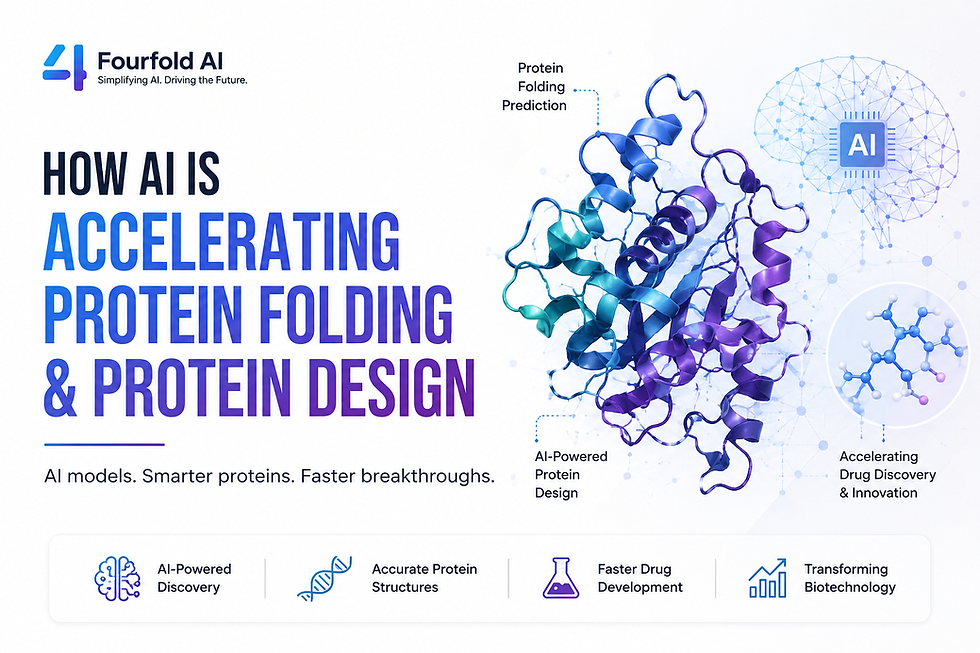
Drug Discovery & Protein Folding
Structural biology has arguably seen the most dramatic transformation. AlphaFold, developed by Google DeepMind, made protein structure prediction from an amino acid sequence alone a largely solved problem for a huge share of known proteins; its public database now serves several million researchers across more than 190 countries. Its successor, AlphaFold 3, extended that capability to model interactions between proteins, DNA, RNA, and small-molecule ligands, the kind of interaction that actually matters for designing a drug. In February 2026, DeepMind spinoff Isomorphic Labs released IsoDDE, a unified drug-design engine that reportedly more than doubled AlphaFold 3's accuracy on the hardest generalization cases, unfamiliar biomolecular structures with little resemblance to anything in its training data. Isomorphic has active pharma partnerships with Eli Lilly and Novartis and is targeting first-in-human trials for an AI-designed drug candidate by the end of 2026.

Climate Forecasting & Weather Prediction
Neural weather models have moved from research curiosity to operational tool remarkably fast. GraphCast and its successor GenCast replace the traditional numerical weather prediction pipeline with a trained network that ingests the current atmospheric state and outputs a forecast almost instantly. GraphCast has already demonstrated real-world value, DeepMind has documented cases where it identified a hurricane's likely landfall location several days before traditional ensemble models converged on the same answer. These systems don't discard traditional meteorology; most forecasting operations now run AI and physics-based models side by side, treating disagreement between them as a useful signal of forecast uncertainty.
Materials Discovery & Battery Research
GNoME's 2.2 million candidate crystal structures, with roughly 380,000 flagged as likely stable, were folded into the open Materials Project database, giving researchers worldwide a dramatically expanded search space for next-generation batteries, solar materials, and superconductors. A related effort paired GNoME's predictions with an autonomous robotic lab at Berkeley Lab, which successfully synthesized dozens of the AI-proposed materials without human intervention at each step, an early but concrete example of AI-guided materials synthesis moving from prediction to physical reality.
Semiconductor Design & Aerospace Engineering
Fluid dynamics and heat dissipation problems, historically some of the most computationally expensive simulations in engineering, are increasingly handled by trained neural surrogates that approximate the outcome of a full computational fluid dynamics (CFD) run in a fraction of the time. This matters directly for chip design, where thermal behavior at nanometer scale determines performance limits, and for aerospace applications like airfoil and heat-shield design, where testing every possible geometry physically simply isn't feasible.
Earth Observation & Nuclear Science
NASA and IBM's Prithvi family of geospatial foundation models, trained on satellite imagery and decades of climate reanalysis data, supports tasks ranging from flood mapping to deforestation tracking to crop monitoring. In 2026, a compressed version of Prithvi became the first geospatial foundation model deployed in orbit, running directly aboard a satellite and an International Space Station payload to test real-time flood and cloud detection. In nuclear science, similar surrogate-modeling approaches are being applied to plasma containment problems in fusion research, where full physics simulations are extraordinarily compute-intensive.
Scientific Foundation Models vs General Foundation Models
It's worth being precise about why a general-purpose model like a standard large language model isn't a substitute for a purpose-built scientific one, even a very capable one. The core issue is what researchers sometimes call physical law violation: an LLM trained purely on text can generate a sentence describing a molecule with five bonds on a carbon atom, because the sentence is grammatically and statistically plausible, even though it's chemically impossible. The model has no internal representation of valence chemistry forcing it to reject that output.
Data sources differ sharply: general LLMs train primarily on text and code scraped from the internet, while scientific foundation models train on curated structural, genomic, or physical datasets, often validated against experimental ground truth. Validation loops differ too. Scientific models are frequently built with an active-learning cycle, generate a prediction, validate computationally or experimentally, feed the result back into training, that general LLMs typically lack. Logic constraints in scientific models are often physics-based and hard-coded into the loss function, whereas a general LLM's only real constraint is linguistic coherence. And physical awareness is baked structurally into scientific models through architectures like PINNs and GNNs, rather than emerging incidentally from language patterns. None of this makes general-purpose models less useful, they remain excellent at literature synthesis, hypothesis brainstorming, and code generation for research tooling, but the deep, quantitative work of predicting a molecule's binding affinity or a material's stability still belongs to purpose-built scientific systems.
Leading Scientific Foundation Models in 2026
AlphaFold and IsoDDE (Google DeepMind / Isomorphic Labs): AlphaFold transformed structural biology from a decades-long experimental challenge into a largely computational one, and its 2024 successor, AlphaFold 3, extended prediction to protein-DNA, protein-RNA, and protein-ligand interactions. Isomorphic Labs' 2026 follow-up system, IsoDDE, pushes further into the actual drug-design pipeline, binding affinity estimation, antibody modeling, and pocket detection, rather than structure prediction alone.
Evo 2 (Arc Institute, with NVIDIA): Evo 2 is a long-context genomic foundation model, trained with 40 billion parameters on more than 9 trillion nucleotides spanning over 100,000 species across all three domains of life. Published in Nature in 2026, it can identify disease-causing mutations, including clinically significant variants in genes like BRCA1, directly from DNA sequence, and can generate entirely new genome-scale sequences. Its developers describe it as a foundational layer for generative functional genomics, capable of both reading and writing the genetic code.
Climate and Materials Foundations: NASA and IBM's Prithvi family covers both geospatial imagery (Prithvi-EO) and weather and climate variables (Prithvi-WxC), the latter trained on four decades of NASA's MERRA-2 reanalysis data. On the materials side, DeepMind's GNoME and the underlying Materials Project database have become a shared foundation that other labs, including autonomous synthesis efforts, now build on directly.
Enterprise Use Cases
Pharmaceuticals are using these models to compress the earliest, slowest phase of drug development, target identification and hit generation, from years down toward months, screening enormous virtual compound libraries before committing to expensive wet-lab synthesis. Manufacturing and energy companies are applying materials foundation models to optimize catalyst formulations for chemical processes and to model wind farm array layouts for maximum energy capture, tasks that used to require exhaustive physical prototyping. Automotive and aerospace engineering teams are using neural surrogates to accelerate crash-test simulation and airfoil design iteration, running thousands of virtual design variants before committing to a physical wind-tunnel or crash-test run.
Benefits for Businesses
For executive stakeholders evaluating whether this technology is worth adopting, the business case tends to rest on a handful of concrete advantages: faster innovation cycles, since candidate screening that once took quarters can now take days; reduced experimentation costs, as computational screening narrows what actually needs physical testing; better forecasting across weather-dependent operations like agriculture, logistics, and insurance; accelerated R&D timelines across pharma and materials pipelines; the ability to build digital twins of physical systems for ongoing simulation and monitoring; and a competitive advantage for organizations that establish strong data and modeling pipelines before their peers do.
Current Challenges
None of this comes without real friction, and it's worth stating the limitations plainly rather than glossing over them. Compute requirements remain steep; training and fine-tuning large scientific foundation models still demands substantial HPC and GPU capacity, which is a meaningful part of the broader conversation around AI infrastructure that enterprise AI adoption depends on. Data scarcity is a persistent bottleneck, clean, well-labeled experimental data is expensive to generate and often proprietary, which limits how broadly some domain-specific models can generalize. Explainability is a genuine open problem: these models can produce accurate predictions without offering a clear mechanistic explanation for why a given structure is stable or a given forecast is likely, the classic "black box" issue, which matters enormously in regulated fields like pharmaceuticals. Validation and reproducibility add further complexity, since a computationally promising candidate still has to be confirmed experimentally before anyone trusts it, and independent labs don't always reproduce headline benchmark numbers. Finally, benchmark limitations mean that strong performance on a standard test set doesn't always translate cleanly to messy, real-world research conditions.
Future Trends
AI Scientists & Autonomous Laboratories
The pairing of robotic wet labs with self-driving experimental loops is moving from proof-of-concept to early operational reality. Berkeley Lab's A-Lab, which used GNoME's materials predictions to autonomously synthesize dozens of new compounds, is an early example of a broader pattern: AI proposes a hypothesis, a robotic system runs the physical experiment, and results feed back into the model automatically.
Multi-Agent Research Systems
Specialist AI agents are increasingly being organized into collaborative research pipelines, one agent drafts an experimental plan, another executes or simulates it, a third critiques the results against known literature, and a fourth documents the findings. This division of labor mirrors how human research teams already operate, and it's a natural extension of the broader move toward autonomous, tool-using AI systems.
Scientific Reasoning Models & Hybrid Symbolic AI
A growing thread of research combines deep neural pattern recognition with exact symbolic solvers, using the neural model to propose candidate solutions quickly and a symbolic system to verify them against hard mathematical or physical constraints. This hybrid approach aims to capture the speed advantage of neural prediction without sacrificing the absolute reliability that fields like structural engineering or nuclear physics require.
How Organizations Should Prepare
For technology leaders weighing when and how to get involved, a practical roadmap tends to include four steps.
1. Data Readiness. Start by auditing and cleaning proprietary experimental data. Scientific foundation models are only as useful as the data available to fine-tune or validate them against, and most organizations underestimate how much internal data cleanup this requires.
2. Infrastructure. Evaluate hybrid cloud and HPC strategies early. Few organizations need to train a foundation model from scratch, but running inference and fine-tuning at scale still requires deliberate infrastructure planning.
3. Governance & Safety. Establish clear safety protocols before deploying generative models in sensitive domains, particularly anything touching biochemical synthesis, where the same generative capability that designs a useful molecule could, in principle, be misused.
4. Pilot Projects. Begin with small, high-probability surrogate modeling tasks rather than attempting to replace an entire simulation pipeline at once. A narrow, well-scoped pilot, replacing one expensive simulation step with a trained surrogate, builds internal confidence and expertise before scaling further.
Conclusion
Scientific foundation models mark a genuine shift in how research gets done: from empirical observation, to computationally expensive simulation, to fast, learned prediction that narrows down where the expensive work actually needs to happen. That doesn't mean the lab bench or the supercomputer is going away, validation still matters enormously, especially in regulated fields like pharmaceuticals. But the bottleneck is moving. Increasingly, the limiting factor in research isn't how fast you can simulate a system; it's how well you can direct your limited experimental resources toward the candidates most likely to work. That's the quiet, structural change scientific foundation models are driving, and it's likely to be one of the more durable AI stories of the next several years.
Frequently Asked Questions
What are Scientific Foundation Models? Scientific foundation models are AI systems pretrained on large-scale scientific data, molecular structures, genomic sequences, or physical simulations, that generalize across many downstream research tasks. Unlike narrow machine learning models built for one function, they can be adapted or fine-tuned for multiple prediction and design tasks within a scientific domain without retraining from the ground up.
How do Scientific Foundation Models work? They're pretrained on massive scientific datasets using architectures like transformers, graph neural networks, and diffusion models, learning statistical patterns in physical and biological data. Physics-informed constraints are often built into training so outputs respect real-world laws. Once pretrained, the model can be fine-tuned or prompted for specific tasks like structure prediction or property estimation.
What is the difference between standard foundation models and Scientific Foundation Models? Standard foundation models, like general-purpose LLMs, are trained mainly on text and code and excel at language tasks. Scientific foundation models are trained on structured physical and biological data and are built with domain-specific constraints, like physics-informed loss functions, that make them far more reliable for quantitative scientific prediction.
Why are Scientific Foundation Models important? They compress research timelines that traditionally took years into weeks by replacing some expensive simulation and experimentation with fast, learned prediction. This lowers costs, expands the number of candidates researchers can explore, and helps direct limited lab resources toward the most promising options first.
Which industries use Scientific Foundation Models? Pharmaceuticals and biotech use them for drug discovery and protein structure prediction. Climate and meteorology use them for weather forecasting. Materials science and energy use them for battery and catalyst discovery. Aerospace, semiconductor design, and Earth observation are also active adopters.
Are Scientific Foundation Models better than ChatGPT? They're built for a different purpose. General-purpose assistants like ChatGPT are strong at language tasks, summarization, and brainstorming, but lack grounding in physical law, meaning they can generate scientifically implausible outputs. Scientific foundation models are purpose-built and constrained for quantitative accuracy in their specific domain, which makes them more reliable for tasks like structure or property prediction.
Can businesses use Scientific Foundation Models? Yes. Enterprises in pharma, materials, energy, and aerospace already use them to accelerate R&D, from virtual compound screening to materials discovery to simulation replacement. Most organizations start with a narrow pilot project rather than building or training a model from scratch.
What challenges do Scientific Foundation Models face? Key challenges include high compute requirements, scarcity of clean labeled experimental data, limited explainability of model outputs, and the need for experimental validation before results can be trusted. Benchmark performance also doesn't always translate directly to messy real-world research conditions.
What is a scientific foundation model? It's an AI model pretrained on large scientific datasets, such as molecular, genomic, or climate data, that can generalize across multiple related research tasks rather than being built for a single narrow function, similar in spirit to how general-purpose language models generalize across text tasks.
What are examples of Scientific Foundation Models? Notable examples include AlphaFold and IsoDDE for protein structure and drug design, Evo 2 for genomic sequence modeling and design, GraphCast and GenCast for weather forecasting, GNoME for materials discovery, and NASA/IBM's Prithvi models for Earth observation and climate applications.
How is AI changing scientific research? AI is shifting research from simulation-led to prediction-led workflows. Instead of running every candidate through expensive physical or computational simulation, researchers increasingly use trained models to screen and rank candidates first, reserving costly experimental validation for the most promising results.
Can Scientific Foundation Models replace physical simulations?
Not entirely. They act as fast surrogates that approximate what a full simulation would show, which is extremely useful for initial screening, but high-stakes decisions still typically require validation against traditional simulation methods or physical experiments, particularly in regulated fields.
Are Scientific Foundation Models expensive to build?
Training a large scientific foundation model from scratch requires significant compute and curated data, making it expensive, which is why most organizations rely on models built by research labs like DeepMind, Arc Institute, or NASA/IBM, fine-tuning them for specific applications rather than training from zero.
References
This article draws on research and reporting from the following sources:
Google DeepMind — Millions of new materials discovered with deep learning (GNoME)
Arc Institute — Evo 2: AI can now model and design the genetic code for all domains of life
NASA Earthdata — NASA and IBM Research Apply AI to Weather and Climate
NASA Science — NASA's Prithvi Becomes First AI Geospatial Foundation Model in Orbit
IBM Research — Prithvi-EO: An Open-Access Geospatial Foundation Model
This article is backed by current research and reporting from the organizations and publications cited above. Readers are encouraged to consult the original sources for full technical detail.
Disclaimer
Disclaimer: This article is intended for informational and educational purposes only and does not constitute professional, scientific, medical, financial, or investment advice. AI model capabilities, benchmarks, and organizational claims referenced here are based on publicly available information at the time of writing and may change. For full details, please read our complete disclaimer at fourfoldai.com/disclaimer.
Curious how AI is reshaping enterprise operations more broadly, not just research labs? Explore more strategic breakdowns of AI infrastructure, agentic systems, and enterprise adoption on FourfoldAI.com.
About the Author
Muizz Shaikh is an AI enthusiast and digital technology professional at FourfoldAI. He is passionate about exploring AI tools, industry trends, and practical applications of emerging technologies. Through FourfoldAI, Muizz contributes to simplifying artificial intelligence for businesses and learners. Connect with him on LinkedIn: linkedin.com/in/muizz-shaikh-45b449403/
© 2026 FourfoldAI. All rights reserved.


https://rr88m1.com/ mình vừa ghé qua để xem bố cục trang thôi vì dạo này nhiều web trông giống nhau. Vào trang thấy họ chia nội dung thành từng khối tách bạch, kéo xuống đọc khá nhanh mà không rối mắt. Mình chú ý nhất là phần họ công khai thông tin về nguồn gốc/pháp lý ngay trên web, ai muốn xem sơ qua thì khỏi phải đi tìm ở đâu khác. Mấy thao tác chuyển mục cũng ổn, bấm qua lại không thấy đứng hay chờ lâu. Mình không đăng ký hay thử gì sâu, chỉ lướt như người mới để xem cảm giác dùng thế nào. Nhìn chung cách họ đặt tiêu đề và các box thông tin theo…
Mình không phải dạng mê lô đề hay xổ số gì ghê gớm, nhưng lâu lâu vẫn liếc qua cho đỡ căng thẳng sau giờ làm. Hồi trước mình chọn số kiểu hên xui, thấy con nào hợp mắt thì ghi lại, nên trúng thì hiếm mà trượt thì quen, cũng chẳng đặt nhiều kỳ vọng. Gần đây mình thử đổi cách một chút: đọc vài bài nói về cầu kèo, xem thống kê tần suất rồi tự note lại, coi có hợp gu mình không. Có bữa mình xem dự đoán xổ số miền bắc hôm nay rồi so với cách mình hay chọn, thấy cũng có vài chỗ nghe hợp lý, nhưng mình vẫn nghĩ quan trọng nhất…