
Frontier AI Models Explained: The Ultimate Comparison Guide (2026)

Choosing an AI model in 2026 is no longer about picking the "smartest" name on a leaderboard. It's about matching a specific workload — coding, customer support, research, content generation — to the model architecture that actually handles it best. Frontier AI models now span half a dozen labs, each optimizing for a different slice of the problem: raw reasoning, agentic tool-calling, massive context ingestion, or rock-bottom inference cost. What used to look like a single winner-take-all race has turned into a genuinely diverse ecosystem, where the "best" model changes depending on what you're asking it to do. At FourfoldAI, we track this landscape closely because the practical implications — cost, latency, compliance, vendor lock-in — matter more to most businesses than a two-point gap on a benchmark chart.
This guide breaks down the current frontier model landscape, compares the major players on the metrics that actually affect deployment decisions, and gives you a framework for choosing rather than guessing.
What Are AI Models?
Foundation models explained
A foundation model is a neural network pre-trained on a massive, diverse dataset, built to generalize across a wide range of downstream tasks rather than solve one narrow problem. Instead of training a fresh model for every use case, developers adapt a single foundation model through fine-tuning, retrieval-augmented generation, or simple prompting. That reusability is what turned foundation models into infrastructure rather than a research curiosity — the same base model can draft a contract, debug a Python script, or summarize a support ticket depending on how it's prompted.
LLMs vs multimodal AI
Large Language Models started as text-in, text-out systems: predict the next token, repeat. That's no longer where the frontier sits. Modern frontier systems process text, images, audio, and video inside a single shared latent space, meaning a model can watch a screen recording, read the transcript, and reason about both together without bolting on separate vision or speech modules. Google's Gemini family has pushed this hardest, with native video and audio input built into its core architecture rather than added as an afterthought.
How frontier AI differs
What separates a frontier model from a merely competent enterprise model comes down to three things: emergent reasoning that wasn't explicitly trained for, reliable multi-step tool-calling, and the capacity to plan across a long agentic sequence — booking a flight, checking a calendar, drafting a follow-up email — without a human stepping in between each action. This is the layer where agentic AI workflows actually become viable in production rather than staying a demo.
What Is the Frontier AI Race?
Evolution from GPT-3 to modern frontier models
The jump from GPT-3 to today's models wasn't just "more parameters." Reinforcement learning from human feedback (RLHF) turned raw completion engines into instruction-followers. Then came test-time compute — models that spend extra reasoning tokens mid-answer, effectively "thinking" before responding. OpenAI's o1 popularized this pattern in late 2024, and by 2026 it's standard across nearly every frontier lab, branded differently: "thinking mode" at Alibaba, "extended reasoning" at Anthropic, "Deep Think" at Google.
Why every AI lab competes
The incentives here go beyond bragging rights. Anthropic's valuation climbed to roughly $965 billion after a May 2026 Series H round, briefly overtaking OpenAI as the highest-valued AI startup in history — a signal of how much capital is chasing developer-ecosystem lock-in and enterprise API revenue. Every major lab is racing for the same thing: become the default inference layer businesses build on top of, because switching costs compound once a company has wired its workflows to a specific model's tool-calling format.
How scaling laws changed AI
Bigger models trained on more data used to reliably produce better performance — the classic scaling law. That curve is flattening. Labs have shifted budget toward post-training optimization, synthetic data generation, and reinforcement learning refinement rather than simply buying more GPUs and hoping. DeepSeek's cost breakthroughs are the clearest evidence of this pivot: architectural efficiency, not raw compute, is now where competitive advantage gets built.
Major Frontier AI Companies
OpenAI
OpenAI's current lineup, announced in July 2026, splits into three tiers under the GPT-5.6 family: Sol (the frontier flagship), Terra (roughly 5.5-level intelligence at half the inference cost), and Luna (a fast, small model for lightweight tasks). Sol was initially limited to vetted partners through the API and Codex, reflecting a broader 2026 trend of governments reviewing high-capability models before wide release — GPT-5.6 Sol was positioned as OpenAI's strongest cybersecurity-capable model, which triggered a phased rollout rather than an immediate public launch.
OpenAI's strategic bet remains breadth: reasoning, computer-use agents, and a consumer-facing ecosystem (ChatGPT Plus/Pro) that keeps millions of daily users inside its product surface. That scale gives OpenAI an evaluation and feedback loop few competitors can match.
Anthropic
Anthropic's flagship lineup as of mid-2026 runs Claude Opus 4.8 (released May 2026) for complex, long-horizon reasoning and agentic coding, Claude Sonnet 4.6 (February 2026) for balanced agentic workflows and content pipelines, and Claude Haiku 4.5 for speed and cost efficiency. Anthropic also released Claude Fable 5 and Claude Mythos 5 on June 9, 2026 — both briefly suspended between June 12 and June 30 under U.S. export control review before being fully restored on July 1, 2026.
Anthropic's differentiator is structured output and coding reliability. Claude models power a large share of the developer tooling ecosystem, including Cursor, Windsurf, and Anthropic's own Claude Code, largely due to consistent JSON schema adherence and strong real-world software engineering performance on benchmarks like SWE-bench.
Google DeepMind
Google's Gemini family leads on context window size and native multimodality. Gemini 3.1 Pro and the newer Gemini 3.5 Pro (cleared for a July 2026 launch without the same government restrictions applied to some rival models) support context windows in the 1-million-token range, with strong scores on graduate-level reasoning benchmarks like GPQA Diamond. Google's advantage is distribution — deep integration across Android, Google Cloud, and Workspace means Gemini reaches enterprise users without a separate procurement conversation.
Meta
Meta remains the standard-bearer for open-weight models at scale. Llama 4, in its Scout and Maverick variants, offers context windows stretching into the multi-million-token range in some configurations, letting developers ingest entire codebases in a single prompt. In July 2026, Meta added Muse Spark 1.1, a 1-million-token-context agentic model positioned to rival GPT-5.5 and Claude Opus 4.8 on agentic evaluations, alongside Meta's first paid developer API in public preview. Meta's open licensing (with restrictions above 700 million monthly active users) continues to drive down the cost of self-hosted enterprise deployment globally.
DeepSeek
DeepSeek disrupted the pricing conversation entirely. Its V4 Pro and V4 Flash models, released April 2026, use Multi-head Latent Attention (MLA) to compress a 1.6-trillion-parameter model down to roughly 49 billion active parameters per token — delivering frontier-adjacent coding and reasoning scores at a fraction of the cost of closed alternatives. DeepSeek's entire model line ships under the MIT license, removing legal friction for commercial deployment.
Mistral
Mistral's Mistral Large 3, released in December 2025, is a 675-billion-total-parameter MoE model under Apache 2.0 with a 256K context window and text-plus-image input across 80-plus languages. Mistral's pitch centers on European data-residency compliance and permissive licensing with no monthly-active-user cap — a meaningful difference for enterprises operating under strict EU regulatory frameworks.
xAI / SpaceXAI
xAI's Grok models continue to lean on real-time data access through X, giving them an edge in workflows that need current events or social signal grounding. In July 2026, xAI was folded into a unified SpaceXAI brand, with its first flagship release built on a large MoE architecture trained heavily on real-world coding-agent interaction data.
Alibaba Qwen
Alibaba's Qwen 3.6 / 3.7 line leads open-model reasoning benchmarks, posting GPQA Diamond scores that rival — and in some evaluations exceed — closed frontier models, while running on far smaller active-parameter counts. Qwen's strength lies in multilingual coverage (200-plus languages), native multimodal input, and mature Model Context Protocol tooling for agent development.
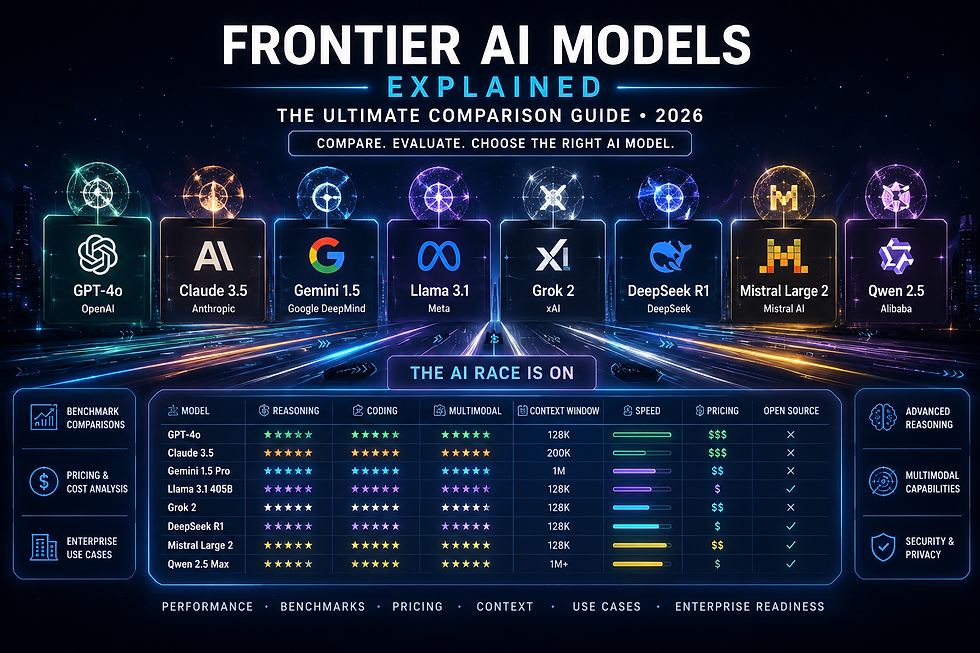
Frontier AI Models Compared
Model Family: Claude (Anthropic) — Current release: Opus 4.8 / Sonnet 4.6 / Haiku 4.5. Context window: up to 1M tokens. Multimodal: text, vision. Coding strength: industry-leading, powers most third-party coding agents. Reasoning: structured, agentic. Enterprise security: zero data retention option available. Pricing (per 1M in/out): roughly $3 / $15 on Sonnet-tier. Source model: closed.
Model Family: GPT (OpenAI) — Current release: GPT-5.6 (Sol / Terra / Luna). Context window: 1M tokens on flagship tier. Multimodal: text, vision, audio, computer use. Coding strength: strong, leads on several agentic evals. Reasoning: test-time compute scaling. Enterprise security: enterprise agreement SLA. Pricing: varies sharply by tier (Terra roughly half of Sol's cost). Source model: closed.
Model Family: Gemini (Google DeepMind) — Current release: Gemini 3.1 Pro / 3.5 Pro. Context window: 1M+ tokens. Multimodal: text, vision, video, audio — the strongest native multimodal support in the field. Coding strength: high, especially for large codebase ingestion. Reasoning: leads GPQA Diamond among closed models. Enterprise security: Vertex AI compliance. Pricing: around $2 / $12 per 1M tokens on the Pro tier. Source model: closed.
Model Family: Llama 4 (Meta) — Current release: Scout / Maverick, plus Muse Spark 1.1. Context window: multi-million-token on Scout variants. Multimodal: text, vision on select variants. Coding strength: strong with fine-tuned variants. Reasoning: standard. Enterprise security: local hosting / on-prem. Pricing: free to self-host, cloud-hosting costs vary by provider. Source model: open weights (community license, MAU cap applies).
Model Family: DeepSeek V4 — Current release: V4 Pro / V4 Flash. Context window: 1M tokens. Multimodal: text, some vision. Coding strength: high, competitive coding benchmarks lead the open-weight field. Reasoning: reinforcement-learning based. Enterprise security: private cloud deployment. Pricing: roughly $0.435 / $0.87 per 1M tokens on Pro, $0.14 / $0.28 on Flash. Source model: open weights (MIT license).

AI Benchmark Comparison
A handful of benchmarks dominate frontier model evaluation, and each measures something different:
MMLU (Massive Multitask Language Understanding) tests general academic knowledge across dozens of subjects. It's largely saturated at the frontier tier — most top models now cluster within a few points of each other, which limits its usefulness as a differentiator.
SWE-bench evaluates a model's ability to resolve real software engineering issues pulled from actual GitHub repositories, making it one of the more production-relevant coding benchmarks available.
HumanEval measures Python coding problem-solving on a fixed set of programming challenges — useful as a baseline, though narrower than SWE-bench's real-world repository tasks.
GPQA (Graduate-Level Google-Proof Q&A) targets extremely difficult scientific and logical questions designed to resist simple lookup, making it a strong proxy for genuine reasoning depth.
AIME draws from competition-level mathematics problems, testing multi-step quantitative reasoning under time pressure.
Why benchmark scores don't always predict production performance
Benchmark contamination is the quiet problem underlying most leaderboards. When a model's training data overlaps with a benchmark's test set — even indirectly, through web-scraped forum discussions of the answers — its score stops reflecting genuine capability and starts reflecting memorization. This is difficult to fully rule out given how much of the public internet has been scraped repeatedly across training runs.
Rigid evaluation formats compound the problem. Many benchmarks score a single, tightly formatted answer, which rewards models tuned to match that exact format over models that reason correctly but express the answer differently. A review of GSM8K, for instance, found invalid question rates as high as 42% in some auditing passes — meaning a chunk of "wrong" answers may actually reflect flawed test data, not model failure.
Differences in prompting paradigms matter just as much. A model evaluated with chain-of-thought prompting can score dramatically differently than the same model evaluated with a single-shot prompt, and vendors don't always disclose which configuration produced their headline number. That's why the most reliable signal for your specific use case is running your own held-out evaluation set against your actual workload, rather than importing a public leaderboard ranking as ground truth. For a deeper framework here, see our guide on AI model evaluation.
Which AI Model Wins for Different Use Cases?
Coding: Claude Opus 4.8 and Sonnet 4.6 remain the developer-tooling standard for long-form codebase management and debugging, with Qwen 3.6/3.7 and DeepSeek V4 Pro as strong open-weight alternatives at a fraction of the cost.
Writing: Claude's natural prose style tends to read less formulaic than GPT-generated copy, which is why many editorial and marketing teams default to it for long-form content.
Marketing: Highly steerable models that follow tone and brand-voice instructions precisely make rapid copywriting and campaign iteration faster — this is where lighter, fast-inference models often outperform heavier reasoning models on cost-per-output.
Data Analysis: Models with built-in Python code execution sandboxes — like ChatGPT's Advanced Data Analysis — handle exploratory analysis and chart generation without a separate coding environment.
Scientific Research: Reasoning-focused models that can step through multi-layered logic and hypothesis validation, such as OpenAI's o-series descendants and DeepSeek's R1 lineage, are best suited to research-style, multi-step problems.
Customer Support: Low-latency, low-cost models — Gemini Flash tiers, Llama 4 variants, or DeepSeek V4 Flash — handle real-time chat routing economically at scale, especially inside a properly built AI workflow automation layer rather than as a raw standalone chatbot.
AI Agents: Models with excellent JSON schema adherence and reliable tool-calling execution are non-negotiable here — inconsistent formatting breaks downstream automation, which is why Claude and Qwen currently anchor much of the agent-tooling ecosystem.
Enterprise Automation: The winning choice usually balances speed, compliance, and cost rather than chasing the single highest benchmark score — a pattern that shows up repeatedly across the best AI tools our team evaluates for business use.
Open Source vs Closed AI Models
Security & Compliance: Open-weight models hosted on private infrastructure give organizations direct control over data residency — a meaningful advantage for regulated industries. Closed models depend on vendor-managed clouds, though most major vendors now offer zero-data-retention agreements for enterprise customers.
Cost: Open-weight models carry high upfront capital expenditure for GPU infrastructure and ongoing management overhead. Closed models trade that for predictable, usage-based API pricing with no infrastructure to maintain.
Customization: Open weights allow deep fine-tuning on proprietary data at the parameter level. Closed models are typically adapted through system-prompt engineering and retrieval-augmented generation rather than direct weight modification.
Deployment: Open models support edge computing and fully offline deployment. Closed models are generally locked to centralized API calls, which introduces network latency that can matter for real-time applications.
Enterprise AI Decision Framework
Use this sequence to narrow down a model choice systematically:
Step 1 — Data Sensitivity: Does the workload require strict on-premises or sovereign data boundaries? If yes, move to a locally hosted open-weight model. If no, continue.
Step 2 — Workload Complexity: Does the task require multi-step reasoning, logical planning, or code generation? If yes, prioritize a reasoning-tier model or Claude Opus/Sonnet. If no, continue.
Step 3 — Latency & Budget: Is the goal high-volume, real-time customer response? If yes, route to a small, high-throughput model like Gemini Flash or DeepSeek V4 Flash. If no, continue.
Step 4 — Context Window Requirements: Are you processing entire codebases or long legal documents? If yes, Gemini's Pro tier or a long-context open-weight model with custom vector retrieval is the better fit.

Hidden Costs of Frontier AI
Inference & Token Scaling: Multi-agent validation loops — where one model checks another's output — compound token costs quickly, often 3-5x the cost of a single-pass query.
Latency Overhead: Reasoning models that "think" before answering trade speed for quality. That trade-off is invisible in a benchmark chart but very visible in a live customer-facing application.
Maintenance & Context Drift: System prompts tuned for one model version can degrade silently when a vendor updates or deprecates the underlying model, requiring ongoing prompt maintenance most teams underbudget for.
Vendor Lock-in: Hardcoding prompt formats to a specific model's quirks makes migration expensive later — a cost that rarely shows up in the initial build estimate but always shows up eventually.
Why "Best AI Model" Is the Wrong Question
Workflow Fit: Treat models like specific microservices in a pipeline rather than a single do-everything engine. A reasoning-heavy model for planning, a fast model for execution, and a cheap model for routing often outperforms a single expensive model handling everything.
Cost-Performance Balance: Routing roughly 80% of trivial requests to lower-tier models and reserving expensive reasoning models for the hardest 20% is one of the more reliable ways to optimize margins at scale.
Multi-Model Routing Strategy: Model orchestration layers — dynamic routers that select a model based on prompt complexity in real time — are becoming standard architecture for any team running meaningful production volume, rather than a one-model-fits-all deployment.
Future of AI Model Competition
Smaller Specialized Models: High-capability Small Language Models trained on tightly filtered synthetic datasets are closing the gap with frontier models on narrow tasks, at a fraction of the inference cost.
Agentic AI & Model Orchestration: The shift from chat interfaces toward background agentic processes running continuous execution is accelerating, with frameworks like the Agentic AI Foundation (formed under the Linux Foundation) standardizing how models coordinate across tools.
Edge AI: Running increasingly capable models directly on local user hardware is becoming realistic as quantization and distillation techniques mature.
Sovereign AI & Regulation: Government review of frontier model releases became a defining story of mid-2026, with a U.S. executive order creating a voluntary framework for reviewing "covered frontier" models before wide release. Expect national compute and model development programs to keep shaping which models are available in which markets.
Conclusion
There's no single frontier model that wins every category, and there probably won't be one anytime soon. The organizations getting the most value from AI right now aren't the ones chasing the highest leaderboard score — they're the ones building evaluation frameworks around their own actual workloads and routing tasks to whichever model architecture fits best. Matching the job to the model's architectural sweet spot, rather than defaulting to whichever name is loudest in the news cycle, is the real competitive advantage here. At FourfoldAI, this is the lens Muizz Shaikh and the team apply when evaluating new releases — practical fit over headline benchmarks.
Frequently Asked Questions
Which AI model is best for coding? Claude Opus 4.8 and Sonnet 4.6 are currently the most widely adopted models for coding, offering strong logical reasoning and reliable parsing across multi-file repositories. Qwen 3.6/3.7 and DeepSeek V4 Pro are the strongest open-weight alternatives at significantly lower cost.
Which AI model has the largest context window? Meta's Llama 4 Scout and Google's Gemini 3.5 Pro currently offer among the largest context windows in the industry, with some configurations supporting well beyond 1 million tokens — enough to ingest large codebases or lengthy documents in a single prompt.
What is the difference between GPT and Claude? OpenAI's GPT-5.6 family emphasizes raw reasoning, computer-use agents, and breadth across consumer and developer surfaces. Anthropic's Claude models emphasize structured output, coding reliability, and natural-sounding writing, which is why they anchor much of the third-party developer tooling ecosystem.
Is Gemini better than ChatGPT? Gemini leads on context window size and native multimodal input — particularly video and audio. ChatGPT tends to lead on computer-use capability and its built-in code-execution sandbox. Neither wins across every category.
What is the difference between open-source and closed AI models? Closed models are hosted and managed by a vendor and accessed via API, offering convenience but limited direct data control. Open-weight models can be downloaded and run on private infrastructure, offering stronger data privacy, customization, and long-term cost control at the expense of infrastructure overhead.
Which AI model is best for enterprises? It depends on the security requirement. Strict data-governance needs point toward self-hosted open-weight models like Llama 4 or Mistral Large 3. Teams prioritizing rapid scale and reasoning depth typically lean on Claude or GPT under enterprise agreements with zero data retention.
Which AI model is cheapest? DeepSeek V4 Flash and similarly priced fast-tier models currently offer the lowest per-token API pricing among frontier-adjacent options. For absolute cost efficiency at scale, self-hosting smaller open-weight models reduces variable costs close to zero over time.
Which AI model performs best on benchmarks? Leadership rotates by benchmark and by month — Claude tends to lead real-world software engineering evaluations, Gemini leads several reasoning benchmarks, and DeepSeek's open-weight models increasingly match or beat closed competitors on coding-specific tests. Because scores saturate quickly, real-world task evaluation is becoming more useful than static leaderboard rank.
References
This article draws on current model documentation, pricing pages, and industry benchmark trackers. Full sources below:
Anthropic — Claude Fable 5 and Mythos 5 access restoration statement: https://www.anthropic.com/news/fable-mythos-access
Stanford HAI — The 2026 AI Index Report, Technical Performance chapter: https://hai.stanford.edu/ai-index/2026-ai-index-report/technical-performance
DeepSeek V4 Pro — API pricing and benchmarks, OpenRouter: https://openrouter.ai/deepseek/deepseek-v4-pro
DeepSeek V4 Pro — Intelligence, performance and price analysis, Artificial Analysis: https://artificialanalysis.ai/models/deepseek-v4-pro
Frontier Model Labs List: Companies, Models & Strategy (2026): https://cheatsheets.davidveksler.com/ai-frontier.html
AI Model Releases Timeline, DemandSphere Radar: https://www.demandsphere.com/research/demandsphere-radar/ai-frontier-model-tracker/releases/
Best LLM Models 2026 Compared: Reasoning, Coding, Multimodal & Price, AI/ML API Blog: https://aimlapi.com/blog/top-llm-models-in-2026-the-best-ai-models-for-reasoning-coding-multimodal-tasks
Open-Weight Models Compared 2026: Llama 4 vs Qwen 3 vs Mistral vs DeepSeek: https://tech-insider.org/llama-4-vs-qwen-vs-mistral-2026/
July 2026 AI Releases recap, ThursdAI: https://thursdai.news/releases/2026-07
AI Industry News: The Frontier-Model Regulation Shake-Up (2026): https://pixflow.net/blog/ai-frontier-model-regulation-shakeup/
Explore more AI insights at FourfoldAI.com — where we break down the tools, models, and strategies shaping how businesses adopt artificial intelligence.
This article is for informational purposes only and does not constitute technical, financial, or procurement advice. Pricing, benchmarks, and model availability change frequently — always verify current figures directly with each provider before making a deployment decision. For more, see our full disclaimer.
About the Author
Muizz Shaikh is an AI enthusiast and digital technology professional at FourfoldAI. He is passionate about exploring AI tools, industry trends, and practical applications of emerging technologies. Through FourfoldAI, Muizz contributes to simplifying artificial intelligence for businesses and learners. Connect with him on LinkedIn: linkedin.com/in/muizz-shaikh-45b449403/
© 2026 FourfoldAI. All rights reserved.


Comments