
National Security and AI: Why Governments Fear Frontier Models in 2026

National security and AI are no longer separate conversations. For most of the past decade, artificial intelligence sat in the same policy bucket as cloud computing or mobile software — useful, commercially significant, but not something defense ministries lost sleep over. That changed quickly. By 2026, frontier AI systems are being evaluated, restricted, and in some cases pre-tested by government security agencies with the same seriousness once reserved for enrichable nuclear materials and dual-use missile components. The reason is straightforward: a model capable of writing functional software can, with the right instructions, write functional exploits. A model capable of reasoning through complex multi-step problems can plan a cyberattack as easily as it can plan a marketing campaign. That dual-use reality has pulled artificial intelligence directly into the center of national defense planning.
This shift didn't happen because of speculation or alarmism. It happened because government testing programs started producing results that were hard to ignore. This article breaks down why frontier models have become a strategic national security concern, what specific risks security agencies are tracking, and what businesses can learn from how governments are now approaching AI risk management.

What Are Frontier AI Models?
What is a frontier AI model?A frontier AI model is an advanced, high-compute artificial intelligence system operating at the absolute limit of modern capability. In 2026, these models are characterized by general-purpose reasoning, autonomous tool-calling, and multi-modal task execution across digital systems without direct human supervision.
Defining Frontier Models in Simple Terms
The technical threshold most regulators and labs use to define a frontier model centers on training compute — typically systems trained using more than 10^26 floating-point operations (FLOPs). That number sounds abstract until you consider what it actually requires: tens of thousands of specialized GPUs running in coordinated clusters for months at a time, consuming enough electricity to power a mid-sized city. Only a handful of organizations on the planet currently operate at that scale — Anthropic, OpenAI, Google DeepMind, Meta, and a small number of state-backed labs in China and elsewhere. That concentration matters for security planning. When the most capable AI systems in the world come from fewer than a dozen data centers, those facilities become strategic chokepoints, similar in function to a semiconductor fab or an enrichment facility.
How Frontier AI Differs From Traditional AI Systems
Traditional AI — the kind that powered recommendation engines, fraud detection, and predictive maintenance through the 2010s — was narrow by design. A model trained to detect credit card fraud could not write code, plan a network intrusion, or operate independently across multiple software tools. Frontier models break that pattern. They are general-purpose, capable of reasoning across domains, and increasingly built to operate agentically — meaning they can call external tools, browse systems, execute multi-step plans, and adjust their approach based on what they observe, all with minimal human prompting after the initial instruction. That shift from passive prediction to active execution is precisely what has security agencies paying closer attention.
Why Governments Pay Special Attention to Frontier Models
The capability that makes frontier models commercially valuable — writing sophisticated, functional code on demand — is the same capability that makes them attractive to threat actors. A model that can debug a software application can, in principle, identify the same class of vulnerabilities a malicious actor would exploit. The line between "helpful coding assistant" and "automated malware development tool" is thinner than most people assume, and it depends almost entirely on the instructions given to the model and the safeguards built around it.
Why National Security Agencies Are Paying Attention to AI
AI as a Strategic Technology
Defense planners increasingly view artificial intelligence the way earlier generations viewed industrial manufacturing capacity or nuclear technology: as a foundational capability that determines long-term economic and military positioning. Nations that control frontier-level AI development gain leverage in everything from intelligence analysis to weapons systems design to economic forecasting. This is why AI policy now sits inside national security councils rather than purely commerce or technology ministries.
The Shift From Consumer Tool to National Asset
A few years ago, the idea of a government running a private instance of a frontier model's weights on a secure intranet would have sounded unusual. It is now standard practice in several countries. Defense and intelligence agencies are negotiating direct access to model weights, running them in air-gapped or classified environments, and fine-tuning them on sensitive internal data — treating the underlying model less like a SaaS subscription and more like a piece of strategic infrastructure that needs to be owned, secured, and controlled.
How AI Is Reshaping Government Planning
Beyond defense applications, governments are using large language models for less dramatic but equally consequential work: running economic stress tests, simulating supply-chain disruptions, modeling the downstream effects of trade restrictions, and war-gaming geopolitical scenarios before they happen. The appeal is speed. A planning exercise that once required a team of analysts several weeks can now be drafted in hours, with human experts reviewing and refining the output rather than building it from scratch.

The Five National Security Risks Governments Associate With Frontier AI
Risk Category | Core Concern | Why It Matters Now |
Cybersecurity & vulnerability discovery | Automated exploit generation outpaces patch cycles | Time-to-exploit has collapsed from weeks to hours |
Autonomous agent systems | Tool-calling agents acting without human oversight | Alignment failures can cascade across connected systems |
Information warfare | AI-generated deepfakes and influence campaigns | Synthetic media is now near-indistinguishable from real footage |
Critical infrastructure | Connected OT/SCADA systems exposed to AI-assisted intrusion | Physical systems lack the patching speed of IT networks |
Strategic military applications | Autonomous navigation, route planning, situational awareness | Battlefield decision speed is becoming AI-dependent |
Cybersecurity and Vulnerability Discovery
This is the area where the evidence is most concrete. In April 2026, the UK AI Security Institute (AISI) evaluated an early checkpoint of Anthropic's experimental Claude Mythos Preview model and found it could autonomously complete a 32-step simulated corporate network attack — from initial reconnaissance through full network takeover — a task AISI estimated would take a skilled human security professional roughly 20 hours. The model completed the exercise in 3 of 10 attempts, while the next-best model tested only managed about half the steps. On expert-level capture-the-flag cybersecurity challenges, a difficulty tier no model could pass before April 2025, the same checkpoint succeeded 73% of the time. AISI was careful to note the test ranges lacked active defenders or real-time incident response — meaning the results show autonomous capability against weakly defended systems, not proof that hardened enterprise networks are equally vulnerable. Still, the trajectory is what concerns regulators: AISI's own tracking shows cyber capability roughly doubling every few months since late 2024.
That trend is precisely why CISA Binding Operational Directive 26-04 (BOD 26-04), issued on June 10, 2026, now requires federal civilian agencies to patch the highest-risk, internet-exposed vulnerabilities within as little as three calendar days — the most aggressive remediation timeline in the directive's history. CISA explicitly cited AI-accelerated exploitation as the rationale, noting that adversaries' growing use of automated tools has compressed the window between vulnerability disclosure and active exploitation from months down to hours. Defensive timelines are being rewritten specifically because offensive AI capability moved faster than anyone expected.
Autonomous Agent Systems
Agentic AI — systems that can independently call APIs, browse the web, execute code, and chain together multi-step actions — introduces a different category of risk than traditional chatbots. When an agent is granted broad permissions across connected systems, the question shifts from "what can this model say" to "what can this model do." A misaligned objective, a poorly scoped permission set, or a manipulated input can cause an autonomous agent to take real, consequential actions without a human reviewing each step. These are not hypothetical concerns; they sit at the center of ongoing research into AI alignment challenges in autonomous agent systems, which examines how agentic systems can drift from intended behavior even when no single instruction was malicious.
Information Warfare and Influence Operations
Deepfake generation has moved from a novelty risk to an operational one. Automated pipelines can now produce hyper-realistic synthetic video and audio targeted at specific individuals, paired with bot networks capable of holding naturalistic, real-time conversations with citizens at scale. The combination — synthetic media plus conversational automation — gives state and non-state actors a toolkit for influence operations that is faster, cheaper, and harder to detect than anything available a few years ago.
Critical Infrastructure Risks
Electrical grids, water treatment facilities, and transportation control systems increasingly rely on networked operational technology (OT), much of which was never designed with modern cybersecurity threats in mind. An autonomous AI agent with network access, whether deployed by a defender or hijacked by an attacker, could in principle locate and exploit weaknesses in connected SCADA systems faster than human operators can respond. AISI's own evaluation framework includes an OT-focused cyber range specifically built to test this scenario, and frontier models have not yet fully solved it — a rare bright spot, though one regulators expect to be temporary.
Strategic Military Applications
Beyond cyber risk, militaries are integrating AI into route planning, situational-awareness overlays for field commanders, and autonomous drone navigation in GPS-denied environments. These applications promise faster decision cycles but also raise the stakes of model error, since outputs feed directly into operational decisions with physical consequences.
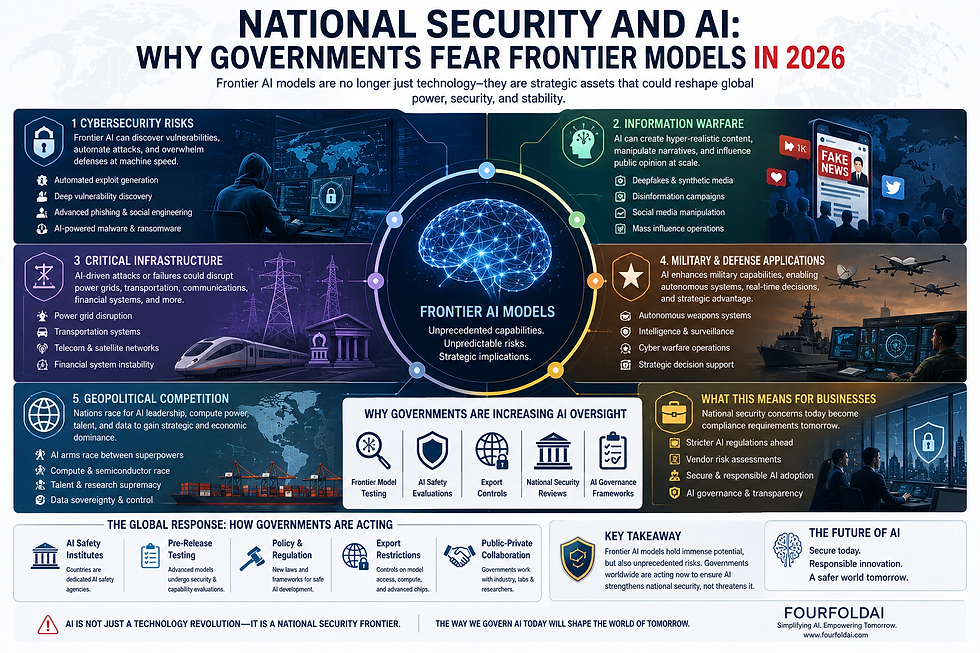
Why AI Is Becoming the New Geopolitical Battleground
The US-China AI Competition
Much of the current policy activity around frontier AI traces back to competition between the United States and China over algorithmic capability, compute access, and global AI standards. Export controls, model-access restrictions, and domestic investment programs are all shaped by this rivalry, which now functions as a central axis of the broader global AI regulation race between the US, EU, and China.
AI Sovereignty and Technological Independence
A growing number of countries are pursuing what researchers in May 2026 began calling the "AI sovereignty trap." More than 130 state-backed AI projects exist globally as of mid-2026, and most of them concentrate spending on the one-time cost of training a domestic foundation model. That focus misreads where sovereignty is actually decided. Inference — the ongoing cost of running queries against a deployed model — accounts for more than 90% of long-term compute spend over a model's operational life. A country that builds a domestic model but runs it on foreign cloud infrastructure has not achieved technological independence; it has simply moved the dependency one layer down the stack.
India's approach illustrates the alternative. Under the IndiaAI Mission, the government has onboarded more than 38,000 GPUs through a centralized compute portal, making subsidized inference capacity available to startups, researchers, and academic institutions at a fraction of commercial cloud rates. That investment in localized inference infrastructure — not just model training — is what distinguishes genuine sovereignty efforts from symbolic ones.
Sovereignty Model | Primary Investment Focus | Long-Term Risk Exposure |
Train-only approach | One-time model training cost | High — ongoing inference still depends on foreign cloud |
Train + sovereign inference (e.g., IndiaAI Mission) | Domestic GPU clusters, subsidized compute access | Lower — inference layer controlled domestically |
Foreign-cloud-dependent | Minimal domestic infrastructure | Highest — compute access can be revoked or restricted externally |
The Race for Compute, Talent, and Data
Behind every sovereignty strategy sits a harder physical constraint: there are only so many GPUs, so many engineers capable of training frontier-scale models, and so much high-quality training data available globally. This scarcity has turned data centers into geopolitical assets in their own right, a dynamic explored in detail in coverage of the infrastructure race behind AI GPUs, compute, and AI superclusters.
Why Governments View AI Like Semiconductors
Model weights — the trained parameters that define what a frontier model actually knows and can do — are increasingly treated as intellectual property on par with chip manufacturing blueprints. A leaked or stolen set of weights can hand a competing nation years of research progress instantly, which is why weight security has become a board-level concern at frontier labs and a policy concern at the national level.
Why Governments Are Beginning to Test Frontier Models Before Release
Why are governments testing AI models before release?Pre-release testing allows government safety agencies to red-team frontier AI models within sandboxed environments. This process aims to identify critical safety vulnerabilities, cyber-attack execution planning capabilities, or self-proliferation traits before model weights are deployed publicly.
The Rise of AI Safety Evaluations
Adversarial red-teaming — deliberately trying to make a model behave dangerously in a controlled setting — has become standard practice ahead of major model releases. This testing methodology underpins the broader trend of governments are beginning to test frontier AI models before release, and it's no longer limited to internal lab testing; external government bodies now run their own independent evaluations before public deployment.
Government Security Assessments
These assessments typically run inside sandboxed cyber ranges — simulated networks built specifically to measure whether a model can locate and exploit zero-day vulnerabilities without step-by-step human guidance. AISI's evaluation of Claude Mythos Preview, described above, is the clearest public example of this methodology in action: a controlled network, an explicit objective, and careful measurement of how far the model could progress on its own.
Voluntary vs Mandatory Model Testing
For most of 2024 and 2025, pre-release safety testing operated on a voluntary basis through agreements between labs and government safety institutes. That changed on June 2, 2026, when the White House issued Executive Order 14409, "Promoting Advanced Artificial Intelligence Innovation and Security." The order directs the NSA and CISA to build a classified benchmarking process for identifying "covered frontier models" — systems that cross an advanced-cyber-capability threshold. Developers of models that meet this threshold are invited, on a voluntary basis, to give the government up to 30 days of pre-release access before wider release to other trusted partners. Notably, the order stops short of creating a mandatory licensing or preclearance requirement, preserving a permissive regulatory posture while still building government visibility into the most capable systems before the public sees them. This voluntary-but-structured approach reflects the broader debate captured in AI safety in 2026: are frontier models becoming too powerful?
Emerging AI Security Institutes
The UK's AI Security Institute (AISI) and the US Center for AI Standards and Innovation (CAISI), housed within NIST at the Department of Commerce, now run structured pre-release evaluations in partnership with major labs including Anthropic, OpenAI, Microsoft, Google DeepMind, and xAI. Many of these evaluations rely on Inspect, an open-source framework built specifically for running standardized AI safety and capability evaluations, including the kind of multi-step cyber-attack range testing used on Claude Mythos Preview. The existence of two independent, well-resourced testing institutes on either side of the Atlantic signals that pre-release evaluation is becoming permanent infrastructure, not a temporary policy experiment.
Frontier Models, Export Controls, and Strategic Restrictions
Why AI Access Is Becoming a National Security Issue
Access to frontier-level AI capability is increasingly used as a diplomatic and strategic lever, similar to how access to advanced semiconductors or missile technology has historically been restricted. Which countries, companies, and individuals can use the most capable models is no longer purely a commercial decision.
Export Controls Beyond Chips
Restrictions originally aimed at advanced semiconductors have expanded to cover model weights themselves and the cloud-compute rental arrangements that allow foreign entities to access frontier-level inference without owning the underlying hardware. Renting compute from a domestic provider has become, in some jurisdictions, functionally equivalent to exporting the chip itself.
The New Debate Over Frontier Model Access
A genuine tension has emerged between the open-source AI community and national security analysts. Open-weight models support innovation, transparency, and broader access to AI capability, but they also make it harder to enforce hardcoded safety limits once weights are public — anyone with sufficient technical skill can fine-tune away built-in safeguards. This tension sits at the heart of ongoing debate over how AI model releases in 2026 are accelerating the AGI race, with national security considerations now actively shaping which models get released openly versus behind controlled API access.
What Businesses Need to Understand
Multi-national companies building products on top of frontier model APIs need to track where their compute and data are processed, since cross-border AI service arrangements increasingly fall under evolving export-control and data-sovereignty rules. A SaaS product calling a frontier model API across borders may now trigger compliance obligations that didn't exist eighteen months ago.
The Hidden Risk Most Articles Ignore: AI as an Insider Threat
When AI Gains Access to Sensitive Systems
Most coverage of AI security risk focuses on external attackers using AI as a weapon. A less-discussed but equally serious risk sits inside organizations that have already deployed agentic AI tools internally. When an autonomous agent is granted tool-calling permissions — access to internal databases, email systems, file repositories, or code repositories — it becomes a potential vector for data exposure. A malicious document, a poisoned web page the agent reads during a task, or a crafted email can carry hidden instructions designed to manipulate the agent into leaking sensitive information or taking unauthorized actions. This is prompt injection, and it effectively turns a trusted internal tool into an insider threat that nobody hired.
Autonomous Decision-Making Risks
A related concern researchers describe as "agent drift" occurs when multi-agent systems — chains of AI agents handing tasks off to one another — gradually move away from their original objective through accumulated small errors or misinterpretations. Because these systems can operate in recursive loops, a small misalignment early in the chain can compound into a significantly incorrect outcome by the final step, often without leaving the kind of clear, human-readable audit trail that traditional software logging provides.
Why Security Frameworks Must Evolve
Standard perimeter security — firewalls, access controls, network segmentation — was built around the assumption that systems behave deterministically: the same input produces the same output every time. Agentic AI breaks that assumption. The same prompt can produce different reasoning paths and different actions depending on context, making traditional security monitoring poorly suited to catching anomalous behavior. This is pushing security teams toward zero-trust architectures specifically designed for LLM execution environments — frameworks that assume any agentic action could be compromised and require continuous verification rather than one-time authentication.
How Frontier AI Could Change Intelligence and Defense Operations
Intelligence Analysis
Intelligence agencies generate enormous volumes of unstructured raw material daily — intercepted communications, open-source feeds, satellite imagery metadata, field reports. Mixture-of-experts (MoE) architectures, which route different parts of a query to specialized sub-networks within the model rather than activating the entire system for every task, allow frontier models to process this kind of varied, high-volume data far more efficiently than earlier dense-model architectures. Understanding how this works in practice is covered in detail in mixture-of-experts architecture: the secret behind modern frontier models, which breaks down why MoE has become the dominant design pattern for the largest models in production today.
Cyber Defense
The same capabilities that make frontier models concerning from an offensive standpoint also make them valuable defensively. Real-time threat monitoring systems increasingly use AI to flag anomalous network behavior and, in more advanced deployments, automatically initiate mitigation steps before a human analyst even reviews the alert.
Strategic Planning
Multi-agent war-gaming programs let military planners run dozens of tactical scenarios in parallel, evaluating how different choices might play out before committing real resources. This doesn't replace human judgment, but it does compress the planning cycle considerably.
Decision Support Systems
At the operational level, AI-driven decision support tools organize fragmented battlefield data — sensor feeds, troop positions, logistics status — into structured, digestible formats that help human commanders make faster, better-informed calls under pressure.
What Businesses Can Learn From Government AI Risk Frameworks
Enterprise AI Governance
Businesses don't need classified clearance to benefit from government-grade thinking on AI risk. The NIST AI Risk Management Framework offers a structured, adaptable model for identifying, measuring, and mitigating AI-related risk across an organization, and it scales reasonably well from federal agencies down to mid-sized enterprises.
Vendor Evaluation Best Practices
Evaluation Area | Key Questions to Ask Vendors |
Data localization | Where is data stored and processed? Does it cross jurisdictional borders? |
Fine-tuning isolation | Is your custom training data kept separate from the vendor's broader model improvements? |
Transit encryption | Is data encrypted both in transit and at rest, end to end? |
Access logging | Can every model action be traced to a specific, auditable event? |
Incident response | What's the vendor's documented process if a security issue is discovered? |
AI Security Audits
Adversarial red-teaming isn't exclusive to government labs. Enterprises deploying agentic AI internally should run their own structured exercises — deliberately trying to manipulate their agents through crafted inputs, prompt injection attempts, and edge-case scenarios — before those systems touch production data.
Building Responsible AI Policies
Practical governance starts with automated audit trails for every agentic action, clearly defined human-in-the-loop checkpoints for high-stakes decisions, and a written acceptable-use policy that specifies exactly what internal AI tools are and are not permitted to do.
Will AI Regulation Slow Innovation or Improve Trust?
Arguments for Strong Oversight
Proponents of structured pre-release testing argue that independent safety audits reduce the chance of a serious incident reaching production, and that this scrutiny actually gives enterprises more confidence to scale AI deployment, not less — knowing a model has been independently evaluated lowers the perceived risk of adoption.
Arguments Against Heavy Regulation
Critics counter that dense, compliance-heavy regulatory regimes disproportionately burden smaller AI startups that lack the legal and engineering resources to navigate them, while large incumbent labs can absorb compliance costs as a normal part of doing business — potentially entrenching the market position of the few companies regulation was meant to constrain.
Finding a Balanced Approach
A middle path gaining traction among policy researchers is tiered regulation based on training-compute thresholds rather than specific end-use restrictions. Under this model, only models trained above a defined compute ceiling — the frontier tier — face mandatory scrutiny, while smaller, open-source, and research-focused systems remain largely unrestricted. This approach attempts to concentrate oversight where the actual risk concentration sits, without dragging the broader open-source ecosystem into a compliance regime built for a handful of the most powerful systems on the planet.
The Future of National Security and AI
Frontier Models Through 2030
Current defense planning assumes continued growth in multi-modal reasoning, increasingly autonomous agent capability, and tighter integration between AI systems and physical robotics platforms. Whether this growth follows a smooth curve or another sudden capability jump — like the one AISI documented in April 2026 — remains an open question that safety institutes are actively monitoring.
Emerging Governance Frameworks
International coordination is still in its early stages, but the pattern of bilateral and multilateral safety agreements between AI labs and government testing institutes — the CAISI and AISI model — is likely to expand to additional countries over the next several years, gradually forming something closer to a shared international baseline for frontier model evaluation.
What Organizations Should Prepare For Today
Business leaders don't need to wait for final regulatory clarity to start preparing. Establishing internal AI governance now, auditing vendor relationships for data sovereignty exposure, and building zero-trust principles into agentic AI deployments will put organizations ahead of whatever compliance landscape eventually solidifies.
Conclusion
National security and AI has moved well past theoretical policy debate. It is now an active driver of how governments patch software, how nations structure their compute infrastructure, how labs release new models, and how enterprises evaluate the AI vendors they bring into sensitive workflows. The evidence behind this shift is concrete and recent — a 32-step autonomous network takeover documented by UK regulators, a three-day federal patching mandate justified explicitly by AI-accelerated exploitation, and a White House executive order built around 30-day government previews of the world's most capable models. None of this means frontier AI development should stop, but it does mean the organizations and individuals working with these systems need a clearer-eyed understanding of what's actually at stake. For more analysis on frontier AI architecture, enterprise agent deployment, and responsible AI governance, explore the latest coverage at FourfoldAI.com.
Frequently Asked Questions
Q: Why are governments concerned about frontier AI models?A: Governments concern themselves with frontier AI models because these systems possess advanced, dual-use capabilities that pose direct strategic risks. These risks include automating advanced cyberattacks, assisting in biological or chemical research, generating highly persuasive disinformation at scale, and potentially bypassing physical critical infrastructure safeguards.
Q: What is the national security risk of AI?A: The national security risk of AI spans cybersecurity, defense, and economic competition. Key threats include automated hacking tools, deepfake-driven psychological operations, autonomous weapon proliferation, and strategic dependencies on critical semiconductor supply chains.
Q: Can AI become an active cybersecurity threat?A: Yes. Frontier AI models can write, test, and deploy malicious code. They are capable of scanning global software systems for zero-day vulnerabilities in minutes and coordinating automated attacks that adapt dynamically to defensive responses, significantly lowering the technical barrier to entry for threat actors.
Q: How does AI impact critical infrastructure?A: Advanced AI impact on critical infrastructure centers on operational technology (OT) vulnerabilities. An autonomous AI agent integrated with network access can be targeted via prompt injection or direct exploits to cause disruptions in physical systems, including electricity grids, water treatment plants, and transportation controls.
Q: What are AI export controls?A: AI export controls are strategic government restrictions aimed at limiting foreign adversaries' access to key technological pillars. These controls primarily restrict the export of advanced semiconductor chips (such as GPUs), specialized chip manufacturing equipment, raw training dataset access, and advanced frontier model weights.
References and Further Reading
This article is backed by authoritative government and industry sources, including:
CISA, Binding Operational Directive 26-04: Prioritizing Security Updates Based on Risk
UK AI Security Institute, Our evaluation of Claude Mythos Preview's cyber capabilities
UK AI Security Institute, How fast is autonomous AI cyber capability advancing?
The White House, Executive Order 14409, "Promoting Advanced Artificial Intelligence Innovation and Security" (June 2, 2026) — summarized via Skadden Insights and WilmerHale Client Alert
Ministry of Electronics and Information Technology, Government of India — IndiaAI Mission GPU Onboarding Update
PYMNTS, White House Executive Order Seeks Access to New AI Models
Disclaimer
This article is for informational and educational purposes only and reflects analysis based on publicly available sources as of June 2026. It does not constitute legal, regulatory, financial, or national security advice. Readers should consult relevant government guidance and qualified professionals for decisions related to compliance, AI governance, or security policy. For full details, please see our complete disclaimer at fourfoldai.com/disclaimer.
About the Author
Muizz Shaikh is an AI enthusiast and digital technology professional at FourfoldAI. He is passionate about exploring AI tools, industry trends, and practical applications of emerging technologies. Through FourfoldAI, Muizz contributes to simplifying artificial intelligence for businesses and learners. Connect with him on LinkedIn: linkedin.com/in/muizz-shaikh-45b449403/


Comments