
On-Device AI and Edge AI: How AI Is Moving to Phones, Laptops, and Smart Devices

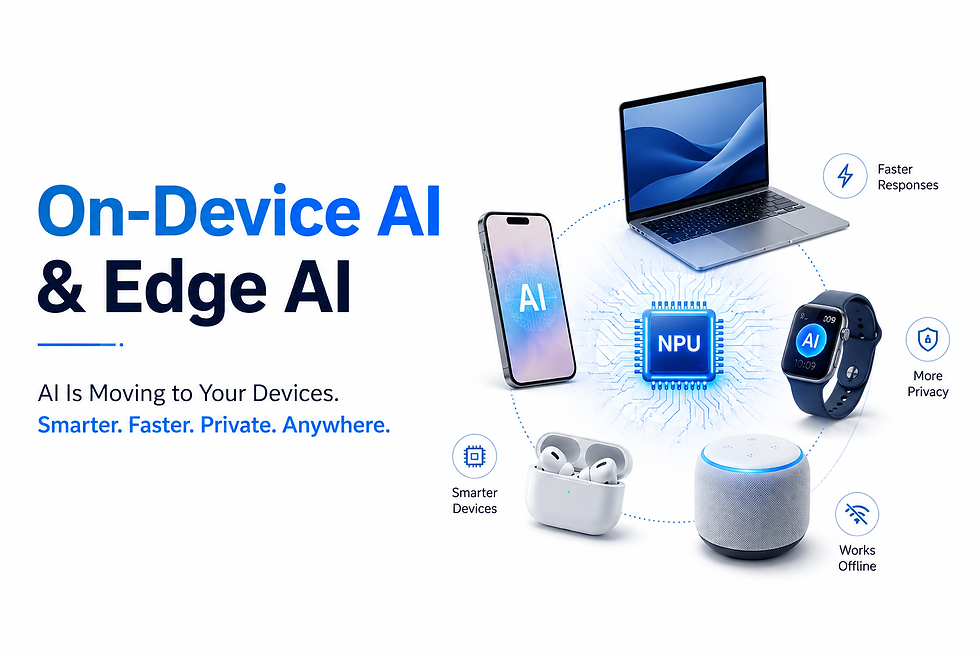
For the last three years, "AI" has been shorthand for a data center somewhere sending your words to a GPU cluster and sending an answer back. That model isn't disappearing, but it's no longer the only game in town. On device ai — the practice of running machine learning models directly on the phone, laptop, or wearable in front of you, without a round trip to the cloud — has quietly become one of the defining engineering shifts of 2026. It's not a marketing feature bolted onto a keynote slide. It's a rearrangement of where computation physically happens, and it has real consequences for latency, privacy, and the economics of running AI at scale.
Most people first notice on-device AI through small conveniences: a phone that transcribes a voicemail instantly, even in airplane mode, or a laptop that blurs a video call background without visibly straining the fan. Those are surface effects. Underneath them is a genuine architectural bet — that silicon designed specifically for tensor math, paired with aggressively compressed models, can deliver "good enough" intelligence locally, fast enough and cheap enough that routing every request to a cloud LLM stops making sense.
The pressure driving this shift is partly financial. Cloud inference at consumer scale is expensive, and every voice query, every autocomplete suggestion, every photo classification that gets shipped to a remote GPU adds to a bill someone has to pay. It's partly regulatory — data residency and privacy rules increasingly discourage moving personal content off a device in the first place. And it's partly physical: light still takes time to travel, and no amount of cloud optimization removes the round-trip latency of a network hop. This guide walks through why the shift is happening, what hardware makes it possible, how the software gets models small enough to fit, and where the real trade-offs still bite. If you want the broader picture of how this fits into long-term future of artificial intelligence, this is one of the more concrete threads in that story.
The Shift to On-Device AI: Why the Cloud Is No Longer the Only Answer
The Cloud Bottleneck: Latency, Cost, and Privacy Challenges
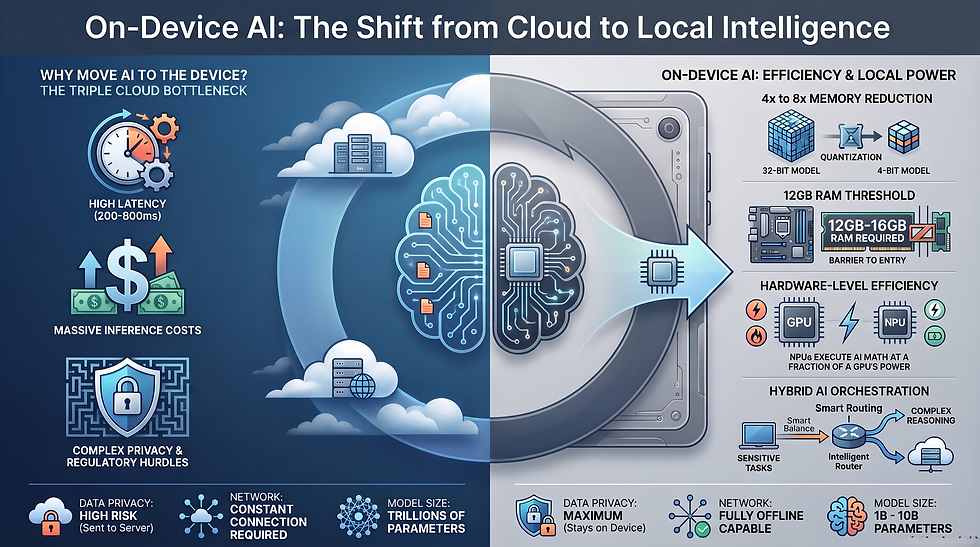
Cloud-based generative AI works well, but it carries three structural costs that don't show up until you're operating at scale. The first is latency: even a well-optimized API call involves DNS resolution, TLS handshakes, queueing on a shared inference cluster, and the return trip — often adding 200 to 800 milliseconds before a token even starts streaming. For a chatbot, that's tolerable. For a voice assistant, a camera-based translation overlay, or a car's collision-avoidance system, it's a real constraint.
The second cost is data egress and inference pricing. Every request that leaves the device consumes cloud compute, and at billions of daily queries, that adds up to a genuinely large recurring bill for whoever operates the service. Running even a fraction of those requests locally — on hardware the user already owns — shifts that cost off the balance sheet entirely.
The third is privacy and regulation. Financial records, medical notes, and internal enterprise documents increasingly can't leave a jurisdiction, let alone a device, without triggering compliance reviews. On-device processing sidesteps that conversation by keeping the data where it originated.
Defining Edge AI vs. On-Device AI: Clearing Up the Confusion
The terms get used interchangeably, but they describe different points on the same spectrum. Edge AI typically refers to computation happening close to the user but not necessarily on their personal hardware — a retail store's on-premises server analyzing camera feeds, or a factory-floor gateway box that only ever needs a local network connection. On-device AI is a narrower, stricter case: the model runs on the actual terminal hardware the person is holding or wearing, with zero dependency on any nearby server. Every on-device deployment is a form of edge computing, but not every edge deployment is on-device. The distinction matters for architects planning deploying edge AI models across a fleet of retail, healthcare, or field-service hardware, because the design constraints — power budget, thermal limits, offline reliability — are far tighter once the model has to live inside a phone or a pair of glasses rather than a rack-mounted appliance nearby.
On-device AI refers to the execution of artificial intelligence and machine learning models directly on end-user hardware, such as smartphones, laptops, and IoT devices, without relying on external cloud computation or constant internet connectivity.
The Hardware Evolution: Silicon Built for On-Device AI
The Rise of the Neural Processing Unit (NPU) and System-on-Chip (SoC) Architectures
A CPU is a generalist, built to execute unpredictable, branching instructions one after another. A GPU is a parallel workhorse, originally built for pixel math, later repurposed for the matrix multiplications that dominate neural network inference. A Neural Processing Unit (NPU) is neither. It's an accelerator purpose-built for exactly one job: running the multiply-accumulate operations that make up the bulk of a neural network's forward pass, at a fraction of the power draw a GPU would need for the same workload. That efficiency is the entire point — a phone can't carry an active cooling loop, and a laptop battery has a fixed number of watt-hours to spend.
Modern SoCs — Apple's M and A-series, Qualcomm's Snapdragon line, Intel's Core Ultra family — now treat the NPU as a first-class citizen sitting alongside the CPU and GPU on the same die, sharing access to the same pool of memory. That shared-memory design, generally called a unified memory architecture, turns out to matter more than the NPU's raw speed, a point worth returning to below.
Analyzing the 2026 Hardware Landscape: Intel, Apple Silicon, and Qualcomm
The 2026 landscape has three serious contenders, each taking a different architectural bet. Apple's M5, which began shipping in late 2025 and anchors the current MacBook Pro and iPad Pro lineup, pairs a 16-core Neural Engine rated at roughly 38 TOPS with a genuinely large architectural advantage: a dedicated Neural Accelerator built into every GPU core, plus unified memory bandwidth of 153GB/s — nearly 30% higher than the M4 generation. The M5 Pro and M5 Max push that further, with the Max variant supporting up to 128GB of unified memory at 614GB/s of bandwidth, which is the real reason Apple silicon can run large local language models that would simply refuse to fit on comparable Windows hardware.
Qualcomm has pursued the opposite strategy: chase the TOPS number aggressively and standardize it across a wide product tier. The Snapdragon X2 Elite, unveiled at CES 2026, ships with roughly 80 TOPS of dedicated NPU performance, while the Snapdragon 8 Elite Gen 5 for flagship Android phones brought a next-generation Hexagon NPU rated around 37% faster than its predecessor, with INT2 precision support for running larger quantized models on phone-class hardware.
Intel's path has been the most uneven. Its Lunar Lake-based Core Ultra Series 2 chips reached 48 TOPS, clearing Microsoft's 40 TOPS threshold for "Copilot+ PC" certification, but the earlier Arrow Lake desktop refresh initially shipped with a far weaker 13 TOPS NPU before a later refresh brought desktop NPUs up to 48 TOPS as well. That gap between Intel's laptop and desktop AI silicon shows how uneven this transition still is even within a single manufacturer's own lineup — decisions about specialized AI hardware processors genuinely differ by product tier, not just by brand.
Why TOPS Is a Misleading Benchmark
TOPS — Trillions of Operations Per Second — is the number every chip vendor leads with, and it's the number that tells you the least on its own. A chip capable of 80 TOPS is useless if it can't feed that compute with data fast enough, and that's a memory bandwidth problem, not a compute problem. Independent testing has shown that Apple's M5 Max, despite a Neural Engine rated at "only" 38 TOPS, can run a 70-billion-parameter model that simply won't fit in the 32GB LPDDR5X pool of a Core Ultra 9 laptop rated at higher standalone NPU TOPS — because the bottleneck isn't compute, it's whether the model's weights can even be held in accessible memory and streamed fast enough to keep the accelerator fed. Thermal headroom compounds the problem: a chip can hit its rated TOPS figure in a burst, then throttle down within seconds once the SoC package heats up, especially in fanless or thin-and-light form factors. Buyers evaluating AI hardware and infrastructure requirements for a fleet of enterprise laptops should treat TOPS as one input among several, not a purchasing decision by itself.
The Software Engineering behind Local Intelligence
Model Compression: Quantization, Pruning, and Distillation
Silicon only solves half the problem. The other half is making the model itself small enough to live inside a phone's memory budget. Quantization is the workhorse technique: a model trained with 32-bit floating point weights (FP32) gets converted down to 8-bit integers (INT8) or even 4-bit integers (INT4), shrinking the memory footprint by 4x to 8x with a comparatively modest accuracy cost when done carefully. Newer NPUs, including Qualcomm's latest Hexagon design, now support INT2 precision, pushing compression even further at the cost of noticeably higher accuracy risk.
Pruning takes a different angle: rather than shrinking every weight, it removes entire neurons, attention heads, or layers that contribute little to the model's output, cutting compute requirements directly rather than just memory. Distillation trains a smaller "student" model to mimic the behavior of a much larger "teacher" model, effectively compressing the teacher's capability into a fraction of the parameter count. In practice, production on-device models usually combine all three techniques rather than relying on just one.
Edge Execution Frameworks: ExecuTorch, OpenVINO, and ONNX Runtime
Compressed weights still need a runtime that can actually execute them efficiently across wildly different hardware. ExecuTorch, PyTorch's edge deployment framework, has become one of the more consequential pieces of this stack — it already powers Meta's on-device AI inside Instagram, WhatsApp, Quest 3, and Ray-Ban Meta smart glasses, and it supports direct export of models like Llama 3.2, Qwen 3, and Phi-4-mini straight from PyTorch without intermediate format conversion. Its built-in support for KV-cache quantization and 4-bit group-wise weight quantization is specifically aimed at the memory constraints that make LLM deployment on phones so difficult. Intel's OpenVINO and the cross-vendor ONNX Runtime solve a similar problem from a different angle, optimizing a model graph once and letting it target CPUs, GPUs, and NPUs from multiple vendors without a full rewrite. Together, these frameworks are what let the same underlying model — sometimes built for generative AI compared to traditional systems use cases — actually run on a Snapdragon phone, an Intel laptop, and an Apple Silicon Mac without three separate engineering efforts.
Small Language Models (SLMs) Reaching Frontier Capabilities
The other half of the software story is that the models themselves have gotten genuinely better at being small. Llama 3.2's 1B and 3B parameter variants, Microsoft's Phi-4-mini, and Google's Gemini Nano are all designed from the ground up to operate inside a phone's memory envelope rather than being shrunk down as an afterthought from a much larger model. These SLMs won't match a frontier cloud model on open-ended reasoning benchmarks, but for the narrower tasks that dominate real usage — summarizing a document, drafting a reply, classifying an image, running a voice command — the gap has closed enough that users rarely notice they're talking to a 1-3B parameter model instead of a 500B+ parameter one.
Real-World Applications and Use Cases in 2026
Consumer Electronics: Adaptive Audio, Smart Wearables, and Smart Glasses
The most mature on-device use case is arguably audio. Modern earbuds run adaptive active noise cancellation that reprofiles itself in real time against the specific acoustic signature of a subway car versus an open office, entirely on a small local chip, because a cloud round-trip would introduce audible lag that defeats the purpose. Wearables track heart rate variability and sleep staging directly on the wrist, keeping raw biometric streams off any server. Smart glasses, building on the same advancements in computer vision that power phone cameras, now run object recognition and live translation locally, which matters both for latency and for the fact that a camera constantly streaming a wearer's surroundings to the cloud is a privacy problem few people would accept.
Enterprise Edge: Private Document Assistants and Local Knowledge Graphs
Enterprises handling sensitive financial or legal documents have a genuine reason to keep AI local: a document assistant that reads a client's financial statements to summarize risk exposure cannot upload that data to a third-party API without triggering serious compliance review in most regulated industries. Local knowledge-graph assistants, running entirely on an employee's laptop, can index internal files, contracts, and notes, and answer questions against them without a single byte leaving the corporate network. This is a direct extension of how role of AI agents is evolving inside the enterprise — the agent's reasoning happens locally even if its knowledge base is refreshed periodically from internal systems.
Industrial IoT: Zero-Latency Predictive Maintenance
On a factory floor, a vibration sensor detecting an early bearing failure needs to trigger a shutdown in milliseconds, not after a round trip to a regional data center. On-device inference on the sensor node itself, or on a nearby edge gateway, makes that kind of zero-latency response possible, and it's one of the more concrete AI applications in manufacturing already in production. This pattern is also reshaping broader industrial automation trends, where reliability during a network outage isn't a nice-to-have, it's a hard operational requirement.
Cloud AI vs. On-Device AI: Architectural Trade-offs
The two approaches aren't competing so much as occupying different points on a trade-off curve, and the differences show up clearly once you line them up side by side.
Execution Location is the most basic distinction: cloud-based generative AI runs on remote GPU or TPU clusters in a data center, while on-device AI executes entirely on the local NPU, CPU, or GPU of the end-user's hardware.
Network Dependency follows directly from that: cloud AI requires a stable internet connection for every single inference call, while on-device AI functions fully offline once the model is downloaded and installed.
Latency Profile favors on-device processing by a wide margin for simple to moderate tasks — typically tens of milliseconds versus hundreds for a cloud round trip — though cloud models can still win on raw reasoning speed for extremely complex, multi-step queries where a frontier-scale model outclasses a compressed local one.
Model Parameter Limits are the sharpest contrast: cloud models can scale into the hundreds of billions or trillions of parameters without the user's hardware ever noticing, while on-device models are generally capped in the single-digit billions, occasionally reaching into the tens of billions on the highest-end unified-memory laptops.
Data Privacy Level tilts strongly toward on-device AI, since no personal data needs to leave the physical hardware at any point in the inference pipeline, whereas cloud AI inherently involves transmitting queries (and sometimes attachments) to a third-party server.
Hardware Cost Driver differs in kind rather than degree: cloud AI shifts the capital cost onto the service provider's data center infrastructure, while on-device AI shifts it onto the price of the consumer or enterprise device itself, through the NPU, RAM, and thermal design required to run models locally.
Given those trade-offs, most enterprise platforms in 2026 aren't picking a side — they're building hybrid pipelines that start every query on-device and escalate only the requests that genuinely need cloud-scale reasoning, which keeps routine tasks fast, private, and free of per-query cost while still giving users access to frontier-level capability when it's actually warranted.
Critical Challenges Facing On-Device AI Adoption
Memory Bandwidth and the RAM Bottleneck
The single biggest practical constraint on running a local model isn't compute, it's memory. An 8-billion-parameter model quantized to INT4 still needs roughly 4-6GB just to hold its weights, and once you add the KV-cache overhead needed for a reasonable context window, realistic minimums land closer to 12GB to 16GB of unified RAM for smooth operation. That immediately rules out budget phones, most laptops sold with 8GB of RAM, and any device more than three or four years old. It also explains why Apple's unified memory architecture — where CPU, GPU, and Neural Engine all draw from the same large memory pool rather than each having a separate, smaller allocation — has become such a meaningful differentiator for running genuinely large local models rather than just small utility ones.
Thermal Throttling, Power Consumption, and Battery Drain
Sustained AI inference generates heat, and a phone or thin laptop has nowhere for that heat to go except back into the chassis. A burst of local LLM inference might briefly hit a chip's rated TOPS figure, but sustained use over several minutes routinely forces the SoC to downclock, sometimes cutting effective throughput by a third or more, particularly in fanless designs. Battery drain compounds the problem: an NPU is efficient relative to a GPU doing the same job, but it's still additional continuous power draw, and users running local AI features heavily do notice shorter time between charges — a real cost that cloud-based inference simply pushes onto someone else's data center power bill instead.
The "Accuracy vs. Efficiency" Compression Tax
Every compression technique extracts a price, even when it's applied carefully. Aggressive quantization — particularly the newer INT2 formats appearing on the latest NPUs — can measurably degrade a model's reasoning accuracy, especially on tasks requiring multi-step logic or precise numerical work. Context windows on local models also tend to be shorter than their cloud counterparts, partly because a longer context means a larger KV-cache, which eats directly into the same limited RAM budget the model's weights are already competing for. None of this makes on-device models unusable — for summarization, classification, and short-form generation the accuracy loss is often barely noticeable — but it does mean treating a local SLM as a drop-in replacement for a frontier cloud model, for genuinely complex reasoning tasks, is currently the wrong expectation to set.
The Hybrid AI Model: Orchestrating Local and Cloud Intelligence
Smart Routing: Keeping Sensitive Data Local
The practical answer most platforms have converged on is a routing layer that decides, per query, where computation should actually happen. A lightweight local model parses the user's intent first: if the request touches personal files, health data, or anything flagged as sensitive, it's handled entirely on-device using the NPU, and nothing leaves the hardware. If the request needs broader world knowledge or heavier reasoning than the local model can provide, the system strips personally identifiable information where possible before routing the remainder to a cloud LLM. This kind of smart routing is becoming a standard building block of modern agentic AI frameworks, where the decision about where to compute is treated as seriously as the decision about what to compute.
Local Agentic Workflows: Executing Multi-Step Actions Privately
Beyond simple query routing, some of the more interesting recent work involves local agentic workflows — multi-step task execution that happens entirely on-device, coordinating between a phone's calendar, camera roll, and messaging apps through system-level APIs, without ever touching a cloud endpoint. A local agent reading a screenshot, extracting an address, and drafting a calendar entry can do the entire chain on-device if the SLM and the surrounding tool-calling framework are efficient enough. This mirrors the broader shift toward autonomous agent architectures in cloud environments, just constrained to a much smaller compute and memory envelope, and with a correspondingly higher bar for reliability since there's no larger model to fall back on mid-task if the local one gets confused.
Frequently Asked Questions about On-Device AI
What is the difference between on device ai and cloud AI? On-device AI runs the entire model directly on the user's phone, laptop, or wearable, using local chips like NPUs, and works without an internet connection. Cloud AI sends the request to a remote data center, processes it on large-scale GPU or TPU clusters, and sends the response back over the network. The core trade-off is that on-device AI offers better latency, privacy, and offline reliability, while cloud AI supports much larger, more capable models.
Why do modern devices need a dedicated Neural Processing Unit (NPU)? An NPU is built specifically to run the matrix multiplication operations that dominate neural network inference, doing so far more efficiently than a general-purpose CPU or even a GPU. This efficiency directly translates to longer battery life and less heat generation when running AI features like voice transcription, photo classification, or local chatbots. Without an NPU, those same tasks would either drain the battery far faster or need to be routed to the cloud.
Can you run large language models (LLMs) completely offline? Yes, but with meaningful size limits. Small language models such as Llama 3.2's 1B/3B variants, Phi-4-mini, and Gemini Nano are specifically designed to run fully offline on phones and laptops. Genuinely large frontier-scale models, however, generally require either a high-end workstation with substantial unified memory or cloud infrastructure, since their parameter counts exceed what typical consumer hardware can hold in memory.
What is model quantization and does it lower the accuracy of AI? Quantization converts a model's weights from high-precision formats like 32-bit floating point down to lower-precision formats like 8-bit or 4-bit integers, shrinking the model's memory footprint significantly. This does introduce some accuracy loss, though moderate quantization (like INT8 or INT4) is often barely noticeable for everyday tasks. More aggressive compression, such as newer INT2 formats, trades a larger amount of accuracy for a smaller memory footprint.
How much RAM does a phone or laptop need to run local AI models? For a compressed 7-8 billion parameter model, most practical deployments need at least 12GB to 16GB of available RAM to run smoothly, accounting for both the model's weights and the memory needed for context handling. Smaller models in the 1-3 billion parameter range can often run acceptably with 6-8GB. This is why many budget devices and older phones simply can't support the more capable on-device AI features being marketed on newer hardware.
Does using on-device AI drain the device's battery significantly faster? Sustained local AI inference does consume more power than idle use, since the NPU, and often the CPU and GPU, are actively working. However, NPUs are specifically engineered to be far more power-efficient at this task than a general-purpose processor would be for the same workload. Short, occasional AI tasks like voice commands have minimal battery impact, while continuous heavy use, like extended local LLM chat sessions, will noticeably shorten time between charges.
How do on-device models keep user data private? Because the entire inference process happens on the local hardware, the user's input data — whether it's a voice recording, a photo, or a text message — never needs to be transmitted to an external server. This eliminates an entire category of privacy risk that comes from data interception, unauthorized server-side logging, or third-party data handling. It's particularly valuable for sensitive contexts like healthcare, legal documents, and financial records.
What are some popular framework choices for running AI models on mobile devices? ExecuTorch, PyTorch's edge deployment framework, has become widely used, already powering on-device AI inside apps like Instagram, WhatsApp, and Ray-Ban Meta smart glasses. Intel's OpenVINO and the cross-platform ONNX Runtime are also common choices, particularly for developers who need a model to run across multiple hardware vendors without a full rewrite for each one. The right choice usually depends on which hardware backend a developer is targeting first.
What is hybrid AI, and how does it balance cloud and local computing? Hybrid AI refers to an architecture where a device first attempts to handle a request locally using an on-device model, and only escalates the request to a cloud-based model when the task genuinely exceeds local capabilities. This approach preserves privacy and speed for routine tasks while still giving users access to more powerful reasoning when it's actually needed. Most major consumer AI platforms in 2026 use some form of this routing rather than committing entirely to one approach.
Will local AI models replace standard cloud-based APIs for enterprises? Unlikely as a full replacement, at least in the near term — the parameter limits imposed by consumer hardware mean local models simply can't match frontier cloud models on complex, open-ended reasoning tasks. What's more realistic, and what's already happening, is a hybrid split where routine, sensitive, or latency-critical tasks move to local models while genuinely complex reasoning stays on cloud APIs. Enterprises are more likely to expand their use of both in parallel than to abandon either one.
Conclusion: Navigating the Next Era of On-Device AI
On device ai isn't replacing the cloud, and it was never really trying to. What it's doing is taking over the enormous share of everyday AI tasks — transcription, summarization, classification, quick agentic actions — that don't need a 500-billion-parameter model to answer well, and handling them locally, instantly, and privately instead. The hardware side of this story is moving fast, with Apple, Qualcomm, and Intel each making genuinely different architectural bets on how to balance NPU throughput against memory bandwidth and thermal reality. The software side is arguably moving faster still, with quantization, pruning, and frameworks like ExecuTorch making models small enough to fit inside a phone's memory budget without gutting their usefulness.
The honest picture is one of trade-offs, not a clean win for either side. RAM minimums, thermal throttling, and the accuracy cost of aggressive compression are real limitations that aren't disappearing this year or next. But the trajectory is clear enough: more of the AI you interact with daily will run on the silicon already in your pocket, and the cloud will increasingly be reserved for the reasoning tasks that genuinely need it. For readers who want to keep tracking how this connects to broader shifts in agentic AI frameworks and enterprise hardware strategy, FourfoldAI's ongoing coverage digs deeper into both the infrastructure and the practical adoption side of this transition.
References
Disclaimer
This article is intended for general informational purposes only and reflects publicly available research and industry reporting as of the publication date. Hardware specifications, benchmark figures, and product availability referenced above are subject to change by their respective manufacturers. For our full editorial and content disclaimer, please visit fourfoldai.com/disclaimer.
About the Author
Muizz Shaikh is an AI enthusiast and digital technology professional at FourfoldAI. He is passionate about exploring AI tools, industry trends, and practical applications of emerging technologies. Through FourfoldAI, Muizz contributes to simplifying artificial intelligence for businesses and learners. Connect with him on LinkedIn: linkedin.com/in/muizz-shaikh-45b449403/
© 2026 FourfoldAI. All rights reserved.


Comments