
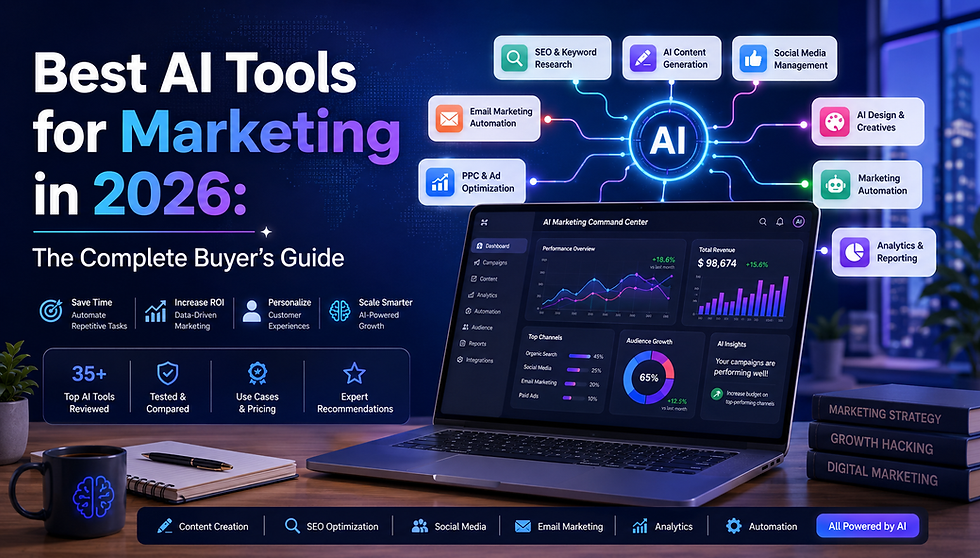
Best AI Tools 2026: The Complete Buyer's Guide for Business, Marketing, Coding & Productivity

Something shifted in how businesses use artificial intelligence this year. Two years ago, "using AI" mostly meant typing a question into a chatbot and copying the answer somewhere else. In 2026, that's almost a quaint description of what's actually happening. Tools now plan their own steps, call other tools, check their own work, and hand off tasks to each other without a human clicking "next" at every stage. That's the agentic shift, and it's the backdrop against which every tool in this guide has to be judged.
Picking the best AI tools 2026 has to offer isn't really about finding "the best chatbot" anymore. It's about assembling a stack — a chatbot for reasoning and drafting, a coding agent for engineering work, an automation layer that connects everything, and specialized tools for image, video, and content production. Get the stack right and you save real hours every week. Get it wrong and you end up paying for six overlapping subscriptions that all do roughly the same thing.
That overlap is the core problem we see again and again when talking to business owners: tool fatigue. Someone on the marketing team pays for Jasper. Someone in sales pays for a separate writing tool. The dev team has three coding assistants because nobody canceled the old ones. Multiply that across a 40-person company and you're looking at thousands of dollars a month in redundant software, most of it under-used.

This guide exists to cut through that. FourfoldAI tested and cross-referenced pricing, feature sets, and real-world performance across the categories that matter most to business decision-makers, marketers, developers, and enterprise architects: chatbots, writing assistants, coding tools, image and video generation, marketing automation, and productivity software. Every price point below was checked against vendor documentation and cross-verified against independent pricing trackers as of mid-2026, since — as you'll notice throughout — AI pricing changes more often than almost any other software category on the market.
Quick List — Best AI Tools in 2026
If you only have thirty seconds, here's the shortlist. Each of these tools earned its spot through actual testing rather than marketing copy, and each one is explored in depth further down this guide.
Tool | Best For | Free Plan | Paid Plan Starts At | Rating (Out of 5) |
Claude (Anthropic) | Complex Coding & Logical Reasoning | Yes | $20/month | 4.9 |
ChatGPT (OpenAI) | Versatile Ideation, Multimodal Research | Yes | $20/month | 4.8 |
Cursor / Windsurf | Agentic IDE, Automated Coding | Yes | $20/month | 4.9 |
Perplexity | Real-Time Web Research & Citations | Yes | $20/month | 4.7 |
Make.com / n8n | Multi-Agent Workflows & Orchestration | Yes (Free tier / Self-Host) | ~$10/month | 4.8 |
Midjourney | Photorealistic & Artistic Image Generation | No | $10/month | 4.8 |
Notice something interesting there: three of the six tools now cluster around the same $20/month price point. That convergence isn't an accident — it reflects how competitive the frontier model market has gotten, and it means the deciding factor for most buyers isn't cost anymore. It's fit.
How We Tested These AI Tools
Rather than rank tools by feature checklists alone, FourfoldAI's evaluation framework runs every platform through eight practical vectors that map to how businesses actually use these products day to day.
Features
We looked at functional depth first — how well each tool follows detailed, multi-step prompts, and whether it can maintain context across a long project rather than just answering isolated questions.
Accuracy
Hallucination rates matter more in 2026 than they did in the early chatbot era, mostly because AI outputs now feed directly into client-facing work. We paid close attention to reasoning capacity on multi-step logic problems and how models handle ambiguous instructions without inventing facts to fill the gaps.
Speed
Tokens-per-second output and end-to-end latency were tested under normal working conditions rather than best-case demos. A tool that's brilliant but takes ninety seconds to respond during a live client call performs consistently well under moderate workloads but shows real friction the moment usage spikes.
Ease of Use
Onboarding curve and UI/UX design carry more weight for non-technical teams than developers often assume. A tool with excellent capabilities but a confusing interface will simply sit unused after month one.
Integrations
Native API connectivity, webhook support, and custom connector availability were scored separately from raw model quality, because a powerful model locked inside a closed ecosystem is worth less to a business than a slightly less powerful one that plugs into your existing stack.
Pricing
We calculated value-to-cost ratio rather than sticker price alone, and specifically flagged hidden seat pricing — a growing issue as more platforms shift from flat subscriptions toward per-seat or credit-based billing.
Business Value
Where possible, we estimated measurable ROI in terms of workflow hours saved, drawing on both vendor case studies and independent user reports rather than marketing claims alone.
Security & Support
SOC 2 compliance, local data hosting options, workspace privacy controls, and enterprise SLA terms were checked directly against each vendor's trust or security documentation, not summarized from sales pages.
Best AI Chatbots
The foundational large language models — LLMs — remain the entry point for most businesses adopting AI, and 2026's field looks noticeably different from even a year ago.
ChatGPT
OpenAI's flagship product still leads on sheer breadth. GPT-5.5 handles everything from coding to research to conversational voice interaction, and ChatGPT's ecosystem — Custom GPTs, Sora video generation, Codex for coding, and Agent Mode for autonomous task execution — remains the widest of any single platform. The Free tier now includes ads in the US (introduced February 2026), while Plus at $20/month removes them and unlocks the full feature suite, including roughly ten Deep Research runs per month. A newer Pro tier at $100/month sits between Plus and the original $200/month Pro plan, offering five times the usage limits for power users who don't need the absolute ceiling.
Claude
Anthropic's Claude has built its reputation on coding accuracy and long-form reasoning, and that reputation holds up under testing. Claude Pro at $20/month includes access to Claude Code for terminal-based development work, Projects for organizing long-running context, and Artifacts for generating standalone documents, code, and interactive content directly inside a conversation. Power users who exhaust Pro's five-hour usage window can step up to Max 5x ($100/month) or Max 20x ($200/month), which multiply usage capacity rather than adding new features — a structure that mirrors what ChatGPT and Perplexity have both adopted this year.
Gemini
Google's Gemini benefits enormously from native integration across Gmail, Docs, and Drive — if your business already lives in Google Workspace, Gemini removes the copy-paste friction that plagues every other assistant. Google AI Pro costs $19.99/month and includes a notably larger context window than competing $20 plans, along with generous cloud storage bundled in. The top-tier AI Ultra plan runs considerably higher, aimed squarely at developers and technical leads who need maximum throughput.
Microsoft Copilot
Copilot's strength isn't raw model capability so much as where it lives: directly inside Word, Excel, PowerPoint, Outlook, and Teams. For enterprises already standardized on Microsoft 365, Copilot removes the adoption friction that comes with introducing an entirely new tool, and its integration with Azure's security and compliance stack makes it a natural fit for regulated industries.
Perplexity
Perplexity earns its spot by doing one thing better than any general chatbot: sourced, citation-backed research. Every answer comes with clickable references to the pages it drew from, which matters enormously for content teams doing fact-based writing and for anyone who's been burned by a chatbot confidently inventing a statistic. Pro costs $20/month and lets you switch the underlying model per query — Claude for nuanced writing, GPT for structured reasoning, Gemini for multimodal tasks — which is a genuinely useful feature none of the single-model competitors offer.
Comparison | Reasoning Capacity | Web Search Reliability | Best Business Use Case |
ChatGPT | Very strong, broad | Good, integrated | General-purpose ideation & multimodal work |
Claude | Strongest for coding logic | Limited native search | Software development & long-document analysis |
Gemini | Strong, improving fast | Native Google integration | Workspace-embedded teams |
Microsoft Copilot | Solid, enterprise-tuned | Bing-integrated | Office-centric enterprises |
Perplexity | Good, multi-model | Best-in-class, cited | Research, fact-checking, content verification |
Best AI Writing Tools
Purpose-built writing platforms still hold an edge over general chatbots for one specific reason: workflow integration. They're built around templates, brand voice training, and team approval chains that a raw chatbot conversation doesn't offer out of the box.
Jasper
Jasper remains the most enterprise-oriented option here, with genuinely sophisticated Brand Voice training that learns from a company's existing content and applies that tone consistently across every output. It integrates directly with Surfer SEO for on-page optimization and supports multi-brand workspaces, which matters for agencies managing several clients at once. The tradeoff is price — Jasper has no permanent free tier, and its Creator plan starts well above most competitors, which only makes sense if your team is producing enough volume to justify the premium.
Grammarly
Grammarly has quietly evolved from a spelling-and-grammar checker into a full writing assistant with generative capabilities layered on top of its original editing engine. For teams that already have a content process and just need consistency — clarity, tone, style-guide enforcement across dozens of writers — Grammarly's free tier handles the basics, while the paid Pro tier around $12/month adds fluency and engagement suggestions plus AI-assisted rewriting.
Writesonic
Writesonic's pitch is built-in SEO: its Article Writer analyzes live Google results for the target keyword before generating content, which theoretically shortens the gap between "written" and "ranking." It bundles a Chatsonic conversational tool and basic image generation alongside its writing features, and its entry-level paid plans sit meaningfully below Jasper's, making it a common landing spot for teams that outgrow free AI tools but aren't ready for premium pricing.
Copy.ai leans hard into short-form output — ad variations, social captions, email subject lines — rather than long-form editorial content. Its free tier is genuinely usable for testing, and its workflow templates connect more naturally with sales and marketing automation than with structured blog production. For businesses running Make.com or n8n's Multi-Agent Orchestration pipelines, Copy.ai's simpler API surface tends to be easier to wire into existing sequences than Jasper's more locked-down workspace model.
Best AI Coding Tools
Agentic development environments have arguably changed more in the past twelve months than any other category on this list. What used to be autocomplete has become something closer to a junior developer that reads your whole codebase before touching a single file.
Cursor
Cursor remains the dominant AI-native fork of VS Code, and its Composer agent handles multi-file edits with a diff-and-approve loop that keeps a human in the review chain at every step — a deliberate design choice that trades some autonomy for safety on production code. Pro costs $20/month with a monthly credit pool; heavier users step up to Pro+ at $60/month or Ultra at $200/month for expanded frontier-model access. Its codebase indexing is fast enough that even large repositories return relevant context within seconds.
GitHub Copilot
Copilot remains the cheapest serious entry point into AI-assisted coding, with Pro priced around $10/month — half of what Cursor or Windsurf charge for their equivalent tier. It's less autonomous than either competitor, functioning more as an intelligent autocomplete layer than a full agent, but its deep GitHub integration and built-in security vulnerability scanning make it a sensible default for teams already standardized on GitHub's ecosystem, especially at the Business and Enterprise tiers where per-seat pricing and workspace CLI support come into play.
Windsurf
Windsurf's Cascade agent takes the opposite philosophy from Cursor: give it a task like "refactor all API calls to use the new SDK," and it reads the relevant files, makes the changes, runs tests, and only stops for confirmation on genuinely ambiguous decisions. That autonomy is faster on greenfield projects, though some engineering teams prefer Cursor's tighter approval loop for production systems. Windsurf now matches Cursor's $20/month Pro pricing, but differentiates through broader IDE support — plugins exist for over 40 editors including JetBrains, Vim, and Xcode — plus stronger compliance credentials (HIPAA, FedRAMP High) for regulated industries.
Best AI Image & Video Generation Tools
Best AI Image Generation Tools
Midjourney continues to lead on pure artistic quality — painterly, atmospheric, distinctly stylized output that other generators struggle to match for creative and editorial work. It has no free tier; Standard at $30/month is the practical entry point, giving unlimited generations in Relax Mode once your monthly Fast GPU hours run out.
Adobe Firefly takes the opposite approach, prioritizing commercial safety over artistic range. Every image is trained exclusively on licensed Adobe Stock content and public domain material, and Adobe backs enterprise customers with IP indemnification — meaning if someone claims copyright infringement on a Firefly-generated image, Adobe stands behind you contractually. For businesses producing marketing assets at volume, that legal backstop often matters more than raw creative flair, and Firefly's deep Photoshop and Illustrator integration means designers rarely have to leave their existing workflow.
Flux (Black Forest Labs) has become the benchmark for photorealistic image generation, producing convincingly camera-real output in a few seconds. It's open-weight at its base, so development teams can self-host and fine-tune without per-image fees, while hosted API access remains inexpensive for lighter usage.
Best AI Video Tools
Video generation moved fastest of any category this year, driven by native audio synchronization becoming a real, working feature rather than a future promise.
Runway remains the most accessible entry point for businesses new to AI video, with a genuinely useful free tier and an image-to-video pipeline well suited to product photography brought to life. Pika offers a comparably generous free allocation for creators experimenting with short-form social content. For enterprise use cases specifically — training videos, localized marketing content with an on-screen presenter — Synthesia remains the category leader, supporting dozens of languages and avatar-based video starting around $29/month, which sidesteps the cost and logistics of traditional video production entirely.
Best AI Marketing & Automation Tools
Best AI Marketing Tools
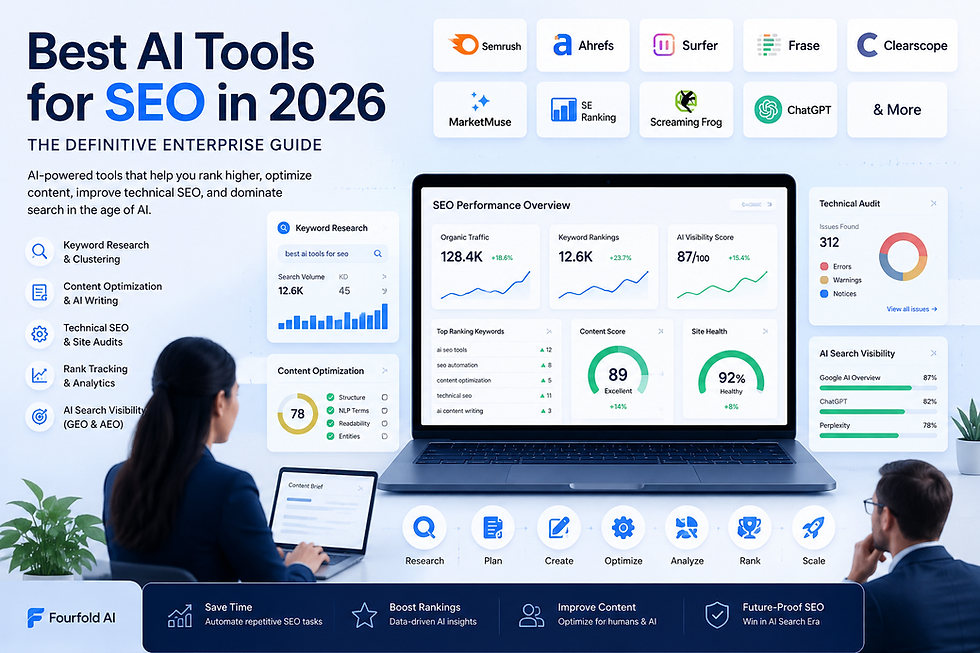
Surfer SEO continues to serve as the industry standard for on-page content optimization, scoring drafts in real time against what's actually ranking for a target keyword. It sits at a premium price point compared to newer entrants, but its accuracy and Google Docs integration keep it embedded in most serious content teams' workflows. Semrush's AI features extend the platform's existing keyword and competitor research tools with generative content suggestions, which is useful specifically for teams that already rely on Semrush for broader SEO tracking and don't want to fragment their toolchain further. HubSpot AI takes a different angle for marketing teams already inside the HubSpot ecosystem — its pipeline automation and increasingly its answer-engine-optimization tooling help teams understand not just where they rank on Google, but whether their brand gets cited inside ChatGPT, Gemini, and Perplexity responses, which is quickly becoming its own discipline worth tracking.
Best AI Automation Platforms
This is where Agentic Workflows stop being a buzzword and start being an actual operational layer. Zapier remains the easiest on-ramp for non-technical teams, with the largest app catalog in the market — 7,000-plus integrations — and a natural-language Copilot that builds automations from a plain-English description. The tradeoff is cost at scale: Zapier bills per task, and complex, high-volume workflows can become expensive quickly compared to the alternatives.
Make.com takes a visual, node-based approach that handles branching logic and multi-step transformations more gracefully than Zapier's linear model, typically at 50 to 60 percent lower cost for equivalent complexity, since Make counts operations rather than individual task-steps. Its free tier (1,000 operations monthly) is genuinely useful for testing before committing budget.
n8n is the only platform of the three built around true self-hosting, and it charges by execution rather than by step — meaning a ten-step workflow costs the same as a two-step one. That structure makes it dramatically cheaper at high volume for teams with the technical capacity to manage their own infrastructure, and it's increasingly the platform of choice for teams building complex Multi-Agent Orchestration pipelines, thanks to native LangChain integration and dozens of purpose-built AI nodes. For businesses exploring how retrieval accuracy factors into these workflows, understanding the role of vector databases in custom RAG data layers becomes essential once automation scales beyond simple trigger-and-action sequences.
Best AI Productivity Tools
Notion AI & ClickUp AI
Both platforms have folded generative AI directly into their existing workspace tools rather than launching standalone products. Notion AI works as an add-on across Notion's existing plans, generating page summaries, drafting content inline, and answering questions against your team's own workspace content — genuinely useful for teams that already treat Notion as their internal wiki. ClickUp AI applies the same logic to project management specifically, generating task summaries, auto-writing project updates, and turning loose meeting notes into structured, assigned action items without leaving the platform.
Fireflies & Fathom
Meeting intelligence has become its own AI category, and the two leading tools split along a clear line. Fathom offers the most generous free tier in the category — unlimited recording, transcription, and storage on Zoom with no time limit — making it the default choice for individuals and small teams. Fireflies, priced around $10 per user per month at its Pro tier, pulls ahead for sales and customer-facing teams specifically, with deeper CRM integrations (Salesforce, HubSpot, Pipedrive) and support for over 100 languages, letting revenue teams automatically log call notes directly against deal records.
AI Tool Comparison Matrix
Tool Category | Pricing Strategy | Key Integrations | Ideal Business Size | Data Privacy Compliance | API Availability |
Enterprise Chat (ChatGPT, Claude, Gemini) | Seat-based ($20–$30/user) | API, Zapier, Custom GPTs/Projects | All Sizes | Opt-out of training available on Team/Enterprise | Yes |
Agentic Coding (Cursor, Windsurf, Copilot) | Free tier / $10–$20 seat | Local Git, GitHub, GitLab | Startups to Large Enterprise | Local indexing/Zero-retention options | Yes (underlying model APIs) |
Workflow Automation (Make, Zapier, n8n) | Operation or execution-based | 1,000+ apps, webhooks, MCP | Mid-Market to Enterprise | SOC 2 Type II, GDPR | Yes |
Image/Video Generation (Midjourney, Firefly, Runway) | Flat subscription tiers | Creative Cloud, API access | Marketing teams, all sizes | Varies — Firefly offers IP indemnification | Partial |
Writing & Content (Jasper, Writesonic, Grammarly) | Per-seat, credit, or flat rate | WordPress, Surfer, Google Docs | SMB to Enterprise agencies | Standard data processing agreements | Yes (select tiers) |
Custom AI Tool Stack Recommendations
Rather than one universal answer, here's what actually makes sense by business profile.
The Small Business Stack
Claude or ChatGPT Plus ($20/month) for daily reasoning and drafting, Fathom (free) for meeting notes, and Make.com's Core plan (roughly $10/month) to connect the two to your CRM without hiring a developer.
The Marketing Team Stack
Perplexity Pro for sourced research, Surfer SEO or Writesonic for optimized long-form content, and Zapier or Make to push finished drafts into your CMS and social scheduler automatically.
The Startup Stack
Cursor or Windsurf Pro for the engineering team, Claude Pro for the founders' strategy and writing work, and n8n self-hosted once your automation volume outgrows Zapier's free tier — the execution-based pricing model pays for itself quickly at startup scale.
The Enterprise Stack
ChatGPT Enterprise or Claude Enterprise for organization-wide chat access with full compliance controls, GitHub Copilot Business for standardized developer tooling, and Make or n8n's enterprise tiers with SSO and RBAC for governed automation across departments.
The Freelancer & Creator Stack
Claude or ChatGPT Plus for client work and ideation, Midjourney Standard for visual assets, and Fireflies' lower-tier plan to keep client call notes organized without a full CRM.

How to Choose the Right AI Tool & Common Mistakes
A Strategic Framework for Evaluation
Skip the temptation to subscribe to whatever's trending this month. A more reliable process looks like this: first, define the actual workflow bottleneck you're trying to solve — not "we should use AI more," but a specific, named problem. Second, evaluate security and SOC 2 compliance for anything touching customer data. Third, actually test the integration's API capabilities against your existing stack rather than trusting the marketing page. Fourth, pilot with a small team for two to four weeks before rolling out company-wide. Fifth, calculate ROI in hours saved, not just subscription cost — a $200/month tool that saves twenty hours a week is far cheaper than a free tool nobody actually uses.
Common Pitfalls to Avoid
The most common mistake we see is over-subscribing to overlapping tools — three departments independently paying for three different AI writing assistants that do nearly the same job. A close second is ignoring native pipeline integrations, adopting a powerful tool that then sits disconnected from the rest of the stack because nobody checked whether it actually talks to your CRM. Skipping a security review before rolling out AI tools to teams handling customer data is a real and growing risk, particularly as more platforms shift toward opt-out (rather than opt-in) training policies by default. And finally, teams that never build a structured prompt library end up re-solving the same problems from scratch every time, losing most of the efficiency gain the tool was supposed to deliver.

Future AI Trends for 2026
Agentic AI and Multi-Agent Workflows are the clearest throughline of this year's tool landscape — LLMs that run tasks in loops, checking their own outputs and correcting course without needing a human to prompt every single step. This shift toward autonomous execution is reshaping everything from coding assistants to marketing automation, and it's worth understanding the mechanics behind building AI agents if your business plans to move beyond simple chatbot use cases.
Voice AI and local models are gaining ground as businesses push back against sending every query to the cloud. Lower-latency, locally-executed models address genuine data privacy concerns, particularly for industries handling sensitive customer information where round-tripping data to a third-party server isn't acceptable.
AI search and vertical integrations mark a shift away from generic, one-size-fits-all databases toward systems tailored to specific industries and use cases — legal research tools trained specifically on case law, medical assistants trained on clinical literature, and so on, rather than a single general-purpose model trying to be everything to everyone.
Final Verdict: Navigating the 2026 AI Landscape
If there's one takeaway from testing this many platforms side by side, it's that the best AI tools 2026 has to offer aren't defined by a single winner — they're defined by fit. Start with a foundational chatbot model that matches how your team actually thinks and writes, whether that's Claude's precision, ChatGPT's breadth, or Gemini's Workspace integration. Layer in custom workflow automation through Make.com or n8n once manual, repetitive tasks start eating real hours out of your week. And throughout all of it, keep security standards non-negotiable — SOC 2 compliance and clear data-training policies aren't optional extras anymore; they're baseline requirements for any tool touching customer or business data.
The businesses getting genuine value out of AI in 2026 aren't the ones with the most subscriptions. They're the ones that picked two or three tools deliberately, integrated them properly, and actually trained their teams to use them well.
Frequently Asked Questions
Q: What are the best AI tools in 2026 for businesses? The strongest overall picks are Claude or ChatGPT for daily reasoning and content work, Cursor or Windsurf for software development, and Make.com or n8n for connecting everything into automated workflows. The right combination depends on team size, technical skill, and which specific bottleneck you're solving first.
Q: Which AI chatbot is best: ChatGPT or Claude? Both cost $20/month at their standard tier and perform strongly overall. Claude tends to edge ahead on coding accuracy and long-form writing consistency, while ChatGPT offers broader tooling — Sora video, Advanced Voice, a wider plugin ecosystem — making it the stronger all-rounder for varied daily tasks.
Q: What are the top free AI tools available? ChatGPT, Claude, Gemini, and Perplexity all offer genuinely usable free tiers for casual use, though each carries usage caps. On the automation side, n8n's self-hosted community edition and Make.com's free 1,000-operations tier are strong no-cost starting points for testing workflows before committing budget.
Q: Which AI tool saves the most time for software developers? Cursor and Windsurf currently lead for full agentic development work, both priced at $20/month for their Pro tier, while GitHub Copilot remains the most budget-friendly option at roughly $10/month for teams that want AI-assisted autocomplete without full agentic autonomy.
Q: What AI subscriptions are actually worth paying for in 2026? For most businesses, one $20/month chatbot subscription (Claude, ChatGPT, or Gemini), one coding tool if you have a development team, and one automation platform cover the majority of practical use cases. Beyond that, add specialized tools — image generation, meeting transcription, SEO writing — only once you've identified a specific, recurring need.
Q: How do I ensure our company data remains secure when using AI tools? Prioritize vendors offering SOC 2 Type II certification, GDPR compliance, and explicit opt-out (or default opt-out) policies for using your data in model training. Enterprise and Team-tier plans across most major platforms include contractual data protections that individual consumer plans typically don't offer, so it's worth budgeting for the higher tier if customer data is involved.
Explore more technology insights, AI tool breakdowns, and implementation guides at FourfoldAI — built to help businesses and individuals understand and adopt artificial intelligence with clarity, not hype.
References and Further Reading: This guide draws on pricing and feature data verified directly against vendor documentation and independent 2026 pricing trackers, current as of mid-2026. Pricing and features are subject to change; always verify current rates directly with each vendor before purchasing.
All links were live and verified at the time of publication. Since AI tool pricing changes frequently, readers are encouraged to confirm current rates directly on each provider's site before making a purchasing decision.
Disclaimer
Disclaimer: This article is intended for informational and educational purposes only and does not constitute professional, legal, or financial advice. Pricing, features, and availability for the tools mentioned are subject to change without notice. For full details, please read our complete disclaimer at fourfoldai.com/disclaimer.
About the Author
Muizz Shaikh is an AI enthusiast and digital technology professional at FourfoldAI. He is passionate about exploring AI tools, industry trends, and practical applications of emerging technologies. Through FourfoldAI, Muizz contributes to simplifying artificial intelligence for businesses and learners. Connect with him on LinkedIn: linkedin.com/in/muizz-shaikh-45b449403/
© 2026 FourfoldAI. All rights reserved.

Comments