
Hyper-Personalization with AI:Complete Guide, Strategy & Real Use Cases (2026)

From how the data pipeline actually works to why most AI "personalization" still feels hollow — we cut through the noise with data, real examples, and our tested 4-layer framework.

Think back to the last time you got a marketing email that started with "Hi [First_Name]" — the brackets visible, the merge tag broken. That's traditional personalization at its worst. Now think about the last time Netflix served you a show that felt like it was made for you alone, or Spotify's Discover Weekly nailed your Monday morning mood. That gap — between a broken mail merge and a recommendation that reads your mind — is exactly where hyper-personalization with AI lives.
We at FourFoldAI work at the intersection of AI research and real-world marketing strategy, and we've seen this space mature fast. This guide is our most complete breakdown of what hyper-personalization with AI actually is, how the technology works under the hood, where it wins, where it fails, and what it means for your business in 2026 and beyond.
Quick Answer — Featured Snippet Optimized
Hyper-personalization with AI is the use of machine learning, NLP, and real-time behavioral data to deliver a unique, continuously adapting experience to each individual user — not a segment of thousands. Think of it like a skilled barista who doesn't just remember your "usual" but adjusts your drink based on the weather, how tired you looked last Tuesday, and the playlist you're streaming right now. Predictive analytics and recommendation engines are the core engines driving it, and first-party data is the fuel.
How Hyper-Personalization with AI Actually Works
There are three stages in every hyper-personalization system, regardless of whether it's powering a Fortune 500 e-commerce giant or a bootstrapped SaaS startup. Understanding these stages helps you avoid the classic mistake of buying a tool before you've built the foundation.
Stage 1 — Data Collection
The system ingests first-party data from every touchpoint a customer touches: website clicks, scroll depth, purchase history, email open times, app behavior, location signals, device type, and even pauses on a video. This is the raw material. Without clean, unified data, everything downstream is guesswork. A Customer Data Platform (CDP) is typically the architecture that merges these scattered inputs into a single customer profile. Industry analysts project that by 2026, 80% of enterprises will have adopted a CDP as core infrastructure for real-time personalization.
Stage 2 — AI Processing
Once data flows into a central system, machine learning models — specifically collaborative filtering, content-based filtering, and increasingly, deep learning neural networks — find patterns you'd never catch manually. Natural Language Processing (NLP) adds another layer: it reads the intent behind a search query, parses sentiment in a product review, or understands that "budget-friendly" and "affordable" mean the same thing in your catalog search. Predictive analytics then forecasts what a user is likely to want next — before they've expressed it.
Stage 3 — Real-Time Adaptation
This is where hyper-personalization separates itself from everything that came before. The system doesn't just run nightly batch updates. It adapts in real time. A user who searched for "winter boots" at 8 AM and then switched to "running shoes" by noon will see a completely different homepage by lunchtime. The customer journey is no longer a linear funnel — it's a living, responsive experience that adjusts at every micro-moment.

The Key Technologies Behind It
Let's demystify the tech stack without the jargon overload. Here's what's actually powering these systems:
Technology | What It Does | Real-World Role |
Machine Learning (ML) | Finds patterns in massive datasets without explicit programming | Powers product recommendations, churn prediction, dynamic pricing |
Natural Language Processing (NLP) | Makes AI understand and generate human language | Search intent parsing, sentiment analysis, chatbot personalization |
Recommendation Engines | Suggest the next-best product, content, or action per user | Netflix's "Continue Watching," Amazon's "Frequently Bought Together" |
Predictive Analytics | Forecasts future user behavior from historical signals | Email send-time optimization, pre-emptive churn offers |
Generative AI | Creates new personalized content dynamically | Personalized ad copy, individualized product descriptions, dynamic landing pages |
Real-World Examples: Netflix, Spotify, and Amazon
These three companies aren't mentioned because they're trendy. They're the standard-bearers because their personalization systems are the most studied, most effective, and most publicly documented. Let's look at what makes each one tick.
Netflix — Personalization at 230 Million Profiles
Netflix doesn't run one algorithm. It runs an ensemble of machine learning models simultaneously — including collaborative filtering, deep neural networks, and contextual bandits. The result: over 80% of what users watch on the platform comes from personalized recommendations, not search. The company attributes $1 billion+ in annual customer retention revenue directly to its personalization engine. It analyzes data from over 230 million subscriber profiles, tracking not just what you watch but where you pause, what you rewatch, and even how long you spend reading a show description before leaving.
Spotify — NLP Meets Collaborative Filtering
Spotify's magic lies in combining two approaches. Collaborative filtering maps your taste against millions of similar listeners. NLP analyzes song lyrics, blog posts, and music reviews to categorize tracks by mood, theme, and energy level. The result is Discover Weekly — a playlist that feels curated by a friend who has great taste and unlimited time. Spotify doesn't just know you liked a song; it knows why you liked it, and it uses that to find music you haven't discovered yet.
Amazon — 35% of Revenue from a Recommendation Engine
The statistic that tends to stop people mid-sentence: Amazon generates approximately 35% of its total revenue from its recommendation engine. That's not from paid ads or promotions. It's from a system that surfaces the right product at the right moment in the right format — "Customers who bought this also bought," "Items related to your recent history," and dynamic homepage layouts that are never the same for any two users.
80%
of Netflix content discovered via AI recommendations
35%
of Amazon revenue driven by its recommendation engine
$24B
global hyper-personalization market size in 2025 (projected)
15–30%
marketing ROI improvement from AI-driven personalization (McKinsey)
Benefits & Challenges: The Honest Scorecard
We won't pretend hyper-personalization is a cost-free upgrade. It has real, measurable benefits — but it also comes with hurdles that smaller teams genuinely struggle with.
The Wins | The Hurdles |
Revenue Lift: McKinsey data shows personalization drives 5–15% revenue uplift for most companies, with top performers hitting 40% more than competitors | Privacy & Compliance: GDPR, CCPA, and the post-cookie era make first-party data collection harder; 71% of consumers expect transparency on how their data is used |
Customer LTV: Personalized experiences increase customer lifetime value by reducing churn and boosting repeat purchase rates; 78% of consumers say they're more likely to repurchase from brands that personalize | Data Silos: If your CRM, email platform, and e-commerce tool don't talk to each other, your AI can't build a real picture of the customer |
Marketing Efficiency: 10–30% improvement in marketing spend efficiency when AI targets the right people with the right message (McKinsey) | Algorithmic Bias: AI can amplify biases present in historical data — leading to discriminatory recommendations or excluding segments of customers unfairly |
Engagement: Personalized campaigns drive up to 3x higher open and click-through rates vs. generic messaging (HubSpot, 2024) | Scalability Cost: Real-time inference at scale requires significant compute; this is a legitimate barrier for businesses below a certain data volume |
We at FourFoldAI hold a firm position here: personalization done without informed consent isn't marketing — it's surveillance. Collecting behavioral data ethically, communicating data use clearly, and building in bias-auditing checkpoints aren't optional extras. They're foundational to any system that's supposed to build trust with real people. The brands that get this right in 2026 will be the ones consumers stick with for the next decade.
Hyper-Personalization vs. Segmentation — The Reality Check
Here's a perspective that might surprise you, given this entire article: segmentation is sometimes better. We know. Stick with us.
Classic segmentation — grouping customers by age, location, purchase category, or behavior — still works exceptionally well for broad awareness campaigns, new market entry, and small data environments. If you have 5,000 customers and 3 months of transaction history, you don't have enough signal to run meaningful one-to-one personalization. What you have is enough for 5–7 smart segments, and that's perfectly adequate.
The mistake most marketers make is chasing hyper-personalization before they've nailed segmentation. One European telecom that McKinsey studied went from 4 macro-segments to 150 AI-defined micro-segments and achieved a 40% lift in response rates and a 25% reduction in deployment costs. But notice — that's still segmentation, just at a much finer resolution. True one-to-one personalization only unlocks when you have the data volume, clean infrastructure, and ongoing feedback loops to sustain it.
"Jumping to hyper-personalization before your data foundation is solid is like trying to bake a soufflé in a broken oven. The recipe isn't the problem."— FourFoldAI Research Team
Why Most AI Personalization Still Feels Fake
Spend five minutes on any marketing forum — Reddit's r/marketing, Quora's sales threads, LinkedIn comments — and you'll find the same complaint: "This feels like a robot pretending to know me." They're right. And the reason is usually one of three things.
1. Lazy data sourcing. A lot of so-called "personalized" outreach is built on scraped LinkedIn data, third-party cookie pools, or publicly available demographic files. None of that captures actual intent or behavior. You get a message that references someone's job title and company — something they listed publicly three years ago — and call it personalization.
2. Static logic dressed as AI. Many tools sell "AI personalization" that's actually a decision tree with slightly more branches. If the logic doesn't update continuously based on real behavior, it's not machine learning — it's automation with a better marketing name.
3. No feedback loop. Personalization without a feedback mechanism is a one-way broadcast. Real AI personalization gets smarter with every interaction because the model's predictions are constantly being tested against actual user behavior. If you're not closing that loop, you're broadcasting, not personalizing.
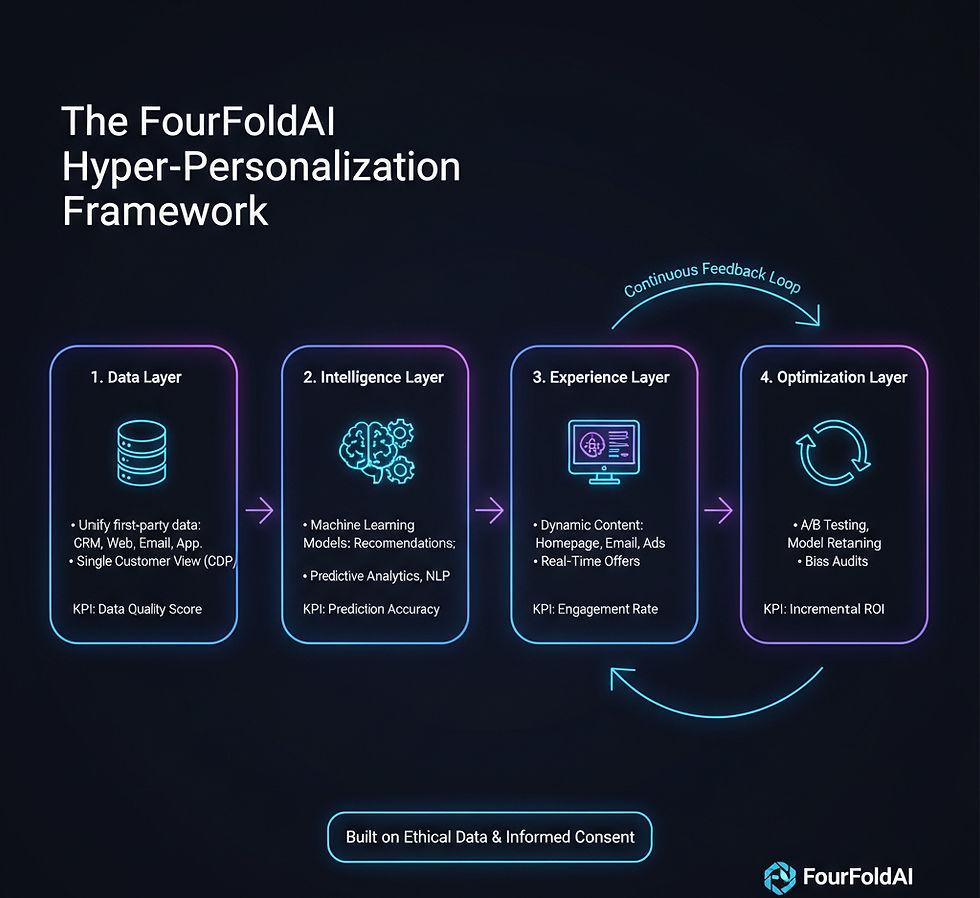
The FourFoldAI Hyper-Personalization Framework
After working with multiple brands across e-commerce, SaaS, and B2B verticals, we developed a 4-layer framework that maps cleanly onto how personalization systems actually need to be built — and audited. It's designed to be modular, meaning you can be strong in one layer while still building out another.
1
Data Layer
The foundation. This means unifying your first-party data from CRM, website analytics, email, app behavior, and offline touchpoints into a single customer profile. No AI system performs well on fragmented data. Your CDP or data warehouse is the backbone here. Start by auditing what data you actually have vs. what you wish you had — the gap is usually instructive.
2
Intelligence Layer
This is where your machine learning models live — recommendation engines, predictive analytics models for churn and next-best-action, and NLP systems for intent detection. This layer processes the unified data from Layer 1 and produces actionable predictions. The key performance indicator here is prediction accuracy vs. a simple rule-based baseline. If your ML model isn't beating a smart segment rule, it's not ready to deploy.
3
Experience Layer
The output: what the user actually sees. Dynamic homepage modules, personalized email content, real-time product recommendations, and adaptive pricing. This is where the customer journey becomes genuinely individual. But be careful — personalization that feels intrusive erodes trust faster than generic messaging. The rule of thumb: personalize the context, not the surveillance. Show someone a relevant product; don't show them you've been tracking their every click.
4
Optimization Layer
The feedback loop. Every interaction — a click, a skip, a purchase, an unsubscribe — feeds back into Layer 2 to retrain your models. This is what separates a system that gets smarter from one that stagnates. Run structured A/B tests, track model drift, and schedule regular bias audits. In 2026, regulatory frameworks will increasingly require documented evidence that your personalization systems aren't producing discriminatory outcomes.
ROI Metrics That Actually Matter
Too many personalization dashboards are full of vanity metrics. Here's what we actually track — and what ties directly to revenue impact.
Metric | Why It Matters | Benchmark to Beat |
Click-Through Rate (CClick-Through Rate (CTR)TR) | Measures immediate content relevance — are your recommendations getting acted on? | Personalized campaigns drive up to 3x higher CTR vs. generic (HubSpot 2024) |
Conversion Rate | Tracks whether personalized experiences actually move people to purchase | Organizations using AI personalization see 15–25% conversion lift vs. generic experiences |
Customer Lifetime Value (LTV) | The long-game metric — are personalized customers sticking around and spending more? | 31% of customers more likely to remain loyal due to personalized experiences |
Marketing ROI | Are you getting more efficient spend, not just more revenue? | Companies tracking AI marketing impact see 20–30% higher campaign ROI (McKinsey 2024) |
Customer Acquisition Cost (CAC) | AI-targeted ads reduce wasted impressions and lower CAC meaningfully | Brands using AI personalization reduce CAC by up to 25% (Deloitte 2024) |
Churn Rate | Predictive models that flag at-risk users and trigger retention offers before a customer leaves | AI-powered next-best-experience systems cut cost-to-serve by 20–30% (McKinsey 2025) |
One important discipline note: don't track all of these at once at launch. Pick the one or two metrics most directly tied to your current business problem, establish a clean baseline, then run a structured pilot. Companies that chase five metrics simultaneously usually optimize for none of them.
The Future of Hyper-Personalization (2026–2030)
Where is this all heading? We track this closely, and a few trends stand out as genuinely transformative — not just incremental upgrades.
Generative AI-Powered Personalization
The shift from predictive to generative personalization is already happening. Early systems predicted what you might want from an existing catalog. The next wave creates new assets specifically for you. An outdoor brand that knows you hike in the Pacific Northwest doesn't just show you a raincoat from inventory — its AI generates a product image of that jacket on a rainy trail that looks like your local geography. We're already seeing this with AI-generated personalized email copy, dynamic landing pages, and individualized video ad variants.
Autonomous Customer Journeys
Agentic AI — systems that plan and execute sequences of actions autonomously — is moving personalization beyond single-touchpoint optimization. An agentic system will manage the entire customer journey: detecting a trigger event, choosing the right channel, drafting the message, sending it at the optimal moment, and adjusting the next touchpoint based on what happened. Industry data already shows 51–75% of customers of major platforms are actively using AI decisioning in their marketing operations as of early 2026.
AI-Personalized SERPs and Answer Engines
Google's AI Overviews and Perplexity's personalized answer threads are beginning to serve different answers to different users based on their context and search history. This changes content strategy fundamentally. Writing for a single keyword is giving way to writing for entities, intents, and conversational contexts — which is exactly why AEO (Answer Engine Optimization) is a discipline your content team needs to understand now, not in two years.
The Privacy-Personalization Balance
The final deprecation of third-party cookies, tighter GDPR enforcement, and new regional privacy laws are forcing a healthier model: personalization built entirely on first-party data, zero-party data (data customers willingly share), and federated identity frameworks. This is actually good news for brands willing to invest in customer trust. The companies earning direct data relationships will be the personalization leaders of 2028–2030.
Frequently Asked Questions
Q1 How is hyper-personalization different from standard personalization?
Standard personalization typically uses static rules applied to broad segments — like showing all "female customers aged 25–34" the same banner. Hyper-personalization uses machine learning and real-time behavioral data to create a continuously adapting, one-to-one experience for each individual. The difference isn't just technical — it's the difference between knowing someone's demographic and actually understanding their intent in this exact moment. Standard personalization is a photograph; hyper-personalization is a live video feed.
Q2 Is AI personalization "fake" or genuinely intelligent?
It depends entirely on the implementation. The best systems — like Netflix's ensemble of neural networks or Spotify's NLP-powered music analysis — are genuinely learning and improving. A lot of tools in the market, though, use basic rule-based automation with "AI" in the marketing copy. The tell: if the system doesn't update its recommendations based on your most recent behavior, it's not real machine learning. Real AI personalization gets measurably more accurate over time.
Q3 Is hyper-personalization scalable for small businesses?
Yes, with realistic expectations. Small businesses shouldn't try to build a Netflix-scale ML pipeline. What's accessible and effective right now: AI-driven email personalization platforms (like Klaviyo or ActiveCampaign with AI features), smart recommendation engines on e-commerce platforms (like Shopify's built-in AI), and predictive analytics tools for churn and engagement scoring. The key is to start with one channel, prove ROI, and layer outward. A business with 10,000 customers and clean first-party data can see meaningful results within 60–90 days of a focused pilot.
Q4 What are the best AI personalization tools in 2026?
The right tool depends heavily on your use case, data maturity, and budget. That said, here's a practical breakdown by category: CDPs — Segment, mParticle, Bloomreach; E-commerce Personalization — Dynamic Yield, Nosto, Monetate; Email & CRM AI — Klaviyo, Salesforce Einstein, HubSpot AI; B2B / Sales — Persana AI, 6sense, Demandbase; Recommendation Engines — Amazon Personalize (AWS), Google Recommendations AI. Before choosing any tool, audit whether your first-party data infrastructure can actually feed it — a great tool with fragmented data produces mediocre results.
FourFoldAI Research Team
AI Research & Content Strategy · fourfoldai.com
We research AI technologies, enterprise adoption patterns, and real-world implementation strategies. Our work draws on primary data analysis, industry reports, and hands-on audits of AI personalization systems across retail, SaaS, and B2B verticals. Views are evidence-based and independent.
References & Further Reading
This article is backed by authoritative sources and research. Every statistic cited has been cross-referenced against at least two independent sources before inclusion. We do not accept sponsored placement or affiliate arrangements that influence data selection.
McKinsey & Company — "The future of AI-powered personalization" & "Next best experience: How AI can power every customer interaction" (2025)https://www.mckinsey.com/capabilities/growth-marketing-and-sales/our-insights/discussing-the-future-of-ai-powered-personalization
McKinsey Global Survey on AI (2025) — "The state of AI in 2025: Agents, innovation, and transformation"https://www.mckinsey.com/capabilities/quantumblack/our-insights/the-state-of-ai
HubSpot — Marketing Personalization Statistics & Trends 2024. Covering CTR lifts, email engagement benchmarks, and AI adoption in marketing teams.https://www.hubspot.com/marketing-statistics
Salesforce — "State of the Connected Customer" (6th Edition, 2024). Data on consumer expectations for personalization and AI trust.https://www.salesforce.com/resources/research-reports/state-of-the-connected-customer/
Deloitte — "AI in Retail & Consumer Products" (2024). Research on customer acquisition cost reduction through AI-targeted personalization.https://www.deloitte.com/global/en/our-thinking/insights/industry/consumer-industry/retail-industry-outlook.html
Gartner — Research on CDP adoption, AI personalization infrastructure, and enterprise marketing technology trends (2025–2026).https://www.gartner.com/en/marketing/topics/personalization
MIT Technology Review — Coverage of generative AI personalization, algorithmic bias, and the ethical dimensions of large-scale behavioral data use.https://www.technologyreview.com/topic/artificial-intelligence/
© 2026 FourFoldAI · Research & Insights Team · All data verified April 2026


Comments