
The Global AI Regulation Race: US vs EU vs China (2026 Guide)

By Muizz Shaikh | FourfoldAI
Something fundamental shifted in how governments think about artificial intelligence. Not long ago, AI policy debates were mostly academic — ethics boards, voluntary frameworks, and think-tank white papers. That era is over. The global AI regulation race has become one of the most consequential geopolitical competitions of our time. Governments are no longer asking whether to regulate AI. They're racing to establish the rulebook first, because whoever sets the standard sets the terms of global market access.
This is not simply about protecting citizens from algorithmic bias or preventing deepfakes. What's unfolding is a three-way contest between fundamentally different governance philosophies. The European Union is building a mandatory, risk-layered legal architecture that reaches beyond its own borders. The United States remains structurally fragmented — a patchwork of state mandates, sector-specific agency enforcement, and an increasingly assertive federal deregulatory agenda. China operates an entirely different system: a pre-launch approval gate managed by the state, where no generative AI product goes public without government sign-off.
For AI developers, enterprise technology leaders, compliance officers, and investors with cross-border exposure, these three systems are not abstract policy discussions. They are operational realities. A software team in San Francisco or Singapore that deploys a model touching European users must satisfy the EU AI Act's compliance architecture. A company entering China's market must register its algorithm with the Cyberspace Administration of China before a single API call goes live. And even within the United States, a single product can trigger compliance obligations in Colorado, California, and potentially a dozen other states simultaneously.
The stakes keep escalating. Understanding where each jurisdiction stands — and where each is heading — is now a baseline requirement for anyone scaling AI products internationally.

What Is the Global AI Regulation Race?
Why Governments Are Racing to Govern AI
The phrase "AI governance" used to conjure images of ethics guidelines and corporate responsibility pledges. The current reality is far more structural. Governments are competing to establish control not just over AI outputs, but over the underlying infrastructure layers — compute access, training data flows, model weights, and deployment standards.
At its core, this race is being driven by three overlapping pressures. First, AI has become inseparable from national security. Large language models, surveillance systems, and autonomous logistics networks are now dual-use technologies: commercially valuable and militarily significant simultaneously. Second, data sovereignty concerns have intensified. Who controls the data pipelines feeding AI systems determines who controls the economic value those systems generate. Third, whoever's regulatory framework becomes the de facto global standard gains outsized influence over technology supply chains.
The Brussels Effect — the documented phenomenon where EU regulations effectively set global compliance baselines because multinationals find it economically simpler to comply uniformly — makes the EU's moves particularly significant. When the EU mandates model documentation standards or red-teaming requirements, those requirements often ripple through to engineering teams in Austin, Tokyo, and Bangalore.
How AI Regulation Impacts Innovation and Competitiveness
This is where the tension becomes most acute. Over-regulate AI and you risk triggering capital and talent flight. Under-regulate and you create the kind of legal uncertainty that makes enterprise adoption hesitant and investor risk calculus uncomfortable.
The EU is consciously gambling that strong consumer protections will create trust-based competitive advantage — that companies complying with the EU AI Act will be seen as more reliable, better governed, and safer partners. The US is currently betting the opposite: that keeping regulatory friction low will allow its AI industry to move faster, ship more products, and hold technological leadership through sheer output. China's wager is different again — that state-directed AI development, tightly integrated with national industrial strategy, can accelerate deployment in ways that atomized private markets cannot.
All three bets carry real risks. The EU risks making itself an inhospitable environment for early-stage AI development. The US risks a fragmented compliance environment that paradoxically imposes more cost than a unified national standard would. China risks producing AI systems optimized for domestic consumption that struggle to compete on trust and openness in international markets.
Why Businesses Can No Longer Ignore AI Compliance
The critical concept here is extraterritoriality. Regulation no longer respects the borders of the company building the product. A startup incorporated in Delaware that deploys a model to European users is subject to the EU AI Act's requirements. A US enterprise software vendor whose European subsidiary uses an AI hiring tool must comply with EU risk documentation standards — regardless of where the system was built or where the engineers are located.
China adds another dimension. Foreign companies operating in China's market, or Chinese subsidiaries of foreign firms, must register generative AI services with the CAC, submit to security assessments, and ensure their model outputs comply with Chinese content standards. The global AI regulation race, in other words, is not a spectator sport for any business with international ambitions.
What is the global AI regulation race? The global AI regulation race is the geopolitical competition between the United States, the European Union, and China to establish the dominant global standard for artificial intelligence oversight. This race shapes market access, dictates software engineering standards, and balances security risk against technological competitiveness across borders.
The European Union's Approach: Risk-Based AI Regulation
Understanding the EU AI Act
Regulation (EU) 2024/1689 — officially the EU Artificial Intelligence Act — is the world's first comprehensive, legally binding AI law. It entered into force in August 2024, but its obligations are rolling out in phases. The prohibited practices ban has been active since February 2025. General-purpose AI model rules became enforceable in August 2025. High-risk AI system obligations for most applications were set for August 2026, with significant amendments now provisionally agreed.
What makes the AI Act uniquely powerful is its extraterritorial scope. Any AI system placed on the EU market, or whose outputs are used within the EU, falls under the Act's jurisdiction — regardless of where the provider is based. A US company, an Indian startup, a Canadian research lab: if their model touches EU users, they are in scope.
The Act's architecture is built around a core principle: the higher the potential harm, the heavier the compliance burden. That sounds simple. The implementation is anything but.
Risk Categories Under the EU AI Act
The Act divides AI applications into four risk tiers.
At the top sits Unacceptable Risk — practices that are categorically prohibited. These include social scoring systems that rank citizens based on behavior, biometric categorization systems used to infer political opinions or sexual orientation, and real-time remote biometric identification in public spaces for law enforcement (with narrow exceptions). These bans have been in effect since February 2025.
High-Risk AI covers systems used in critical infrastructure, employment screening and worker management, credit scoring, educational assessment, and access to essential services. These systems require conformity assessments, detailed technical documentation, data governance controls, human oversight mechanisms, and audit logs maintained for years. The May 2026 Digital Omnibus amendments deferred Annex III compliance deadlines by 16 months, pushing them to December 2, 2027. Systems embedded in safety-regulated products (Annex I) get until August 2028.
Limited Risk systems — primarily customer-facing chatbots and synthetic media generators — must be transparent about their AI nature. Users must know they're interacting with an automated system. This tier carries lighter obligations but is already in force.
Minimal Risk covers most AI applications, including standard productivity tools and spam filters. These face no mandatory obligations under the Act, though the EU encourages voluntary codes of conduct.
General-Purpose AI and Foundation Model Rules
The EU AI Act introduced specific obligations for General-Purpose AI (GPAI) models — foundation models capable of performing a wide range of tasks. All GPAI providers must maintain technical documentation, publish transparency reports, and provide training data summaries that include copyright compliance information.
For the most powerful models, the stakes escalate. A GPAI model trained on compute exceeding 10²⁵ FLOPs is presumed to pose "systemic risk" — meaning its failure or misuse could cause cascading harm across the EU at scale. Models clearing this threshold (which likely includes GPT-5, Claude Opus 4, and Gemini 3 Pro based on publicly available estimates) face additional obligations: adversarial testing (red-teaming), incident reporting to the EU AI Office, dedicated cybersecurity protections, and energy consumption reporting.
The EU AI Office, established within the European Commission, is the primary enforcement body for GPAI. Its enforcement powers for direct AI Office fines activated in August 2026, giving providers a 12-month working period with regulators after the August 2025 GPAI compliance date.
How EU Regulation Affects Global AI Companies
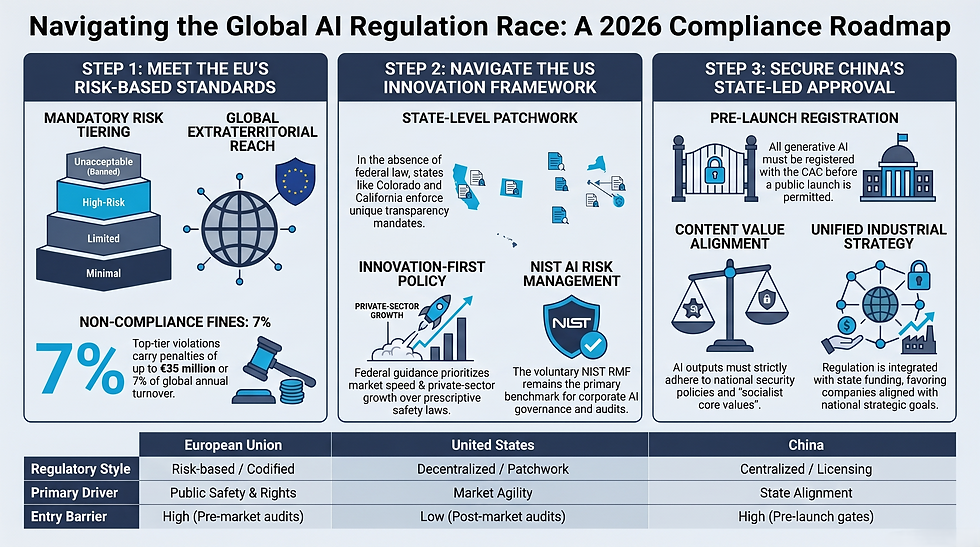
The penalty structure is designed to get attention at board level. Violations of prohibited practices — the top tier — carry fines of up to €35 million or 7% of global annual turnover, whichever is higher. For a company the size of Alphabet, 7% of annual revenue would exceed $20 billion. High-risk and GPAI violations carry fines up to €15 million or 3% of global turnover. Providing misleading information to regulators draws up to €7.5 million or 1.5% of turnover.
These figures exceed GDPR maximums, making the EU AI Act the highest-stakes compliance instrument in EU digital regulation history. The May 2026 Digital Omnibus agreement — while deferring Annex III timelines — did not reduce penalty exposure. Companies that delayed compliance preparations thinking deadlines would evaporate are facing a harder reckoning. The AI Office has made clear: deferred deadlines raise the bar for what regulators consider adequate preparation, they don't lower it.
For enterprises relying on SLM vs LLM enterprise architecture decisions, the EU's GPAI threshold at 10²⁵ FLOPs is a critical factor in evaluating which models trigger systemic risk obligations versus which stay below that watermark.
How does the EU AI Act regulate AI? The EU AI Act regulates AI using a tiered, risk-based framework. It strictly bans unacceptable-risk practices, enforces transparency rules for general-purpose AI, and mandates comprehensive security, documentation, and human oversight audits for high-risk applications before they can enter the EU market.
The United States Approach: Innovation First, Regulation Second
Why the US Has No Comprehensive Federal AI Law
As of mid-2026, the United States still has no single, overarching federal AI law. That is not an oversight — it reflects a deliberate political and economic calculation. Congressional division, the velocity of AI development relative to the pace of legislation, and deep disagreements about federal preemption have all conspired to leave the US without the kind of unified framework the EU completed in 2024.
The transition from the Biden administration's October 2023 Executive Order — which had directed extensive AI safety assessments across federal agencies — to the Trump administration's deregulatory posture shifted federal AI policy significantly. The December 11, 2025 Executive Order directed the administration to challenge state-level AI laws that might fragment the market, signaling a preference for innovation velocity over prescriptive safety standards. The follow-up National Policy Framework for Artificial Intelligence, released on March 20, 2026, codified this approach with 27 legislative recommendations organized around protecting free speech, prioritizing private sector development, and federally preempting conflicting state requirements.
The Role of NIST AI Risk Management Framework
In the absence of binding federal law, the NIST AI Risk Management Framework (AI RMF), first published in January 2023 and refined since, has become the primary "soft law" benchmark for AI governance in the US. Most enterprises building or deploying AI systems reference it during internal audits, vendor assessments, and board-level risk reviews.
The NIST AI RMF is voluntary. It organizes AI risk management around four core functions: Govern, Map, Measure, and Manage. It does not create legal liability on its own, but alignment with it increasingly features in procurement requirements, financial sector guidance, and enterprise due diligence frameworks. The FTC's Operation AI Comply enforcement sweep — which has produced settlements against companies making unsubstantiated AI performance claims — effectively treats NIST-aligned documentation as evidence of good faith, even if it's not explicitly required.
State-Level AI Laws and Emerging Requirements
With federal law absent, states moved to fill the gap — and the result is precisely the "patchwork chaos" the Trump administration has been trying to preempt.
Colorado was at the center of the most dramatic regulatory development of 2026. SB 24-205, originally designed as the most comprehensive state-level AI law in the US, was challenged, delayed from February to June 2026, stayed by a federal magistrate in April 2026, and ultimately repealed and replaced by SB 26-189, signed by Governor Polis in May 2026. The replacement law — now effective January 1, 2027 — governs automated decision-making technology (ADMT) and requires consumer notices before AI influences consequential decisions, 30-day explanations of adverse outcomes, and meaningful human review processes. It's less expansive than SB 24-205 but more durable, crafted to survive constitutional challenges.
California continues to advance multiple AI transparency and accountability bills, including disclosure requirements for AI-generated content and testing obligations for frontier model developers. New York's RAISE Act and other state-level proposals reflect a growing appetite to regulate at the state level regardless of federal signals.
California's SB 942 and AB 853 require AI system providers with over one million monthly users to embed latent disclosures in AI-generated content metadata — a technical requirement that directly affects software architecture decisions for consumer-facing products.
Balancing AI Leadership and AI Safety
Senator Marsha Blackburn's TRUMP AMERICA AI Act discussion draft, released March 18, 2026, represents the most ambitious congressional attempt yet to create a unified federal AI framework. At 291 pages, it covers duty of care requirements for AI developers, liability frameworks, child safety provisions, copyright protections, and — critically — preemption of conflicting state AI laws.
The Act's full formal name is "The Republic Unifying Meritocratic Performance Advancing Machine Intelligence by Eliminating Regulatory Interstate Chaos Across American Industry Act" — an elaborate acronym that signals its political framing. Whether it passes in its current form is uncertain. What it signals is clear: the federal government is moving toward a "one rulebook" approach, designed to prevent a 50-state compliance maze from becoming the dominant feature of the US AI operating environment.
For enterprises building on AI, understanding how AI models master tool usage and computer interaction has taken on compliance dimensions it didn't have 18 months ago — particularly as agentic systems trigger questions about liability and decision accountability under these emerging state frameworks.
How is AI regulated in the United States? AI in the United States is regulated through a decentralized patchwork of state-level statutes, alongside enforcement from sector-specific federal agencies using existing laws. While Colorado and California lead with strict state-level risk mandates, federal policy emphasizes innovation and national competitiveness.
China's Approach: State-Led AI Governance
China's AI Security and National Strategy
China's AI regulatory architecture cannot be understood separately from its national strategy. The 2030 AI Leadership Plan, announced in 2017, set an explicit goal: achieve global AI leadership by the end of the decade. That plan has been backed with hundreds of billions in state-directed investment, preferential access to domestic markets for aligned companies, and a regulatory environment designed to accelerate deployment for strategic applications while controlling content and data at every layer.
From Beijing's perspective, AI is simultaneously an economic asset, a national security tool, and a potential internal security risk. That dual nature explains why China's regulatory framework is the most restrictive in the world on content governance while remaining actively supportive of AI development. The government wants fast, capable AI — developed under conditions it controls.
Generative AI Registration Requirements
The most distinctive feature of China's AI governance system is its pre-launch gate. Unlike the EU, which imposes obligations before and after deployment, or the US, which primarily intervenes after harm occurs, China's Cyberspace Administration requires registration before any generative AI service goes live to the public.
Under the 2023 Interim Measures for Generative AI Services — still the operating framework in 2026 — providers must file with the CAC before launching public-facing generative AI products. This filing includes a security self-assessment covering algorithm behavior, training data sources, content generation capabilities, and risk mitigation measures. The assessment process typically takes three to six months.
By the end of 2025, the CAC reported 446 newly filed and 330 newly registered generative AI services for the year — including major Chinese platforms like DeepSeek and Baidu's Ernie Bot, which completed registration prior to public launch. Foreign companies seeking to operate generative AI services in China face the same gate. The filing number must be displayed to users. Operating without one is a violation subject to service suspension and fines up to 10% of annual revenue.
Content Control and Algorithm Governance
China's content compliance requirements go beyond what any Western jurisdiction mandates. AI systems operating in China must ensure their outputs align with "socialist core values," avoid content that subverts state authority or undermines national unity, and actively filter for material the government classifies as illegal or harmful.
The TC260 (National Cybersecurity Standardization Technical Committee) has been the primary technical standards body translating these high-level requirements into testable specifications. Its generative AI security standards — including GB/T 45654-2025 on service security requirements — became effective November 2025, providing concrete technical benchmarks for content filtering and data annotation compliance.
AI-generated content must be labeled. The CAC's mandatory national standard for AI-Generated Synthetic Content labeling went into force in September 2025, requiring providers to embed metadata in AI-generated text, images, audio, and video to enable detection. Platforms that fail to apply compliant labels — including the "explicit metadata" and "implicit watermarking" layers specified in TC260 standards — face enforcement actions. The CAC's Qinglang ("Clear and Bright") enforcement campaign ran a dedicated three-month sweep in 2025 targeting non-compliant AI labeling, resulting in thousands of penalized accounts and suspended services.
Why China Views AI as Critical Infrastructure
China's regulatory system integrates seamlessly with state capital allocation. Companies that comply with CAC requirements and align their AI development with national industrial priorities gain access to preferential procurement, state-backed research partnerships, and government-directed market channels. Those that don't face regulatory friction that makes commercial scaling impossible.
This is fundamentally different from how Western companies experience AI regulation. In the EU and US, regulation and market incentives are largely separate systems. In China, they are unified. The regulatory framework is part of the industrial strategy — designed not just to constrain AI but to channel it toward state-defined objectives.
Developers exploring AI model distillation controversies and techniques in the context of the Chinese market should be aware that the CAC's security assessments include scrutiny of training methodologies and model compression approaches, particularly where distillation might affect content filtering effectiveness.
How does China regulate artificial intelligence? China regulates artificial intelligence through mandatory, pre-launch algorithmic registrations and generative AI licensing enforced by the Cyberspace Administration of China. All AI systems must adhere to strict content guidelines and clearly label synthetic media to ensure alignment with national security policies.
US vs EU vs China: Comparing the Three AI Governance Models
Structural Comparison
Each jurisdiction has built a system that reflects its underlying political economy. The EU's approach prioritizes rights, legal predictability, and uniform standards across 27 member states — at the cost of compliance complexity and implementation timelines that frustrate fast-moving developers. The US system prioritizes market dynamism and private sector innovation — at the cost of the jurisdictional fragmentation that makes scaling across states expensive and legally unpredictable. China's system prioritizes state alignment and content security — at the cost of transparency, openness, and the kind of international trust that drives export adoption.
None of these is purely superior. Each reflects genuine trade-offs between values that reasonable policymakers weigh differently.
Factor | United States | European Union | China |
Regulatory Style | Decentralized, sector-specific patchwork with active state laws. | Extraterritorial, risk-based, codified uniform law. | Centralized, state-directed, pre-launch licensing. |
AI Safety Requirements | Voluntary frameworks (NIST) with some state-level risk audits. | Strict compliance auditing, data logging, and human oversight. | Mandatory algorithm filings and security self-assessments. |
Innovation Focus | Private-sector led, venture-driven, prioritized deregulation. | Public safety-centric, sandbox-supported compliance. | State-supported, targeted industrial and national security. |
Enforcement | Agencies (FTC, EEOC) and state attorneys general. | EU AI Office and national market surveillance authorities. | CAC, MIIT, and public security agencies. |
Business Impact | High agility, but significant state-by-state compliance friction. | High compliance cost, with deferred high-risk deadlines. | Strict content compliance, with high filing gate barriers. |

How AI Regulation Is Reshaping the Global AI Industry
Impact on Frontier AI Labs
The EU AI Act's GPAI requirements are already changing how frontier labs approach model development. Red-teaming — adversarial testing designed to identify failure modes — has shifted from a voluntary safety practice to a legal obligation for models above the 10²⁵ FLOP threshold. Incident reporting pipelines, previously internal, now require structured disclosure to the EU AI Office.
These obligations add real cost. Anthropic, Google DeepMind, OpenAI, and Meta all maintain significant EU-facing compliance operations. For smaller frontier labs, the compliance architecture required to market a high-capability model in Europe represents a structural disadvantage relative to incumbents who can amortize these costs across larger revenue bases.
Liability frameworks are evolving faster than most legal teams anticipated. The EU's product liability directive amendments, running parallel to the AI Act, extend manufacturer-style liability to AI system providers in ways that make legal exposure for AI-generated harm a balance sheet consideration, not just a reputational one.
Impact on Open Source AI
Open-source AI sits in a genuinely complicated regulatory position. The EU AI Act includes limited exemptions for open-weight models that are released genuinely openly — but models that cross the systemic risk threshold at 10²⁵ FLOPs do not benefit from these exemptions, regardless of their licensing terms.
The geopolitical dimension is significant. Open-weight models like the Llama ecosystem from Meta create regulatory tension in China — where open weights complicate the CAC's ability to assess and control model behavior — while raising legitimate questions in the EU about who bears compliance responsibility when a foundation model is modified and deployed by a third party. Understanding the nuances of open-weight AI models and the Llama ecosystem is increasingly a compliance question, not just a technical one.
Impact on Enterprise AI Adoption
Enterprise AI adoption has generated a parallel industry in governance toolkits — audit trail systems, model cards, compliance dashboards, and risk classification tools. For large enterprises, AI governance has become a procurement category. Vendors are expected to demonstrate compliance documentation before contracts are signed.
The demand for local model deployments has risen as companies seek to contain data flows within regulatory boundaries. Processing sensitive user data inside the EU using a locally deployed, documented model is architecturally more compliant — and increasingly commercially preferable — to routing it through an API to an overseas data center.
Impact on Cross-Border AI Services
The most operationally demanding consequence of divergent AI regulation is what practitioners call regulatory geofencing. Companies are being forced to run materially different AI implementations for EU users, US users, and Chinese users — different content filters, different data retention policies, different disclosure formats, different model versions.
This creates software architecture complexity that didn't exist five years ago. A single AI feature in a global product may require three separate compliance layers, three sets of audit logs, and three different disclosure mechanisms. For companies scaling across jurisdictions, this isn't a future consideration. It's a present engineering requirement.
The Next Frontier: Regulating Foundation Models and Agentic AI
Why Existing Laws May Not Be Enough
Every major AI regulation currently in effect was designed for a specific implicit model of how AI systems work: receive input, process it, produce output, stop. The EU AI Act's conformity assessments, China's security self-assessments, and US risk frameworks all assume this static input-output architecture at some level.
Agentic AI systems — models that take actions in the world, chain decisions across multiple steps, and operate semi-autonomously over extended periods — break this assumption. A model that browses the web, writes and executes code, manages files, and sends emails on a user's behalf is not well captured by frameworks designed for classifiers and content generators.
Agentic AI Governance Challenges
The core governance problem with agentic systems is non-determinism at scale. A conventional AI model behaves predictably enough that pre-deployment testing can characterize its risk profile with reasonable accuracy. A multi-agent system, operating across dynamic environments with real-time inputs and feedback loops, can produce behavior in deployment that no pre-deployment test would have predicted.
This matters for dynamic memory management — how agent networks store and retrieve context across sessions — and for the behavioral drift that can emerge as agents adapt to novel environments. The EU AI Act's conformity assessment procedures were not designed for systems that evolve after deployment.
Autonomous Decision-Making Risks
Liability becomes acutely difficult when AI agents make consequential decisions autonomously. If an AI agent executes a financially harmful stock trade, approves a fraudulent loan, or violates a user's privacy while acting on delegated authority, who bears legal responsibility? The model developer? The enterprise deploying it? The user who granted permissions?
Current legal frameworks across all three jurisdictions treat AI systems as tools controlled by human operators. Agentic systems challenge this by distributing agency across human-machine configurations that don't map cleanly onto existing operator liability frameworks.
Potential Regulatory Directions After 2026
Emerging regulatory thinking points toward runtime monitoring — continuous surveillance of model behavior in deployment rather than one-time pre-deployment conformity assessments. This would require AI systems to generate structured behavioral logs in real time, exposing them to ongoing regulatory review rather than a single certification event.
Cryptographic agent signatures — mechanisms that allow actions taken by AI agents to be traced to specific model versions and deployment configurations — are being discussed as a technical standard that would make liability attribution tractable. The EU AI Office has flagged agentic AI as a priority area for its 2027 work program. Expect the regulatory surface area for autonomous AI systems to expand significantly before any of the current frameworks reach full implementation.
What Businesses Must Do to Prepare for Global AI Compliance
Compliance preparation is no longer something that happens at the end of product development. It needs to be embedded from the start. Here are five foundational steps for businesses operating across the US, EU, and Chinese regulatory environments:
1. Build an AI Inventory. Document every AI model in use across your organization — including third-party APIs, embedded models in SaaS tools, and models used by subsidiaries. You cannot classify risk, assign compliance obligations, or respond to a regulatory inquiry without knowing what systems you're running.
2. Implement AI Governance Policies. Establish a cross-functional oversight committee that includes legal, engineering, product, and compliance stakeholders. AI governance cannot live exclusively in the legal team or exclusively in the engineering team. It requires active coordination across both.
3. Conduct Risk Assessments. For every AI system that influences consequential decisions — hiring, credit, healthcare triage, law enforcement support — perform documented risk assessments aligned to the frameworks applicable in your operating jurisdictions. Under EU standards, this means conformity-level documentation. Under emerging US state laws, it means duty-of-care assessments with evidence of testing.
4. Create AI Audit Trails. Implement immutable logging for model inputs, outputs, and configuration versions. This is a legal requirement under the EU AI Act for high-risk systems, and an emerging expectation under US state frameworks. It is also the primary mechanism for defending against enforcement actions after the fact.
5. Prepare for Multi-Jurisdiction Compliance. Build flexible model serving layers that allow different configurations for different regional regulatory environments. This means architecting your systems with regulatory geofencing capability from the start — not retrofitting it later when enforcement pressure arrives.
Who Is Winning the Global AI Regulation Race?
The EU's Regulatory Leadership
The EU has won the first-mover battle convincingly. No other jurisdiction has a comprehensive, binding AI law in force. The Brussels Effect is operating exactly as predicted: multinationals building compliance for the EU AI Act are adopting documentation standards, red-teaming practices, and governance structures that exceed what any other jurisdiction currently mandates. Those practices are migrating back into global operations, making EU standards the de facto baseline even in jurisdictions where they're not legally required.
The US Innovation Advantage
The United States retains the structural advantages that have defined its AI dominance: the deepest concentration of frontier research talent, the largest pool of venture and private equity capital deployed into AI, the most powerful compute infrastructure (primarily through hyperscalers AWS, Azure, and GCP), and the largest domestic market for enterprise AI adoption. These advantages compound over time. No regulatory framework in the EU or China can replicate the conditions that produced GPT-4, Claude, Gemini, or Llama in the near term.
China's Centralized Governance Model
China's model has a genuine structural strength that Western analysts sometimes underestimate: speed of industrial coordination. When the Chinese government decides to deploy AI in logistics, manufacturing, smart cities, or healthcare, it can synchronize regulatory approval, state capital, infrastructure build-out, and pilot programs at a speed that market-driven systems cannot match. The 446 generative AI services registered with the CAC in 2025 alone represent a regulated but genuinely active deployment ecosystem, not a stagnant one.
Will Global AI Standards Ever Converge?
Not completely. The philosophical distances between the EU's rights-centered model, the US's market-centered model, and China's state-centered model reflect genuine differences in political values, governance philosophy, and economic structure that cannot be harmonized through technical standards committees or bilateral agreements. What is possible — and beginning to happen — is selective interoperability: common technical standards for AI labeling, model documentation formats, and incident reporting that allow companies to satisfy multiple regulatory systems with a single technical layer, even where the policy objectives behind those systems remain divergent.
The International Organization for Standardization (ISO), the IEEE, and the ITU are all developing AI standards that could serve as this bridge. Progress is slow. But the direction is toward pragmatic technical alignment on top of persistent policy divergence.
Conclusion
The global AI regulation race is not heading toward a single winner. It is producing a permanent multi-polar regulatory environment — one where the EU, the US, and China operate competing governance systems that businesses must navigate simultaneously. That reality is here now, not approaching.
For modern technology companies, this means AI compliance is no longer a legal bottleneck to route around. It is a competitive asset. The organizations that invest early in governance architecture — model inventories, audit trails, cross-functional oversight, flexible deployment infrastructure — are building capabilities that will differentiate them as enforcement tightens across all three jurisdictions. Those that treat compliance as an afterthought will face a significantly harder remediation problem, and potentially significant regulatory exposure, in the years immediately ahead.
Understanding the regulatory terrain is the first step. At FourfoldAI, we track the intersection of AI governance, emerging technology, and enterprise strategy to help businesses navigate this environment with clarity and confidence. Explore more at FourfoldAI.com.
Frequently Asked Questions (AEO-Optimized)
Which country has the strictest AI regulations?
The European Union currently operates the world's strictest binding AI regulatory framework through the EU AI Act (Regulation 2024/1689). It bans certain AI practices outright, mandates conformity assessments for high-risk applications, and enforces transparency obligations for general-purpose AI models — with fines up to €35 million or 7% of global turnover for the most serious violations. China's pre-launch registration requirements are arguably more restrictive in terms of market entry barriers, but the EU's framework is broader in scope across industry sectors.
What is the EU AI Act?
The EU AI Act (Regulation 2024/1689) is the European Union's comprehensive, binding AI law — the first of its kind in the world. It classifies AI systems into four risk tiers: unacceptable risk (banned), high risk (requiring extensive documentation and human oversight), limited risk (transparency obligations), and minimal risk (no mandatory requirements). It applies extraterritorially, meaning any AI system used by EU residents falls under its scope regardless of where the provider is based. Key enforcement deadlines include prohibited practice bans active since February 2025, GPAI rules since August 2025, and high-risk system obligations deferred to December 2027 following May 2026 amendments.
How is AI regulated in China?
China regulates AI through a mandatory pre-launch registration and licensing system managed by the Cyberspace Administration of China (CAC). Generative AI services must file security self-assessments and receive CAC registration before public launch. AI-generated content must be labeled with compliant metadata. All AI outputs must align with "socialist core values" and actively filter content the government classifies as illegal or harmful. The TC260 technical standards committee issues detailed compliance specifications. Enforcement includes service suspension, fines up to 10% of annual revenue, and potential criminal liability for serious violations.
Does the United States have an AI law?
No comprehensive federal AI law exists in the United States as of mid-2026. AI regulation is handled through a combination of state-level laws (most notably Colorado's replacement law SB 26-189, effective January 1, 2027, and California's AI transparency requirements), sector-specific federal agency enforcement (FTC's Operation AI Comply, EEOC guidance, FDA rules for healthcare AI), and voluntary frameworks like the NIST AI Risk Management Framework. The Trump administration has proposed federal preemption of conflicting state laws through the TRUMP AMERICA AI Act discussion draft, but it has not been enacted.
How will AI regulations affect businesses?
AI regulations increase compliance costs, require new documentation practices, and create operational complexity for companies deploying AI across multiple jurisdictions. In practical terms: businesses must build AI inventories, conduct risk assessments, implement audit logging, and prepare for different regulatory requirements in the EU, US, and Chinese markets. For enterprise AI, compliance demands are accelerating demand for AI governance tools, local model deployments, and cross-functional compliance teams. Companies that invest early in governance infrastructure gain competitive advantage as regulatory enforcement tightens.
Can a company comply with US, EU, and China AI rules simultaneously?
Yes, but it requires deliberate architectural and governance planning. Companies operating across all three jurisdictions typically build "regulatory geofencing" into their AI infrastructure — running different model configurations, content filters, and data handling procedures for EU, US, and Chinese user bases. They maintain documentation that satisfies EU conformity assessment standards, align with NIST AI RMF for US operations, and maintain separate CAC registrations and content compliance pipelines for China. It is complex and costly, but operationally achievable for organizations that plan for it proactively.
What are the biggest AI compliance risks in 2026?
The highest-risk areas in 2026 include: deploying high-risk AI systems (hiring, credit, healthcare) in the EU without conformity documentation; making unsubstantiated AI performance claims in US markets (FTC enforcement exposure); operating generative AI in China without CAC registration; failing to label AI-generated content in jurisdictions requiring disclosure; and deploying agentic AI systems without liability frameworks for autonomous decision-making. For frontier model providers, GPAI systemic risk obligations under the EU AI Act carry penalty exposure that can reach into the billions for large organizations.
Will global AI regulations become standardized?
Complete standardization is unlikely given the fundamental philosophical differences between the EU's rights-based model, the US's market-led approach, and China's state-directed framework. What is more likely is selective technical convergence — common standards for AI content labeling, model documentation formats, and incident reporting that allow multi-jurisdiction compliance through a single technical layer. International standards bodies including ISO, IEEE, and ITU are working toward these bridges, but the underlying policy objectives of the three major regulatory systems will remain distinct.
References
European Parliament and Council. Regulation (EU) 2024/1689 of the European Parliament and of the Council on Artificial Intelligence (EU AI Act). EUR-Lex. https://eur-lex.europa.eu/legal-content/EN/TXT/?uri=CELEX:32024R1689
Council of the European Union. Artificial Intelligence: Council and Parliament agree to simplify and streamline rules. May 7, 2026. https://www.consilium.europa.eu/en/press/press-releases/2026/05/07/artificial-intelligence-council-and-parliament-agree-to-simplify-and-streamline-rules/
White & Case LLP. EU agrees Digital Omnibus deal to simplify AI rules. May 14, 2026. https://www.whitecase.com/insight-alert/eu-agrees-digital-omnibus-deal-simplify-ai-rules
Inside Privacy (Covington). EU AI Act Update: Timeline Relief, Targeted Simplification, and New Prohibitions. May 2026. https://www.insideprivacy.com/artificial-intelligence/eu-ai-act-update-timeline-relief-targeted-simplification-and-new-prohibitions/
Akin Gump. Colorado Postpones Implementation of Colorado AI Act, SB 24-205. September 2025. https://www.akingump.com/en/insights/ai-law-and-regulation-tracker/colorado-postpones-implementation-of-colorado-ai-act-sb-24-205
STACK Cybersecurity. Colorado AI Act Compliance Guide. June 2026. https://stackcyber.com/posts/ai-colorado-laws
Latham & Watkins. Trump Administration Takes Major Steps Toward Comprehensive Federal AI Regulation. March 26, 2026. https://www.lw.com/en/insights/trump-administration-takes-major-steps-toward-comprehensive-federal-ai-regulation
Alston & Bird. The Trump Administration's AI Framework: Key Federal Policy Priorities and Legislative Recommendations. March 30, 2026. https://www.alstonprivacy.com/the-trump-administrations-ai-framework-key-federal-policy-priorities-and-legislative-recommendations/
Bird & Bird. China TMT Bi-monthly Update — January and February 2026 Issue. April 2026. https://www.twobirds.com/en/insights/2026/china/china-tmt-bi-monthly-update---january-and-february-2026-issue
Pertama Partners. China AI Algorithm Filing Rules 2026. February 2026. https://www.pertamapartners.com/insights/china-ai-regulations
Disclaimer
This article is intended for informational and educational purposes only. It does not constitute legal, compliance, or regulatory advice. AI regulations are subject to rapid change, and the information provided reflects publicly available sources as of June 2026. Readers should consult qualified legal counsel for guidance specific to their jurisdiction, industry, and use case. For FourfoldAI's full disclaimer, visit fourfoldai.com/disclaimer.
Explore More on FourfoldAI
Stay current on AI governance, enterprise strategy, and emerging technology. Visit FourfoldAI.com to explore our library of in-depth AI guides, tools comparisons, and practical implementation resources for business and technology leaders.
About the Author
Muizz Shaikh is an AI enthusiast and digital technology professional at FourfoldAI. He is passionate about exploring AI tools, industry trends, and practical applications of emerging technologies. Through FourfoldAI, Muizz contributes to simplifying artificial intelligence for businesses and learners. Connect with him on LinkedIn: linkedin.com/in/muizz-shaikh-45b449403/


Comments