
AI Personal Assistant in 2026: Best Tools, How They Work & Which One Is Right for You

By Muizz Shaikh | FourfoldAI Research Team | Published: April 2026
Let's be honest. The term Personal AI Assistants has been thrown around so much that it's started to lose its meaning. People use it to describe everything from a basic chatbot that answers FAQs to a fully autonomous agent that books your flights, drafts your emails, and sends your invoices — all while you're asleep.
But in 2026, the gap between those two things has never been wider. And if you're a student, a freelancer, or a small business owner trying to figure out which tool is actually worth your time and money, you've come to the right place.
This article is going to cut through the noise. We'll talk about what these tools really do, how they work under the hood (without the jargon), which ones are genuinely best for your situation, and a few things most guides don't tell you — including the privacy risks you absolutely need to know about.

What Is an AI Personal Assistant?
Snippet Block: An AI personal assistant is software powered by a large language model (LLM) that can understand natural language, remember context, and complete real-world tasks — like scheduling, writing, research, and automation — on behalf of a user. Unlike basic chatbots that follow scripts, modern AI assistants reason, adapt, and act autonomously across apps and platforms.
A lot of people still think of AI assistants as smarter versions of the old "type a question, get an answer" chatbot. That's not quite right anymore.
Think of it this way. A chatbot is like a vending machine. You press a button, you get a specific item. It doesn't remember you. It doesn't adapt. It just responds to whatever input you give it.
A Personal AI Assistant in 2026, on the other hand, is more like a highly capable colleague who works at your pace, learns your preferences over time, connects to your tools, and proactively helps you stay ahead of your workload. The key difference is agency. Modern assistants don't just respond — they act.
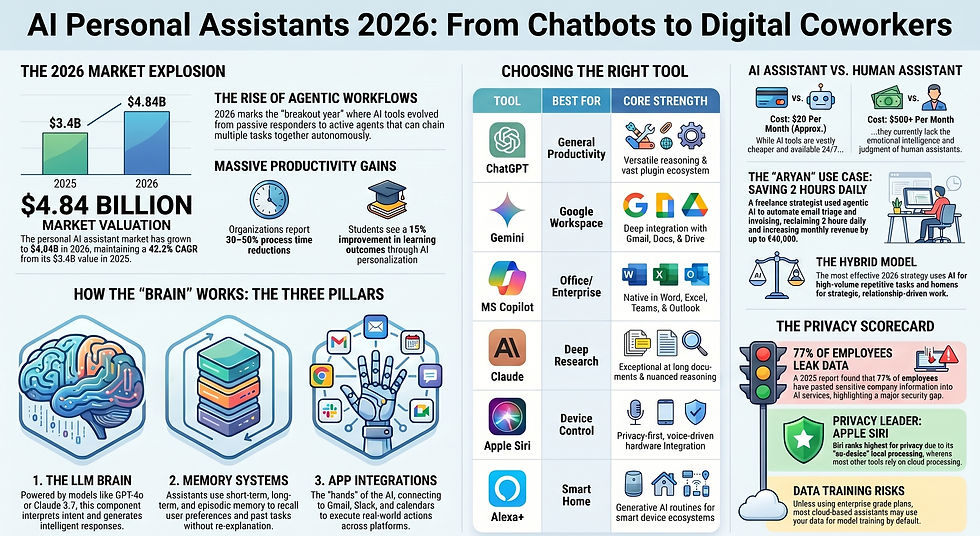
2026 marks what many in the AI industry are calling a breakout year. Why? Because agentic workflows have finally matured. Before this, AI tools were impressive but passive. Now, they can chain together multiple tasks — research a topic, draft a report, schedule a meeting, and send a follow-up — in a single instruction. That's a fundamental shift in how we interact with software.
How Does an AI Personal Assistant Work?
Snippet Block: AI personal assistants work by combining a large language model (LLM) for language understanding, a memory system for storing context and preferences, and app integrations for taking real-world actions. They process your input, retrieve relevant information, and execute tasks through connected platforms like Gmail, Notion, Slack, or your calendar.
The LLM Brain, Memory Systems, and App Integrations
Under the hood, every modern AI assistant has three core components working together.
First, there's the LLM — the language brain. This is the model that understands what you're saying, interprets your intent, and generates intelligent responses. Models like GPT-4o, Gemini 2.0, and Claude 3.7 power the assistants you use every day.
Second, there's memory. Early AI assistants had none. Every conversation started from scratch. Today, assistants use different memory architectures — short-term memory for the current session, long-term memory for persistent preferences, and episodic memory to recall past tasks. This is what allows an assistant to know that you prefer bullet-point summaries, that you have a weekly Monday standup, and that your client's name is Sarah — without you having to say it every time.
Third, there are app integrations. An AI assistant is only as useful as the tools it can access. The best ones in 2026 connect to your email, calendar, project management tools, documents, browsers, and even external APIs. That's what enables real task execution — not just conversation.
The Move Toward Voice-First and Automation Agents
There's a clear shift happening. Typing is becoming optional.
Apple's Siri is now deeply integrated into iOS device controls via the App Intents system, allowing users to manage apps, edit files, and send messages entirely by voice. Amazon's Alexa+, relaunched in February 2025 with full generative AI capabilities, now holds natural, multi-turn conversations and takes autonomous actions across smart home devices and third-party services.
Meanwhile, automation agents — tools like n8n, Gumloop, and Zapier Agents — allow you to build multi-step AI workflows that run in the background. These aren't just chatbots. They're digital workers.
A note on local vs. cloud processing: One thing that rarely gets discussed is where the AI actually runs your data. Cloud-based assistants (like ChatGPT and Gemini) send your queries to remote servers — faster, more powerful, but your data leaves your device. Local processing tools (like some privacy-first assistants built on open-source models) keep everything on your machine. Slower, but far more private. In 2026, the best tools are starting to offer a hybrid approach — quick responses through cloud, sensitive data handled locally.
Why Is AI Personal Assistant Demand Exploding in 2026?
Snippet Block: Demand for AI personal assistants is surging in 2026 due to rising remote work, growing freelancer economies, and the maturity of agentic AI. Students need personalized study tools, professionals need scheduling and email automation, and solopreneurs need to scale without hiring. The personal AI assistant market is valued at $4.84 billion in 2026, growing at a 42.2% CAGR.
The numbers tell a clear story. The personal AI assistant market is growing from $3.4 billion in 2025 to $4.84 billion in 2026 at a compound annual growth rate of 42.2%. And it's not slowing down. The market is projected to reach $19.63 billion by 2030, driven by growing deployment of AI-powered assistants, increasing investment in machine learning capabilities, and rising adoption of smart home ecosystems.
But the real driver isn't just the technology. It's the people using it.
Freelancers are competing with entire agencies. Students are managing more coursework, side projects, and internship applications simultaneously than any generation before them. Small business owners are running operations that would have required entire departments a decade ago. AI personal assistants are becoming the great equalizer — giving individuals the leverage that was once reserved for well-funded teams.
In education, AI assistants have been shown to improve learning outcomes by 15% through personalized experiences. In customer service, they reduce response times by 35% by handling routine queries instantly.
And it goes beyond individuals. According to the LayerX Enterprise AI & SaaS Data Security Report 2025, 77% of employees reported pasting company information into AI or LLM services — reflecting just how deeply embedded these tools have become in daily professional workflows.
Best AI Personal Assistant Tools in 2026 (Comparison Table)
Snippet Block: The best AI personal assistants in 2026 include ChatGPT for general use, Gemini for Google ecosystem users, Microsoft Copilot for Office workflows, Claude for deep analysis and research, Siri for Apple device control, and Alexa for smart home automation. Each tool has distinct strengths depending on your workflow and platform.
Tool | Best For | Core Strength |
ChatGPT (OpenAI) | General productivity, writing, coding | Versatile reasoning, vast plugin ecosystem, strong memory |
Gemini (Google) | Google Workspace users, research | Deep integration with Gmail, Docs, Drive, and Search |
Microsoft Copilot | Office & enterprise workflows | Native in Word, Excel, Teams, Outlook — no context switching |
Claude (Anthropic) | Deep analysis, long documents, research | Exceptional at nuanced reasoning and handling large documents |
Siri (Apple) | iPhone/Mac device control, on-device tasks | Tight hardware integration, privacy-first, voice-first design |
Alexa+ (Amazon) | Smart home control, daily routines | Generative AI-powered conversations + vast smart device ecosystem |
Each of these tools is excellent in its category. The question is always: which one fits your world?

Use Case Breakdown (Specific Segments)
Which AI Personal Assistant Is Best for Work?
Snippet Block: For professional work tasks — emails, scheduling, and notes — Microsoft Copilot and ChatGPT lead the pack. Copilot integrates directly into Outlook and Teams, while ChatGPT offers flexible automation through its plugin ecosystem and API. Both support calendar management and automated email drafting.
If your day revolves around emails, meetings, and documentation, you want an assistant that lives inside the tools you already use — not one you have to switch tabs to access.
Microsoft Copilot is the clear winner for corporate environments. It's embedded inside Outlook for email drafting, Teams for meeting summaries and action items, Word for document creation, and Excel for data analysis. You don't have to describe your context — it already knows it because it can see your calendar, your emails, and your project files.
ChatGPT with its Projects feature and memory enabled is the runner-up for flexibility. It's especially powerful for freelancers and professionals who work across many platforms and need a versatile assistant rather than one locked into a single ecosystem.
For professionals processing 100+ emails daily, AI email assistants can proactively categorize, prioritize, and even draft responses — handling the cognitive load of triage so professionals can focus on decisions rather than composition.
Which AI Personal Assistant Is Best for Students?
Snippet Block: For students, ChatGPT and Claude are the top AI personal assistants in 2026. ChatGPT excels at homework help, essay drafting, and study planning. Claude handles long academic papers, deep research tasks, and multi-source analysis. Both offer free tiers, making them accessible for student budgets.
Students have a different set of needs. Speed matters, yes — but so does accuracy and the ability to handle complex academic material.
Claude stands out for students who deal with long research papers, dense textbooks, or multi-source analysis. It can process large volumes of text and synthesize information in a structured, thoughtful way that most tools still struggle to match.
ChatGPT is better for the day-to-day: drafting essays, creating study schedules, explaining difficult concepts in simple language, and generating practice questions. Its tone adapts well to educational contexts.
Both tools have free tiers, which matters enormously when you're on a student budget. For most students, starting with the free version of either is the right call before committing to a paid plan.
Can AI Personal Assistants Replace Human Assistants?
Snippet Block: AI personal assistants can handle scheduling, research, drafting, and data tasks faster and cheaper than human assistants. However, they lack emotional intelligence, cultural nuance, and the ability to manage truly unexpected situations. The most effective approach in 2026 combines AI for high-volume, repetitive tasks with humans for strategic, relationship-driven work.
Short answer: not entirely. But they're getting closer.
Here's what AI does better than a human assistant right now — it doesn't get tired, it doesn't forget, it doesn't need a lunch break, and it can process information at a speed no human can match. Need a 40-page report summarized in five minutes? Done. Want fifty emails drafted in different tones for different clients? Easy.
Here's what it still can't do. It cannot read the room. It cannot make a judgment call when a client is upset and needs a human voice on the phone. It cannot build a genuine relationship with your business partners. And when something truly unexpected happens — the kind of situation that requires creative problem-solving and emotional intelligence — most AI assistants still fall short.
The distinction that matters is this: agentic AI platforms can anticipate what needs to happen next and take action, while still leaving humans in charge for decisions that require judgment. That's the healthy model for 2026 — AI handles the volume, humans handle the nuance.
AI Personal Assistant Privacy Risks You Must Know
Snippet Block: AI personal assistants pose real privacy risks, including access to sensitive emails, calendar data, and documents. When you grant an AI assistant access to your inbox or files, your personal data is transmitted to third-party servers. Key concerns include data retention policies, third-party sharing, and the risk of sensitive information being used in model training.
This is the section most AI tool review sites skip. We won't.
When you allow an AI assistant access to your inbox, calendar, or files, you are handing over an entire snapshot of your most personal information — messages, entries dating back years, and more. You're also granting the AI permission to act autonomously on your behalf, which requires an enormous amount of trust in a technology that is already prone to getting things wrong.
Continuous interaction with AI digital assistants generates vast amounts of personal data that could be susceptible to unauthorized access or misuse, raising serious questions about user consent and data protection.
Security experts have raised extensive concerns about AI personal assistants that rely on large personal data inputs — from years of emails to the contents of a hard drive — noting that privacy lapses in these tools can be extraordinarily difficult to reverse.
Privacy Scorecard: Top 5 AI Assistants
Tool | Data Retention | Training Use | Local Processing Option | Privacy Score |
Claude (Anthropic) | Limited (opt-out available) | No (API/Pro) | No | ⭐⭐⭐⭐½ |
Microsoft Copilot | Enterprise-grade controls | No (enterprise) | No | ⭐⭐⭐⭐ |
ChatGPT (OpenAI) | 30-day default (opt-out) | Optional (can disable) | No | ⭐⭐⭐½ |
Gemini (Google) | Synced to Google account | Activity-linked | No | ⭐⭐⭐ |
Siri (Apple) | Minimal, on-device | No | Yes | ⭐⭐⭐⭐⭐ |
Key rule: If you're working with sensitive client data, legal documents, or financial information — never paste it directly into a cloud-based AI assistant on a personal account. Use enterprise plans with data protection agreements, or keep sensitive work offline.
AI Personal Assistant With Memory — Why It Matters
Snippet Block: AI assistants with memory can store user preferences, past workflows, and recurring tasks to provide proactive, personalized assistance. Instead of re-explaining context every session, a memory-enabled assistant learns your working style over time — reducing friction and enabling smarter, more anticipatory help.
Memory is what separates a useful AI assistant from a transformative one.
Without memory, every conversation starts at zero. You have to re-explain who you are, what your project is, how you like your emails written, and what your client's name is. That's friction. And friction kills productivity.
With memory, the assistant knows that you're a freelance UX designer who works with three recurring clients, prefers concise summaries, always checks Slack on Mondays, and has a standing deliverable every Friday. It can then proactively remind you of that Friday deadline on Thursday afternoon without you asking.
ChatGPT launched persistent memory and is continuously refining it. Claude has memory available on its higher-tier plans. Gemini integrates memory through your Google account activity. Copilot draws memory from your Microsoft 365 data ecosystem.
The smartest use of memory-enabled assistants is building what some productivity researchers call a "second brain" — a system where your assistant gradually accumulates the context of your work life and starts anticipating needs before you voice them.
How a Freelancer Saves 2 Hours Daily (Real-Life Example)
Snippet Block: A freelance content strategist using an AI personal assistant can automate client email drafting, project status updates, invoice reminders, and research summaries — reclaiming up to 2 hours of daily administrative time and redirecting that energy toward billable, creative work.
Meet Aryan, a freelance content strategist based in Pune. He manages five clients simultaneously, produces three long-form articles a week, and handles all his own outreach and invoicing.
Before using an AI personal assistant, Aryan's mornings looked like this: 45 minutes clearing emails, 30 minutes writing project update messages to clients, 20 minutes looking up reference material for his current article, and another 25 minutes formatting and sending invoices. That's roughly 2 hours of administrative work before he even opened a blank document.
After setting up ChatGPT with memory, custom instructions aligned to his tone, and a Gmail integration through Zapier Agents, his morning routine changed dramatically.
His assistant now drafts client update emails based on project notes he drops into a shared folder. It flags urgent emails and suggests replies. It pulls research summaries every morning for his current article topic. Invoices are generated from a template and sent automatically on the first of every month.
Aryan now spends those 2 hours on actual writing — which means he can take on one extra client per month. At his rate, that's roughly ₹25,000–₹40,000 in additional monthly revenue from time he was previously burning on admin.
This isn't hypothetical. This is what agentic AI looks like in practice.
The "AI vs. Human" Assistant Cost Comparison
Snippet Block: AI personal assistants cost between $0–$200/month depending on the plan. A human virtual assistant typically costs $500–$2,000/month for part-time work in India or $2,500–$5,000/month for full-time work in Western markets. For high-volume, repetitive tasks, AI offers a 90%+ cost advantage — though human assistants retain the edge in judgment-heavy work.
Category | AI Personal Assistant | Human Virtual Assistant |
Monthly Cost | $0 – $200 (Free to Pro tiers) | $500 – $5,000+ |
Availability | 24/7, instant | Business hours, timezone-dependent |
Email Drafting | ✅ Automated | ✅ Manual, more nuanced |
Calendar Management | ✅ Integrated | ✅ With access setup |
Research & Summaries | ✅ Excellent | ✅ Good |
Complex Negotiations | ❌ Limited | ✅ Strong |
Emotional Intelligence | ❌ None | ✅ High |
Scalability | ✅ Instant, unlimited | ❌ Requires hiring/training |
Setup Time | Hours | Days–Weeks |
The verdict? For students and early-stage freelancers, an AI assistant on a free or $20/month plan is an obvious choice. For small business owners handling sensitive relationships and complex decisions, a hybrid model — AI for high-volume tasks, a part-time human assistant for strategic work — often delivers the best ROI.
How to Choose the Best AI Personal Assistant for You
Snippet Block: Choosing the right AI personal assistant depends on your primary use case, existing tool ecosystem, privacy needs, and budget. Use this decision framework: if you're in a Microsoft environment, choose Copilot; for deep research, choose Claude; for Google Workspace, choose Gemini; for general flexibility, choose ChatGPT; for Apple hardware, choose Siri.
Here's a simple decision framework. Start with your primary need and work down.
Step 1 — What's your ecosystem?
Mostly Microsoft 365/Teams → Copilot
Mostly Google Workspace/Gmail → Gemini
Mostly Apple devices/iPhone → Siri
Step 2 — What's your primary task type?
Writing, research, general tasks → ChatGPT
Deep analysis, long documents → Claude
Smart home control → Alexa+
Step 3 — What's your privacy priority?
Maximum privacy, on-device → Siri
Enterprise compliance → Copilot (enterprise plan)
Balanced privacy + features → Claude
Step 4 — What's your budget?
Free tier available: ChatGPT, Claude, Gemini, Copilot (basic)
Best paid value (~$20/month): ChatGPT Plus or Claude Pro
Enterprise: Copilot for Microsoft 365 ($30/user/month)
If you're still unsure, start with ChatGPT Free for two weeks. Use it for the tasks you find most tedious. If you hit its limitations, upgrade or switch.
The Future of AI Personal Assistants in 2030
Snippet Block: By 2030, AI personal assistants will evolve into proactive OS-level agents, wearable AI companions, and fully autonomous digital workers. They will predict needs before users express them, coordinate across multiple devices seamlessly, and handle complex multi-step workflows entirely independently. The market is projected to reach $19.63 billion by 2030.
The trajectory is clear and, honestly, a little breathtaking.
Agentic AI will become the norm, not the exception. Gartner projects that 15% of day-to-day work decisions will be made autonomously through agentic AI by 2026 — and that number will continue climbing toward 2030. Organizations implementing AI automation strategies are already reporting 30–50% process time reductions along with improved accuracy across their workflows.
Wearable AI is the next frontier. Devices like AI-powered earbuds and smart glasses will allow assistants to listen passively, offer contextual suggestions during conversations, and take notes in real time — all without you touching a screen.
Proactive OS-level assistants will know your schedule, your relationships, your goals, and your current workload. Instead of waiting to be asked, they'll surface information at exactly the right moment. Imagine your assistant telling you at 9 AM: "Your 11 AM client, Priya, tends to ask about project timelines. Based on your last three calls, here's a quick summary of where you stand."
The global personal AI assistant market is expected to reach $19.63 billion by 2030 at a 41.9% CAGR — driven by growing deployment, expanding smart home ecosystems, and surging demand for automated task management.
We are not at the destination. We're still very much at the beginning of the journey.
FAQs About AI Personal Assistants
What is the best AI personal assistant in 2026? It depends on your use case. ChatGPT is the best all-rounder for general productivity. Copilot leads for Microsoft Office users. Claude is best for deep research and long document analysis. Siri wins for Apple device control and privacy. There's no single "best" — there's only the best one for you.
Is an AI personal assistant free? Yes, most top tools offer free tiers. ChatGPT, Claude, Gemini, and Copilot all have free plans with meaningful capabilities. Paid plans (typically $17–$30/month) unlock memory, higher usage limits, and advanced features.
Can AI personal assistants manage my calendar? Yes. Gemini connects directly to Google Calendar. Copilot manages Outlook Calendar. ChatGPT can integrate with calendar apps via plugins and tools like Zapier. Most assistants can schedule meetings, set reminders, and manage appointments — though some require initial setup.
Is an AI personal assistant safe? They are generally safe for everyday tasks, but you must be careful with sensitive data. Avoid pasting confidential client information, financial data, or private documents into cloud-based assistants on personal accounts. Use enterprise plans with proper data agreements for professional environments, or opt for privacy-first tools like Siri that process data on-device.
Which AI personal assistant has memory? ChatGPT has persistent memory available on free and paid plans. Claude offers memory on Pro and higher tiers. Gemini uses your Google activity as implicit memory. Copilot draws context from your Microsoft 365 data. Siri uses device-based context but has more limited cross-session memory than the others.
Final Thoughts
Personal AI Assistants in 2026 are not future technology. They're present technology. The gap between knowing they exist and actually using one effectively is where most people still sit — and that gap costs time, money, and mental energy every single day.
Start simple. Pick one tool. Use it for the most repetitive part of your workday. Measure the time you get back. Then go from there.
The assistants will keep improving. The question is whether you'll let them improve your life.
Explore more from the FourfoldAI Research Team:
References & Citations
This article is backed by authoritative sources and research from leading industry analysts, academic institutions, and technology publications. All data points are sourced from credible, verifiable reports.
Research and Markets — Personal AI Assistant Market Global Report 2026 | https://www.researchandmarkets.com/reports/6226037/personal-ai-assistant-market-report
Grand View Research — AI Assistant Market Size & Industry Report, 2025–2033 | https://www.grandviewresearch.com/industry-analysis/ai-assistant-market-report
Technavio — Personal AI Assistant Market Size 2026–2030 | https://www.technavio.com/report/personal-ai-assistant-market-industry-analysis
MarketsandMarkets — AI Assistant Market: Trends, Growth & Forecast | https://www.marketsandmarkets.com/Market-Reports/ai-assistant-market-40111511.html
MIT Technology Review — Is a Secure AI Assistant Possible? (February 2026) | https://www.technologyreview.com/2026/02/11/1132768/is-a-secure-ai-assistant-possible/
TechCrunch — For Privacy and Security, Think Twice Before Granting AI Access to Your Personal Data (July 2025) | https://techcrunch.com/2025/07/19/for-privacy-and-security-think-twice-before-granting-ai-access-to-your-personal-data/
Infosecurity Magazine — Why AI's Rise Makes Protecting Personal Data More Critical Than Ever (January 2026) | https://www.infosecurity-magazine.com/news-features/data-privacy-day-ai-rise-protect/
Trend Micro — AI Assistants in the Future: Security Concerns and Risk Management | https://www.trendmicro.com/vinfo/gb/security/news/security-technology/looking-into-the-future-risks-and-security-considerations-to-ai-digital-assistants
Gartner (via UseCarly) — 15% of Day-to-Day Work Decisions Made Autonomously by AI by 2026 | https://www.usecarly.com/blog/best-ai-agents-productivity/
Slack — Best Agentic AI Platforms for 2026 | https://slack.com/blog/productivity/best-agentic-ai-platforms-for-2026-what-they-are-and-how-to-choose-one
OneReach.ai — Agentic AI Orchestration in 2026: Organizations Report 30–50% Process Time Reductions | https://onereach.ai/blog/agentic-ai-orchestration-enterprise-workflow-automation/
Market.us Scoop — Intelligent Virtual Assistant Statistics and Facts (2026) | https://scoop.market.us/intelligent-virtual-assistant-statistics/
IMARC Group — Intelligent Virtual Assistant Market Size & Share Report 2026–2034 | https://www.imarcgroup.com/intelligent-virtual-assistant-market
LayerX / Infosecurity Magazine — Enterprise AI & SaaS Data Security Report 2025: 77% of Employees Have Pasted Company Data into AI Tools | https://www.infosecurity-magazine.com/news-features/data-privacy-day-ai-rise-protect/
© 2026 FourfoldAI. All rights reserved. | http://fourfoldai.com


Comments