
Synthetic Data and the Future of AI Training Pipelines: How AI Models Will Learn in 2026 and Beyond
- Shaikhmuizz javed
- 10 hours ago
- 22 min read

By Muizz Shaikh | FourfoldAI
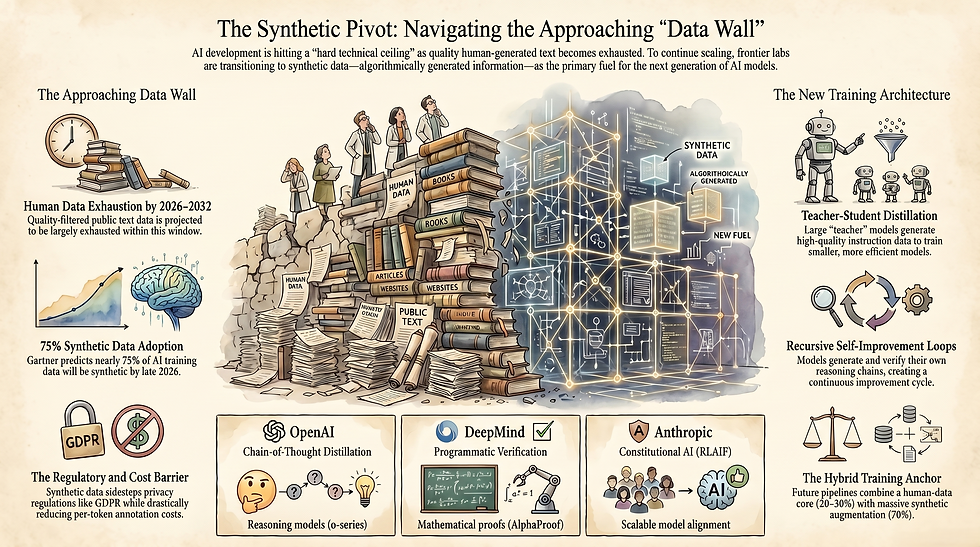
There's a wall approaching. Not a metaphor — a hard technical ceiling on how much high-quality, human-generated text the world's AI labs can actually use to train the next generation of models. Research firm Epoch AI projects that usable, quality-filtered public text data will be largely exhausted for frontier training purposes somewhere between 2026 and 2032. By April 2025, over 74% of newly created webpages already contained AI-generated content. The internet is, in a very real sense, starting to eat itself.
This is why synthetic data in AI training has moved from an interesting research footnote to an architectural necessity. It's not just about privacy compliance or cost savings anymore. Synthetic data is rapidly becoming the primary mechanism through which frontier AI labs scale reasoning, simulate edge cases, train autonomous systems, and push toward more complex cognitive capabilities — all without waiting for humans to generate the raw material first.
At FourfoldAI, we track how foundational AI technologies evolve in practice. What this shift toward synthetic training data represents isn't a short-term workaround. It's a structural redesign of how intelligence gets built. This article walks through what synthetic data actually is, how the biggest labs use it today, where it fails, and what AI training architectures may look like as we move through the rest of this decade.

What Is Synthetic Data in AI?
Synthetic Data Explained in Simple Terms
What is synthetic data? In machine learning, synthetic data is high-fidelity information generated algorithmically by mathematical simulations, physical engines, or generative AI models rather than collected from real-world human activities. It mimics the statistical properties of real data without containing actual records, identities, or events.
Think of it the way pilots train: they spend thousands of hours in flight simulators before they ever command a real aircraft. The simulator isn't a perfect replica of the sky. But it's precise enough that the patterns, responses, and edge cases it generates translate into genuine skill. Synthetic data works the same way for AI systems — it creates conditions that are real enough to train on.
How Synthetic Data Differs from Real-World Data
Real-world data comes from human activity: scraped web pages, annotated medical records, recorded conversations, transaction logs. It's messy, unbalanced, privacy-sensitive, and finite. Synthetic data is manufactured. It's generated to order, filtered to specification, and scaled without physical limits.
There are two broad categories:
Structured synthetic data — Think simulated financial transactions, synthetic patient health records, or tabular datasets that mirror the distribution of real customer behavior. These are generated using statistical models, generative adversarial networks (GANs), or rule-based engines.
Unstructured synthetic data — This includes LLM-generated reasoning traces, synthetically produced medical imagery, fabricated legal documents, or simulated multi-turn conversations. These are far more complex to generate at high quality and are where most of the cutting-edge lab work happens today.
Why AI Companies Are Generating Artificial Datasets
Three forces converge here. Real data is running out. Real data is regulated. And real data is expensive to produce at the quality modern models need. When a single pretraining run for a frontier model requires tens of trillions of tokens, you cannot rely on human annotators writing that content by hand. The math doesn't work. Synthetic generation offers a way to produce training inputs at machine speed, at machine scale.
Why Synthetic Data Is Becoming Essential for AI Training
The Growing Shortage of High-Quality Human Data
The foundational pretraining corpora that built GPT-4, Claude 3.5, Gemini 1.5, and Llama 3 drew from broadly the same well: web crawls, digitized books, academic papers, code repositories, and licensed content. That well is not infinite. Epoch AI's estimates put the exhaustion window for quality-filtered public text at 2026–2032, with the higher end assuming aggressive overtraining on existing corpora.
Low-quality web data has a longer runway — perhaps to 2030 or beyond. But the useful training signal — the kind that improves complex reasoning and reduces hallucination — comes from quality text. That supply is tight and getting tighter.
By 2024, Gartner estimated that 60% of the data used in AI and analytics projects was synthetically generated, up from just 1% in 2021. That figure is expected to approach 75% of AI training data by the end of 2026. The shift isn't gradual. It's accelerating.
Data Privacy and Regulatory Challenges
Europe's AI Act and GDPR have established meaningful enforcement mechanisms around training data that contains personally identifiable information (PII). In the United States, CCPA and sector-specific regulations like HIPAA constrain how medical, financial, and communications data can be used for model training. Labs operating across multiple jurisdictions face a patchwork of compliance requirements that makes broad human-data scraping legally hazardous.
Synthetic generation sidesteps this. A hospital can generate 10 million synthetic patient records that statistically match the distribution of real clinical data without exposing a single patient's identity. A bank can simulate millions of fraudulent transaction patterns without waiting for actual fraud to occur. Regulatory-safe training data, produced on demand — that's a structurally different situation than negotiating licensing deals with data brokers.
Rising Costs of Data Collection and Annotation
Human annotation is expensive. High-quality reasoning traces — the kind needed to train models like OpenAI's o-series — require skilled annotators working painstaking hours on complex problems. At frontier model scale, that cost becomes prohibitive.
Synthetic generation dramatically reduces the per-token cost of training data. A large model generating candidate reasoning traces costs a fraction of what a team of PhD-level annotators would charge for equivalent coverage. The economics of AI infrastructure have been shifting rapidly — and if you want to understand how those infrastructure costs break down more broadly, FourfoldAI's coverage of the AI Infrastructure Boom and NVIDIA AI Infrastructure covers the compute side in detail.
The New Economics of AI Development
OpenAI closed a $110 billion funding round backed by Amazon, SoftBank, and NVIDIA at a $730 billion pre-money valuation — partly on the thesis that the cost of producing training data at scale could be driven down dramatically. Meta released its Synthetic Data Kit alongside Llama 3.3 specifically to allow teams to use larger models to generate training data for smaller ones. The economic logic is clear: if a 70B model can generate high-quality instruction data that trains a 3B model to near-equivalent task performance, the cost curve bends sharply in the right direction.
This isn't theoretical. It's the current operating model across multiple frontier labs.
How Synthetic Data Fits into Modern AI Training Pipelines
Synthetic Data for Pretraining Foundation Models
Pretraining is where models learn the basic fabric of language, reasoning, and world knowledge. Traditionally this required enormous amounts of human-generated text. Today, labs supplement web-scraped corpora with synthetically generated content specifically designed to fill coverage gaps — domains, languages, or reasoning styles that are underrepresented in naturally occurring text.
The output quality of synthetic pretraining data is still a live research question. The academic consensus, as of 2026, is that pretraining on a purely synthetic corpus introduces statistical drift that degrades performance. The practical approach blends curated human text with targeted synthetic augmentation.
Synthetic Data for Fine-Tuning
Fine-tuning is where synthetic data has the most established track record. Labs use larger "teacher" models to generate instruction-following examples, question-answer pairs, code completions, and reasoning traces. These feed into supervised fine-tuning (SFT) of smaller student models. Meta's Llama 3.1 release explicitly used this approach — iterative post-training with synthetic SFT data generated from progressively better model checkpoints.
Synthetic Data for Reinforcement Learning
OpenAI's o1 and o3 models represent the most visible example of synthetic data driving reinforcement learning. The models generate candidate reasoning chains, verify them against ground truth (in domains where verification is feasible, like mathematics or code execution), and use successful traces as synthetic training data in a self-play loop. This "chain-of-thought distillation" approach is how the o-series models achieve the reasoning capabilities that distinguish them from pure language models.
Synthetic Data for Model Evaluation
Evaluating models reliably requires test sets that aren't contaminated by training data. Synthetic benchmarks — generated from known ground-truth rules — can create evaluation sets at scale where the correct answers are programmatically verifiable. This is especially valuable in math, logic, and code domains. The FourfoldAI guide on AI Model Evaluation and Benchmarking covers validation methodology in more depth.
Synthetic Data for Benchmark Creation
Contamination of standard benchmarks like MMLU and HumanEval has become a real problem as these datasets appear repeatedly in training corpora. Synthetic benchmark generation — creating fresh, verifiable test problems from first principles — gives labs a way to measure genuine capability rather than pattern-matched familiarity.
The Synthetic-Loop Training Pipeline
Below is a simplified representation of how a modern synthetic training loop operates. Data doesn't flow in one direction — it cycles, improves, and self-corrects:
┌──────────────────────────────────────────────────────────────────────┐
│            SYNTHETIC-LOOP AI TRAINING PIPELINE                       │
└──────────────────────────────────────────────────────────────────────┘

  ┌──────────────────┐
  │  GENERATOR MODEL │  ◄── Large teacher model (e.g., GPT-4o, Llama 70B)
  │  (Data Producer) │      generates: reasoning traces, QA pairs,
  └────────┬─────────┘      instruction data, synthetic scenarios
           │
           ▼
  ┌──────────────────┐
  │  QUALITY FILTER  │  ◄── Reward model + programmatic checks
  │      NODE        │      filters: low-quality outputs, hallucinations,
  └────────┬─────────┘      statistical outliers, duplicates
           │
           ▼
  ┌──────────────────┐
  │  MODEL UNDER     │  ◄── Student/target model being trained
  │  TRAINING        │      learns from filtered synthetic corpus
  └────────┬─────────┘      via SFT, RLHF, or DPO
           │
           ▼
  ┌──────────────────────────┐
  │  HUMAN VALIDATION /      │  ◄── Human experts validate samples,
  │  FEEDBACK NODE           │      flag errors, calibrate reward signals
  └────────┬─────────────────┘
           │
           ▼
  ┌──────────────────┐
  │  FINE-TUNING     │  ◄── Updated model checkpoint
  │  LAYER           │      incorporates validated feedback
  └────────┬─────────┘      improves future generation quality
           │
           └──────────────────────────────────────┐
                                                  │
                                                  ▼
                                    [LOOP REPEATS → Generator
                                     improves with each cycle]
How Frontier AI Labs Use Synthetic Data
OpenAI's Approach
OpenAI's most significant synthetic data innovation is baked into the o-series reasoning models. The o1 and o3 models are trained using a reinforcement learning process where models generate candidate solutions to problems, verify them against known correct answers (in math, code, and logic domains), and use the successful reasoning chains as synthetic training data. This "chain-of-thought distillation" loop means the models are continuously producing the training signal that improves their own successors.
It is worth noting that o1's chain-of-thought training performs significantly better on problems whose reasoning templates are well-represented in the synthetic training corpus. For novel problems requiring entirely new reasoning pathways, the approach shows its limits. OpenAI also used 100,000 synthetic ChatGPT prompts in o1's safety evaluation pipeline — generating artificial user inputs specifically to test deception and policy compliance at scale.
Google DeepMind's Approach
DeepMind's AlphaGeometry and AlphaProof represent arguably the clearest demonstration of what synthetic data can achieve when the domain allows for programmatic verification. AlphaGeometry synthesized 100 million unique geometry theorem-proof pairs without any human demonstrations — sidestepping the data bottleneck entirely by generating training material from first principles. The original system solved 25 out of 30 Olympiad geometry problems; its successor, AlphaGeometry 2, was trained on an order of magnitude more synthetic data than its predecessor and tackled significantly harder problems.
AlphaProof took a different route. It trained on millions of formally auto-generated math problems using a reinforcement learning loop in the Lean theorem prover — proving or disproving problems iteratively, reinforcing successful proof strategies over time. Together at the 2024 International Mathematical Olympiad, these systems achieved a silver medal equivalent, solving four of six competition problems. The hardest problem in the competition was solved by only five human contestants. AlphaProof solved it too.
Anthropic's Approach
Anthropic's contribution centers on Constitutional AI (CAI), introduced in 2022 and continuously refined through Claude's model generations. CAI uses a set of explicit principles — a "constitution" — to guide an AI model in critiquing and revising its own outputs. The resulting self-generated preference data replaces a substantial portion of what would otherwise require human labelers to evaluate.
This approach, formally called Reinforcement Learning from AI Feedback (RLAIF), generates synthetic alignment data at scale. Rather than hiring thousands of annotators to label "harmful" vs. "helpful" responses, the model evaluates its own outputs against constitutional principles. Claude 4 and subsequent models combine CAI-based constitutional principles with human feedback in a hybrid pipeline — using synthetic preference data to cover scale and human feedback to anchor accuracy.
Meta's Open Model Strategy
Meta's approach to synthetic data is arguably the most transparent, largely because it's building tools others can use. The Llama 3.1 series used iterative post-training with synthetic SFT data generated from progressively improved checkpoints. Meta explicitly released its Synthetic Data Kit — a toolkit that uses large models like Llama-3.3-70B to generate training data for smaller downstream models through knowledge distillation.
The 405B parameter Llama model was partly positioned as a teacher — a resource the open-source community could use to generate high-quality training data for custom fine-tuned models. This matters for Mixture-of-Experts architectures, where distinct synthetic semantic domains can train separate expert modules. Meta's open model strategy makes synthetic distillation accessible well beyond the frontier lab tier.
NVIDIA and Synthetic Data Infrastructure
NVIDIA's role in synthetic data is infrastructural. The Omniverse platform provides a physically simulated 3D environment where robotics and autonomous vehicle developers can generate synthetic training data at scale using physics-accurate rendering.
NVIDIA Cosmos — announced at CES 2025 — extends this significantly. Cosmos's world foundation models predict future world states as videos based on multimodal inputs. Paired with Omniverse, it creates what NVIDIA describes as a "synthetic data multiplication engine": developers create 3D scenarios in Omniverse, feed outputs into Cosmos to generate photorealistic video variations, and use those to train physical AI systems. NVIDIA's 2025 acquisition of Gretel deepened its synthetic data generation capabilities for structured/tabular data, rounding out a full-stack synthetic infrastructure play. Serve Robotics, operating one of the largest autonomous delivery robot fleets in the US, runs its training pipeline through Isaac Sim — generating synthetic scenarios that would be impossible or dangerous to recreate in the physical world.
The Synthetic Data Generation Process
LLM-Generated Text Datasets
The most common synthetic generation method today uses a large teacher model to produce text-based training data for a smaller student model. The teacher receives a prompt schema, generates candidate outputs, and a quality filter (often a reward model or rule-based checker) accepts, rejects, or scores each output before it enters the training pool.
Image and Video Synthesis
Generative image models — diffusion models, GAN variants — produce synthetic visual training data for computer vision tasks. NVIDIA Cosmos handles the video side, generating photorealistic synthetic environments for physical AI. Medical imaging synthesis produces rare disease presentations that don't appear frequently enough in real hospital records to train classifiers effectively.
Simulation-Based Data Generation
Physical simulators generate ground-truth labeled data for robotics, autonomous vehicles, and industrial AI. NVIDIA's Isaac Sim and Omniverse are the leading examples. Simulation-based generation allows domain randomization — varying lighting, textures, weather, and geometry to build robustness without any physical data collection.
Multi-Agent Data Generation Systems
Multiple AI agents interact in sandboxed environments to produce training data through emergent behavior. This is particularly relevant for agentic AI training, where you need examples of decision chains rather than isolated question-answer pairs.
Human Validation Layers
Human validators don't write the data — they curate it. Reviewers quickly accept, reject, or lightly edit synthetic candidates. Each action becomes an implicit annotation signal. This turns the human role from laborious authorship into high-speed curation, dramatically increasing throughput without sacrificing quality control.
Generator Methods Comparison
Generation Method | Best For | Key Filtering Mechanism | Target Downstream Use |
LLM Teacher Distillation | Instruction data, reasoning traces | Reward model scoring | SFT, RLHF fine-tuning |
GAN / Diffusion Synthesis | Image, video, medical data | FID score, human visual review | Computer vision models |
Physical Simulation (e.g., Omniverse) | Robotics, AV, spatial AI | Physics validator, ground truth labels | Physical AI systems |
Rule-Based Generation (e.g., AlphaGeometry) | Math, logic, formal proofs | Symbolic verifier (no ML needed) | Reasoning model training |
Multi-Agent Simulation | Agentic decision chains | Trajectory scoring, outcome validation | Agent training, RL |
Synthetic Data for AI Agents and Autonomous Systems
Training Agentic AI
Agentic AI systems need training data that captures multi-step decision processes, not single-shot responses. Real human logs of agent-like behavior — browsing sessions, tool-use sequences, file system operations — are scarce and hard to annotate at scale. Synthetic environments let labs generate millions of agentic trajectories, including failure modes that rarely appear in clean human demonstrations.
Synthetic Environments for Decision Making
Decision-making AI requires exposure to state spaces that are too large to enumerate from real data. Synthetic environments define the boundaries of those state spaces and populate them with scenarios drawn from realistic distributions. For AI workflow orchestration use cases, this means training agents on thousands of simulated task sequences — including complex edge cases where tools fail, instructions are ambiguous, or intermediate steps require backtracking.
Simulation-Driven Learning
Simulation is especially critical for AI agents in business automation scenarios where deploying undertrained agents in live environments is either expensive or risky. A customer service agent trained on 50,000 simulated difficult conversations will generalize better than one trained on 5,000 real logs, assuming the synthetic distribution is well-calibrated.
Continuous Self-Improvement Loops
The most ambitious version of synthetic agent training is the self-improvement loop: an agent performs tasks, its outcomes are evaluated, and successful trajectories become training data for the next version. This is the architecture underlying OpenAI's o-series reasoning improvement and DeepMind's AlphaProof. It's also the mechanism most at risk of model collapse if the human anchor is removed (covered in risks).

Enterprise Use Cases for Synthetic Data
Healthcare AI
Healthcare represents the clearest ROI case for synthetic data. Real clinical records contain PII, fall under HIPAA, and require expensive de-identification before use. Synthetic patient records — generated to match the statistical distribution of real records without containing any real patient data — allow hospitals, pharma companies, and diagnostics labs to train AI systems without compliance exposure.
Rare disease AI is particularly dependent on synthetic generation. Conditions with small patient populations produce datasets too small to train classifiers reliably. Synthetic augmentation can produce statistically realistic rare-disease presentations at scale, enabling models that would otherwise be impossible to train.
Financial AI Systems
Banks and financial institutions use synthetic transaction data for fraud detection — simulating the patterns of fraudulent behavior to train anomaly detectors without waiting for actual fraud events. Anti-money laundering (AML) models are trained on synthetic transaction chains that replicate laundering patterns. The synthetic market crash simulation use case has grown significantly: financial AI systems that need to handle tail-risk scenarios train on synthetic histories of events that may never have appeared in real historical data.
Manufacturing AI
Digital twins — virtual replicas of physical manufacturing environments — generate synthetic operational data for predictive maintenance, quality control, and robotic path optimization. NVIDIA's Omniverse powers digital twin pipelines for companies including Caterpillar and Siemens, where factory layouts are simulated before physical deployment. Robotic grasp optimization — teaching arms to handle objects they've never physically encountered — relies almost entirely on simulation-based synthetic data.
Customer Support AI
Customer support agents trained exclusively on historical tickets are brittle. They handle the cases they've seen well and fail on novel ones. Synthetic conversation generation can produce thousands of simulated angry, confused, or multilingual user interactions — including the rare, high-stakes cases that human supervisors dread — and use them to stress-test agents before deployment. Localized support agents, tuned to specific industries or regions, depend on this approach to cover conversation distributions that don't exist in real ticket logs.
Internal Enterprise Copilots
Deploying a domain-specific AI copilot inside an enterprise faces a cold-start problem: the model hasn't seen the company's internal processes, terminology, or documents. Synthetic data generation — using the company's existing documentation as seed material — can bootstrap a custom knowledge base before real user interactions accumulate.
Benefits of Synthetic Data in AI Training
Unlimited Scalability
Human data generation has a physical ceiling. Synthetic generation doesn't. A properly configured pipeline can produce billions of training tokens per day. For domains where real data is scarce — formal mathematics, rare medical conditions, edge-case robotics scenarios — this isn't just an advantage. It's the only viable path.
Faster Model Development
Waiting for human annotators to label datasets is slow. A synthetic pipeline that generates, filters, and validates training data autonomously compresses timelines dramatically. Teams can iterate on model checkpoints weekly instead of quarterly.
Better Privacy Protection
Synthetic data carries no PII. It enables compliance with GDPR, HIPAA, CCPA, and the EU AI Act without requiring the legal infrastructure that handling real personal data demands. For enterprises entering regulated industries, this reduces both legal exposure and procurement friction.
Rare Scenario Generation
Real data distributions are heavily skewed toward common events. The rare, high-stakes scenarios that most challenge AI systems — a medical emergency with atypical symptoms, a cyberattack sequence that's never appeared in the wild, a robotics edge case that occurs once every million operations — appear infrequently or not at all in real logs. Synthetic generation can deliberately produce these scenarios to order.
Improved Dataset Diversity
Historical data reflects historical biases. Demographic underrepresentation, linguistic skew, and geographic imbalance in training corpora produce models that perform worse on underrepresented populations. Synthetic generation can deliberately balance these distributions — producing equal coverage across demographics, geographies, and linguistic registers.
The Risks and Limitations of Synthetic Data
Model Collapse Explained
Model collapse is the most serious structural risk in synthetic data pipelines. In 2024, Ilia Shumailov and colleagues at Google DeepMind published a peer-reviewed study in Nature demonstrating that models trained recursively on their own synthetic outputs lose informational diversity over successive generations.
The mechanism works like this: a probability distribution over possible outputs has tails — rare, low-probability outputs that represent unusual but legitimate patterns. When a model generates data from that distribution and a new model trains on those samples, the tails get underrepresented. The next generation's distribution is narrower. Over enough cycles, the model collapses into repetitive, low-entropy outputs — it can only produce things that look like the center of the distribution it's been trained on.
Mathematically, three error sources compound across generations: statistical approximation error, functional expressivity error, and functional approximation error. Each generation amplifies the previous generation's narrowing. The critical practical finding, from Gerstgrasser et al. (COLM 2024), is that replacement causes collapse; accumulation prevents it. If you keep the real-data anchor in the training pool and add synthetic data on top, test loss remains bounded. If you replace real data with synthetic data generation by generation, collapse is eventual and irreversible.
As of 2026, by some estimates, over 74% of newly created webpages contain AI-generated text. Future web crawls for pretraining data will inevitably capture this content — meaning the public internet is itself becoming a contaminated synthetic feedback source.
Bias Amplification
A synthetic generator trained on biased real data produces biased synthetic data. The bias isn't neutralized — it's often amplified. Statistical outliers in the original distribution get flattened in the synthetic version. A model trained on this material inherits the original biases and may propagate them with greater consistency than a model trained on messy real data, where the noise at least provides some distributional coverage.
Hallucination Propagation
When a teacher model generates synthetic training data, it can generate plausible-sounding but factually incorrect content. A student model trained on this data doesn't learn that the information is wrong — it learns it as a stylistically correct training signal. These hallucinations become hardcoded patterns. The student model will reproduce the error confidently.
This is particularly dangerous when synthetic reasoning traces contain incorrect intermediate steps that happen to lead to a correct final answer. The model learns the faulty reasoning chain. Catching this requires programmatic verification — which is only feasible in domains where answers can be checked automatically.
Data Quality Validation Challenges
Validating billions of synthetic tokens programmatically is non-trivial. Reward models used to filter synthetic data can themselves be gamed — outputs that score well against the reward model but fail in deployment (reward hacking). At billion-token scale, human review is physically impossible. This creates a quality assurance problem that the field hasn't fully solved.
Synthetic Data Feedback Loops
The longer-term risk is the poisoned-well problem. Synthetic content generated by today's AI systems is being uploaded to the internet without labeling. Future data collection pipelines — scraping the web for pretraining corpora — will capture it alongside genuine human content. Models trained on this mixed corpus are partially training on their ancestors' outputs without knowing it. The feedback loop is already underway. It's slow and indirect today. Without systematic provenance tracking, it compounds.
For retrieval-augmented systems, this is especially acute. When synthetic artifacts enter long-context retrieval stores, the model's ability to distinguish authoritative sources from generated approximations degrades — a problem covered in FourfoldAI's analysis of AI Memory Systems and Long-Context Models.
Will Synthetic Data Replace Human Data?
The Hybrid Data Future
Can synthetic data replace real data? No, synthetic data cannot entirely replace real-world human data. Without high-quality human-derived anchors to ground training runs, AI models trained purely on synthetic data suffer from statistical drift and model collapse. The future of AI training relies on a hybrid framework where human data provides foundational logic and alignment, while synthetic data scales domain coverage and edge cases.
Why Human Data Remains Critical
Human-generated text and behavior carries something synthetic generation cannot fully reproduce: genuine novelty, authentic error patterns, the full statistical tail of human experience. Real human preferences tell models what actually matters to people, not what a previous model predicted would matter. The alignment signal is fundamentally different.
Labs like OpenAI and Anthropic still actively pursue licensing deals — OpenAI has signed agreements with the Associated Press, Axel Springer, and Reddit; Google has licensed Reddit content — precisely because authentic human data is irreplaceable as a training anchor.
Human-in-the-Loop Validation
The structural answer the industry has converged on is not "replace humans" but "reposition humans." Human roles shift from writing training data to auditing it. The work becomes high-speed curation: reviewing synthetic candidates, catching errors that automated filters miss, and calibrating reward signals. This is less labor-intensive than raw annotation but more cognitively demanding — and more important.
The Most Likely Future AI Training Architecture
Current trajectory points to a training stack that looks roughly like this: a curated high-quality human data core (~20–30% of total training tokens), a synthetic augmentation layer (~60–70% of total tokens) generated by teacher models and domain-specific pipelines, and a continuous human validation layer that monitors quality ratios and catches collapse signals before they compound.
Synthetic Data and the Future of AGI Development
Recursive Self-Improvement
The connection between synthetic data and AGI development runs through a concept called recursive self-improvement: a system that generates training data for its own successors, each cycle producing a more capable generator. This is the theoretical basis for accelerating capability gains without depending on human data production.
The practical version of this is already operational. OpenAI's o-series models improve their reasoning through RL loops that generate and verify their own training signal. AlphaProof proved millions of mathematical theorems over its training run — each proof becoming data that made the next proof easier. The loop is real. The question is how far it can scale before the collapse risks outlined above require intervention.
AI Teaching AI
The teacher-student distillation model is the current industry standard for synthetic generation. Large capable models generate data that trains smaller efficient ones. As model capabilities increase, the quality of the synthetic data they can generate increases with it — creating an upward spiral. Meta's open release of the 405B Llama model was partly a bet that a capable-enough open teacher would accelerate the entire ecosystem.
Synthetic Reasoning Datasets
The most valuable synthetic data in 2026 isn't raw text — it's reasoning traces. Step-by-step solution paths for mathematics, code, logic, and scientific problems have disproportionate training value compared to surface-level text. The o-series models' chain-of-thought distillation is the most prominent example, but similar approaches are emerging across every frontier lab.
Synthetic reasoning datasets also represent the clearest path toward training systems that go beyond pattern-matching — toward models that can genuinely construct new arguments, derive new proofs, and solve problems outside their training distribution.
Future AGI Training Pipelines
By 2030, AI training pipelines will likely look substantially different from today's. Simulation-based environments will allow AI systems to derive physical laws synthetically — interacting with physics engines to discover principles rather than reading about them. For how simulated physical environments could allow systems to deduce natural laws, FourfoldAI's analysis of the Future of Generative AI and AI in Scientific Discovery explores this trajectory.
What AI Training Could Look Like by 2030
Speculating carefully: training pipelines by 2030 will likely feature continuous learning from simulated environments (rather than discrete training runs), multi-agent self-play across a wide range of domains, real-time quality monitoring to detect collapse signals, and smaller but continuously improving human validation layers. The human role doesn't disappear — it becomes more selective, more specialized, and more consequential.
Conclusion: Synthetic Data May Become the Foundation of Future AI Training Pipelines
Synthetic data started as a workaround. Labs used it when real data was unavailable, regulated, or too expensive. That framing is now outdated.
Synthetic data is becoming the primary scaffolding of how advanced AI systems learn to reason, plan, and act. The exhaustion of quality human text, the tightening regulatory environment, the impossibility of annotating at frontier scale, and the emergence of self-play reasoning loops all push in the same direction. Synthetic generation isn't filling a gap — it's building the road ahead.
The risks are real and deserve serious engineering attention: model collapse, bias amplification, hallucination propagation, and contaminated feedback loops are not theoretical. They require active mitigation through human data anchors, quality validation pipelines, and provenance tracking.
But the direction is clear. The labs building the most capable AI systems today — OpenAI, Google DeepMind, Anthropic, Meta, NVIDIA — are all deepening their synthetic data capabilities, not retreating from them.
For enterprises building AI systems, this has practical implications. The quality of your synthetic data pipeline matters as much as your model architecture. If you're building AI applications and want to understand how to design safe, high-fidelity training data pipelines for your specific domain, FourfoldAI's team works with organizations navigating exactly these decisions.
Frequently Asked Questions
Q1: What is synthetic data in AI training?
Synthetic data in AI training refers to high-fidelity variables, records, and interaction logs created algorithmically — by mathematical simulations, generative AI models, or physics engines — to simulate real training inputs without requiring actual human-generated content. It can be structured (tabular records, transaction logs) or unstructured (reasoning traces, synthetic imagery, generated conversations).
Q2: Why are AI companies using synthetic data?
AI companies use synthetic data to address three converging problems: the approaching exhaustion of high-quality public human-generated text, the rising cost of manual data annotation at frontier scale, and the regulatory barriers that prevent use of personally identifiable information in training pipelines. Synthetic generation allows labs to produce training inputs at machine speed, at machine scale, without copyright or privacy exposure.
Q3: Can synthetic data replace real-world data?
No. Synthetic data cannot entirely replace real-world human data. Without high-quality human-derived anchors in the training pipeline, AI models trained purely on synthetic data experience statistical drift and eventually model collapse. The industry consensus points to a hybrid architecture: curated human data provides foundational alignment and logical grounding, while synthetic data scales domain coverage, generates edge cases, and fills regulatory gaps.
Q4: What are the risks of synthetic data?
The primary risks are model collapse (progressive loss of output diversity and quality through recursive synthetic training), bias amplification (statistical flattening of underrepresented distributions), hallucination propagation (incorrect outputs from teacher models becoming learned patterns in student models), and synthetic feedback loops (AI-generated content from the public internet contaminating future pretraining corpora without provenance labels).
Q5: What is model collapse?
Model collapse is the recursive degradation of generative quality that occurs when a model is trained exclusively on its own outputs — or other AI-generated outputs — over several successive generations. Established by Shumailov et al. (2024) in a peer-reviewed Nature study, collapse happens because each generation's output distribution is narrower than the previous one. Rare but legitimate patterns disappear first. The model eventually converges to bland, repetitive outputs far removed from the diversity of the original human data. The practical mitigation is to accumulate real data alongside synthetic data rather than replacing it.
Q6: How does synthetic data improve AI models?
Synthetic data improves AI models by generating thousands of complex edge cases — rare scenarios, failure modes, and unusual distributions — that don't appear frequently enough in natural data to train reliably from real examples alone. It also enables deliberate demographic and domain balancing, targeted coverage of weak model areas, and reasoning trace generation that teaches models to think through multi-step problems rather than pattern-match to answers.
Q7: Which companies use synthetic data for AI training?
OpenAI uses synthetic chain-of-thought reasoning traces for the o-series models. Google DeepMind uses synthetic mathematical proof generation for AlphaGeometry and AlphaProof. Anthropic uses synthetic AI feedback data through Constitutional AI and RLAIF for Claude. Meta uses teacher-model distillation with Llama and released an open Synthetic Data Kit. NVIDIA provides synthetic data infrastructure through Omniverse, Cosmos, and Isaac Sim for physical AI systems.
Q8: Is synthetic data important for AGI development?
Yes. Recursive self-improving synthetic reasoning loops are increasingly viewed as critical for scaling AI capabilities past raw text processing toward symbolic and mathematical reasoning. The ability to generate, verify, and learn from synthetic reasoning traces — as demonstrated by AlphaProof and the o-series — represents a qualitative step change in how AI systems build internal world models. How far this mechanism can scale before running into fundamental limitations remains one of the most consequential open questions in AI research today.
References and Further Reading
This article draws on publicly available research, industry documentation, and verified reporting from authoritative sources. Key references include:
Shumailov et al. (2024). "AI Models Collapse When Trained on Recursively Generated Data." Nature. nature.com
Gerstgrasser et al. (2024). "Is Model Collapse Inevitable?" COLM 2024. arXiv:2404.01413.
Google DeepMind (2024). "AI Achieves Silver-Medal Standard Solving International Mathematical Olympiad Problems." deepmind.google
Google DeepMind (2025). "Olympiad-Level Formal Mathematical Reasoning with Reinforcement Learning." Nature. nature.com
Google DeepMind (2024). "AlphaGeometry: An Olympiad-Level AI System for Geometry." deepmind.google
OpenAI (2024). "Learning to Reason with LLMs." openai.com
OpenAI (2024). "o1 System Card." openai.com
Meta AI (2024). "Introducing Llama 3.1: Our Most Capable Models to Date." ai.meta.com
NVIDIA (2025). "NVIDIA Expands Omniverse with Generative Physical AI." nvidianews.nvidia.com
NVIDIA (2025/2026). "Into the Omniverse: OpenUSD Workflows Advance Physical AI." blogs.nvidia.com
Epoch AI (ongoing). "Data Constraints on the Machine Learning Industry." epochai.org
Stanford AI Index (2025). Annual AI Report. aiindex.stanford.edu
Groundy (2026). "Synthetic Data Is Eating AI Training." groundy.com
This article is backed by authoritative sources, peer-reviewed research, and verified industry reporting. For complete disclaimers regarding information accuracy and editorial policy, please review FourfoldAI's Disclaimer.
About the Author
Muizz Shaikh is an AI enthusiast and digital technology professional at FourfoldAI. He is passionate about exploring AI tools, industry trends, and practical applications of emerging technologies. Through FourfoldAI, Muizz contributes to simplifying artificial intelligence for businesses and learners. Connect with him on LinkedIn: linkedin.com/in/muizz-shaikh-45b449403/


Comments