
Future of Generative AI in 2026: Trends, Predictions & What's Next

By Shaikh Muizz | Fourfold AI Research Team | fourfoldai.com
Published: April 2026 | Reading Time: ~10 minutes
The future of Generative AI is not some abstract vision to debate at conferences. It is here, running inside the tools you use every day, reshaping how businesses operate, how students learn, and how freelancers compete. At Fourfold AI, we have spent years tracking the evolution of LLM evolution, enterprise adoption, and what comes next — and what we are seeing in 2026 is a shift in kind, not just degree. This article is our attempt to lay it all out, clearly and honestly, without the hype.
What is the Future of Generative AI?
By 2026, Generative AI refers to systems that do not just generate text — they reason, plan, execute tasks, and collaborate with other AI agents autonomously. Built on large language models with multimodal inputs, these systems understand voice, images, video, and code simultaneously. They are the infrastructure layer beneath modern business, not a feature on top of it.
Why is the Future of Generative AI Growing So Fast?
Three forces are driving this growth, and none of them are slowing down.
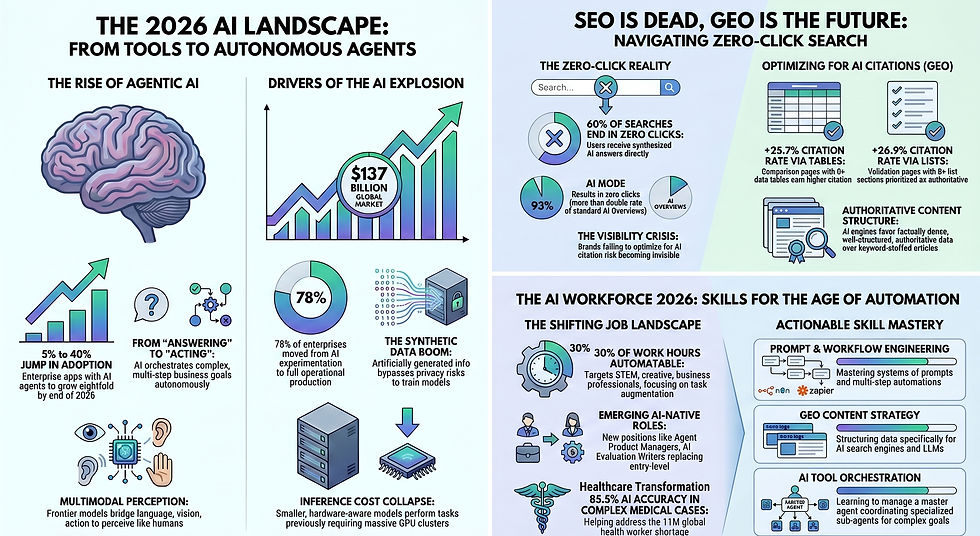
The Data Explosion. The amount of digital information created globally continues to compound. AI models are being trained on richer, more diverse datasets, including synthetic data — artificially generated information that mirrors real-world patterns without privacy risks. By 2026, GenAI models are being used to create endless streams of highly realistic, customizable, and privacy-compliant data, enabling a massive leap in AI research and deployment across sensitive industries. This is particularly important for healthcare and finance, where real data is locked behind regulation.
Compute Power Leaps. Inference costs — the price of running an AI model to generate an output — have been falling dramatically. Smaller, more efficient models are now capable of tasks that required massive GPU clusters just two years ago. IBM researchers note that 2026 is the year of frontier versus efficient model classes, with hardware-aware models running on modest accelerators beginning to appear alongside billion-parameter giants. This democratizes access.
Enterprise Adoption at Scale. This is no longer a pilot-project phenomenon. The global generative AI market has reached $137 billion, with 78% of enterprises now using generative AI in production. The shift from experimentation to full operational integration is the defining story of 2025–2026.
Future of Generative AI Trends in 2026
Agentic AI is the most consequential shift of this cycle. We are moving from AI that answers questions to AI that completes goals. Gartner predicted that enterprise applications integrated with task-specific AI agents will jump from just 5% to 40% by end of 2026 — calling agentic AI "the next platform shift."
That said, we would be doing you a disservice if we painted this as all smooth sailing. Researchers at MIT Sloan, including Thomas Davenport, caution that AI agents "make too many mistakes for businesses to rely on them for any process involving big money," and predict agents will enter the Gartner trough of disillusionment in 2026. The opportunity is real. The hype is also real. The smart move is building with agentic systems carefully, in trusted, scoped workflows first.
Text-only AI already feels dated. The frontier now is systems that see, hear, and speak — simultaneously. Aaron Baughman, IBM Fellow, describes multimodal AI as models that "perceive and act in a world much more like a human," bridging language, vision, and action together. In practical terms, this means a single AI model can watch a video, read the transcript, analyze the data in it, and draft a report — all in one pass.
AI Copilots Everywhere
Microsoft, Google, and Apple are all embedding AI directly into operating systems and productivity software. Aparna Chennapragada, Microsoft's chief product officer for AI experiences, envisions a workplace where a three-person team can launch a global campaign in days, with AI handling data crunching, content generation, and personalization while humans steer strategy. This is not a future scenario. It is the present for early adopters.
Autonomous Workflows — AI Managing AI
This is the part that feels most science-fiction — until you see it in action. Agentic workflows involve one AI model orchestrating other AI models. A master agent breaks down a complex business goal into subtasks, dispatches specialized sub-agents to handle each one, and synthesizes the results. IBM researchers describe 2026 as seeing "cooperative model routing," where smaller models do routine work and delegate to larger models when needed — and "whoever nails that system-level integration will shape the market."

How Will the Future of Generative AI Impact Jobs?
This is the question everyone is actually asking. The short answer: it is complicated, and anyone giving you a clean number is oversimplifying.
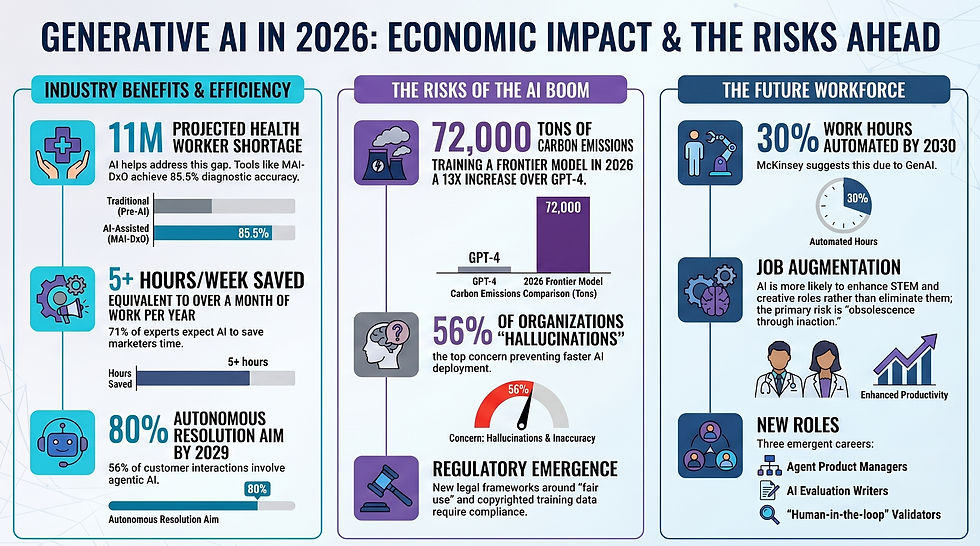
McKinsey Global Institute research suggests that by 2030, activities that account for up to 30% of hours currently worked across the US economy could be automated — a trend accelerated by generative AI. However, McKinsey also notes that generative AI is more likely to enhance the way STEM, creative, and business professionals work rather than eliminating a significant number of jobs outright.
Stanford's AI Index for 2026 found a nuanced picture: entry-level jobs in software development and customer support have been reduced, while mid-career and senior positions have held steady or increased. Contrary to popular expectation, unemployment among workers least exposed to AI has risen more than among workers most exposed.
What this tells us — and what we at Fourfold AI consistently see in our research — is that the real risk is not replacement. It is obsolescence through inaction. McKinsey describes new roles already emerging: agent product managers, AI evaluation writers, and "human in the loop" validators.
For freelancers, the skill shift is the most important story. Those who master prompting, AI tool orchestration, and output quality control are not competing with AI — they are using AI to compete with agencies.
Future of Generative AI in Business & Industries
Industry | Primary AI Application | Key Benefit |
Marketing | Content generation, hyper-personalization, campaign automation | Save 5+ hours/week per marketer |
Healthcare | Diagnostic assistance, treatment planning, patient triage | Addressing a projected 11M health worker shortage by 2030 |
Finance | Risk modeling, fraud detection, regulatory compliance drafting | Faster, more accurate analysis at scale |
Education | Personalized learning paths, AI tutoring, curriculum design | Adaptive learning for every student |
Marketing: Marketers are using GenAI for data analysis (45%), market research (40%), and copywriting (27%), with 71% of experts expecting it to save them five hours of work per week — equivalent to more than a month per year.
Healthcare: Microsoft AI's Diagnostic Orchestrator (MAI-DxO) solved complex medical cases with 85.5% accuracy, far above the 20% average for experienced physicians. With a projected shortage of 11 million health workers globally by 2030, AI is not just convenient — it is necessary.
Finance: Synthetic data is making risk modeling and fraud detection faster and more reliable, without exposing sensitive customer information.
Education: AI tutoring systems now adapt in real-time to student performance, creating genuinely personalized curricula at scale.
What Are the Real-World Use Cases in the Future of Generative AI?
Content Creation: From long-form articles to social media, AI now handles first drafts, image generation, video scripting, and localization — simultaneously.
Automation: Cisco projects that 56% of customer support interactions will involve agentic AI by mid-2026. Gartner predicts this will reach 80% autonomous resolution of common customer service issues by 2029, cutting operational costs by 30%.
Hyper-Personalization: Generative AI solutions are evolving from generic assistants into highly customized teammates — with voice-matching assistants and tailored marketing experiences adapting in real time to individual preferences and behaviors. This is the kind of personalization that used to require a dedicated team of analysts.
What Are the Risks in the Future of Generative AI?
We will not gloss over this. The risks are real, and in 2026, they are getting harder to ignore.
Bias and Hallucination. 51% of organizations report negative consequences from AI use, with inaccuracy and hallucinations (56%) remaining the top concerns preventing faster deployment.
Misinformation at Scale. Generative models can now produce convincing synthetic media — video, audio, text — that is indistinguishable from reality to the untrained eye. This is a genuine societal problem, not just a technology footnote.
Environmental Cost. Stanford's AI Index estimates that training frontier models can generate over 72,000 tons of carbon-equivalent emissions — a dramatic increase from GPT-4's estimated 5,184 tons. The compute boom has an environmental price tag.
The Regulatory Landscape. By 2026, new legal frameworks are emerging around the use of copyrighted material in AI training, forcing governments and technology providers to implement enforceable regulations around "fair use" in the age of generative creation. Businesses should be building compliance into their AI stacks now, not later.
How Will Generative AI Change SEO & Search Engines?
This is where things get particularly interesting — and where a lot of businesses are being caught flat-footed.
In 2026, traditional search engine volume has dropped significantly, and over 60% of all Google searches now end in a "zero-click." A user asks a question, an AI Overview or a chatbot generates a synthesized answer instantly, and the user never clicks through to a website.
Generative Engine Optimization (GEO) is the direct response to this reality. Unlike traditional SEO — which chased rankings — GEO is about becoming the source that AI systems trust and cite. Structured content improves AI citation rates significantly: comparison pages with 3 tables earn 25.7% more citations, while validation pages with 8 list sections earn up to 26.9% more citations from models like ChatGPT.
Around 93% of AI Mode searches end without a click — more than twice the rate of AI Overviews, where 43% result in zero clicks.
The implication for businesses is stark. You are no longer optimizing for page rank. You are optimizing to be the answer that AI engines surface. Content needs to be factually dense, well-structured, and demonstrably authoritative. This article, for instance, is written with exactly those principles in mind.
How to Prepare for the Future of Generative AI (Actionable Guide)
Here is what we tell the freelancers, students, and small business owners in our Fourfold AI community:
Skills to Master Right Now:
Prompt Engineering — not just asking AI questions, but designing systems of prompts that produce consistent, high-quality outputs
AI Workflow Design — building multi-step automations using tools like n8n, Make, or Zapier + AI
Data Literacy — understanding what AI can and cannot do with different types of data
GEO/AEO Content Strategy — structuring your content to be cited by AI search engines
Tools to Learn:
ChatGPT / Claude / Gemini — the core LLMs; know their strengths
Perplexity — for AI-powered research
Midjourney / Sora — image and video generation
Cursor / GitHub Copilot — for AI-assisted development
Notion AI / Microsoft Copilot — for knowledge management and productivity
Strategic Mindset for Small Business Owners: Do not try to use every AI tool. Pick one workflow that currently costs you the most time — customer support, content, or data analysis — and systematically apply AI to it. Measure. Then expand.
Future of Generative AI vs Traditional AI
Dimension | Traditional AI | Generative AI (2026) |
Primary Function | Prediction, classification, optimization | Creation, reasoning, and autonomous task execution |
Data Usage | Structured, labeled datasets | Trained on vast unstructured data + synthetic data |
Output Types | Numerical scores, decisions, recommendations | Text, images, code, audio, video, structured workflows |
User Interaction | API calls, dashboards, defined inputs | Natural language, voice, conversational interfaces |
Customization | Requires retraining for new tasks | Fine-tuning, prompt engineering, RAG-based adaptation |
Autonomy Level | Rule-based, deterministic | Increasingly agentic — sets sub-goals, self-corrects |
Key Limitation | Narrow — one task per model | Hallucination, bias, high inference cost at scale |
Business Use Case | Fraud detection, demand forecasting | Content, automation, copilots, customer experience |
Inference Costs | Low (simple models) | Rapidly declining, but still significant for large models |
LLM Evolution Role | Pre-LLM era | LLM-native — language is the primary interface |
Expert Predictions for the Future of Generative AI (2026–2030)
From the Fourfold AI research team, here are three predictions we are willing to stand behind:
Prediction 1: The Agent Economy Becomes the Primary Business Layer by 2028.Gartner already predicts that AI agents will intermediate more than $15 trillion in B2B spending by 2028, with 15% of day-to-day work decisions being made autonomously — up from 0% in 2024. We believe this timeline is accurate but the distribution will be uneven. Large enterprises will capture the majority of efficiency gains first, while SMBs face a two-to-three-year lag unless they move now.
Prediction 2: Inference Cost Collapse Will Democratize AI at the Edge by 2027.The trend toward smaller, domain-specific models running on modest hardware is not a compromise — it is a strategic evolution. By 2027, we expect AI inference to be economically viable on personal devices for complex tasks, making cloud-dependent AI a choice rather than a necessity. This means a freelancer in Mumbai or Nairobi will have the same AI capability as an enterprise in New York.
Prediction 3: GEO Will Surpass Traditional SEO as the Primary Digital Visibility Strategy by Late 2026.With 92% of companies planning to increase their AI budgets in the next three years and AI search engines becoming the default starting point for research, brands that fail to optimize for AI citation will become effectively invisible. The companies that invest in GEO and AEO strategies now will own disproportionate share of voice in AI-generated answers through 2030.
FAQs About the Future of Generative AI
Will generative AI replace jobs completely? No — not completely, and not imminently. The more accurate picture is a significant restructuring of tasks within jobs. McKinsey research indicates that AI primarily augments work rather than replacing jobs outright, with occupational categories most exposed to generative AI still expected to add jobs through 2030, though the rate of growth may slow. The bigger threat is irrelevance for those who do not adapt.
Is generative AI safe for the future? Conditionally, yes — but active governance is required. A 2025 Gartner survey found that 54% of cybersecurity respondents said their organizations experienced an attack on enterprise AI applications in the prior 12 months. Safety is not built-in by default. It must be designed for.
How accurate will generative AI become? Accuracy is improving rapidly in narrow, well-defined domains. Microsoft AI's Diagnostic Orchestrator already achieves 85.5% accuracy on complex medical cases, compared to a 20% average for experienced physicians. General reasoning accuracy across open-ended tasks remains a challenge, and hallucination is still a structural limitation that requires human oversight.
Can generative AI think like humans? Not yet — and probably not in the way the question implies. Current generative AI systems are extraordinarily capable pattern-completion engines. They exhibit reasoning-like behavior, especially with chain-of-thought prompting. But they do not have consciousness, genuine understanding, or persistent memory across sessions by default. The gap between "appears to think" and "thinks" remains significant and contested.
What industries will benefit the most? Healthcare stands out because AI can genuinely address a structural global crisis — the projected shortage of 11 million health workers by 2030. Marketing, finance, software development, and education will also see transformational gains. The industries that benefit most will be those where high-volume, language-intensive knowledge work dominates — and where the cost of that work has historically been a growth constraint.
References and Data Sources
This article is backed by authoritative sources and research. All statistics and projections cited have been verified from the following primary sources:
Gartner — Agentic AI Enterprise Predictions (2025–2026)
Gartner research on AI agent adoption rates and enterprise application integration.
https://www.gartner.com/en/newsroom/press-releases/2025-agentic-ai
McKinsey Global Institute — The Economic Potential of Generative AI
Comprehensive analysis of GenAI's $4.4 trillion productivity opportunity.
McKinsey Global Institute — Generative AI and the Future of Work in America
Labor market analysis, automation timelines, and skill shift research.
https://www.mckinsey.com/mgi/our-research/generative-ai-and-the-future-of-work-in-america
McKinsey — AI in the Workplace (2025)
Enterprise deployment analysis, ROI data, and agentic AI trends.
https://www.mckinsey.com/capabilities/tech-and-ai/our-insights/superagency-in-the-workplace
Stanford HAI — AI Index Report 2026
Comprehensive state of AI report including employment, emissions, and model benchmarks.
https://spectrum.ieee.org/state-of-ai-index-2026
MIT Sloan Management Review — Five AI Trends in 2026
Thomas H. Davenport and Randy Bean's annual AI predictions analysis.
https://sloanreview.mit.edu/article/five-trends-in-ai-and-data-science-for-2026/
IBM Think — AI and Tech Trends 2026
IBM Research scientists on multimodal AI, efficient models, and agentic workflows.
https://www.ibm.com/think/news/ai-tech-trends-predictions-2026
Microsoft — What's Next in AI: 7 Trends to Watch in 2026
Microsoft Research and product leaders on AI copilots, healthcare, and scientific discovery.
https://news.microsoft.com/source/features/ai/whats-next-in-ai-7-trends-to-watch-in-2026/
AmplifAI — 90+ Generative AI Statistics 2026
Compiled data including Cisco, Forrester, and Gartner research on agentic AI adoption.
https://www.amplifai.com/blog/generative-ai-statistics
TechTarget — The Future of Generative AI: 10 Trends to Follow in 2026
Enterprise AI deployment trends, inference cost dynamics, and cybersecurity risks.
https://www.techtarget.com/searchenterpriseai/feature/The-future-of-generative-AI-Trends-to-follow
Anuragology — Generative Engine Optimization (GEO): The 2026 Zero-Click Search Guide
In-depth analysis of zero-click search trends and GEO strategy.
https://www.anuragology.com/blog/generative-engine-optimization-geo-zero-click-search
Position.Digital — 150+ AI SEO Statistics for 2026
Citation rate data, AI Overview statistics, and GEO content performance benchmarks.
https://www.position.digital/blog/ai-seo-statistics/
Kellton Tech — Generative AI Trends 2026
Synthetic data applications, market revenue projections, and copyright regulatory landscape.
https://www.kellton.com/kellton-tech-blog/generative-ai-trends-2026-transform-work-everyday-life
Master of Code — 350+ Generative AI Statistics (2026)
Industry-specific adoption data, generational usage trends, and vertical AI predictions.
© 2026 Fourfold AI Research Team | fourfoldai.com | Written by Shaikh Muizz


Comments